
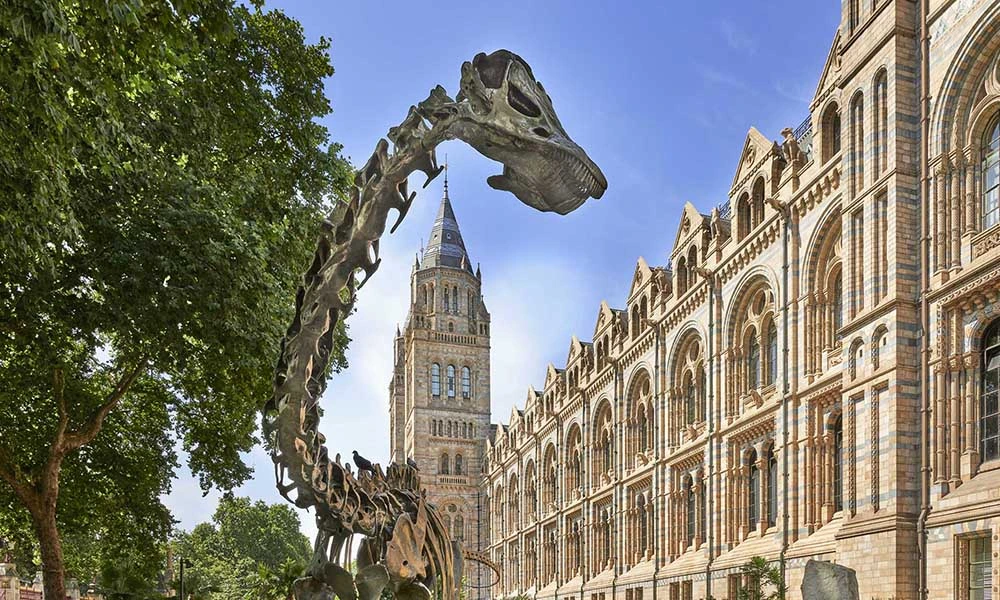
Natural History Museum Victorian Terracotta Meets Evolutionary Wonder
The light filters through the stained glass—a kaleidoscope of botanical patterns casting emerald and ruby pools onto the terracotta floor—as you stand beneath the skeleton of Hope the blue whale at 10:05 AM. The air smells of polished wood and ancient dust; the silence hums with the weight of 80 million specimens contained within these cathedral-like walls. Opened to the public in 1881, the Natural History Museum houses treasures ranging from 4.6-billion-year-old meteorites to the 25-meter-long cetacean hanging above the Hintze Hall. You stand beneath the Romanesque arches designed by Alfred Waterhouse, where every carved plant represents a species collected during the Victorian era, while the ground trembles slightly as the animatronic T. rex roars in the distance. Every gallery whispers a different story: glittering minerals from the Earth's core, preserved creatures in the Spirit Collection, and fossils that predate humanity. In 2026, as climate change accelerates extinction rates globally, visiting the Natural History Museum means engaging with a sanctuary of biodiversity that documents life's resilience. This place matters now because it remains the world's leading center for natural history research, challenging visitors to confront the fragility of our planet while navigating the wonders of evolutionary history.
Why Natural History Museum Embodies Scientific Preservation
The Natural History Museum solves the intellectual need to classify and protect the natural world under one roof—a mission established when it separated from the British Museum in 1881. Sir Alfred Waterhouse designed the building using terracotta blocks rather than stone, choosing the material because it resisted London's sulphurous smog better than limestone, ensuring the facade remains crisp today. The Hintze Hall spans 25 meters in height, supported by wrought iron girders hidden within the ornate columns, creating a vast space capable of suspending the 25.2-meter blue whale skeleton without obstructing views. The collection spans every kingdom of life, with the Zoology department holding over 38 million specimens, including the dodo bones and Darwin's finches. Engineering-wise, the Earth Hall features a giant globe structure you walk through, simulating a journey to the planet's core, while the Volcano exhibit uses hydraulic systems to mimic eruptions. Today, the museum operates as a non-departmental public body, balancing free public access with the immense cost of conserving fragile biological samples in frozen tissue banks. This unique status ensures the Natural History Museum remains not merely a repository of curiosities but a living laboratory where scientists decode DNA and track extinction, blending public education with critical research in a manner few institutions sustain.
The Best Time to Experience Natural History Museum
For optimal viewing and reduced congestion, plan your visit between May 15–June 20 or September 10–October 15, when London's temperatures range from 15–22°C (59–72°F) and daylight extends until 8:30 PM. Arrive precisely at 10:00 AM when doors open to beat the school groups that typically converge by 11:30 AM; the morning light illuminates the Hintze Hall ceiling beautifully without the glare of midday sun. Late Friday evenings offer a serene atmosphere during Lates events (6:30–10:00 PM), though specific galleries may close for private functions or adult-only activities. Avoid July 25–August 31 when school holidays bring peak crowds, pushing entry queues beyond 45 minutes despite free admission. Winter months (December–February) offer shorter lines but temperatures drop to 2–8°C (36–46°F), and the stone floors become uncomfortably cold underfoot. For special exhibitions, verify the calendar at nhm.ac.uk before booking, as popular ticketed shows like the Wildlife Photographer of the Year can sell out weeks in advance. Tuesday and Thursday mornings typically see the lowest visitor volume, allowing for quieter contemplation in the Mineralogy Gallery.
Approximate Budget for a 7-Day Trip (2026)
London remains a premium destination, but staying in Zone 1 near South Kensington provides immediate access to the Natural History Museum without excessive transport costs. These 2026 estimates assume a moderate travel style, accounting for approximately 3-4% annual inflation in UK hospitality and attraction pricing.
- Accommodation: £130–£280 per night for a double room in South Kensington, Earl's Court, or Knightsbridge; budget hostels from £50/night in nearby Fulham
- Food: £50–80 per day—breakfast £9–13 (full English or café pastry), lunch £14–21 (museum café or market stall), dinner £27–46 (mid-range restaurant with wine); traditional Sunday roast £22
- Transportation: £8.10 daily cap for Zones 1-2 using contactless/Oyster; Heathrow Express £25 one-way or Elizabeth Line £12.80; Black Cab from Victoria £20 minimum
- Attractions: Natural History Museum free (donation suggested), Special Exhibition £22.00, Victoria and Albert Museum free, Science Museum free, Thames cruise £18.00
- Miscellaneous: Souvenir guidebook £15, museum postcards £5, rain jacket (essential) £35, travel insurance £50 for week
Total for 7 days: £1,350–1,900 per person (excluding international flights)
7 Essential Natural History Museum Experiences
- Hintze Hall Whale Viewing: Stand beneath Hope, the 25.2-meter blue whale skeleton suspended from the ceiling. Located in the main entrance hall, the skeleton is visible from the ground floor and balconies; arrive by 10:15 AM to see the bones clearly without shoulders blocking your view. The lighting highlights the vertebrae carved with species names.
- Dinosaurs Gallery Walk: Traverse the main staircase to view the animatronic T. rex and actual fossils. The gallery spans two floors; look for the Triceratops skull and the interactive dig pits for children. Audio guides provide context on the extinction events that shaped Earth's history.
- Earth Hall Journey: Enter the giant globe structure to simulate a trip to the planet's core. The walkway spirals downward through zones representing the crust, mantle, and core; notice the temperature increase visuals and the seismic activity displays along the railings.
- Volcano Exhibit Experience: Watch the simulated eruption in the Earth Hall. The hydraulic system triggers smoke and sound effects every 15 minutes; stand on the viewing platform to feel the vibration while learning about plate tectonics from the interactive screens.
- Mineralogy Gallery Exploration: Explore Room 5 to see the glowing minerals under UV light. The collection includes the largest gold nugget found in Australia; examine the crystalline structures in the dimly lit vault section where fluorescence is most visible.
- Wildlife Garden Stroll: Step outside to the hidden garden behind the museum. Open 10:00 AM–5:00 PM in summer; the native plants attract bees and butterflies, offering a quiet contrast to the indoor halls. Sit on the benches to watch the insects while the museum facade looms behind.
- Image Centre Photography: Visit the dedicated photography gallery showcasing the Wildlife Photographer of the Year. The exhibition changes annually; look for the winning images displayed on large lightboxes that reveal intricate details of animal behavior captured in the wild.
3 Hidden Gems Most Travelers Miss
- Darwin Centre Cocoon: This seven-story spiral structure houses 22 million specimens in the modern research facility. Access is via free guided tours departing at 11:30 AM and 2:00 PM from the Hintze Hall; the tour takes you behind the scenes to see scientists working with preserved specimens in alcohol-filled tanks.
- Jerwood Gallery Vault: Located in the Mineralogy section, this vault displays rare gems behind thick glass. Access is included with entry but often overlooked; visit at 3:30 PM when crowds thin to examine the uncut diamonds and historic royal jewels without obstruction. The lighting is designed to maximize sparkle without damaging the stones.
- Waterhouse Building Upper Balconies: In the Hintze Hall, climb to the upper levels for a unique perspective of the architecture. Access via the stairs near the shop; look for the terracotta carvings of extinct plants and animals near the ceiling. The view down onto the whale skeleton offers a dramatic photographic angle most ground-level visitors miss.
Cultural & Practical Tips
- Bag policy: Large bags (over 40×40×50cm) must be checked at the cloakroom; small backpacks are permitted but must be worn on the front in crowded galleries. Allow 15 minutes for bag checks during peak hours (11:00 AM–2:00 PM).
- Photography rules: Photography is permitted in most permanent galleries for personal use without flash. Tripods and selfie sticks are prohibited; respect signs indicating no photography in special exhibitions or near light-sensitive specimens.
- Security screening: All visitors pass through airport-style security; prohibited items include sharp objects, aerosols, and food. Enter via the Main Entrance on Cromwell Road or the Side Entrance for potentially shorter queues.
- Local phrases: Learn "Mind the gap" (watch the step), "Cheers" (thanks), and "Queue here" (wait in line); Londoners appreciate visitors who respect pedestrian flow in the narrow gallery corridors.
- Weather preparedness: The Hintze Hall can be drafty in winter; carry a compact umbrella (£10 from Boots pharmacy) for the queue outside. Stone floors retain cold, so wear comfortable shoes with good grip.
- Accessibility: The museum offers step-free access via lifts and ramps; wheelchair users receive priority entry—contact access@nhm.ac.uk 48 hours ahead to arrange assistance. Manual wheelchairs are available to borrow free of charge.
- Respectful behavior: Keep voices lowered at all times; this is a place of study. Do not touch the display cases or lean on the railings; many specimens are centuries old and fragile beneath the glass.
Conclusion: Travel with Curiosity, Not Just Checklists
The Natural History Museum demands more than a snapshot with the blue whale—it invites you to contemplate the vast timeline of life resting on those terracotta plinths. When you walk the galleries in 2026, tracing the same paths worn by naturalists for centuries, you're not just ticking a sightseeing box; you're witnessing the delicate balance between preserving biodiversity and acknowledging human impact. As overtourism pressures London's landmarks, visiting mindfully means respecting the scientific nature of this institution, understanding that behind the free entry, researchers work tirelessly to conserve fragile ecosystems. Walk slowly across the stone floors, noticing how the light changes on the whale bones; listen to the hush of the galleries not as silence but as reverence. Leave only footprints on the tiles, take only memories of evolutionary wonder, and carry forward the understanding that places like this endure because each generation chooses to protect them—not as zoos of the dead, but as living testaments to our shared, fragile, and enduring natural world.