
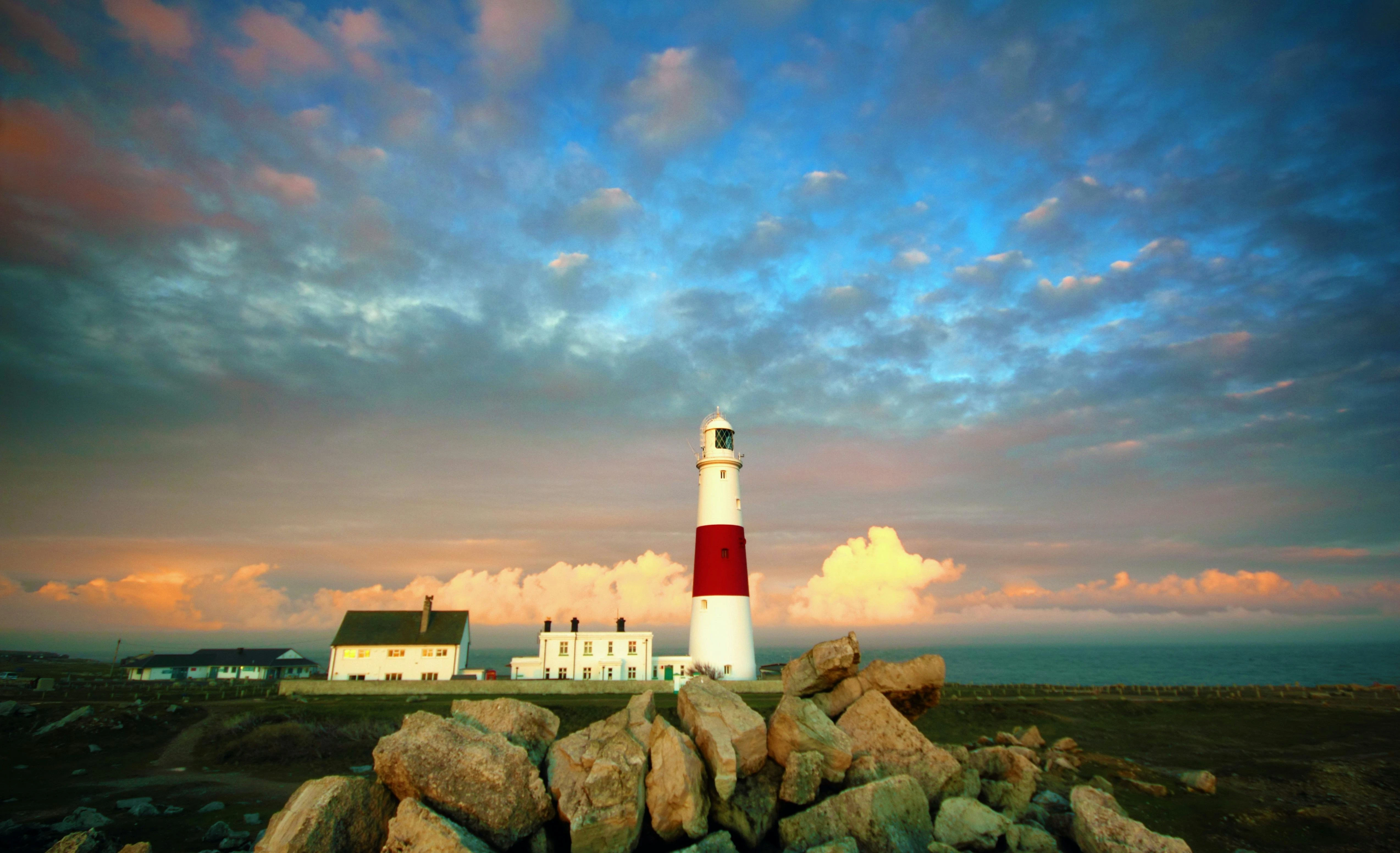
Portland Bill Lighthouse Crimson Stone Meets Raging Seas
Wind howls around the lantern room as dusk settles over the English Channel—the rhythmic sweep of the beam cutting through salt spray every 15 seconds, a mechanical heartbeat surviving since 1906. You stand on the rugged headland, 41 meters (135 feet) above the churning water, while the red and white striped tower glows against a bruised purple sky. Constructed by Trinity House to replace two earlier lights rendered obsolete by quarrying, this structure guards the Shambles sandbank, a graveyard of ships dating back to the 17th century. As you touch the cold Portland Stone, quarried from the very island beneath your feet, you realize the Portland Bill Lighthouse matters now more than ever: in an age of satellite navigation and digital automation, it remains a physical testament to human vigilance, a warning carved in stone against the unpredictable power of the ocean that still claims vessels in 2026.
Why Portland Bill Lighthouse Embodies Maritime Vigilance
The Portland Bill Lighthouse is not merely a navigational aid; it is a monument to engineering resilience against hostile environments. Built between 1903 and 1906 by the renowned firm Coode, Son & Matthews, the tower utilizes local Portland Stone bonded with granite to withstand gales exceeding 100 miles per hour. The optical apparatus, originally a first-order fixed catadioptric system, was upgraded in 1996 to a modern VRB-25 LED array, yet the rotation mechanism remains a masterpiece of Victorian clockwork engineering—weights descending through the central column to turn the lens with minimal friction. This structure solved a critical safety problem: the Shambles sandbank, located 5 kilometers southeast, shifts with tidal currents and has wrecked over 200 recorded vessels.
Today, it fulfills a cultural need for connection to maritime heritage in an automated world. Managed by Trinity House, the lighthouse stands as one of only three remaining manned-style stations open to the public in England. The tower's design incorporates a double balcony to reduce wind load and a foghorn station—now silent but historically vital—whose low-frequency boom once traveled 17 miles across the water. When you climb the 153 spiral steps, you traverse a space where keepers once lived in isolation for weeks, maintaining the light through storms that isolated the island from the mainland. The Portland Bill Lighthouse represents the transition from human-dependent safety to automated reliability, yet it retains the soul of the keepers who tended it, preserved through exhibits detailing their daily lives and the physics of light refraction.
The Best Time to Experience Portland Bill Lighthouse
To witness the Portland Bill Lighthouse in optimal atmospheric conditions, plan your visit between May 20 and June 25. During this window, temperatures average 14-19°C (57-66°F), and migratory puffins return to the nearby cliffs, adding wildlife interest to the geological drama. The best light for photography occurs between 7:30-9:30 AM when morning mist lifts off the sea, and 6:00-8:00 PM for sunset silhouettes. Visiting early also allows you to climb the tower before cruise ship excursions arrive from Portland Harbour, typically between 11:00 AM and 3:00 PM.
Autumn offers a secondary window—specifically September 15 to October 15—when summer crowds dissipate and storm watching becomes dramatic. Temperatures remain mild at 12-17°C (54-63°F), though daylight hours shorten rapidly. Avoid July 25 to August 25 when school holidays push visitor numbers above 1,500 daily, creating queues for the narrow spiral staircase. Winter months (November-February) offer solitude but challenging conditions; high winds often close the tower climb for safety, and sunset occurs as early as 4:05 PM in December. For current opening hours and closure notices, verify information at www.trinityhouse.co.uk or contact the visitor center at +44 (0)1305 820211.
Approximate Budget for a 7-Day Trip (2026)
Exploring the Portland Bill Lighthouse and the wider Isle of Portland requires moderate budgeting, as Dorset is a premium domestic destination with limited public transport. The following budget reflects mid-range travel for one person in 2026, accounting for approximately 4.5% UK inflation (ONS data, January 2026). Prices assume a base in Weymouth or Portland for optimal access to the coastal path and lighthouse.
- Accommodation: £85-£140 per night for a B&B or guesthouse in Weymouth town center (6 nights = £510-£840). Budget options: £45-£65 for hostels in Portland or camping at Southwell.
- Food: £45-65 per day total • Breakfast: £8-12 (Full English at The Old Smokey) • Lunch: £12-18 (Fish and chips at The Bakers Arms) • Dinner: £25-35 (Seafood platter at The Anchor or No 9)
- Transportation: • Train London Waterloo to Weymouth: £65-110 return (advance booking) • Local bus (Route 1): £4.50 day pass • Car rental (recommended): £60/day plus fuel £1.58/liter • Parking at Portland Bill: £5/day (March-October)
- Attractions: • Lighthouse Tower Tour: £10.50 • Portland Castle entry: £10 • Boat trip to Shambles Bank: £35 • Free: Coastal path, lighthouse grounds, visitor center
- Miscellaneous: • Ordnance Survey Explorer Map 117: £10.99 • Local stone souvenirs: £20 • Travel insurance: £35-50 for week • Waterproof gear rental: £20
Total estimated cost: £1,250-£1,550 for 7 days (excluding international flights)
5 Essential Portland Bill Experiences
- Climb the Lantern Room: Book the 45-minute tower tour (departing hourly from 10:00 AM). You will ascend 153 spiral steps inside the thick stone walls, emerging onto the gallery beneath the lens. The view encompasses Lyme Bay to the west and the English Channel to the east; on clear days, you can see the Isle of Wight 40 kilometers away. Bring a windbreaker; exposure at 41 meters (135 feet) creates wind chill 5°C below ground level. The keeper's logbook is displayed here, showing entries from 1906 to present.
- Walk the Coastal Path to Pulpit Rock: Begin at the lighthouse car park and follow the South West Coast Path south for 1.5 kilometers. The route climbs 50 meters to dramatic limestone cliffs where the sea has carved natural arches. Visit at low tide to see the rock formation clearly; high tide submerges the base. Total hiking time: 60 minutes round trip. The sound of waves crashing into the caves below is deafening during storms—maintain a safe distance from the edge.
- Explore the Old Lighthouse: Located 400 meters north of the current tower, the 1716 structure is now a bird observatory. Access is restricted but exterior viewing is permitted daily. The white stone tower predates the striped design and offers context for the evolution of navigational aids. Visit between 8:00-10:00 AM during migration season (April-May) to see wardens scanning for rare species. This site reveals why the current lighthouse was built—quarrying obscured the old light's beam.
- Visit the Foghorn Station: Walk to the building below the lighthouse where the massive diaphone horn once stood. Though decommissioned in 1996, the engine room remains intact with original machinery. Join the volunteer-led talk at 2:00 PM on weekends to hear recordings of the horn's low-frequency boom. The sound was designed to penetrate fog but caused vibrations that cracked nearby windows. This experience connects you to the auditory history of maritime safety before radar.
- Watch Sunset at the Lobster Pot: Reserve a table at the café near the lighthouse grounds. Order the local crab sandwich and a Dorset apple juice. Sit on the terrace facing west; the sun sets over the Jurassic Coast, illuminating the red stripes of the tower. This experience connects you to the continuous hospitality tradition of the island, which has served mariners and visitors for over 300 years. Booking essential for dinner; walk-ins accepted for afternoon tea.
3 Hidden Gems Most Travelers Miss
- Southwell Beach Fossils: While crowds cluster at the lighthouse, this pebble beach 2 kilometers west remains surprisingly quiet. Access via the footpath from Southwell village (parking at SY685705). The cliffs contain Kimmeridge Clay deposits rich in ammonites and belemnites dating to 150 million years ago. Visit 2 hours after low tide when fresh material is exposed. Bring a geological hammer and safety glasses. All fossils must be recorded with the Dorset County Museum. This site offers tangible evidence of the Jurassic environment without the crowds of Charmouth.
- Tout Quarry Sculpture Park: Contact the Portland Sculpture & Quarry Trust (+44 (0)1305 820211) to access this reclaimed limestone quarry turned art gallery. The 2-kilometer trail features 50+ sculptures carved directly into the rock face by international artists. Best visited May-September when vegetation frames the stone works. The path is steep; wear hiking boots with ankle support. This perspective reveals the industrial history of Portland Stone, showing how extraction shaped the landscape visible from the lighthouse.
- The Race Course Viewpoint: Near the southern tip, grid reference SY695695, lies a secluded bench overlooking the tidal race where currents collide. Access requires a 1-kilometer walk from the lighthouse along the cliff edge. The water here churns violently even in calm weather due to underwater topography. Visit during spring tides for maximum effect. No facilities exist—bring water and a headlamp for the return. This spot demonstrates the dangerous currents that made the lighthouse necessary, offering a raw view of the sea's power.
Cultural & Practical Tips
- Respect cliff edges: Limestone cliffs are unstable—rockfalls occur regularly. Stay on marked paths; red warning flags indicate dangerous conditions. Keep children supervised at all times. The National Coastwatch Institution reports 5-10 incidents annually due to visitors straying too close.
- Understand tide schedules: The tidal range at Portland Bill averages 5-6 meters. Check www.uktides.co.uk before visiting. Never turn your back on the sea—rogue waves occur. If trapped by incoming tide, call HM Coastguard immediately at 999.
- Leave no trace: Remove all litter, including biodegradable items. The Trinity House collects 5 tonnes of waste annually from this headland. Do not remove stones or plants—this violates the Wildlife and Countryside Act 1981. Photograph fossils in situ instead.
- Learn local terminology: "The Race" (tidal current collision); "Shambles" (sandbank); "Portland Stone" (local limestone). Using these terms shows respect for maritime heritage and helps guides assist you better during tours.
- Photography guidelines: Tripods are permitted on the grounds but restricted inside the lantern room during busy periods. Drone use requires written permission from Trinity House and Civil Aviation Authority—apply 6 weeks in advance. Respect other visitors; do not block pathways for extended shoots during peak hours (11:00 AM-3:00 PM).
- Weather preparedness: The headland is exposed; wind chill is common even in summer. Pack waterproof layers; Dorset showers are sudden. Wear sturdy shoes with grippy soles—limestone becomes slippery when wet. Sun protection is essential; reflection from white stone increases UV exposure by 20%.
- Accessibility considerations: The tower climb involves 153 steep spiral steps and is not wheelchair accessible. Alternative viewing exists from the grounds. The visitor center is fully accessible. Request an accessibility map at the ticket office upon arrival.
Conclusion: Travel with Reverence, Not Just Sightseeing
The Portland Bill Lighthouse does not exist merely to be photographed—it exists to be understood as a sentinel against the dark. When you stand on this headland in 2026, you are not observing a static monument; you are entering a space where light has pierced darkness for over a century, guiding sailors through storms that haven't changed in millennia. The keepers who tended the flame are gone, but their vigilance remains embedded in the stone. The beam still sweeps the horizon, automated but unyielding. This is not heritage frozen in amber—it is heritage living, breathing, enduring.
So slow down. Sit on the grassy banks for ten minutes without your phone. Listen to the wind that once carried the sounds of shipwrecks and now carries the cries of gulls. Buy your lunch from a café whose owners pay rates that support the local community. Donate to the Trinity House charity rather than purchasing plastic souvenirs. Leave only footprints on ancient stone, take only memories of light against sea, carry home only the profound understanding that some things—safety, vigilance, natural power—cannot be rushed, cannot be owned, can only be honored. The light will still sweep the waves in 2126 if we choose stewardship over exploitation today.