
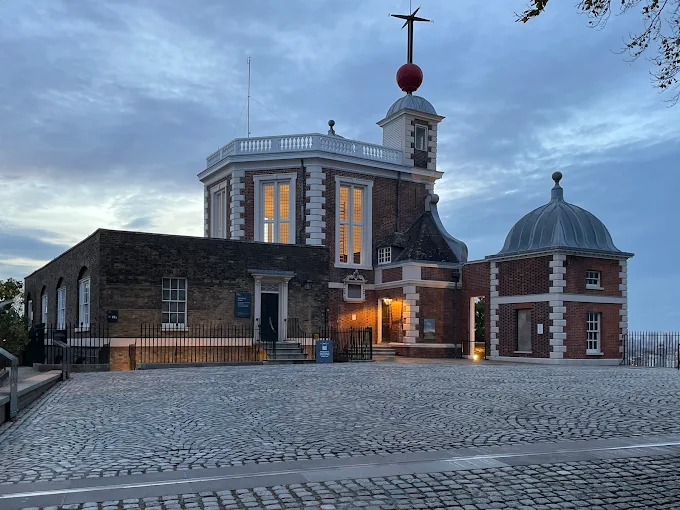
Royal Observatory Greenwich Prime Meridian Meets Celestial Time
The air hums—a quiet, electric tension—as you stand with one foot in the eastern hemisphere and the other in the west at 10:15 AM, balancing on the stainless steel Prime Meridian line. The wind sweeps across the 46-meter-high hill, carrying the scent of cut grass from Greenwich Park while the onion domes of the Royal Observatory gleam against the blue sky. Founded by King Charles II in 1675 to solve the crisis of maritime navigation, this scientific fortress houses the historic Time Ball and the original 0°0'0" longitude marker that governs global time. You look out over the Queen's House, where the white classical facade contrasts with the red brick of Flamsteed House, while the modern skyscrapers of Canary Wharf rise 5 kilometers to the north. Every brick tells a story: John Harrison testing his chronometers, astronomers mapping the stars, and sailors setting their courses by the stars above this very spot. In 2026, as atomic clocks redefine precision and GPS dominates navigation, visiting the Royal Observatory Greenwich means engaging with the physical origin of time itself. This place matters now because it remains the tangible anchor of our temporal reality, challenging visitors to stand at the center of the world's coordinate system and feel the weight of history beneath their boots.
Why Royal Observatory Greenwich Embodies Scientific Navigation History
The Royal Observatory solves the critical 17th-century problem of determining longitude at sea—a feat achieved through royal decree and astronomical innovation. When Charles II established the observatory in 1675, he appointed John Flamsteed as the first Astronomer Royal, tasking him with creating accurate star charts to help sailors navigate the oceans. The building, designed by Sir Christopher Wren, features the Octagon Room with a 4.5-meter diameter aperture in the ceiling for telescope observations, utilizing brick and stone to minimize vibration. Engineering-wise, the Time Ball, installed in 1833, drops 2.5 meters at exactly 1:00 PM GMT, allowing ships on the Thames to synchronize their chronometers before departure. The collection includes John Harrison's H1 through H4 timekeepers, which solved the longitude problem by maintaining accurate time despite ship motion and temperature changes. Today, the Royal Museums Greenwich manages the site, balancing public access with ongoing astronomical research and the maintenance of Greenwich Mean Time. This unique status ensures the Royal Observatory Greenwich remains not merely a museum but a living scientific landmark, blending Stuart-era architecture with modern horology in a manner few institutions sustain.
The Best Time to Experience Royal Observatory Greenwich
For optimal visibility and manageable crowds, plan your visit between May 15–June 20 or September 10–October 15, when London's temperatures range from 15–22°C (59–72°F) and daylight extends until 9:00 PM. Arrive precisely at 10:00 AM when doors open to beat the school groups that typically converge by 11:30 AM; the morning light illuminates the Prime Meridian line beautifully without the glare of midday sun. Evening visits during summer offer a romantic atmosphere as the sun sets over London, though the observatory closes at 5:00 PM. Avoid July 25–August 31 when summer holidays bring peak crowds, pushing entry queues beyond 45 minutes despite timed tickets. Winter months (December–February) offer shorter lines but temperatures drop to 2–8°C (36–46°F), and the hill becomes windy and cold. For event schedules, verify the calendar at rmg.co.uk/royal-observatory before booking, as astronomical events can affect opening hours. Tuesday and Thursday mornings typically see the lowest visitor volume, allowing for quieter contemplation in the Astronomy Centre.
Approximate Budget for a 7-Day Trip (2026)
London remains a premium destination, but staying in Zone 2 near Greenwich provides immediate access to the observatory without central London price gouging. These 2026 estimates assume a moderate travel style, accounting for approximately 3-4% annual inflation in UK hospitality and attraction pricing.
- Accommodation: £120–£260 per night for a double room in Greenwich, Blackheath, or Isle of Dogs; budget hostels from £45/night in nearby Deptford
- Food: £50–80 per day—breakfast £9–13 (café pastry or full English), lunch £14–21 (market stall or pub meal), dinner £27–46 (mid-range restaurant with wine); traditional pie and mash £16
- Transportation: £8.10 daily cap for Zones 1-2 using contactless/Oyster; DLR from Bank £3.90; Thames Clippers river bus £9.40 single Greenwich to Tower
- Attractions: Royal Observatory £22.00 adult, Cutty Sark £20.50, National Maritime Museum free, Planetarium £14.00, Thames cruise £18.00
- Miscellaneous: Souvenir guidebook £15, observatory postcards £5, rain jacket (essential) £35, travel insurance £50 for week
Total for 7 days: £1,300–1,850 per person (excluding international flights)
7 Essential Royal Observatory Greenwich Experiences
- Prime Meridian Line Stand: Stand on the 0° longitude line marked in stainless steel. Located in the courtyard; arrive by 10:15 AM to take photos without crowds blocking the view. The line stretches across the yard, dividing east from west visibly.
- Time Ball Observation: Watch the red ball drop at 1:00 PM GMT. Occurs daily (weather permitting); gather in the courtyard 10 minutes early. The mechanism lowers the 2.5-meter ball precisely, signaling the hour to the city below.
- Harrison Timekeepers Viewing: Examine the H1–H4 clocks that solved longitude. Located in the Time Gallery; the H4 looks like a large pocket watch. The craftsmanship is visible through the glass cases, showing gears untouched for centuries.
- Octagon Room Tour: Enter Wren's original observation room on the upper floor. The 4.5-meter aperture allows light for telescopes; notice the original 17th-century tiles and the view through the windows toward London.
- Peter Harrison Planetarium: Watch a laser show about the universe. Shows run hourly; book tickets in advance as they sell out. The 120-seat theater features a digital projector that simulates the night sky with incredible clarity.
- Greenwich Park Viewpoint: Walk the hill behind the observatory for panoramic views. The slope is steep; wear sturdy shoes. The vista encompasses the Canary Wharf skyline and the Thames River winding through the city.
- Astronomy Centre Exploration: Interact with exhibits about space and time. Open 10:00 AM–5:00 PM; the hands-on displays explain gravity and orbits. The touchscreens allow you to manipulate virtual telescopes and view deep space objects.
3 Hidden Gems Most Travelers Miss
- Flamsteed's Bedroom: This small room on the upper floor was the first Astronomer Royal's private quarters. Access via the guided tour; open at 11:00 AM and 2:00 PM. Most tourists stay in the main galleries, missing the intimate space where Flamsteed slept and worked.
- Shepherd Gate Clock: Located outside the observatory gate, this 24-hour clock displays Greenwich Mean Time. Access is free from the street; look for the Roman numerals and the unique 24-hour face. It has kept accurate time since 1852, synchronized electronically since 1924.
- King Charles II Statue: This bronze statue stands in the courtyard near the Meridian. Access via the main gate; open 24 hours. Commissioned in 1680, it depicts the king in Roman attire, overlooking the park he gifted for scientific advancement.
Cultural & Practical Tips
- Ticket booking: Pre-book online to save 10% and guarantee entry; timed slots fill quickly during school holidays. Print tickets or use mobile QR codes for faster scanning at the turnstiles.
- Photography rules: Photography is permitted in most areas for personal use without flash. Tripods require permission; respect signs indicating no photography inside the Planetarium during shows.
- Weather preparedness: The hill is exposed and windy; carry a compact umbrella (£10 from Boots pharmacy) and windproof layers. Stone steps become slippery when wet—wear shoes with good grip.
- Local phrases: Learn "Mind the gap" (watch the step), "Cheers" (thanks), and "Queue here" (wait in line); Londoners appreciate visitors who respect pedestrian flow on the narrow hill paths.
- Accessibility: The observatory offers step-free access via ramps and lifts; wheelchair users receive priority entry—contact access@rmg.co.uk 48 hours ahead to arrange assistance. Some historic rooms have thresholds.
- Transport logistics: Take the DLR to Cutty Sark or the train to Greenwich Station; both are a 10-minute walk uphill. The Thames Clipper boat offers a scenic arrival route from central London piers.
- Respectful behavior: Keep voices lowered in the Planetarium and Harrison Gallery. Do not touch the glass cases or lean on the historic brickwork; the materials are centuries old and fragile.
Conclusion: Travel with Curiosity, Not Just Checklists
The Royal Observatory Greenwich demands more than a photo on the line—it invites you to contemplate the concept of time resting on that hill. When you stand at the meridian in 2026, tracing the coordinate system used by every GPS device on Earth, you're not just ticking a sightseeing box; you're witnessing the delicate balance between historical measurement and modern precision. As overtourism pressures London's landmarks, visiting mindfully means respecting the scientific nature of this institution, understanding that behind the tourist tickets, astronomers continue to study the cosmos. Walk slowly across the courtyard, noticing how the light changes on the onion domes; listen to the silence of the hill not as emptiness but as focus. Leave only footprints on the steel line, take only memories of celestial mechanics, and carry forward the understanding that places like this endure because each generation chooses to measure them—not just in degrees, but as living testaments to human curiosity, navigation, and the enduring quest to understand our place in the universe.