
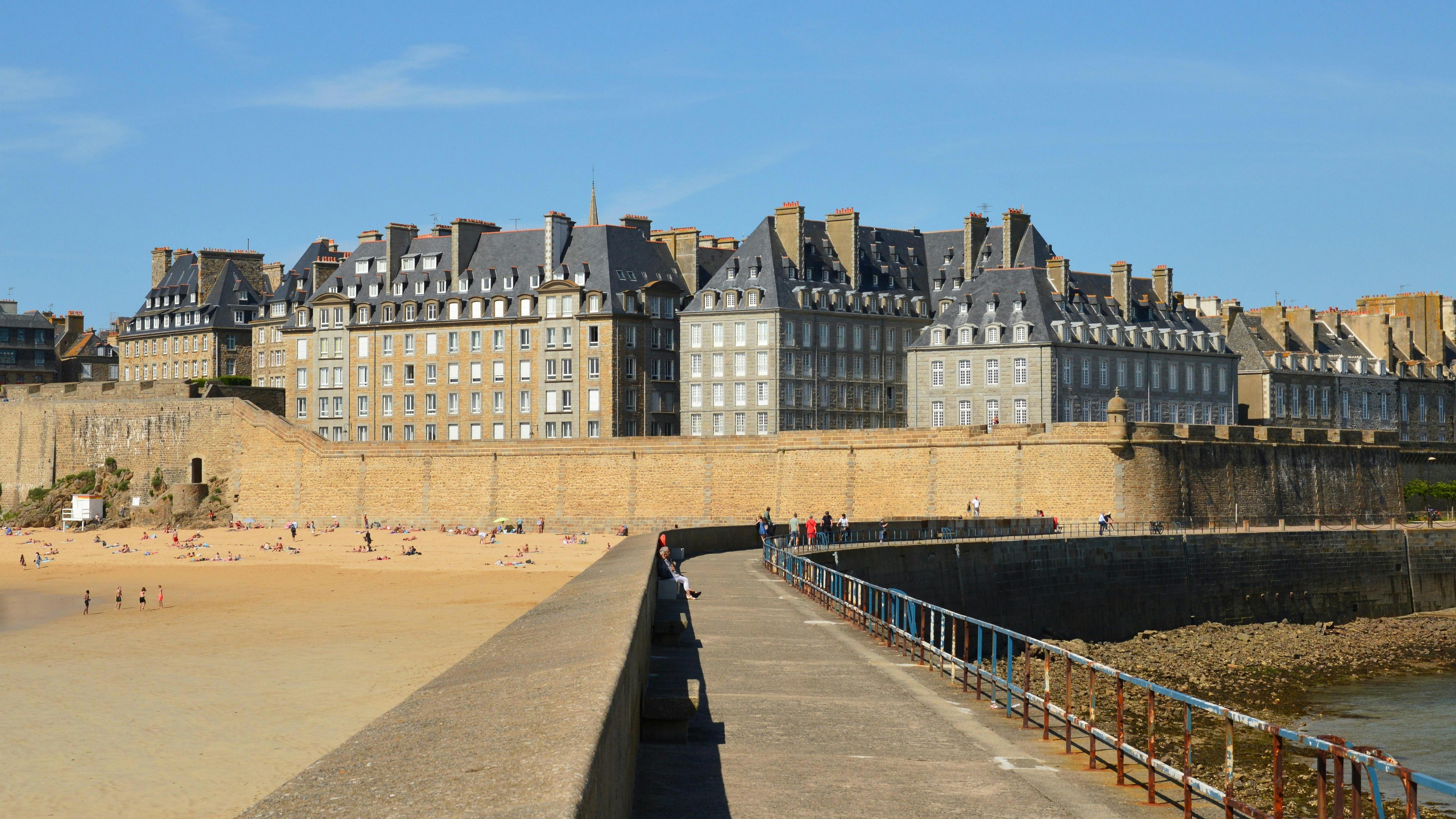
Saint-Malo Ramparts : Granite Walls Meet Atlantic Fury
The stones remember what guidebooks cannot convey. As dawn breaks over the Emerald Coast, the first light strikes Saint-Malo’s 1.8-kilometer ramparts—weathered granite blocks that have withstood 500 years of Atlantic fury and human conflict. Waves crash against the foundations with rhythmic thunder, sending plumes of salt spray high above the battlements where corsairs once scanned horizons for Spanish galleons. The air carries the briny perfume of exposed seaweed mingling with woodsmoke from boulangerie ovens within the walled city. This isn’t theatrical staging but living archaeology: a fortress that has been destroyed and rebuilt three times since its 12th-century founding, most recently after Allied bombing in 1944 reduced it to rubble. Today, every cobblestone in Intra-Muros bears witness to resilience—where privateers like Robert Surcouf launched raids that funded the city’s reconstruction, and where locals painstakingly restored each building to its exact pre-war position. In 2026, Saint-Malo ramparts remain Europe’s most authentically layered coastal fortifications—not preserved behind glass, but breathing with the tides that shaped them.
Why Saint-Malo Ramparts Embodies Maritime Resilience
Saint-Malo ramparts represent more than military architecture—they embody a city’s unbroken negotiation with power and sea. Constructed between the 12th and 17th centuries, these 18-meter-high granite fortifications evolved through centuries of conflict: the original walls protected Breton independence, Vauban’s 17th-century enhancements repelled English sieges, and post-WWII reconstruction honored the Malouins’ vow to rebuild "stone upon stone, as before." Unlike sanitized heritage sites, Saint-Malo’s ramparts retain raw authenticity—cannon embrasures open to sea breezes, spiral staircases worn concave by centuries of footsteps, and the strategic layout that allowed defenders to monitor shipping lanes for 30 kilometers. The city’s genius lies in its dual nature: the fortified island of Intra-Muros (population 4,500) remains a living community where residents navigate narrow streets unchanged since the Age of Sail, while the ramparts themselves function as both defensive structure and public promenade. This continuity creates rare depth: where visitors walking the 1.8-kilometer circuit trace the exact path of corsairs who funded the city’s golden age, and where the view encompasses not just picturesque harbor, but the strategic geography that made this port worth destroying—and rebuilding—three times.
The Best Time to Experience Saint-Malo Ramparts
For optimal conditions—dramatic light on weathered stone, manageable crowds, and authentic maritime atmosphere—visit between May 20 and June 15 or September 12–28. Daytime temperatures average 17–23°C (63–73°F), creating ideal conditions for rampart walks without summer’s intensity. Mornings between 8:00–10:00 AM offer the most magical illumination: low-angle sun transforms the Rance estuary waters to liquid gold while casting long shadows that accentuate defensive architecture details—a critical window before day-trippers arrive from cruise ships. September provides a second excellent opportunity: departing crowds, stable weather, and autumn light that intensifies the granite’s honey-colored tones while fishing boats prepare for winter. Avoid July 20–August 20 when temperatures exceed 26°C (79°F), making rampart paths uncomfortably warm and viewpoints congested. Note that the ramparts become partially submerged during spring high tides—check tide tables at saint-malo-tourisme.com before coastal walks to avoid being cut off by rising water.
Approximate Budget for a 7-Day Trip (2026)
Based on 2025 benchmarks adjusted for 4% inflation (per INSEE and Bretagne Tourism Board projections), a realistic mid-range budget for a Saint-Malo-focused itinerary requires €1,500–€2,000 per person excluding international flights. Accommodation ranges from €100–€145 nightly for family-run guesthouses in Intra-Muros or boutique hotels near Port Solidor—essential for experiencing rampart atmosphere after day-trippers depart. Daily food costs average €90–€105: breakfast at crêperies (€8), lunch of fresh scallops and cider at rampart-side terraces (€24–€30), and dinners featuring locally caught sea bass with Muscadet wine (€48–€58). Transportation is straightforward: Saint-Malo’s compact size makes walking optimal, though regional trains connect to coastal sites like Cap Fréhel.
- Accommodation: €100–€145 per night for a family-run guesthouse in Intra-Muros or boutique hotel near Port Solidor—essential for experiencing rampart atmosphere after day-trippers depart.
- Food: €90–€105 per day—breakfast at crêperie (€8), lunch of fresh scallops and Breton cider at rampart terrace (€26–€32), dinner featuring sea bass with Muscadet wine (€50–€60).
- Transportation: €35 for a 7-day regional bus pass. Train from Paris Montparnasse to Saint-Malo (3h15, €60–€90 one-way via SNCF Connect). Walking is optimal for rampart exploration.
- Attractions: Château de Saint-Malo entry: €8. Ramparts walk: free. Grand Aquarium: €22. Boat tour of bay fortifications: €24. Allocate €100 total.
- Miscellaneous: €65 for artisanal salt from Île de Cézembre, locally woven woolens, or donations to the Ramparts Conservation Association.
Total Estimated Cost: €1,500–€2,000 for seven days, excluding international flights.
5 Essential Saint-Malo Ramparts Experiences
- Ramparts Circuit at Dawn: Walk the complete 1.8-kilometer circuit starting at Tour Solidor at 8:00 AM—watch fishing boats depart the harbor while morning light illuminates the granite fortifications without harsh shadows.
- Château de Saint-Malo Exploration: Visit the 15th-century fortress at 10:00 AM to explore the keep and ramparts—observe how the strategic position allowed defenders to monitor shipping lanes for 30 kilometers in both directions.
- Plage de Bon-Secours Tide Pools: Accessible only 90 minutes before/after low tide via steps from the ramparts—discover anemone gardens and small crabs in pools carved by centuries of wave action (check tide tables at tourist office).
- La Demeure de Corsaire Museum: Tour the reconstructed 17th-century privateer’s house at 2:00 PM—experience how corsairs like Robert Surcouf lived when they returned from raiding Spanish treasure fleets.
- Sunset from Tour de la Générale: Climb this western bastion at 7:30 PM for panoramic views where the setting sun ignites the Rance estuary while fishing lights twinkle in the harbor below.
3 Hidden Gems Most Travelers Miss
- Passage des Murailles Secret Archway: Behind No. 19 Rue de la Poissonnerie, an unmarked stone arch leads to a hidden passageway where 12th-century masons' marks remain visible on foundation stones—accessible during weekday mornings when restoration crews work nearby.
- Pointe de la Varde Tide Pools: A 15-minute coastal walk west of the ramparts reveals fossil-rich pools carved into granite—accessible only 90 minutes before/after low tide (check tide tables at tourist office).
- Atelier du Tailleur de Pierre: A stone-carving workshop hidden in a vaulted cellar at 11 Rue Sainte-Barbe—observe artisans restoring rampart masonry using medieval techniques (open Tuesday mornings by appointment: +33 2 99 20 88 23).
Cultural & Practical Tips
- Tide Table Essential: Never venture onto tidal areas without consulting official tide tables—rising tides move faster than walking speed and have trapped unwary visitors. Download the free "Maree Info" app before arrival.
- Rampart Etiquette: Stay on marked paths—many sections are fragile historic structures. Never climb on cannon embrasures or touch engraved surfaces—oils from skin accelerate deterioration of irreplaceable surfaces.
- Learn Key Phrases: "Demat" (hello in Breton), "Trugarez," and "Où est la tour historique?" (Where is the historic tower?) show respect—guides often share deeper insights with curious visitors.
- Photography Protocol: Best exterior shots captured between 8:00–10:00 AM when eastern light illuminates weathered stone without harsh shadows. Tripods prohibited on narrow rampart paths due to safety concerns.
- Weather Preparedness: Brittany’s microclimate shifts rapidly—carry waterproof layers even in summer. Morning mist often burns off by 11:00 AM, but afternoon showers can appear without warning.
Conclusion: Travel with Historical Reverence, Not Just a Lens
Saint-Malo ramparts endure not as attractions to be consumed, but as testaments to civic resilience forged through centuries of siege and survival. As a conscious traveler, your presence should honor this legacy: walk slowly to appreciate the engineering that withstood cannon fire and tidal forces, support the Ramparts Conservation Association through official donation boxes, and understand that your footsteps tread ground where corsairs chose freedom over submission and republicans defended liberty against monarchy. Sit quietly on the Quai de Terre Neuve bench at dusk and watch fishing lights twinkle where war galleys once clashed—the same waters that witnessed Jacques Cartier’s departure for Canada and modern yachts returning from transatlantic voyages. By approaching these ramparts not as backdrops for social media, but as teachers of endurance, you help ensure their stones continue to shelter not just history, but the unbroken spirit of a city that has always chosen resilience over ruin.