
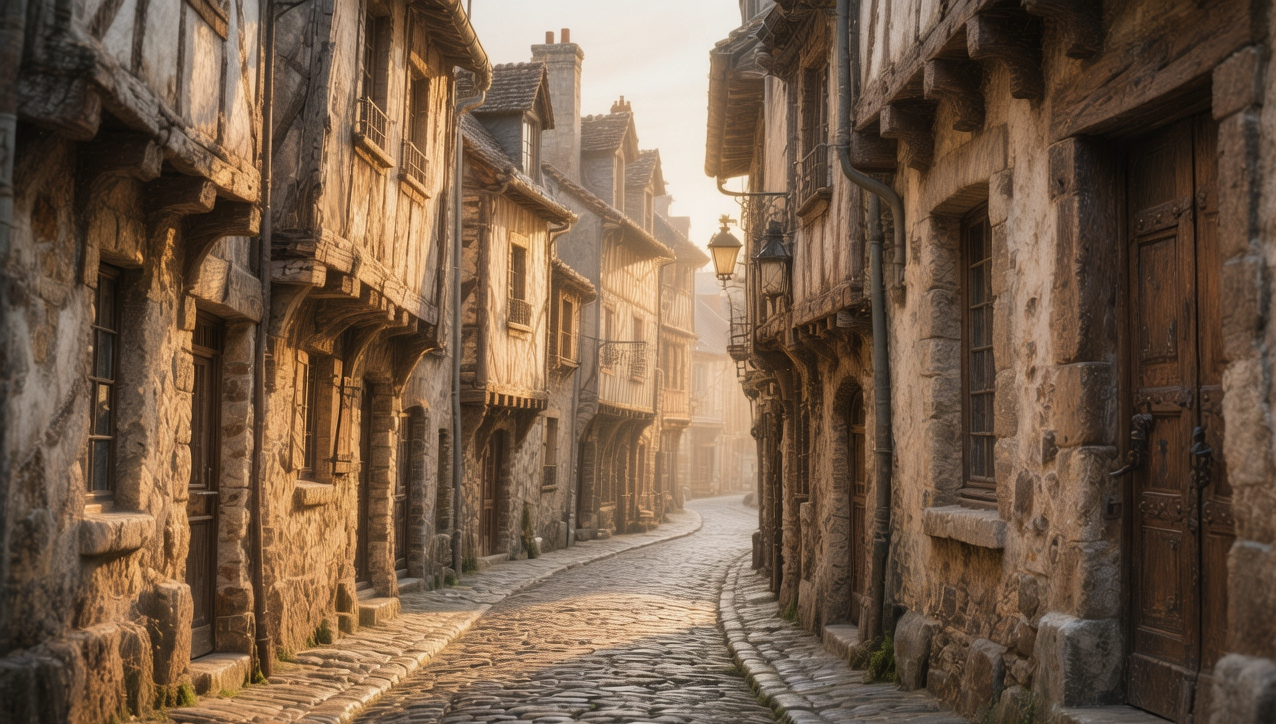
Senlis Medieval Streets Royal Echoes Meet Cobblestone Charm
The late afternoon sun gilds the honey-colored limestone of Senlis’s ancient buildings, casting long shadows across its labyrinthine cobbled streets. You turn a corner onto Rue de la Treille, and the modern world falls away—replaced by a scene that has changed little since the Middle Ages. Timber-framed houses lean precariously over the narrow lane, their upper stories almost touching, while flower boxes overflow with red geraniums. The air carries the faint scent of baking bread from a nearby boulangerie and the distant chime of bells from the Cathédrale Notre-Dame. This is one of France’s best-preserved medieval towns, a place where French kings were crowned as early as the 10th century and where the ramparts, built between 1150 and 1250, still encircle the old town in a near-complete 1,800-meter loop [[1]]. In 2026, as we seek authenticity and a tangible connection to the past, Senlis offers not a museum, but a living, breathing journey through time.
Why Senlis Medieval Streets Embodies Authentic Heritage
Senlis is a rare gem: a medieval town that escaped both the ravages of large-scale industrialization and the heavy hand of post-war reconstruction. Its historical significance is profound—it was here in 987 that Hugh Capet was elected King of the Franks, founding the Capetian dynasty that would rule France for over 800 years [[1]]. The town’s compact, organic layout is a textbook example of a medieval urban plan, radiating from the cathedral and the royal castle (now in ruins). The streets themselves are the main attraction, paved with centuries-old cobblestones and lined with an exceptional concentration of half-timbered houses dating from the 15th to the 17th centuries. The most famous, La Maison d’Adam, built in 1493, features an ornate wooden façade that is a masterpiece of late Gothic carpentry [[3]]. The town’s defensive walls, punctuated by gates like the Porte de la Ville and the Porte de Paris, are not just ruins but fully walkable, offering panoramic views of the surrounding Oise Valley. For the modern traveler, Senlis fulfills a deep need for unmediated history—it solves the problem of the sanitized, theme-park version of the past by offering a genuine, lived-in medieval environment where residents still hang their laundry from the same windows their ancestors did.
The Best Time to Experience Senlis Medieval Streets
To wander the streets of Senlis in near solitude and perfect light, plan your visit for the specific window of May 5–25, 2026. During these spring weeks, the weather is mild, the town’s gardens are in bloom, and the summer tourist crowds have yet to arrive [[10]]. Daytime temperatures are a comfortable 15°C to 19°C (59°F–66°F)—ideal for exploring the cobbled lanes without the heat or rain of other seasons [[10]]. The absolute best time of day is early morning, between 8:00 and 10:00 AM, when the golden light slants through the narrow streets, shopkeepers are setting up their stalls, and you can have the Place du Parvis almost to yourself for a photo of the cathedral. Avoid the peak summer months of July and August, when day-trippers from Paris can congest the main streets, and the popular weekend markets can make navigation difficult [[10]]. For the most current information on market days, guided tours, and any special events, always consult the official Senlis Tourism Office website: senlis-tourisme.fr/en [[5]].
Approximate Budget for a 7-Day Trip (2026)
This budget is calculated for a comfortable, mid-range cultural trip centered on Senlis and the Oise Valley in 2026, factoring in a 4% annual inflation rate as per INSEE standards.
- Accommodation: €85–€120 per night for a room in a charming 3-star hotel or a guesthouse within the medieval walls. Staying inside the old town is essential for the full immersive experience.
- Food: €45 per day. Breakfast (€7): coffee and a croissant at a café on the Place du Parvis. Lunch (€15): a simple lunch of a quiche or a salad nicoise at a bistro on Rue de la Treille. Dinner (€23): a three-course meal at a traditional French restaurant featuring local dishes like duck confit or Oise Valley river fish.
- Transportation: The easiest way to reach Senlis is by train from Paris (Gare du Nord to Senlis, a 30-minute journey via Creil). A round-trip ticket costs around €15. Within the compact medieval center, walking is the only way to travel; no car is needed.
- Attractions: Entry to the Gallo-Roman Museum is €6. A guided “Medieval Senlis” walking tour costs €12. Climbing the cathedral tower for a view is €5. Visiting the ruins of the Royal Castle is free.
- Miscellaneous: Allow €50 for souvenirs (e.g., a book on local history, a handmade ceramic from a local artisan) and small experiences like a picnic in the Jardin du Roy (€10 for supplies from the market).
Total Estimated Cost: €700–€900 for one person for 7 days.
6 Essential Senlis Medieval Streets Experiences
- Walk the Ramparts at Sunrise: Start your day by walking the complete circuit of the medieval walls. The path is well-marked and offers stunning views over the red-tiled rooftops of the old town and the surrounding countryside. The morning light is magical.
- Admire La Maison d’Adam: Stand before this iconic 15th-century house on Rue de la Treille. Its intricate wooden carvings of Adam and Eve are a marvel of medieval craftsmanship. It’s a perfect spot for a quiet moment of reflection.
- Explore the Cathédrale Notre-Dame: This stunning Gothic cathedral, begun in 1153, is a masterpiece of early Gothic architecture. Don’t miss the exquisite stained-glass windows and the unique, asymmetrical west front with its single, soaring tower.
- Get Lost in the Side Streets: Put away your map and simply wander. Discover hidden courtyards, ancient doorways, and unexpected vistas around every corner. The streets like Rue du Chatel and Rue de la Couronne are particularly atmospheric.
- Visit the Gallo-Roman Museum: Housed in the former bishop’s palace, this excellent museum details Senlis’s history from its origins as the Roman city of Augustomagus. It provides essential context for the medieval town above.
- Shop at the Saturday Market: If your visit coincides with a Saturday, don’t miss the vibrant market in the Place du Parvis. It’s a feast for the senses, with local cheeses, charcuterie, flowers, and crafts.
3 Hidden Gems Most Travelers Miss
- The Chapel of Saint-Frambourg: Just outside the main gate, this beautiful 12th-century chapel is often overlooked. Its simple Romanesque architecture and peaceful garden offer a serene escape from the town center. Open daily for quiet reflection.
- The View from Mont Griffon: A short 10-minute walk from the cathedral, this small hill offers a panoramic vista of the entire medieval town, with the cathedral spire as its centerpiece. Go at sunset for a breathtaking, crowd-free photo opportunity.
- The Antique Shops on Rue du Puits-Tiphaine: This quiet street is lined with specialist antique dealers. Even if you’re not buying, it’s fascinating to browse centuries of French history in the form of furniture, art, and objets d’art.
Cultural & Practical Tips
- Wear comfortable walking shoes: The cobbled streets are uneven and can be slippery when wet. Sturdy, flat-soled shoes are a must for a full day of exploration.
- Learn a few key phrases: A polite “Bonjour, Madame/Monsieur” (bon-zhoor, mah-dam/muh-syuh) will be warmly received by local shopkeepers and museum staff.
- Respect private property: Many of the beautiful half-timbered houses are private homes. Admire them from the street, but avoid peering into windows or entering private courtyards.
- Photography is welcome, but be discreet: The town is a photographer’s dream, but remember to be respectful of residents. Early morning is the best time for unobtrusive shots.
- Embrace the slow pace: Life in Senlis moves at a gentle rhythm. Don’t rush your coffee or your walk. This unhurried pace is part of its authentic charm.
Conclusion: Travel with Curiosity, Not Just Cameras
In 2026, the medieval streets of Senlis are more than a picturesque backdrop; they are an invitation to engage with history on a human scale. This is not a place for quick snapshots, but for slow, curious wandering—to trace the grooves in the cobblestones worn by centuries of footsteps, to imagine the lives behind the ancient wooden doors, and to feel the weight of time in the very stones. By traveling with curiosity—with a desire to understand the stories embedded in the architecture and the landscape—you become a steward of its legacy. Your mindful presence supports the local community that works tirelessly to preserve this irreplaceable heritage. So, put your camera away for a while. Listen to the echoes of the past. Let the timeless charm of Senlis reveal itself to you, one quiet street at a time.