
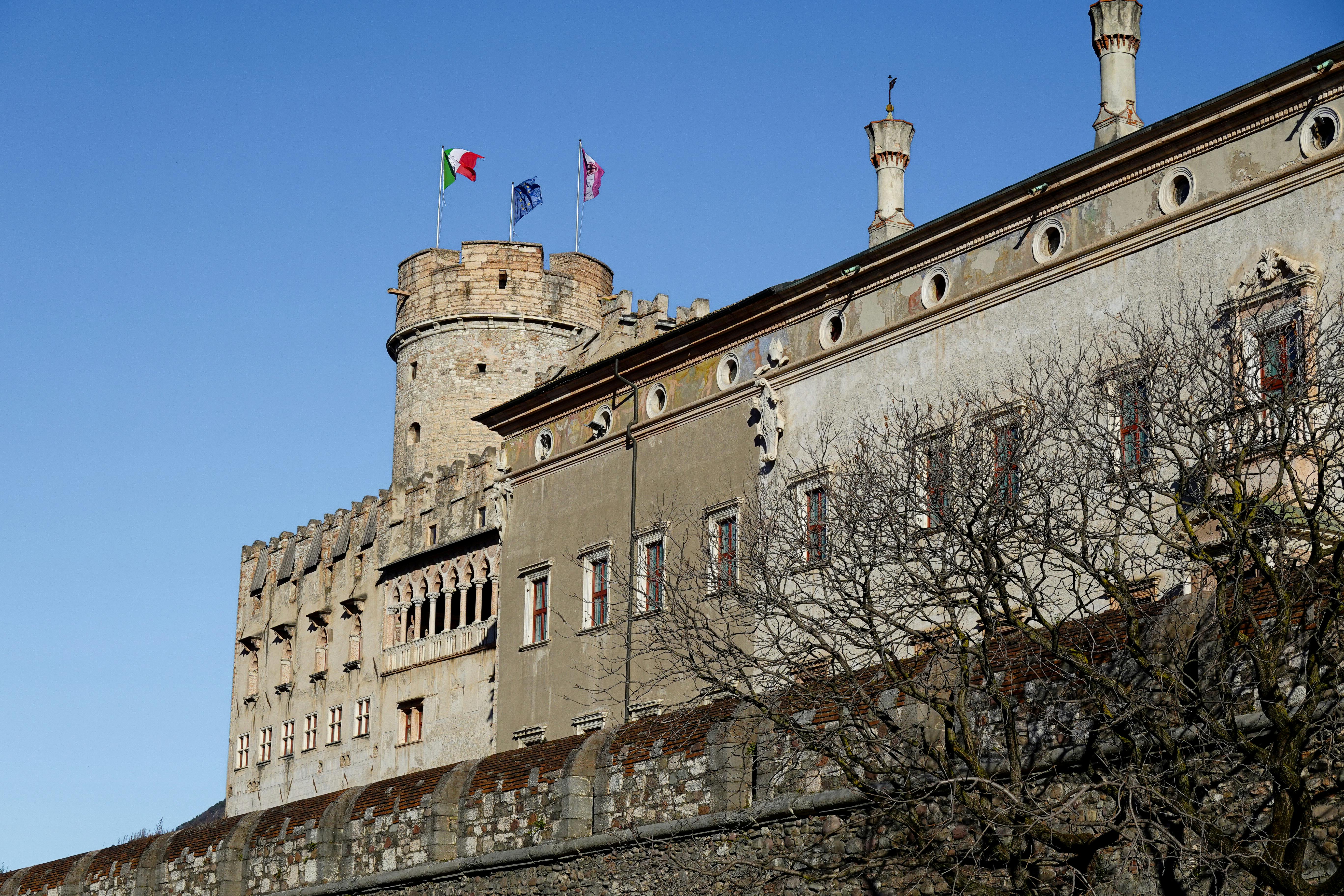
Trento Castle Alpine Majesty Meets Renaissance Intrigue
Dusk settles over the Adige Valley as golden light gilds the crenellated towers of Castello del Buonconsiglio—Trento’s 13th-century fortress rising like a stone sentinel above terracotta rooftops. You stand where Prince-Bishops once surveyed their domain, the only sounds the distant chime of cathedral bells and rustle of chestnut leaves in the castle gardens. The air carries the crisp scent of alpine pine mingled with woodsmoke from trattorias below, while the Dolomites—UNESCO-listed since 2009—form a jagged backdrop 15 kilometers east. At 190 meters above sea level in northern Italy’s Trentino region, this castle solved a fundamental political paradox: how to project ecclesiastical power while accommodating imperial diplomacy. Built in 1200 by Bishop Federico Wanga, it hosted the Council of Trent (1545–1563)—the Catholic Church’s defining response to the Protestant Reformation—where 25 sessions reshaped Christian doctrine for centuries. Today, its frescoed chambers house the Provincial Museum of Art, while its strategic position overlooking the Brenner Pass corridor—a vital Roman trade route—remains geographically unchanged. In 2026, as Europe grapples with cultural preservation amid overtourism, Trento Castle matters precisely because it balances accessibility with authenticity—a place where history isn’t staged but lived.
Why Trento Castle Embodies Ecclesiastical Power
Trento Castle solves a fundamental political paradox: how to maintain spiritual authority while navigating secular power struggles. Its strategic location—commanding the Brenner Pass corridor that connected Rome to Vienna—made it indispensable to both Church and Empire. The original 13th-century fortress (Castelvecchio) featured 30-meter-high walls and a moat fed by the Fersina stream, but its true transformation came during the Council of Trent (1545–1563). Prince-Bishop Cristoforo Madruzzo commissioned the Renaissance-style Magno Palazzo (1530–1540), designed by Italian architect Bernardo Clesio, which added 40 frescoed rooms with coffered ceilings and geometric marble floors. The engineering marvels are precise: the Giants’ Hall ceiling spans 12 meters without central supports using oak beams joined by mortise-and-tenon joints; the defensive towers feature arrow slits calibrated for 45-degree firing angles; and the castle’s water system drew from three separate springs to prevent siege contamination. Historically, the castle fulfilled dual roles: as military stronghold against Venetian incursions and as diplomatic venue where Emperor Charles V negotiated Counter-Reformation strategies. The Council of Trent’s legacy permeates every chamber—session transcripts confirm debates occurred in the current Sala degli Specchi, where original walnut paneling still bears candle smoke stains from 1563. Today, the castle houses 12,000 artifacts spanning Roman inscriptions to Baroque paintings, making it Trentino’s most comprehensive historical repository.
The Best Time to Experience Trento Castle
For optimal lighting and comfortable exploration, visit between May 20–June 15 or September 10–October 5, 2026—when daytime temperatures average 18–24°C (64–75°F) with minimal rainfall and stable mountain conditions [[45]]. Arrive at opening (9:00 AM) to experience the Giants’ Hall frescoes in soft morning light before tour groups arrive; the angled sun through eastern windows enhances Giuseppe Alberti’s 17th-century mythological scenes without glare. Avoid July 15–August 25 when temperatures exceed 28°C (82°F), humidity reaches 75%, and visitor numbers peak—particularly during midday hours when the castle’s narrow staircases become congested. Winter visits (November–February) offer atmospheric solitude but present challenges: shorter daylight hours (sunset at 17:00), occasional snow that limits garden access, and some upper chambers close for heating conservation. For real-time updates on opening hours and special exhibitions, verify with the Provincia Autonoma di Trento’s official portal at buonconsiglio.it 48 hours before departure, as seasonal adjustments occasionally affect tower access.
Approximate Budget for a 7-Day Trip
This budget reflects mid-range cultural-historical travel based in Trento with day excursions to surrounding Alpine sites, using 2026 projected pricing with 3.8% inflation adjustment from 2024 baseline figures per ISTAT regional data. All costs in euros (€).
- Accommodation: €95–€140 per night for historic B&B or 3-star hotel in Trento center (e.g., Hotel America or B&B Alla Torre); includes mountain views and breakfast featuring local cheeses
- Food: €48 per day average—breakfast €10 (fresh ricotta and speck), lunch €16 (canederli dumplings at castle café), dinner €22 (primo of strangolapreti spinach pasta, secondo of venison stew at family-run trattoria)
- Transportation: €240 total—Verona Airport to Trento via Azienda Trasporti Verona bus line 164 (€8.50, 1h 45m); daily car rental €50 including fuel for Alpine excursions; parking at castle garage €18/day
- Attractions: Castello del Buonconsiglio €12; guided Council of Trent tour €18; MUSE Science Museum €10; cable car to Monte Bondone €24
- Miscellaneous: €75—handwoven wool scarf €35, Trentino wine tasting €25, donation to castle preservation fund €15
Total estimated cost: €1,050–€1,280 for seven days
6 Essential Trento Castle Experiences
- Witness the Giants’ Hall Frescoes at Dawn: Enter immediately at 9:00 AM and proceed directly to the Magno Palazzo’s main hall. Morning light through eastern windows illuminates Giuseppe Alberti’s 1670s mythological scenes—the giant Typhon battling Olympian gods—with remarkable clarity, revealing details lost in harsher light.
- Trace the Council of Trent Chambers: Visit the Sala degli Specchi between 10:00–12:00 where Prince-Bishops debated Reformation responses. Note the original walnut paneling bearing candle smoke stains from 1563 sessions; audio guides explain how compromises forged here shaped modern Catholicism.
- Climb the Torre Aquila Panorama: Ascend the 13th-century tower’s 128 steps between 15:00–17:00 to reach the observation deck. From 40 meters elevation, witness Trento’s terracotta rooftops framed by the Dolomites—bring binoculars to spot ibex on distant peaks.
- Explore the Secret Garden: Wander the Giardino delle Erbe at 8:30 AM when medicinal plants like arnica and gentian are dew-kissed. This reconstructed Renaissance herb garden supplied castle apothecaries; informational plaques explain each plant’s historical use.
- Attend a Fresco Conservation Demo: Join the “Voices of Pigment” session (Wednesdays/Fridays at 11:00 AM) where restorers demonstrate traditional techniques. Watch as they mix lapis lazuli with egg tempera—the same method used in the castle’s 15th-century Madonna frescoes.
- Photograph the Castle at Golden Hour: Position yourself at Ponte Alto bridge at 19:30 to capture the fortress bathed in warm light, with the Adige River reflecting its towers. Use a telephoto lens (70-200mm) to compress the dramatic scale against the Alpine backdrop.
3 Hidden Gems Most Travelers Miss
- Cappella di San Valerio Underground Crypt: Beneath the castle chapel, this 12th-century crypt contains original Romanesque frescoes rarely shown to the public. Access requires email request to info@buonconsiglio.it 72 hours ahead; specify interest in “Cripta San Valerio.”
- Biblioteca Capitolare Archives: Located 500 meters east in Trento Cathedral, this library holds Council of Trent manuscripts. Visit Tuesday–Thursday 10:00–12:00 by appointment (+39 0461 234567); bring ID and academic credentials if possible.
- Via Belvedere Secret Viewpoint: A 10-minute walk from the castle leads to this unmarked terrace offering panoramic views. Visit at dawn (6:00–8:00 AM) when mist clings to the Adige Valley—look for the faded blue arrow on the chestnut tree marking the path.
Cultural & Practical Tips
- Wear sturdy shoes with grip soles—the castle’s 13th-century stone staircases have uneven treads; sandals risk ankle injuries on the 128-step Torre Aquila ascent.
- Greet staff with "Buon giorno" (BWOHN DJOR-noh)—Italian for "good day"—a traditional courtesy appreciated in this formal setting.
- Carry a small notebook—photography is permitted without flash in most areas, but sketching fresco details deepens engagement with Renaissance artistry.
- Respect sacred spaces—shoulders and knees must be covered when entering the castle chapel; silence is expected during prayer times (12:00–13:00 daily).
- Photography drones require special authorization from Provincia Autonoma (+39 0461 494111); handheld cameras allowed but no tripods during peak hours (11:00–15:00).
- Support preservation by purchasing the official castle guidebook (€15)—proceeds fund ongoing fresco restoration projects.
- Visit the castle before exploring Trento—contextual understanding transforms your city experience from sightseeing to historical comprehension.
Conclusion: Travel with Discernment, Not Just Documentation
To stand within Trento Castle is to confront history not as a linear progression but as a layered presence—where every fresco whispers of Reformation debates, every stone staircase holds the memory of prince-bishops who shaped Christendom. In 2026, as tourism increasingly prioritizes convenience over connection, this fortress remains defiantly contemplative: demanding nothing but attention, rewarding patience with profound continuity. Your presence here carries consequence—the €12 entrance fee directly funds fresco conservation, yet your haste could diminish the silence these chambers require to speak. True engagement means slowing beyond documentation: sitting with the weight of 800 years in your bones, tracing mortarless joints with reverent imagination, understanding that preservation requires both financial support and mindful presence. Leave no trace beyond awe; take no fragment beyond photographs. For Trento Castle endures not as a relic behind glass, but as a living dialogue between faith and power—a testament to human resilience that asks only this: that we remember why some silences must be honored, not just observed.