
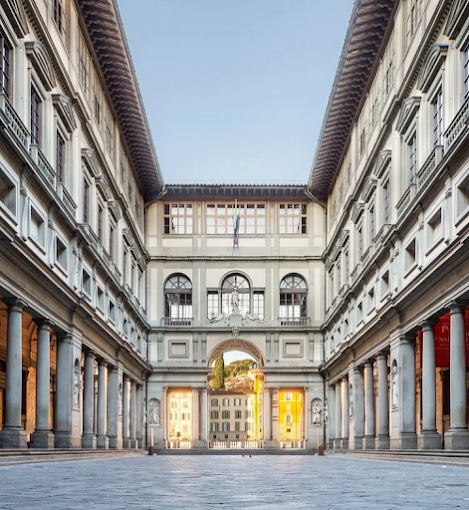
Uffizi Gallery Renaissance Light Meets Timeless Vision
Morning in Piazza della Signoria is a hushed prelude—cobblestones still damp from last night’s rain, the air scented with espresso and old stone. Before the crowds arrive, you stand before the Uffizi Gallery, its long, harmonious façade stretching like a Renaissance scroll unfurled along the Arno. Designed by Giorgio Vasari in 1560 as offices (uffizi) for Florentine magistrates, this building was never meant to be a museum; yet by 1769, it had become the world’s first public art gallery, housing the Medici family’s unparalleled collection. Inside, sunlight filters through high clerestory windows, illuminating Botticelli’s Birth of Venus with the same golden glow that once caressed its pigments in a Medici palace. The gallery spans over 45 rooms and houses more than 3,000 works—each brushstroke a testament to human curiosity, faith, and rebellion. In 2026, as digital fatigue dulls our senses, the Uffizi offers something irreplaceable: the chance to stand face-to-face with genius, not through a screen, but in sacred silence.
Why Uffizi Gallery Embodies the Birth of Public Art
The Uffizi Gallery isn’t just a repository of masterpieces—it is the architectural embodiment of a revolutionary idea: that great art belongs to the people. Commissioned by Cosimo I de’ Medici and designed by Giorgio Vasari, construction began in 1560 as a U-shaped administrative complex flanking the Piazza della Signoria. Its top floor, the Corridoio Vasariano, connected the Palazzo Vecchio to the Pitti Palace, allowing the Medici to move unseen across the city. Over time, the family transformed the upper loggia into a private gallery for their growing collection of antiquities and Renaissance paintings. When Anna Maria Luisa de’ Medici—the last of the dynasty—bequeathed the entire collection to the Tuscan state in 1737 with the stipulation that “it must serve to ornament the State, for the benefit of the public,” she created the blueprint for every public museum that followed. Today, the gallery’s 101 rooms (45 open to the public) span from 13th-century Byzantine icons to Caravaggio’s chiaroscuro dramas. Its Botticelli Room alone holds two of Western art’s most iconic images: The Birth of Venus and Primavera. This is where art ceased to be solely devotional or dynastic and became a shared human inheritance.
The Best Time to Experience Uffizi Gallery
To experience the Uffizi Gallery with space to breathe and light ideal for viewing delicate tempera panels, target the precise window of October 1–15, 2026. During these weeks, Florence enjoys daytime temperatures of 16–22°C (61–72°F)—cool enough for comfortable walking yet warm enough for open windows that soften interior lighting [[22], [25]]. The absolute best time to enter is during the first admission slot at 8:15 AM, which grants near-private access to the Botticelli and Leonardo rooms before tour groups flood in. Tuesdays and Wednesdays are consistently less crowded than weekends. Avoid visiting during peak periods: all of May, July, and August, when wait times can exceed two hours even with reservations, and major holidays like Easter week or Christmas markets [[27]]. For optimal viewing conditions, request a room on the east wing early in your visit—the morning sun enhances the luminosity of gold-leaf backgrounds in Giotto and Cimabue works. Always verify current opening days and special closures via the official website (uffizi.it/en), as restoration projects occasionally close key rooms.
Approximate Budget for a 7-Day Trip (2026)
This budget is based on mid-range 2025 pricing adjusted for Italy’s projected 2026 inflation rate of 1.5% [[37]], providing a realistic estimate for a solo traveler staying within walking distance of the Uffizi.
- Accommodation: €885–€1,170 total (€148–€195 per night) for a 3-star hotel or private apartment in the Santa Croce or San Giovanni neighborhoods—quiet yet central.
- Food: €455 total (€65 per day). Breakfast at a local bar (€3 for cappuccino and cornetto); lunch near Mercato Centrale (€16 for lampredotto sandwich and mineral water); dinner at a trattoria (€40 for pappa al pomodoro, bistecca, and house Chianti).
- Transportation: €25 total. Florence is best explored on foot; this covers a few ATAF bus rides (€1.70 per ticket) or a taxi from Santa Maria Novella station.
- Attractions: €105 total. Uffizi Gallery (€28); Accademia Gallery (€22); Bargello Museum (€15); Boboli Gardens (€12); and a guided Renaissance walking tour (€28).
- Miscellaneous: €110 total. A high-quality print from the Uffizi’s official bookstore (€25); gelato from La Carraia (€4); a leather-bound journal from Scuola del Cuoio (€35); and a wine tasting in Oltrarno (€45).
Total Estimated Budget: €1,580–€1,980
6 Essential Uffizi Gallery Experiences
- Enter at 8:15 AM for Botticelli in Solitude: Book the earliest timed entry to experience the Birth of Venus and Primavera without jostling crowds. The soft morning light through the high windows makes Venus’s skin seem to glow from within.
- Trace the Evolution of Perspective: Walk chronologically from Room 2 (Cimabue’s rigid Maestà) to Room 6 (Giotto’s emotional depth) to Room 15 (Masaccio’s revolutionary use of linear perspective)—a visual timeline of artistic awakening.
- Find Caravaggio’s Quiet Drama: In Room 90, stand before Medusa and Bacchus. Notice how his tenebrism—extreme light-dark contrast—creates psychological intensity that feels startlingly modern.
- Admire Titian’s Sensual Color: In Room 83, Venus of Urbino reclines with languid confidence. Observe how Titian’s loose brushwork and warm palette influenced centuries of European painting.
- Step onto the Niobe Terrace: Midway through the gallery, this small balcony offers a stunning view over the Arno and Ponte Vecchio—a deliberate pause built by Vasari to refresh the eyes.
- Visit the Tribune (Room 20): This octagonal jewel box, designed in 1584, displays the Medici’s most prized antiquities and Renaissance works, including the Medici Venus sculpture and Raphael’s Madonna of the Goldfinch.
3 Hidden Gems Most Travelers Miss
- Studiolo of Francesco I: Tucked away on the second floor near the exit, this tiny, frescoed chamber (just 7x5 meters) was Duke Francesco I’s private laboratory. Its walls are covered in meticulously painted cabinets hiding alchemical tools and rare specimens—a surreal cabinet of curiosities rarely mentioned in guidebooks.
- Loggia del Pesce: Just a two-minute walk from the Uffizi entrance on Via de’ Lamberteschi, this elegant 16th-century loggia by Vasari is often empty. Its arched bays offer shade and a perfect spot to reflect after your visit.
- Giardino delle Rose (Rose Garden): Located below Piazzale Michelangelo, this fragrant garden provides the most iconic panoramic view of Florence, with the Uffizi’s roofline clearly visible among the terracotta sea. Visit at sunset for a post-gallery moment of quiet contemplation.
Cultural & Practical Tips
- Book timed tickets online—at least 3 weeks ahead: Walk-up entry is virtually impossible in 2026. Reserve via the official site (uffizi.it/en) and select the 8:15 AM slot for the best experience.
- Dress respectfully: Shoulders and knees must be covered. This is a cultural institution housed in a historic building with religious artworks.
- Photography is allowed without flash: But avoid tripods or selfie sticks. Be mindful of other visitors—never block doorways or linger excessively in front of major works.
- Learn basic phrases: “Dov’è la sala di Botticelli?” (doh-VEH lah SAH-lah dee Bot-ee-CHEL-lee?) for “Where is the Botticelli room?”; “Grazie mille” (GRAHT-see-eh MEE-leh) for sincere thanks.
- Allow 3–4 hours minimum: Rushing the Uffizi defeats its purpose. Focus on 10–15 key works rather than trying to see everything. The museum is closed on Mondays.
Conclusion: Travel with Presence, Not Just Itineraries
In an age of fleeting digital impressions, the Uffizi Gallery demands something rare: your full presence. Standing before Botticelli’s Venus isn’t about checking a box—it’s about feeling the tremor of human creativity across six centuries. Your €28 ticket in 2026 directly funds the painstaking conservation of fragile egg tempera panels and gilded frames, ensuring these visions survive for future generations. To travel mindfully here means choosing depth over breadth: lingering with one Caravaggio instead of snapping ten rushed photos; supporting the official bookstore’s scholarly prints rather than cheap souvenirs; respecting the silence that allows others to connect with beauty. The Medici gave this collection to the public with a vision of shared enrichment. Honor that legacy not by consuming art, but by letting it transform you—one quiet, reverent moment at a time.