
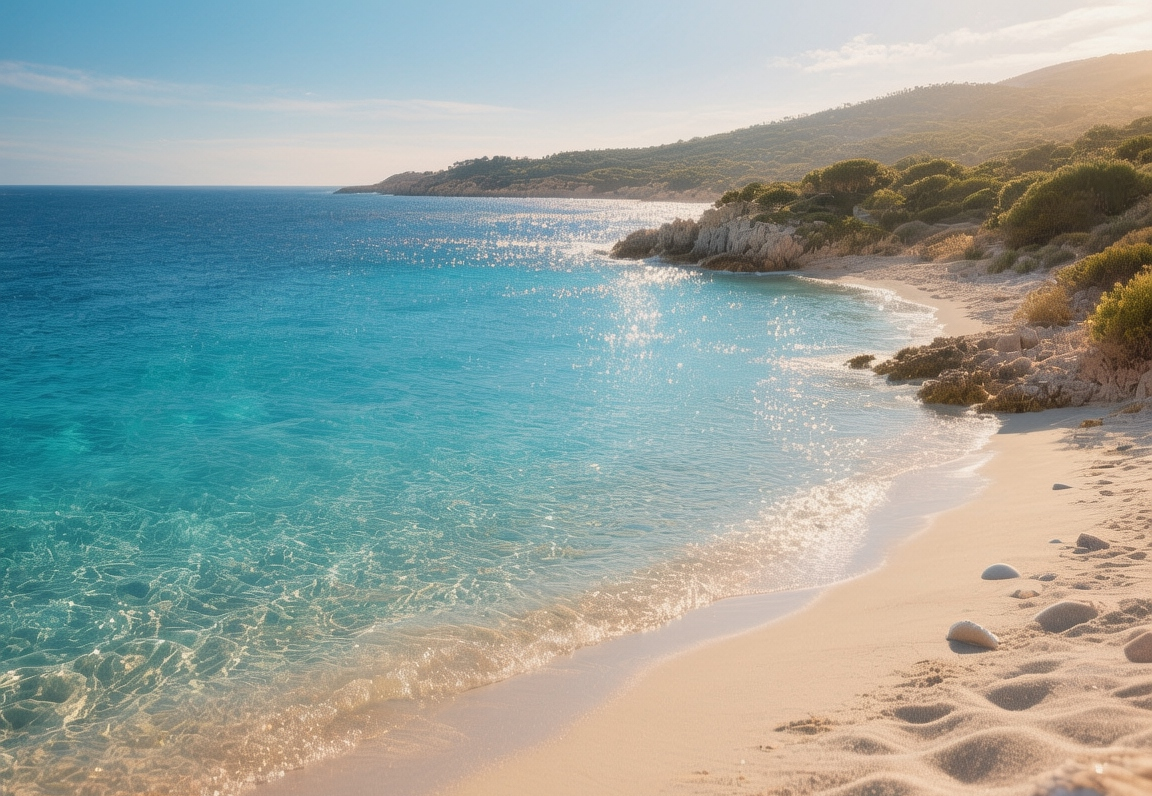
Villasimius Beaches Caribbean Hues Meet Mediterranean Soul
Mid-morning sun fractures through the crystalline waters of Spiaggia di Simius—casting liquid sapphires across a seabed so transparent you count every shell fragment on the white sand 8 meters below. The scent of salt mingles with wild myrtle clinging to granite outcrops that frame this crescent of powder-fine sand, their pink-hued surfaces warmed by Sardinia’s relentless sun. You wade ashore where water temperatures hover at 22°C (72°F), the only sounds the gentle lap of turquoise waves and distant cries of ospreys nesting in the Capo Carbonara cliffs. This southeastern sanctuary—just 45 kilometers from Cagliari yet worlds away in atmosphere—boasts 27 beaches within 20 square kilometers, each a study in contrasts: from the Caribbean-like shallows of Porto Giunco to the windswept drama of Campulongu. Historically a Phoenician trading post by 800 BCE, Villasimius evolved into a tuna fishing hub whose tonnare (tuna traps) supplied Roman feasts. Today, its beaches lie within the Capo Carbonara Marine Protected Area—established in 1998 to shield Posidonia oceanica meadows that filter water to 30-meter visibility. In 2026, as Mediterranean coastlines buckle under overtourism, Villasimius matters precisely because it balances accessibility with conservation—a place where luxury resorts coexist with strict environmental protocols, offering sanctuary without sacrificing sustainability.
Why Villasimius Beaches Embodies Coastal Harmony
Villasimius solves a fundamental Mediterranean paradox: how to offer world-class beaches while maintaining ecological integrity. Its unique geology—where ancient granite meets marine sediment—creates powdery white sands unlike anywhere else in Sardinia, with grains averaging 0.2 millimeters in diameter that reflect sunlight to enhance water clarity. The area’s transformation began in 1967 when developer Mario Diana recognized the potential of Spiaggia di Simius, constructing the first resort while preserving natural dunes—a model later adopted across the region. The real breakthrough came in 1998 with establishment of the Capo Carbonara Marine Protected Area, covering 1,900 hectares of sea and 1,200 hectares of land. This designation enforces strict protocols: no anchoring on Posidonia meadows (which produce 20 liters of oxygen per square meter daily), speed limits for boats within 300 meters of shore, and daily visitor caps at popular beaches like Porto Giunco (max 1,500 people). Technically, the beaches function as integrated systems—the 1.2-kilometer-long Spiaggia di Simius features a natural breakwater of submerged granite boulders that calms waves while creating tidal pools teeming with life; Porto Giunco’s lagoon connects to the sea through a narrow channel that flushes nutrients twice daily, supporting endemic species like the Sardinian goby fish. Culturally, Villasimius honors its fishing heritage: the annual Sagra del Tonno (Tuna Festival) in June celebrates sustainable catches using techniques unchanged since Phoenician times, while local restaurants display blue MSC certification tags guaranteeing responsible sourcing.
The Best Time to Experience Villasimius Beaches
For optimal conditions and manageable crowds, visit between May 20–June 18 or September 10–October 5, 2026—when sea temperatures average 20–24°C (68–75°F) and air temperatures range 22–27°C (72–81°F) with minimal rainfall [[24]]. Arrive at popular beaches like Spiaggia di Simius by 8:30 AM to secure parking and avoid midday heat; morning light provides ideal photography conditions with reduced glare on water surfaces. Avoid July 15–August 25 when sea temperatures exceed 26°C (79°F), humidity reaches 80%, and daily visitor numbers surpass capacity limits—particularly at Porto Giunco where the 1,500-person cap is often reached by 10:00 AM [[25]]. Winter visits (November–February) offer solitude but present challenges: many beach facilities close seasonally, water temperatures drop to 14°C (57°F), and some coastal roads become impassable after heavy rains. For real-time updates on beach capacity and weather-related closures, verify with the Capo Carbonara Marine Protected Area Authority’s portal at 48 hours before departure, as dynamic management adjusts access based on environmental conditions.
Approximate Budget for a 7-Day Trip (2026)
This budget reflects mid-range luxury travel based in Villasimius with beach excursions and coastal exploration, using 2026 projected pricing with 3.8% inflation adjustment from 2024 baseline figures per ISTAT regional data. All costs in euros (€).
- Accommodation: €110–€180 per night for 4-star resort or seaside villa in Villasimius center (e.g., Hotel Cala Caterina or Villa Simius); includes private beach access and breakfast featuring local cheeses
- Food: €55 per day average—breakfast €12 (fresh ricotta and pane carasau), lunch €18 (panino with bottarga at beach kiosk), dinner €25 (primo of malloreddus pasta with lobster, secondo of grilled orata fish at seaside restaurant)
- Transportation: €220 total—Cagliari Elmas Airport to Villasimius via ARST bus line 102 (€6.50, 1h 15m); daily car rental from Villasimius €45 including fuel for coastal exploration; parking at beaches €4/day
- Attractions: Guided snorkel tour of Capo Carbonara €38; boat excursion to Serpentara Island €42; Museo del Mare €8; Tonnara di Villasimius historical tour €12
- Miscellaneous: €80—handwoven textile souvenir €35, Sardinian wine tasting €25, donation to Posidonia conservation program €20
Total estimated cost: €1,250–€1,520 for seven days
6 Essential Villasimius Beach Experiences
- Snorkel the Posidonia Meadows at Porto Giunco: Arrive by 9:00 AM to explore the protected seagrass meadows west of the main beach. The dense underwater prairie—visible to 15-meter depth—hosts octopus dens and neon-colored nudibranchs; wear reef-safe sunscreen to protect this fragile ecosystem that filters water to exceptional clarity.
- Photograph Spiaggia di Simius at Golden Hour: Position yourself on the eastern granite outcrop at 18:30 to capture the beach bathed in warm light, with the white sand creating mesmerizing patterns against turquoise water. Use a polarizing filter to reduce surface glare and emphasize the contrast with the dark sea beyond.
- Boat to Serpentara Island: Charter a private boat from Villasimius harbor at 8:00 AM to reach this uninhabited island 3 kilometers offshore. Snorkel around its perimeter where strong currents create nutrient-rich waters attracting schools of barracuda; the island’s name comes from its serpentine shape visible only from above.
- Attend the Tonnara Historical Demonstration: Join the daily 17:00 briefing at the restored Tonnara di Villasimius where fishermen demonstrate the ancient tonnara net technique used since Phoenician times. Learn how to identify sustainable catches—look for the blue MSC certification tag on local seafood menus.
- Explore Campulongu’s Windswept Drama: Visit this wilder beach on the southern edge of town between 10:00–12:00 when the Maestrale wind creates perfect conditions for bodyboarding. The dramatic granite formations here—sculpted by centuries of wave action—offer sheltered coves for quieter swimming.
- Kayak the Capo Carbonara Coastline: Launch from Spiaggia di Simius at 7:30 AM for a 2-hour paddle along the protected marine reserve. Navigate through sea caves accessible only by kayak and observe ospreys nesting in the 50-meter-high cliffs—early morning ensures calm seas and solitude.
3 Hidden Gems Most Travelers Miss
- Cala Pira Secret Access: Reachable only via a 20-minute hike from the SP17 road, this untouched cove requires descending 150 stone steps built by shepherds. Visit at low tide (check Cagliari port authority tables at porto-cagliari.it/maree) when hidden rock pools become accessible—most tourists never venture beyond the main beaches.
- Stagno di Notteri Bird Observatory: Located 3 kilometers north of Porto Giunco, this coastal lagoon hosts 120 bird species including flamingos during migration seasons. Visit at dawn (6:00–8:00 AM) with binoculars; the unmarked observation blind is reached via a dirt track off SS552—look for the faded blue arrow on the olive tree.
- Museo della Civiltà Marinara Archive: In Villasimius’ town hall basement, unpublished logbooks from 1950s tuna fishermen document sustainable catch techniques. Email archivio@comune.villasimius.ca.it 72 hours ahead specifying interest in “Documenti Tonnara 1950–1965”; bring ID for the 30-minute viewing.
Cultural & Practical Tips
- Wear water shoes with grip soles—even “white sand” beaches have sharp granite fragments; barefoot walking risks cuts requiring medical attention.
- Greet fishermen with "Sa buna pesca" (SAH BOO-nah PEH-ska)—Sardinian for "good catch"—a traditional blessing acknowledging their livelihood.
- Carry reef-safe sunscreen (zinc oxide-based) and biodegradable soap; chemical sunscreens containing oxybenzone are prohibited in the marine park under Regional Law 12/2021.
- Respect daily visitor caps—Porto Giunco allows only 1,500 people per day; book boat tours through authorized operators listed on areamarinacapocarbonara.it to avoid illegal charters.
- Photography drones require special authorization from the Marine Protected Area Authority (+39 070 930011); handheld cameras are permitted but avoid disturbing nesting birds on cliffs.
- Support conservation by purchasing the official marine park map (€10) from Villasimius tourist office—proceeds fund Posidonia monitoring programs.
- Learn basic Italian phrases for emergencies—"Dov’è l’ospedale?" (Where is the hospital?) could be critical given the remote location.
Conclusion: Travel with Stewardship, Not Just Spectacle
To experience Villasimius beaches is to confront beauty that demands reciprocity—a coastline so breathtaking it could easily become a victim of its own allure. In 2026, as Mediterranean destinations buckle under tourism pressure, this sanctuary stands as both gift and test: its Caribbean hues and powdery sands invite indulgence, but its fragile Posidonia meadows and nesting ospreys require restraint. Your presence here carries consequence—the €38 snorkel tour fee funds marine patrols protecting against illegal anchoring, yet your sunscreen choice could poison seagrass that took centuries to grow. True engagement means slowing beyond the postcard moment: snorkeling mindfully to avoid kicking sediment onto coral, dining at restaurants displaying MSC certification, understanding that preservation isn’t passive admiration but active care. Leave no trace beyond ripples; take no fragment beyond memories. For Villasimius endures not as a backdrop for our adventures, but as a living testament to what happens when luxury and conservation align—a covenant written in granite and seawater that asks only this: that we remember why some paradises must be protected, not just visited.
Image Description: Turquoise waters of Simius Beach in Villasimius meeting powdery white sand under clear Sardinian sky at mid-morning