
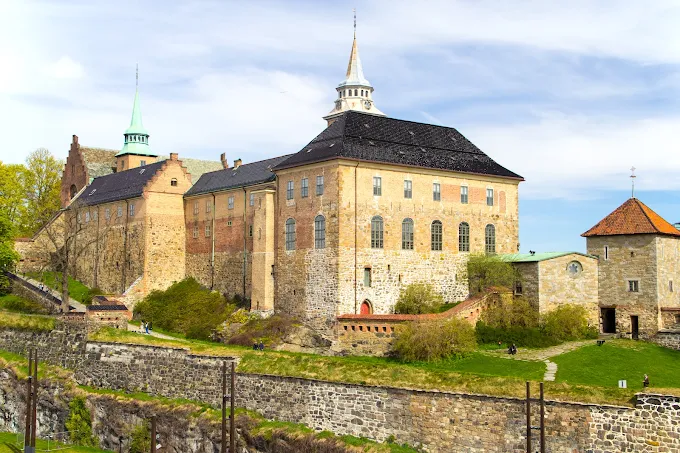
Akershus Fortress Medieval Stone Meets Oslofjord Light
The wind off the Oslofjord carries the sharp tang of salt and the distant hum of ferry engines as you walk the ramparts of Akershus Fortress. Beneath your boots, the cobblestones are uneven—worn smooth by 700 years of soldiers, royalty, and tourists—leading you along a defensive wall that has guarded Oslo since 1299. The sun dips low, casting long shadows across the red-brick Renaissance buildings that sit nestled within the medieval stone shell, creating a striking contrast of eras. You pause at the edge of the headland, 25 meters (82 feet) above the water, watching cruise ships glide silently past the very cannons that once fired in defense of the city. This is not a ruin frozen in time; it is a living military area, a royal reception venue, and a public park all at once. In 2026, as historic sites worldwide struggle to balance preservation with accessibility, Akershus Fortress matters because it remains open and free—a democratic space where history is not locked behind paywalls but walked upon, reminding us that the past belongs to everyone.
Why Akershus Fortress Embodies Norwegian Resilience
Akershus Fortress is not merely a castle; it is the physical manifestation of Norway's struggle for sovereignty. Constructed by King Håkon V Magnusson starting in 1299, the fortress solved a critical defensive problem: how to protect the emerging capital from Swedish and Danish incursions using the natural geography of the fjord. The original medieval keep was built of local gneiss and granite, with walls up to 3 meters (10 feet) thick in places, designed to withstand siege weaponry of the 14th century. Over the centuries, it evolved; Christian IV transformed it into a Renaissance palace in the 1600s, adding the distinctive red-brick facades that define the inner courtyard today.
The site fulfills a profound cultural need: it serves as a national symbol of endurance. During World War II, the fortress was occupied by Nazi forces from 1940 to 1945, used as a prison and execution site. Today, the Resistance Museum (Norges Hjemmefrontmuseum) located within the grounds documents this dark chapter, ensuring the memory of the occupation is not lost. The engineering of the site is equally impressive; the bastion system added in the 17th century utilized earthworks to absorb cannon fire, a military innovation that shaped European fortification design. In 2026, the fortress continues to serve the state—it is still an active military zone used for royal receptions and guards the nearby Royal Mausoleum. It stands as a testament to the idea that a nation's strength lies not just in its walls, but in its ability to adapt, survive, and remain open to its people.
The Best Time to Experience Akershus Fortress
For optimal weather and extended daylight, target June 15–August 20. During this window, temperatures in Oslo range from 15–22°C (59–72°F), and daylight extends to 18 hours, allowing for evening walks when the stone glows in the midnight sun. The grounds are most atmospheric between 7:00–9:00 AM when the light is soft and crowds are minimal, or during golden hour at 8:00–10:00 PM. Guided tours of the Royal Mausoleum operate daily at 1:00 PM during summer months. For winter drama, visit December 1–20 when snow blankets the ramparts, creating a stark monochrome landscape. Temperatures drop to -5 to 4°C (23–39°F), and the contrast of white snow against gray stone is striking.
Avoid July 15–August 5 if you dislike crowds: this period coincides with peak cruise ship season in Oslo. The main courtyard can become congested with tour groups, making photography difficult. Also avoid visiting during national holidays like May 17 (Constitution Day) when the area is closed to the public due to official ceremonies. For real-time opening hours and tour availability, check www.forsvaret.no/akershus or call +47 23 09 20 00. Weather forecasts are available via Yr.no. Note that the outdoor grounds are open 24 hours, but museums and buildings have limited hours (10:00 AM–5:00 PM in winter).
Approximate Budget for a 7-Day Trip (2026)
Oslo remains one of Europe's pricier capitals, reflecting Norway's high standard of living. This budget assumes mid-range travel with 3-4% inflation adjustment from 2024 baselines. Prices are estimated in Euros (€); local currency is Norwegian Krone (NOK). Costs reflect Oslo city center and Akershus areas.
- Accommodation: €180–€280 per night for a double room in a 3-star hotel in Sentrum or Aker Brygge. Budget hostels (Anker Hotel): €65–€85 per bed. Upscale options (The Thief): €350–€550 per night.
- Food: €85–€125 per day per person
- Breakfast: €18–€25 (hotel buffet with bread, cheese, jam)
- Lunch: €25–€40 (café sandwich €32, fish soup €38, or grocery picnic €24)
- Dinner: €42–€70 (restaurant main: lamb €50, fish €48, pasta €38; add €16 for beer)
- Transportation:
- Train (Airport–City): €20 one-way, €35 round-trip
- Local tram/bus day pass (Ruter): €13
- Car rental (7 days): €650–€850 including fuel
- Fjord cruise: €75–€110
- Attractions:
- Akershus Fortress Grounds: Free
- Resistance Museum Entry: €12
- Royal Mausoleum Tour: €10
- Norwegian Armed Forces Museum: €10
- Guided History Tour: €25
- Miscellaneous:
- Souvenirs: Viking replica coin €15, wool sweater €110, book €35
- Coffee and pastry: €12
- Travel insurance (7 days): €50–€70
- eSIM data plan: €25–€35
Total for 7 days (mid-range, per person, double occupancy): €2,150–€2,750
Budget travelers can reduce costs to €1,400–€1,700 by staying in hostels, cooking meals, and using public transport. Luxury seekers should budget €5,000+ for boutique hotels and fine dining at restaurants like Maaemo.
6 Essential Akershus Fortress Experiences
- Walk the Ramparts: Enter through the main gate and ascend to the outer walls. The walk offers panoramic views of the Oslofjord and the Opera House. Start at 9:00 AM to avoid crowds. The cannons along the wall date from the 17th to 19th centuries. Look for the inscriptions on the bronze barrels. Spend 30 minutes walking the perimeter. The wind is stronger here; bring a jacket. It is the best vantage point for photography. Respect the military signage; some areas are restricted.
- Visit the Resistance Museum: Located in the southwest corner of the fortress. Open daily 10:00 AM–5:00 PM (summer). This museum documents Norway's occupation during World War II. View original artifacts, uniforms, and clandestine radio equipment. The exhibition is sobering and detailed. Entry costs €12; free for under 18. Guided tours start at 1:00 PM. It provides essential context for the fortress's modern history. Allow 90 minutes for a full visit. Audio guides are available in English.
- Explore the Royal Mausoleum: Located within the fortress church. Open for tours at 1:00 PM daily in summer. This is the final resting place of Norwegian monarchs since 1905. The interior is ornate with marble sarcophagi. Photography is prohibited inside to respect the dead. Visit at 2:00 PM when light streams through the stained glass. It is a quiet, sacred space. Dress modestly; shoulders and knees should be covered. Entry is included in the church tour fee.
- Walk the Inner Courtyard: The Renaissance courtyard is surrounded by red-brick buildings from Christian IV's era. Visit at noon when the sun illuminates the facades. The architecture contrasts sharply with the medieval outer walls. Benches are available for resting. It is often used for royal events; check for closures. The well in the center dates to the 1600s. Free access to the courtyard. It offers a glimpse into royal domestic life.
- Picnic on the Lawns: The grassy slopes facing the fjord are perfect for a summer picnic. Bring food from a local bakery. Find a spot near the cannons. Locals gather here on sunny Sundays. The atmosphere is relaxed and family-friendly. Children play on the open grass. It offers a chance to see the fortress in a living context. Purchase supplies at a Meny or Kiwi supermarket beforehand. Respect the grass; do not leave trash.
- Watch the Changing of the Guard: Occurs daily at 1:00 PM in the main courtyard. The King's Guard marches from the palace to the fortress. The ceremony lasts 30 minutes. Uniforms are distinctive with blue tunics and lions on helmets. Arrive by 12:45 PM to secure a viewing spot. It is a colorful display of tradition. Photography is allowed but do not use flash. A quintessential Norwegian military experience.
3 Hidden Gems Most Travelers Miss
- Kristian IV's Crypt: Located beneath the fortress church, this crypt houses the remains of King Christian IV and his family. Most visitors only see the main church. Access is via guided tour only; ask at the information desk. The brick vaulting is original from the 1600s. It is overlooked because it is not advertised prominently. The atmosphere is cool and silent. Tours run on Saturdays at 2:00 PM in summer. It offers a direct connection to the builder of the Renaissance palace. No extra cost beyond church tour.
- The Execution Wall: On the outer ramparts facing the city, a specific section marks where resistance fighters were executed during WWII. Located near the Resistance Museum exit. Most tourists walk past without noticing the small plaque. Visit at 4:00 PM when the light is somber. It is a place for quiet reflection. The view from here is ironic; looking over the city they died to free. No appointment needed; it is outdoors. A sobering reminder of the cost of freedom.
- The Fortress Garden: Tucked behind the main buildings, a small herb garden grows plants used in the 17th century. Located near the east gate. Open daily dawn to dusk. Herbs like rosemary, thyme, and sage are labeled with their historical uses. It is missed because visitors rush to the ramparts. The scent is authentic to the period. A quiet spot for reflection. Free access. Best visited in summer when plants are in bloom. It adds a botanical dimension to the history.
Cultural & Practical Tips
- Military Area Rules: Akershus is an active military zone. Do not photograph soldiers or sensitive equipment. Respect barriers and signage. Some areas close without notice for official events. Keep noise levels down near the Mausoleum. The grounds are public, but behavior must be respectful. Violations can result in removal. This ensures security and dignity.
- Cashless Society: Norway is nearly cashless. Bring a credit/debit card with chip-and-PIN. Most places do not accept cash. Mobile payment (Vipps) is ubiquitous but requires a Norwegian number. Stick to cards as a visitor. ATMs are available but rarely needed. Inform your bank of travel plans to prevent blocks. Museum tickets can be bought online.
- Useful Phrases:
- "Takk" (tahk) = Thank you
- "Unnskyld" (oon-shool) = Excuse me
- "Hvor er toalettet?" (voor ehr toa-let-et) = Where is the toilet?
- "Snakker du engelsk?" (snak-ker doh eng-elsk) = Do you speak English?
- Photography Guidelines: Photography is allowed outdoors without restriction. Flash is prohibited inside the Mausoleum and Museums. Tripods are prohibited without special permission. Respect other visitors; do not block views for extended shots. The best light is golden hour. Use a polarizing filter to reduce glare on water. Ask before photographing individuals.
- Footwear: Wear comfortable walking shoes. The grounds involve cobblestones and gravel paths. You will walk on uneven surfaces. Bygdøy paths are gravel; sturdy soles are recommended. In winter, paths can be icy; wear boots with grip. Your comfort affects your enjoyment. Rent shoes if needed at local sports stores.
- Weather Preparedness: Weather changes rapidly. Pack a waterproof jacket even in summer. Temperatures can drop quickly near the water. Umbrellas are useful but wind can break them. Dress in wool; it stays warm when wet. Check Yr.no hourly forecasts. Indoor cafés provide shelter during downpours. The museums are climate-controlled.
- Accessibility: The main courtyard is wheelchair accessible with paved paths. The ramparts involve stairs and are not accessible. The Museums are fully accessible with elevators. Wheelchairs can navigate the grassy lawns with difficulty. Assistive listening devices are available for tours. Book assistance in advance via +47 23 09 20 00. Toilets are accessible near the main gate.
Conclusion: Travel with Reverence, Not Just Checklists
Akershus Fortress is not a backdrop for selfies; it is a monument to survival cast in stone and brick. In 2026, as tourism becomes increasingly transactional, this fortress demands a slower, more reflective pace. Travel here not to tick a box but to honor the history embedded in these walls. Notice the cannon scars; feel the cold stone; understand that this ground witnessed both tyranny and liberation. Leave only footprints on the grass; take only the inspiration that resilience is built over centuries. When you depart, carry the silence of the ramparts with you. For in the end, the true value of this place is not the photo you post, but the connection you feel—that across 700 years, we are still guardians of our own freedom, still standing watch over the things we hold dear, just like the walls that overlook the fjord.