
Akrotiri Archaeological Site: Where Bronze Age Life Meets Volcanic Preservation
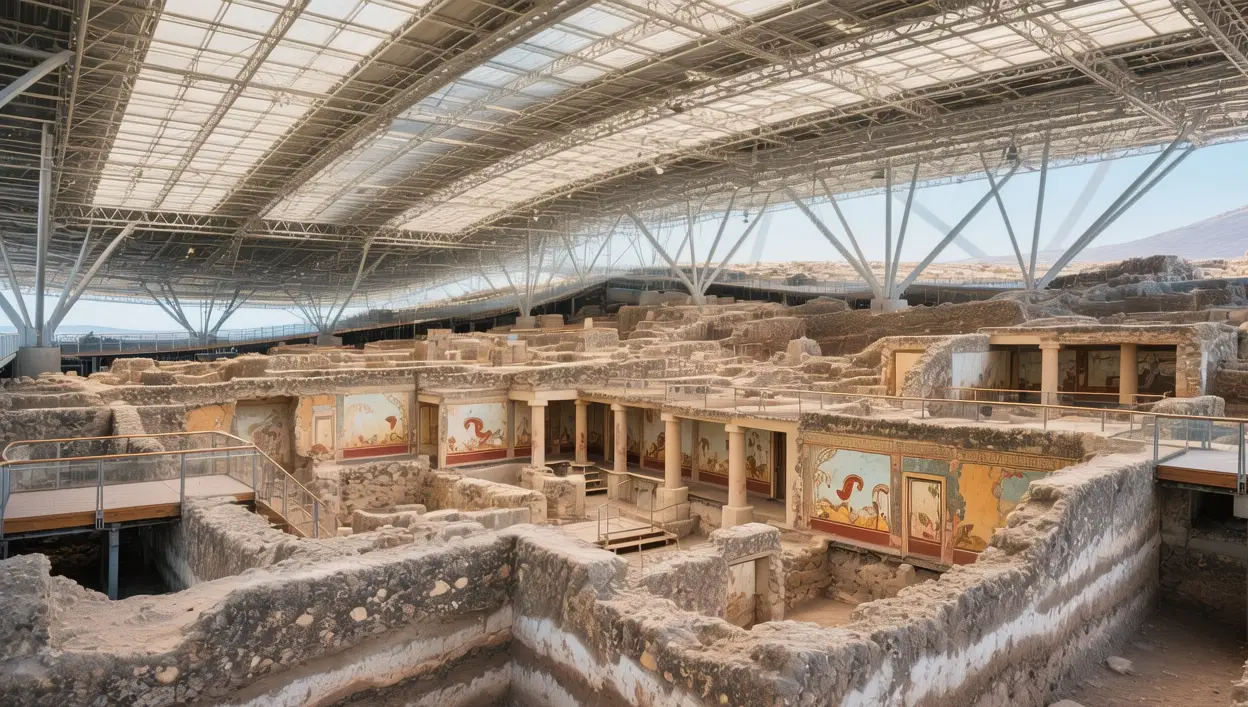
The morning sun filters through the protective canopy covering the Akrotiri archaeological site as you step onto the elevated walkways, where the air carries the faint mineral scent of volcanic ash mixed with wild thyme and the distant murmur of the Aegean Sea. Before you unfolds a remarkably preserved Bronze Age settlement—buried by volcanic ash around 1600 BCE yet revealed with astonishing clarity through meticulous excavation. Multi-story buildings with stone foundations rise 4 to 5 meters high, their doorways and windows still defined by ancient craftsmanship; intricate drainage systems carved into volcanic rock demonstrate sophisticated urban planning; and fragments of vibrant frescoes depicting saffron gatherers, spring landscapes, and marine life hint at the artistic sophistication of this prehistoric community. The only sounds are the soft echo of footsteps on wooden walkways, the gentle rustle of protective fabric overhead, and the whispered explanations of guides sharing stories of a civilization frozen in time. This is not merely an archaeological excavation; Akrotiri matters because it offers an unprecedented window into Bronze Age Aegean life—a place where volcanic catastrophe became unexpected preservation, allowing modern visitors to walk the same streets as people who thrived over three millennia ago and to contemplate the fragile continuity of human culture across deep time.
Why Akrotiri Embodies Extraordinary Preservation
The Akrotiri archaeological site represents one of the Mediterranean's most significant archaeological discoveries—a Bronze Age settlement that solved the fundamental challenge of preserving ancient urban life through the paradoxical power of volcanic destruction. Excavations led by Professor Spyridon Marinatos beginning in 1967 revealed a sophisticated Minoan-influenced town buried beneath 30 meters of volcanic ash and pumice from the cataclysmic eruption around 1600 BCE. The site spans approximately 20 hectares, with excavated areas covering 1 hectare and revealing over 50 buildings, intricate street networks, and advanced infrastructure including a complex drainage system with terracotta pipes still functional after 3,600 years.
Akrotiri's archaeological significance lies in its exceptional state of preservation: the volcanic ash acted as a protective sealant, preserving wooden beams, pottery, furniture impressions, and even food remains that typically decompose in Mediterranean climates. The site's architecture demonstrates remarkable engineering: buildings constructed with rubble masonry and wooden reinforcements featured earthquake-resistant designs, while multi-story structures included light wells and ventilation shafts that regulated interior temperatures. The famous frescoes—painted on wet plaster using mineral pigments that bonded chemically with the lime—retain vivid colors including Egyptian blue, cinnabar red, and ochre yellow, offering unparalleled insight into Bronze Age artistic techniques and cultural values.
Today, Akrotiri fulfills multiple roles: it serves as an outdoor laboratory for archaeological research, an educational resource for understanding Bronze Age Aegean civilization, and a contemplative space where visitors confront the intersection of human achievement and natural forces. The modern protective canopy—engineered to shield excavated areas from weather while allowing natural light—demonstrates how contemporary technology can honor ancient heritage. Every step along the elevated walkways connects you to a community that mastered urban planning, artistic expression, and maritime trade—a reminder that human ingenuity has deep roots in this volcanic landscape.
The Best Time to Experience Akrotiri
Timing transforms a visit to Akrotiri from routine archaeological tour to immersive journey into Bronze Age life. The optimal windows stretch from May 18–June 12 and September 15–October 20, when temperatures hover between 18–25°C (64–77°F), atmospheric clarity allows optimal viewing of fresco details, and visitor numbers remain manageable enough for unhurried exploration of the elevated walkways. During these shoulder seasons, you'll experience comfortable conditions for walking the site while capturing photographs in the soft, directional light that reveals the volcanic ash layers' subtle textures.
Arrive precisely at 8:00–9:00 AM when the gates open—this golden hour delivers cooler temperatures, minimal crowds, and the most dramatic shadows cast by the preserved building walls. The site operates daily from 8:00 AM year-round, closing at 8:00 PM during summer (April–October) and 5:00 PM in winter (November–March), with last entry 30 minutes before closing. Winter months (November–February) offer minimal crowds and moody, overcast skies that create atmospheric photography conditions, though temperatures drop to 10–14°C (50–57°F) with increased rainfall that can make pathways slippery.
Avoid July 15–August 31 unless absolutely necessary: temperatures regularly exceed 28°C (82°F), the protective canopy traps heat creating uncomfortable conditions for extended exploration, and cruise ship schedules create crushing midday crowds that diminish the site's contemplative atmosphere. Also skip Greek Orthodox Easter week and major public holidays when domestic tourism swells visitor numbers. For the most current information on hours, ticket availability, and special exhibitions, always check the official Greek tourism portal at https://www.santorini-view.com before your visit.
Approximate Budget for a 7-Day Trip
Santorini offers exceptional value for travelers seeking iconic Mediterranean beauty combined with profound cultural experiences. The following breakdown reflects mid-range travel—comfortable boutique accommodations, authentic taverna dining mixed with occasional upscale meals, and comprehensive site visits—based on current pricing for a single traveler exploring Akrotiri and greater Santorini.
- Accommodation: €100–€250 per night in Akrotiri, Perissa, or Fira (€700–€1,750 total). Budget studios start at €50; luxury cave suites with caldera views run €400+.
- Food: €45–€70 per day total. Breakfast: €6–€10 (Greek coffee €3.50, bougatsa pastry €3, fresh fruit €3.50). Lunch: €12–€20 (Greek salad €9, grilled octopus €16, moussaka €13). Dinner: €20–€40 (seafood platter €30, lamb kleftiko €20, Assyrtiko wine €7/glass, dessert €7).
- Transportation: €110 total. Ferry from Athens: €45–€75 one-way (€90–€150 round-trip). Local bus day pass: €9. ATV rental: €25/day. Taxi to Akrotiri from Fira: €15–€25 each way.
- Attractions: €95 total. Akrotiri archaeological site entry: €12. Red Beach access: free. Caldera boat tour: €35. Wine tasting tour: €45. Ancient Thera entry: €6.
- Miscellaneous: €120 total. Water/snacks €5/day, volcanic stone souvenirs €25–€60, local saffron €15, museum guidebooks €15, tips €25.
Total: €1,550–€2,350 for 7 days (excluding international airfare and Athens-Santorini ferry)
7 Essential Akrotiri Experiences
- Walk the elevated pathway at sunrise: Enter at 8:00 AM when the site opens and follow the wooden walkway that winds through the excavated settlement. Morning light filters through the protective canopy, illuminating the volcanic ash layers and revealing subtle details in the preserved walls. Allow 60–90 minutes to explore the full circuit; the audio guide (€4) provides essential context for understanding Bronze Age urban life.
- Study the famous frescoes up close: Pause at the designated viewing areas for the site's most celebrated artworks: the Saffron Gatherers fresco depicting young women harvesting crocus flowers, the Spring Frescoe showing a volcanic landscape with blooming lilies, and the Fishermen Frescoe with its vibrant marine life. The mineral pigments retain remarkable color intensity after 3,600 years—notice the Egyptian blue created from ground lapis lazuli and the cinnabar red derived from mercury sulfide.
- Examine the advanced drainage system: Locate the preserved terracotta pipes and stone channels that formed Akrotiri's sophisticated wastewater management system. The engineering demonstrates remarkable foresight: pipes were laid with precise gradients to ensure flow, while access points allowed maintenance without disrupting street life. Visit between 9:00–10:00 AM when natural light reveals the craftsmanship of these 3,600-year-old utilities.
- Photograph the multi-story architecture: Position yourself at the western viewpoint to capture the preserved building facades rising 4 to 5 meters high. The stone foundations, wooden beam impressions, and window placements reveal a community that mastered vertical construction in a seismically active region. Use a wide-angle lens (24mm) to capture the full scale, or focus on details like the ashlar masonry that demonstrates Bronze Age stoneworking precision.
- Explore the pottery workshop area: In the site's southern section, excavations have revealed kilns, clay preparation areas, and finished pottery that illuminate Akrotiri's craft economy. The ceramic styles—featuring marine motifs, geometric patterns, and naturalistic scenes—demonstrate artistic exchange across the Bronze Age Aegean. Allow 15 minutes to appreciate how craft production supported this prosperous settlement.
- Combine with Red Beach: After visiting Akrotiri, walk the 800-meter coastal path to Red Beach for a dramatic geological contrast. The volcanic forces that buried Akrotiri created the crimson cliffs visible from the archaeological site—a powerful reminder of nature's dual capacity for destruction and creation. Visit Red Beach at 4:00–6:00 PM when afternoon light illuminates the iron-rich scoria most vividly.
- Visit the on-site museum displays: Before exiting, explore the small exhibition area featuring original artifacts excavated from Akrotiri: pottery vessels, stone tools, and replica frescoes that provide context for the ruins. The displays explain excavation techniques and conservation methods, offering insight into how archaeologists reconstruct ancient life from fragmentary evidence. Allow 20 minutes to appreciate the scholarly work that makes Akrotiri accessible to modern visitors.
3 Hidden Gems Most Travelers Miss
- The West House fresco fragments: In a quiet corner of the excavation, display cases feature recently conserved fresco fragments from the West House—a prestigious residence that once showcased elaborate wall paintings. These newly revealed sections depict ritual scenes and architectural motifs not visible in the main exhibition areas. Access: Located near the site's western exit; ask staff for directions as signage is minimal. Best viewed between 10:00 AM–12:00 PM when natural light through the canopy illuminates the delicate pigments most clearly. These fragments offer a glimpse into ongoing conservation work that continues to expand our understanding of Akrotiri's artistic heritage.
- The ancient street-level drainage grates: Along the main thoroughfare, look down through the walkway's viewing panels to spot original stone grates that covered Akrotiri's drainage system. These functional artifacts—still positioned exactly as Bronze Age engineers placed them—demonstrate the settlement's sophisticated approach to urban infrastructure. Access: Visible from the central pathway; no special access required. Most visitors focus on the building facades and miss these subtle but significant engineering features. Visit at midday when overhead light creates contrast that makes the grates most visible through the protective flooring.
- The volcanic stratigraphy viewpoint: At the site's northern edge, an interpretive panel explains the volcanic layers that buried Akrotiri, with actual samples of ash, pumice, and lava visible in a small geological display. Understanding the eruption sequence enhances appreciation for how catastrophe became preservation. Access: Located near the exit path; allow 10 minutes extra. Best visited at 3:00–5:00 PM when afternoon light illuminates the rock samples' color variations. This often-overlooked feature transforms abstract geology into tangible history, connecting the archaeological site to Santorini's dramatic volcanic landscape.
Cultural & Practical Tips
- Photography guidelines: Personal photography without flash is permitted throughout Akrotiri. Tripods require advance permission from site staff (+30 22860 81939). The best light for architectural photography occurs during the first and last hours of daylight when shadows accentuate wall textures and ash layers.
- Footwear and terrain: The elevated walkways feature smooth wooden surfaces that can become slippery when wet. Wear sturdy, closed-toe shoes with good grip—avoid sandals or smooth-soled footwear. The pathways include gentle slopes and occasional steps; allow extra time for careful navigation.
- Hydration essentials: Carry at least 1.5 liters of water per person; there are no vendors within the archaeological site. The nearest cafés are in Akrotiri village or at Red Beach. Fill bottles at public fountains near the entrance—Santorini tap water is safe for brushing teeth but bottled water is recommended for drinking.
- Local phrases: Kalimera (kah-lee-MEH-rah) = Good morning; Efharisto (ef-hah-REE-stoh) = Thank you; Parakalo (pah-rah-kah-LOH) = Please/You're welcome; Signomi (see-GNO-mee) = Excuse me. Using these greetings earns warm smiles from site staff and local visitors.
- Accessibility considerations: The elevated walkways are wheelchair-accessible with ramps at entry points; however, some viewing areas have limited accessibility due to preservation requirements. Accessible restrooms are located near the entrance. Staff can provide assistance upon request; contact the site office in advance for specific accommodations (+30 22860 81939).
- Respectful exploration: Akrotiri's preservation depends on visitor care. Stay on marked walkways to protect fragile archaeological layers. Do not touch walls, frescoes, or artifacts—oils from skin accelerate deterioration. Speak softly to maintain the site's contemplative atmosphere for all visitors.
- Seasonal adjustments: Summer visits require early morning exploration to avoid heat trapped beneath the protective canopy. Winter brings occasional rain—wooden walkways become slippery, so wear appropriate footwear. Spring (March–May) offers wildflowers around the site perimeter and perfect temperatures for extended photography sessions.
Conclusion: Travel with Understanding, Not Just Checklists
The Akrotiri archaeological site demands more than a hurried photograph and a quick checkmark—it asks for your curiosity, your reflection, your willingness to stand where Bronze Age people lived, worked, and created art over three millennia ago. When you trace the preserved walls with your eyes or contemplate the vibrant frescoes that survived volcanic burial, you participate in a dialogue across time: the ongoing conversation about how human cultures express themselves through art, architecture, and community. This is not passive tourism; it is active engagement with history, archaeology, and the enduring power of human creativity.
Responsible travel here means understanding that Akrotiri's preservation depends on careful stewardship: every footprint off the walkways risks damaging irreplaceable archaeological layers, every touch accelerates deterioration of ancient pigments, every careless action diminishes the experience for future generations. Walk gently. Speak softly. Take only images; leave only gratitude. Support ongoing conservation by purchasing official tickets and respecting site guidelines that protect this Bronze Age treasure.
This is not a ruin to be consumed but a testament to be experienced—a place where time collapses and you stand alongside artisans, merchants, and families who believed that beauty and order could flourish even on a volcanic island. Slow down. Sit on a designated bench. Watch light move across ancient walls. Let Akrotiri reveal its story gradually, as archaeological layers reveal their secrets to patient observers. The site will still stand tomorrow, but your opportunity to encounter it with wonder and respect exists only in this moment. Choose understanding over haste, connection over completion, and carry not just photographs but a deeper appreciation for the enduring power of human culture across deep time.