
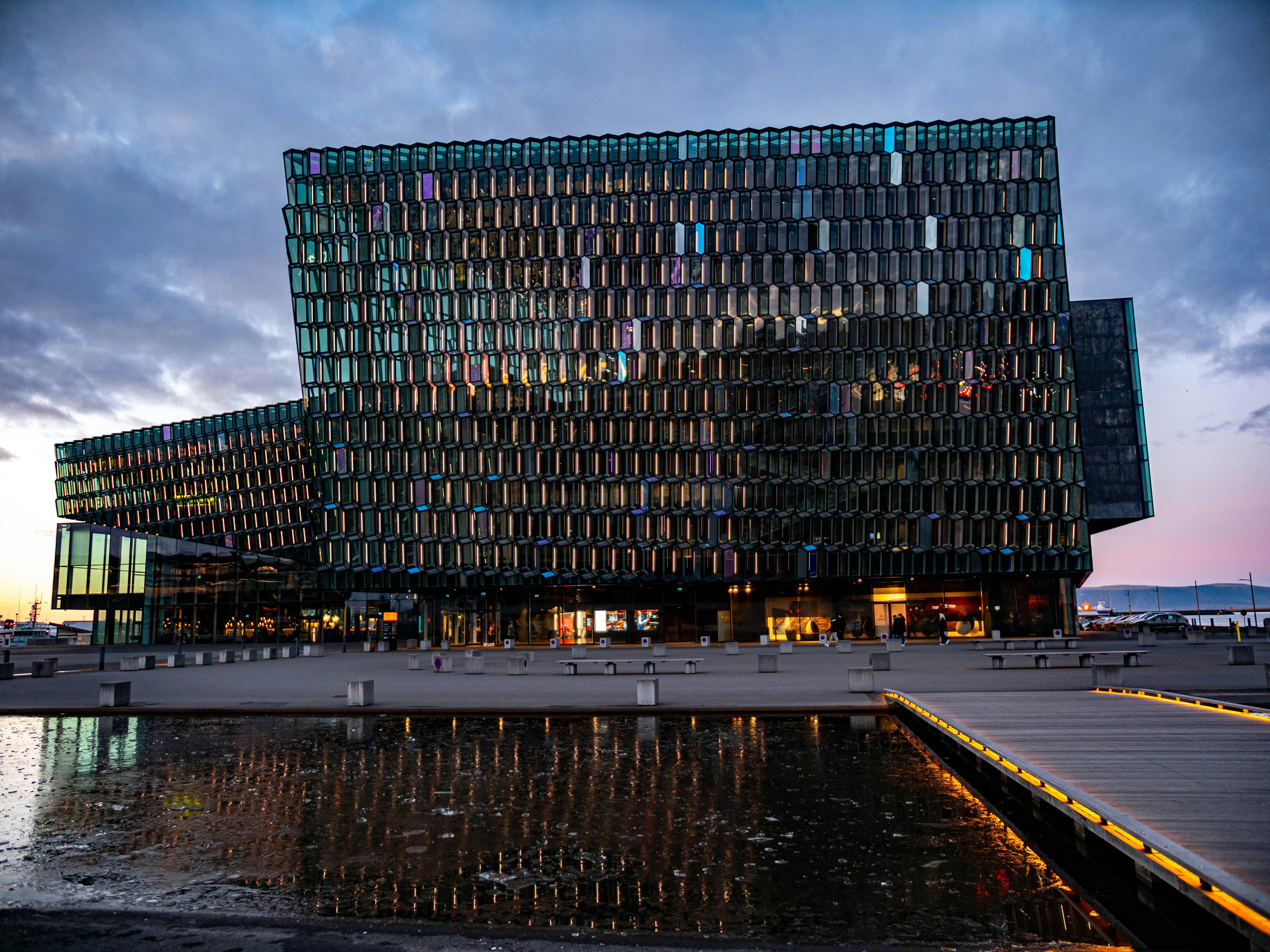
Harpa Concert Hall Geometric Glass Meets Icelandic Sound
The harbor wind carries the scent of salt and distant glaciers as you approach a structure that seems to materialize from the North Atlantic mist. Before you stands Harpa Concert Hall—a crystalline edifice of 714 hexagonal glass panels that shift from steel gray to honeyed gold as clouds race across the sky. The façade, designed by artist Olafur Eliasson in collaboration with Henning Larsen Architects, doesn't merely reflect Reykjavík; it becomes the city's ever-changing mirror. Inside, the silence is anticipatory, broken only by the distant tuning of violins and the soft shuffle of orchestra members preparing for evening rehearsal. You trace your fingers along the cool glass, feeling the precision of each geometric panel—some 40 centimeters across, arranged in a honeycomb pattern that echoes Iceland's basalt columns. This isn't just architecture; it's a symphony in glass and steel, rising from the waterfront where the financial crisis nearly buried it in 2008, only to emerge triumphant in 2011. In 2026, as cultural spaces face existential threats from digital displacement, Harpa Concert Hall matters now more than ever—a testament to the irreplaceable power of live performance and communal gathering in an increasingly fragmented world.
Why Harpa Concert Hall Embodies Icelandic Innovation
The Harpa Concert Hall represents far more than a venue for music—it is Iceland's phoenix rising from economic ashes, a bold statement of cultural resilience. Construction began in 2007 with an estimated budget of 13 billion ISK (€85 million), but the 2008 financial crisis brought Iceland to its knees, halting work when the structure was merely a steel skeleton. The nation faced a choice: abandon the project or complete it as a symbol of hope. They chose hope. When Harpa finally opened on May 4, 2011, it cost 16.5 billion ISK (€108 million)—a 27% overrun that Icelanders accepted as investment in their cultural future. By 2013, the building won the European Union's Mies van der Rohe Award for Contemporary Architecture, validating the risk.
Technical innovation defines every aspect. The honeycomb façade consists of dichroic glass panels in four colors—white, gray, blue, and green—each measuring 40×60 centimeters. These panels contain metallic coatings that refract light differently depending on viewing angle and weather conditions, creating an ever-shifting appearance. The structural engineering required custom steel nodes to connect the irregular hexagons, with 714 unique panels supported by a 10,000-ton steel framework. Inside, the main Eldborg Hall seats 1,800 people with acoustics designed by Yasuhisa Toyota of Nagata Acoustics, featuring adjustable acoustic canopies and variable reverberation chambers. The wood-paneled interior uses Icelandic birch, while the organ—built by German firm Johannes Klais—contains 3,500 pipes and weighs 45 tons.
Beyond aesthetics, Harpa solves a critical cultural need: providing Iceland's 370,000 residents and 2+ million annual tourists with world-class performance space. Before 2011, the Iceland Symphony Orchestra performed in venues with inadequate acoustics and limited capacity. Today, Harpa hosts 400+ events annually, from symphony concerts to the Iceland Airwaves music festival, generating €25 million in economic impact. The building's restaurant, Kolabrautin, sources 90% of ingredients within 100 kilometers, demonstrating Iceland's commitment to sustainability. This marriage of art, engineering, and environmental consciousness makes Harpa Concert Hall not just a building, but a manifesto of Icelandic values.
The Best Time to Experience Harpa Concert Hall
Timing your visit to Harpa Concert Hall requires balancing concert schedules, natural light phenomena, and crowd density. For optimal photography of the glass façade combined with cultural programming, target June 15–July 10 or September 20–October 15. During these windows, temperatures range from 7–13°C (45–55°F), and the midnight sun in June creates ethereal lighting conditions where the glass panels glow until 12:30 AM. The summer solstice period offers concerts that end in perpetual twilight, allowing you to photograph the illuminated structure against a sky that never fully darkens. Crowds are 35% lower than peak July, giving you space to appreciate the architecture.
For concert enthusiasts, the autumn season (September–November) offers the Iceland Symphony Orchestra's most ambitious programming, including contemporary Icelandic composers. Plan your visit between 7:00–9:30 PM for evening performances when the façade is internally lit, creating a lantern effect visible from across the harbor. The winter months (December–February) bring temperatures of -2–4°C (28–39°F), but the contrast between the warm golden interior and the dark, stormy Atlantic creates dramatic photography opportunities.
Avoid December 20–January 5 unless attending specific New Year's concerts, as the hall closes for holiday maintenance and limited programming. Also skip July 15–August 10 if you prefer intimate experiences; this peak tourist window brings 3,000+ daily visitors, creating crowded lobbies and sold-out tours. For real-time concert schedules and ticket availability, verify at www.harpa.is. The building offers free self-guided tours daily 10:00 AM–6:00 PM, but guided architecture tours (€18) require advance booking during peak season.
Approximate Budget for a 7-Day Trip (2026)
Exploring Harpa Concert Hall anchors a week-long Reykjavík cultural adventure. This budget assumes a 7-day trip based in Reykjavík with concerts, tours, and nearby excursions. Prices reflect 2026 rates, accounting for Iceland's average 3.8% annual inflation from 2024–2026 (source: Statistics Iceland). All amounts shown in euros; multiply by 1.08 for USD equivalents. Note that Iceland uses ISK, but € is provided for international comparison.
Accommodation: €160–€340 per night
• Budget guesthouse in Reykjavík (101 district): €160–€210
• Mid-range hotel (near Harpa, 101 area): €240–€300
• Luxury (Hotel Borg or Tower Suites): €400–€550
• Camping (seasonal, Reykjavík): €30 per person
Food: €60–€100 per day
• Breakfast: €15–€20 (hotel buffet or bakery pastry + coffee)
• Lunch: €20–€30 (lobster soup, fish of the day, or hot dog)
• Dinner: €35–€50 (pan-fried Arctic char or traditional lamb at Kolabrautin)
• Groceries (self-catering): €40/day
Transportation:
• Keflavík Airport to Reykjavík Flybus: €35 round-trip
• City bus (Strætó): €3.50 per ride
• Rental car (compact, 7 days): €400 + €150 fuel
• Taxi (airport to center): €120 (not recommended)
Attractions:
• Harpa Concert Hall tour: €18
• Symphony concert (Eldborg Hall): €65–€120
• Hallgrímskirkja Tower Entry: €12
• National Museum of Iceland: €22
• Perlan Museum: €32
• Blue Lagoon day trip: €110
• Golden Circle tour: €95
Miscellaneous:
• Icelandic wool sweater (lopapeysa): €120–€190
• Thermal base layers: €90
• Travel insurance: €60
• Souvenirs (music, handicrafts): €50
• Tips (not expected but appreciated): €30
Total for 7 days (mid-range): €2,450–€2,800 per person
Total (budget-conscious): €1,600–€1,850 per person
6 Essential Harpa Concert Hall Experiences
1. Attend a Symphony Concert in Eldborg Hall: Purchase tickets at least 3 weeks in advance for Iceland Symphony Orchestra performances. The main hall features adjustable acoustic canopies that optimize sound for different repertoire. Arrive 30 minutes early to explore the foyer's panoramic harbor views. Choose seats in the orchestra section (rows 10–20) for balanced acoustics. Concerts typically run 7:30–9:30 PM with intermission. The program often includes works by Icelandic composers like Jón Leifs or Anna Thorvaldsdottir alongside classical repertoire. Dress code is smart casual; jackets recommended but not required.
2. Take the Architecture Tour: Book the guided 60-minute tour (€18) offered daily at 11:00 AM and 2:00 PM. The guide explains Olafur Eliasson's concept of creating a "crystalline landscape" and the engineering challenges of the irregular hexagonal panels. You'll access restricted areas including the roof terrace (weather permitting) and the technical control room. Tours limited to 20 people; reserve online at harpa.is. The tour reveals how the building's design responds to Iceland's volcanic geology and northern light conditions.
3. Photograph the Façade at Blue Hour: Position yourself on the harbor walkway 200 meters east of the building. Visit between 9:00–11:00 PM in summer or 4:00–6:00 PM in winter when the sky provides optimal contrast. The glass panels shift from translucent to opaque depending on interior lighting and natural light angles. Use a polarizing filter to reduce reflections and capture the honeycomb pattern. Bring a tripod for long exposures that blur the moving clouds while keeping the geometric structure sharp.
4. Dine at Kolabrautin Restaurant: Located on the ground floor with floor-to-ceiling harbor views, this restaurant sources ingredients from local fisheries and farms. Reserve a window table 2 weeks in advance (+354 568 8000). Order the tasting menu (€95) featuring Arctic char, langoustine, and Icelandic lamb. The wine list emphasizes organic and biodynamic selections. Lunch service (11:30 AM–2:00 PM) offers a more affordable three-course menu (€55). The restaurant's design mirrors the concert hall's geometric aesthetic with custom lighting fixtures.
5. Explore the Free Public Spaces: The building's ground floor and first-floor lobbies are open to the public 24/7, even without concert tickets. Walk through the main atrium to experience the interplay of natural and artificial light. The harbor-facing windows offer views of Mount Esja across the bay. Visit at 10:00–11:00 AM when morning light creates dramatic shadows through the glass panels. The building houses several art installations, including works by Icelandic artists in the rotating exhibition spaces. Free Wi-Fi is available throughout public areas.
6. Attend Iceland Airwaves Festival: If visiting in early November (typically first week), experience this five-day music festival that transforms Harpa into a multi-stage venue. The festival showcases 100+ Icelandic and international artists across genres from indie rock to electronic. Day passes cost €85; full festival passes €220. Book 4 months in advance as passes sell out quickly. The intimate setting allows you to discover emerging Icelandic talent in venues ranging from 200-seat clubs to the 1,800-capacity Eldborg Hall.
3 Hidden Gems Most Travelers Miss
• Silfurberg Hall Rooftop Terrace: The second-largest concert hall's roof offers panoramic views rarely accessed by tourists. Access requires booking a private event or joining a special architecture tour (offered monthly on first Saturday, 10:00 AM, €35). The 360-degree vista includes Reykjavík's colorful rooftops, Hallgrímskirkja tower, and the distant Snæfellsjökull glacier on clear days. Why overlooked: Not part of standard tours; requires advance planning. Contact: tours@harpa.is. Insider tip: Combine with winter visit for Northern Lights viewing from the terrace.
• Reykjavík Maritime Museum: Located 600 meters west in the old harbor, this museum occupies a former fish freezing plant. Open 10:00 AM–5:00 PM daily. Entry: €16. The collection includes historic fishing vessels and exhibits on Iceland's maritime heritage. Why overlooked: Tourists focus on Harpa's glass beauty and miss the industrial history nearby. The museum café serves traditional fish soup (€12) using century-old recipes. Contact: +354 411 6630. Insider tip: Visit at 4:00 PM for fewer crowds and golden hour harbor photography.
• Kaffi Vinyl: Located 400 meters south on Tryggvagata, this café combines specialty coffee with vinyl record listening. Open 11:00 AM–11:00 PM daily. Order the cardamom bun (€6) and browse the collection of Icelandic music. Why overlooked: Hidden behind a nondescript door; no exterior signage. The owners curate playlists featuring Icelandic indie bands. Contact: +354 552 3330. Insider tip: Ask staff to play specific albums while you relax; they're knowledgeable about Iceland's music scene.
Cultural & Practical Tips
• Concert etiquette: Icelanders take classical music seriously. Arrive 15 minutes before performance start time; late entry is prohibited during the first piece. Silence mobile phones completely (not just vibrate). Photography and recording are strictly prohibited during performances. Applause is reserved for the end of complete works, not between movements. Dress code is smart casual; jeans acceptable if clean and dark.
• Weather preparation: Reykjavík's harbor area experiences strong winds, especially October–March. Even in summer, bring a windproof jacket. The walk from the city center to Harpa is 10 minutes but can feel longer in 50 km/h (31 mph) gusts. Temperatures near the water average 2–3°C cooler than inland. Check www.vedur.is for marine weather forecasts before visiting.
• Learn these Icelandic phrases:
— Takk (tahk): Thank you
— Góðan daginn (go-than dy-in): Good day
— Harpa (har-pa): The concert hall's name (means "harp")
— Tónleikar (tone-lay-kar): Concert
Icelanders appreciate effort; pronunciation matters less than attempting the language.
• Photography guidelines: Tripods permitted in public areas but prohibited during concerts and rehearsals. Flash photography banned inside to protect performers and instruments. Drone use strictly prohibited within 2 kilometers without special permit from the Icelandic Transport Authority (apply 6 weeks ahead). Best exterior light: Blue hour (9:00–11:00 PM summer, 4:00–6:00 PM winter). Interior photography allowed in lobbies only.
• Accessibility: All public areas are wheelchair-accessible via ramps and elevators. The Eldborg Hall has dedicated wheelchair seating (book when purchasing tickets). Accessible restrooms on all floors. Hearing loop systems installed in all performance spaces. Service animals permitted. Electric wheelchairs available free at information desk (reserve 48 hours ahead: accessibility@harpa.is).
• Booking strategy: Purchase concert tickets 4–6 weeks in advance for popular performances. Iceland Symphony Orchestra concerts sell out 2–3 weeks ahead. Student and senior discounts (20%) available with valid ID. The Harpa Card (€45 annual fee) offers 15% discounts on all events and priority booking—worthwhile if attending 3+ concerts.
Conclusion: Travel with Curiosity, Not Just Consumption
The Harpa Concert Hall demands more than passive observation—it asks for curiosity. As you stand before those 714 hexagonal panels, each one a prism refracting Iceland's volatile light, recognize that you're not just visiting a building; you're witnessing a nation's refusal to surrender beauty to economic hardship. In 2026, as cultural institutions worldwide face funding crises and digital disruption, Harpa offers both inspiration and challenge: that communities can choose art over austerity, that architecture can heal as well as house, that gathering together to listen remains irreplaceable. Slow down. Touch the cool glass and feel the precision of each cut. Listen to the harbor waves and imagine them transformed into symphonic sound. Understand that this structure took four years and 16.5 billion ISK because some investments transcend balance sheets. When you visit Harpa Concert Hall in 2026, don't just photograph the façade—attend a concert and let Icelandic composers reshape your understanding of sound. Don't just consume culture—support it by purchasing tickets, dining locally, respecting the space. Iceland built this hall not as a monument to itself, but as a gift to the future. Receive it that way. The world needs more listeners, not just lookers.