
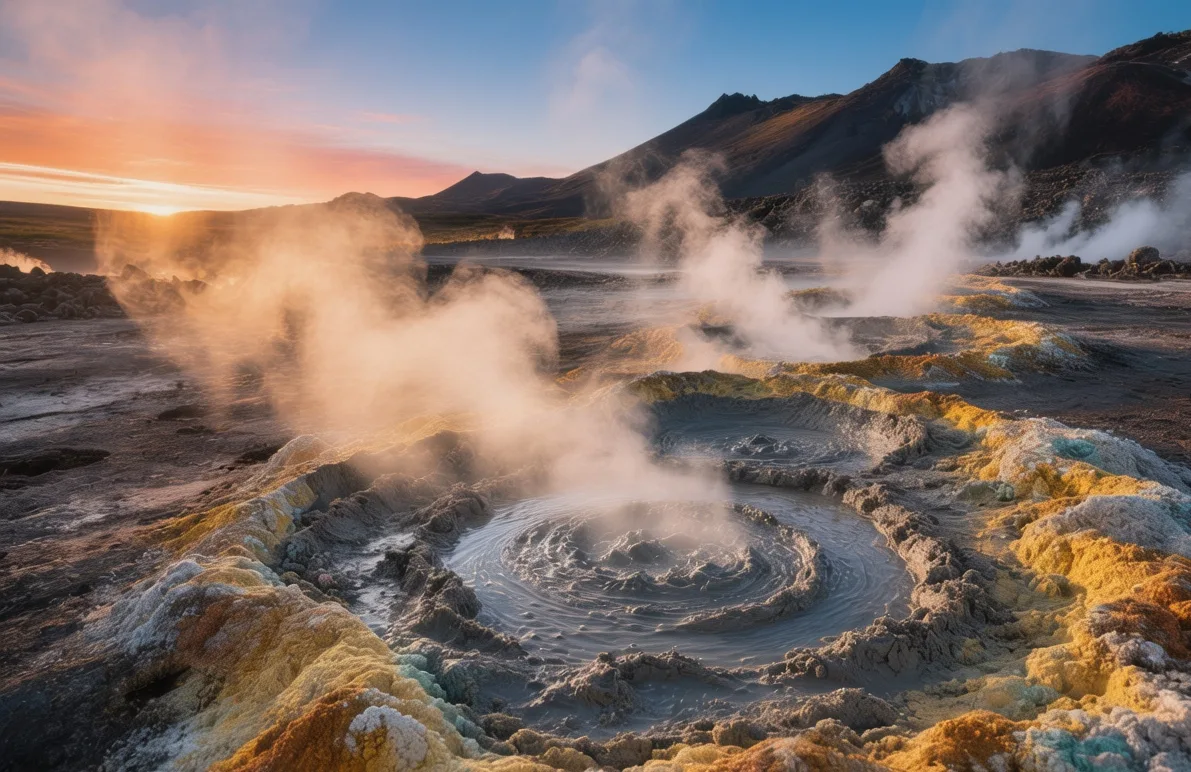
Hverir Geothermal Area Boiling Mud Pots Meet Ancient Volcanic Power
The air shimmers with heat as you step onto the rust-colored earth—sulfur vapors hiss from fissures beneath your boots, carrying the pungent scent of rotten eggs that signals the earth's raw energy waking up. Here, at the Hverir geothermal area, the ground temperature often exceeds 60°C (140°F) just beneath the surface, while steam plumes rise 15 meters into the crisp Arctic air, dancing against the backdrop of Námafjall mountain. It is early morning—around 7:00 AM—and the low sun casts long, dramatic shadows across the ochre hills, illuminating silica deposits that glitter like crushed diamonds in the volcanic soil. This isn't merely a tourist stop; it is a living laboratory where the North American and Eurasian tectonic plates grind together, creating a landscape that has remained virtually unchanged since settlers first documented the smoking valleys in the 12th century. In 2026, as climate change alters global geothermal patterns, Hverir matters more than ever—a visceral reminder of the planet's internal heat and a critical site for Iceland's renewable energy future.
Why Hverir Geothermal Area Embodies Iceland's Volcanic Soul
Hverir—sometimes referred to as Námafjall—represents one of the most intense high-temperature geothermal fields in Europe, serving as a tangible manifestation of Iceland's position atop the Mid-Atlantic Ridge. The site solves a fundamental geological puzzle: how magma chambers close to the surface interact with groundwater to create solfatara fields, fumaroles, and boiling mud pots. Measurements taken by the Iceland GeoSurvey (ÍSOR) indicate subsurface temperatures reach 290°C (554°F) at depths of just 2,000 meters, making this area a critical hub for energy research since systematic drilling began in 1970.
Beyond science, the Hverir geothermal area fulfills a cultural need for connection to the land's dangerous beauty. Historically, locals utilized this heat for baking rye bread—burying pots in the warm soil for 24 hours—a tradition that continues at nearby farms today. The landscape is composed of altered rhyolite and dacite, minerals that oxidize to create the striking reds, yellows, and greens visible across the 5-square-kilometer field. Unlike passive thermal springs, Hverir is dynamic; new vents open periodically, and old ones seal shut, reminding visitors that they walk on active terrain. In 1984, the area received protection status to prevent damage to fragile crusts, ensuring that the hissing steam vents remain unobstructed for future generations to witness the earth breathing.
The Best Time to Experience Hverir Geothermal Area
For optimal safety and visibility, plan your visit between June 10 and August 25, when daytime temperatures range from 12–18°C (54–64°F) and wind speeds are generally lower. The best lighting occurs between 5:00–7:00 AM or 9:00–11:00 PM during the midnight sun period, when the low angle of sunlight enhances the vibrant mineral colors without the glare of midday sun. During these months, the access road (Route 1) remains fully open, and parking facilities are staffed for safety monitoring.
Shoulder season (May 1–June 9 and August 26–September 30) offers cooler temperatures of 5–10°C (41–50°F) and fewer crowds, but weather becomes unpredictable with sudden fog reducing visibility near steam vents. Winter visits (November–March) are strongly discouraged for casual travelers; temperatures drop to -10°C (14°F), roads frequently close due to snow accumulation, and icy paths near boiling mud pose severe slip hazards. Additionally, hydrogen sulfide gas concentrations can become trapped in low wind conditions, creating health risks for those with respiratory issues.
Avoid visiting during storm warnings issued by the Icelandic Meteorological Office. The site is open 24 hours with no entrance fee, but the information boards are only lit during summer months. Always verify road conditions at road.is and gas dispersion forecasts at vedur.is before departure, as volcanic activity in the nearby Krafla system can occasionally restrict access without notice.
Approximate Budget for a 7-Day Trip (2026)
Iceland's North region is slightly more affordable than Reykjavík, but costs remain high due to import dependencies. These 2026 estimates assume a mid-range travel style, accounting for Iceland's projected 3.8% inflation rate and current exchange rates (1 USD = 0.92 EUR). Prices reflect the Mývatn/Reykjahlíð area, which serves as the base for visiting Hverir.
- Accommodation: €140–€200 per night for guesthouses or farm stays in Reykjahlíð (closest village); budget hostels from €75; luxury hotels €280+
- Food: €70–€90 per day—breakfast €15 (often included), lunch €25 (fish soup at Bræðraborgarstofa), dinner €40–€50 (lamb or Arctic char at Vogafjós Farm Café)
- Transportation: Rental car essential: €85–€110/day for 4WD vehicle (gravel protection recommended); fuel €2.20/liter (approximately €140 for week); Akureyri to Hverir round-trip: 100 km; Route 1 (Ring Road) plus Route 863
- Attractions: Hverir free; Mývatn Nature Baths €38; Grjótagjá Cave free (access restricted); Krafla Viti Lighthouse free; guided geology tour €70
- Miscellaneous: Lava rock souvenir €15–€40; waterproof gear rental €30; travel insurance €50; parking fees minimal (€0–€5 at some sites)
Total estimated cost for 7 days: €1,600–€2,100 per person (excluding international flights)
7 Essential Hverir Geothermal Area Experiences
- Walk the main boardwalk loop: This 800-meter elevated path takes 30 minutes and keeps you safe from fragile crusts and boiling mud. Start at the main parking area (65°38.550'N, 16°54.200'W) and follow the wooden planks through the most active fumarole zone. Best photographed mid-morning when steam contrasts against blue sky.
- Observe the boiling mud pots: Located near the eastern edge of the field, these viscous pools bubble slowly, throwing gray clay into the air with a wet sucking sound. Stand upwind to avoid the sulfur smell. The largest pot measures approximately 4 meters in diameter and maintains a temperature of 95°C (203°F).
- Hike to Leirhnjúkur crater: A marked 2-kilometer trail leads to this small volcanic crater overlooking the geothermal field. The climb takes 45 minutes and rewards with panoramic views of the entire smoking valley. Bring windproof layers; exposure is high at the summit. Best visited late afternoon for soft light.
- Photograph the mineral stains: The ground here is painted with iron oxide (red), sulfur (yellow), and silica (white). Focus on close-up textures rather than wide shots. Use a polarizing filter to cut through steam haze. Avoid stepping off paths to get angles—crusts are thin and dangerously hot.
- Visit the Krafla Viti Lighthouse: A 15-minute drive north brings you to this historic navigation marker situated on a hill above the geothermal zone. Built in 1939, it offers a unique perspective looking down on the steam fields. Open daylight hours; no entry fee. Combine with Hverir for a half-day itinerary.
- Experience the silence between hisses: Pause halfway through your walk, close your eyes, and listen. The landscape isn't quiet; it breathes. You will hear deep rumbles from underground chambers followed by sharp releases of steam. This auditory experience defines the volatile nature of the Hverir geothermal area.
- Watch the sunset over Námafjall: During summer solstice, the sun sets around 12:15 AM. Position yourself at the western viewing platform to see the mountain ridges glow amber while steam vents turn pink. Temperatures drop rapidly after 11:00 PM, so wear thermal layers even in July.
3 Hidden Gems Most Travelers Miss
- Jórvík Viking Village: Located 5 kilometers west of Hverir along Route 1, this reconstructed settlement offers insight into how early Icelanders utilized geothermal heat. Most tour buses skip it for Mývatn. Open June–August, 10:00 AM–6:00 PM. Entry €15. Inside, you can bake your own rye bread using earth heat—a tangible connection to the landscape's utility. Contact: jorvik.is for booking.
- Stóragíjar fault rift: A lesser-known fissure system 3 kilometers south of the main parking area. Access requires a high-clearance vehicle and walking 1 kilometer over rough lava. The rift offers a close-up view of tectonic separation without the crowds. No facilities here; bring water and GPS. Best visited midday when shadows reveal depth.
- Krafla Caldera viewpoint: While most look at the vents, few drive the 10 kilometers further north to the caldera rim. The view encompasses the entire volcanic system including Hverir from above. Access via gravel road F-863 (4WD required). Open summer only. The silence here is profound, broken only by wind. No signage—download offline maps before leaving Reykjahlíð.
Cultural & Practical Tips
- Safety first: Hydrogen sulfide gas is toxic in high concentrations. If you smell strong rotten eggs and feel dizzy, move to higher ground immediately. Wind direction changes quickly; always stand upwind of vents. Children and pets must be supervised closely near mud pots.
- Stay on marked paths: The ground crust can be only centimeters thick over boiling water. Stepping off boardwalks risks severe burns and damages fragile geological formations. Fines for trespassing in protected areas can reach €500. Respect barriers—they are placed for your survival.
- Weather preparedness: North Iceland weather is volatile. Even in July, pack: windproof waterproof jacket, thermal base layers, sturdy hiking boots with ankle support, hat and gloves. Check vedur.is for real-time forecasts. Wind speeds can exceed 25 m/s (56 mph), making standing difficult.
- Photography etiquette: Tripods permitted on stable ground but don't block paths. Drone use requires special permit from Umhverfisstofnun (Icelandic Environment Agency)—apply at ust.is at least 14 days in advance. Steam can damage lens coatings; use protective filters.
- Local phrases: Learn these Icelandic essentials: Takk (tahk) = Thank you; Góðan daginn (go-than die-in) = Good day; Hvað heitir þetta? (kvad hey-tir thet-ta) = What is this called? Effort with language earns warm smiles from locals.
- Emergency contacts: Dial 112 for all emergencies. Nearest hospital: Akureyri Hospital, 90 km south (+354 470-1000). Cell coverage is good at Hverir parking but spotty on surrounding trails. Download offline maps via Google Maps or Maps.me before arrival.
- Accessibility note: Main boardwalk is wheelchair accessible with assistance. Terrain is uneven gravel in parking area. Visitor facilities include accessible restrooms. Contact visitnorthiceland.is for detailed accessibility maps before traveling.
Conclusion: Travel with Reverence, Not Just Checklists
Hverir demands more than a quick photo stop and a hashtag—it asks for your caution, your patience, your willingness to stand respectfully on ground that is actively shaping itself. As you walk these boardwalks in 2026, remember that each step lands on terrain sacred to both geological history and living energy systems. The steam vents aren't merely scenic backdrops; they are exhaust ports for the planet's internal engine, written in vapor and heat.
Responsible travel here means staying on paths, respecting gas warnings, and leaving only footprints on wooden planks. It means understanding that the heat beneath your feet powers nearby homes, connecting your visit to the daily lives of North Icelanders. When you purchase from local farms, hire regional guides, and follow safety barriers, you participate in an economy that values preservation over exploitation.
So linger past the guidebook's recommended 30 minutes. Sit on a safe rock and watch steam rise against volcanic ridges. Let the hiss of escaping gas remind you that some places aren't meant to be conquered or consumed—they're meant to be witnessed with humility, protected with intention, and carried in memory long after your boots have left the parking lot.