
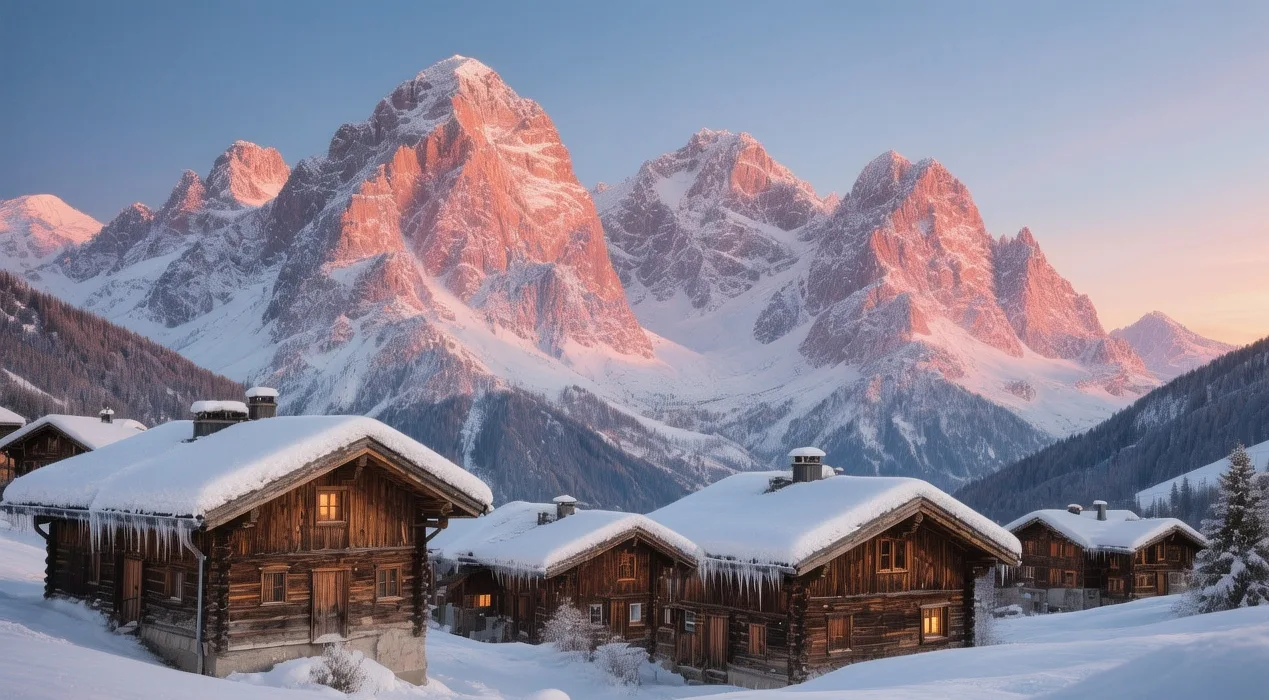
Klosters Village Walser Heritage Meets Alpine Majesty
The morning bell of the 16th-century Reformierte Kirche tolls seven times—each note dissolving into the thin mountain air at 1,200 meters (3,937 feet) above sea level. You stand on the Landstrasse, breath visible in crystalline puffs, watching sunlight strike the eastern faces of the Silvretta Alps: a blade of rose-gold cutting through blue shadow. The scent of fresh Zopf drifts from Schneider bakery, mixing with woodsmoke from centuries-old stone chimneys. This is Klosters—neither the glitz of St. Moritz nor the corporate bustle of Davos, but something rarer: a living village where 1,900 residents maintain traditions older than Switzerland itself, where Prince Charles skied incognito for decades, and where the 1565 Nutli Hüschi farmhouse still bakes bread in its original wood-fired oven . In 2026, as overtourism strains Europe's iconic destinations, Klosters remains a masterclass in equilibrium—preserving its soul while offering world-class skiing, summer hiking, and that ineffable quality the Swiss call Gemütlichkeit.
Why Klosters Embodies Alpine Authenticity
Klosters solves a problem that luxury tourism created: the erosion of place. While Davos—just 10 kilometers (6.2 miles) northeast—hosts the World Economic Forum and concrete hotel blocks, Klosters has resisted architectural homogenization through strict building codes enacted in 1972. The village's 320 heritage-protected wooden chalets—many featuring the distinctive Walser style with stone foundations, carved balconies, and gently sloping roofs—create what preservationists call "visual silence" .
The village's history anchors this authenticity. Founded in 1224 by Cistercian monks (hence Klosters, meaning "cloister"), the settlement became a Walser colony in the 14th century when German-speaking migrants from the Valais brought their architectural DNA: wide-eaved roofs designed to shed meters of snow, facades assembled without nails using interlocking dovetail joints, and the Stube—the wood-paneled living room that remains the spiritual heart of every home . When the first British tourists arrived in 1894—drawn by tuberculosis sanatorium literature extolling high-altitude air—they found a working agricultural community, not a resort. That DNA persists: 40% of local families still maintain alpine dairy operations, producing the AOP-protected Bündner Bergkäse you taste at the Kesslerhof farm shop .
The engineering is equally precise. The Gotschna-Parsenn cable car—installed in 1950 and upgraded in 2023—transports 2,400 skiers hourly to 300 kilometers of pistes, yet the valley station nestles discreetly into a 19th-century barn facade. The Sunniberg Bridge, completed in 1998 and illuminated each December for its anniversary, curves 85 meters above the Landquart River with such elegance that it won the 2001 Outstanding Structure Award . This is Klosters' genius: infrastructure that serves without dominating, modernity that bows to tradition.
The Best Time to Experience Klosters
For winter sports enthusiasts, target January 15–February 5, 2026. Snowpack typically reaches 150 centimeters (59 inches) by mid-January, and this window avoids both the Christmas crush and February school holidays when European families descend . Temperatures hover between -6°C and 4°C (21°F–39°F), with morning groomers crystallizing at -8°C (17°F) for perfect carving conditions . The 97th Spengler Cup Davos runs December 27–31, 2025, followed by the Hotschrennen piglet races on New Year's Day—both worth planning around .
Summer hikers should book June 18–July 15 or September 1–October 10. June brings alpine roses blooming at 2,000 meters, while September offers golden larch forests and empty trails. Daytime temperatures reach 18°C–22°C (64°F–72°F), dropping to 8°C (46°F) at night—ideal for sleeping with windows open to the sound of cowbells . Avoid November 10–December 5, when rain and gray skies dominate, and many restaurants close for maintenance .
For current snow conditions and lift operations, verify at davos.ch—the Davos Klosters tourism board updates daily at 6:00 AM CET .
Approximate Budget for a 7-Day Trip (2026)
These figures reflect a mid-to-upper range experience—Klosters' natural demographic—with 2025 prices adjusted 4% for inflation per Swiss Federal Statistical Office projections. The village caters to discerning travelers seeking authenticity without ostentation; budget backpackers should consider Interlaken or Grindelwald instead.
- Accommodation: €280–€450 per night ($305–$490). The four-star Hotel Vereina on Landstrasse 179 offers traditional Stube dining and spa facilities at €380/night, while the Seven Alpina Boutique Hotel near the train station provides modern Alpine design at €290/night . For families, the Piz Buin aparthotel includes kitchen facilities at €220/night.
- Food: €95 per day ($103). Breakfast: €18 (hotel buffet with local cheeses, birchermüesli, and Nussgipfel pastries). Lunch: €28 (mountain hut Rösti with fried eggs at Gotschnagrat, or soup and bread at Vereina's terrace). Dinner: €45 (veal Zurich at Chesa Grishuna, or fondue for two at Wynegg with wine). Coffee breaks: €4 (espresso at Café Klatsch) .
- Transportation: €45 daily. The Davos Klosters Inclusive Card (included with most accommodations) covers buses and trains between villages. Add €35 for the Gotschna-Parsenn day pass (€62 for two days) . Zurich Airport transfers via the Rhaetian Railway: €35 each way (2.5 hours with changes at Landquart and Davos Platz).
- Attractions: €60 daily. Madrisa Land family park: €38 adults. Kirchner Museum Davos: €15. Paragliding tandem flight: €180. Horse-drawn carriage ride (45 minutes): €35 .
- Miscellaneous: €40 daily. Kesslerhof aged cheese (500g): €18. Hand-carved cowbell at Jochler interiors: €45. Zwergenweg trail map: €5.
Total for 7 days: €3,640–€4,690 ($3,960–$5,100) per person, assuming double occupancy. Luxury travelers booking private ski guides and helicopter transfers should budget €8,000+ .
6 Essential Klosters Experiences
- Dawn ascent of Gotschnagrat: Catch the first cable car at 8:15 AM—before the Davos crowds arrive. At 2,285 meters, the Parsenn massif reveals itself in longitudinal light: shadowed couloirs, wind-sculpted cornices, and the promise of 12 kilometers of uninterrupted downhill to Wolfgang's restaurant. The Besenbinde run, threading through Arolla pines alive with coal tits, delivers you to a lunch of Gerstensuppe and dark bread .
- Walser bread-baking at Nutli Hüschi: In this 1565 farmhouse—now village museum—don an apron and learn to fire the ancient oven. The Bündner Nusstorte you bake uses walnuts from the valley floor and honey from hives visible from the kitchen window. Reserve 48 hours ahead: +41 81 422 10 70 .
- Horse-drawn carriage to Monbiel: From the stables behind Wynegg restaurant, Christian Flutsch's draft horses—blanketed in sheepskin—haul you up the Garfiun valley. At kilometer 3, stop for Glühwein at a meadow clearing where the Silvretta range fills the horizon. The 90-minute round trip costs €35; book through the hotel concierge .
- Twilight at the Sunniberg Bridge: Arrive by 4:30 PM in December or January to watch the structure illuminate as darkness falls. The curved concrete deck—designed by Christian Menn—spans 526 meters with such minimalism that it appears to float. Bring a tripod; the blue hour here lasts precisely 34 minutes at this latitude.
- Swim at Eau-là-là aquatic center: After a morning of powder skiing, descend into 32°C (90°F) thermal waters while snow accumulates on the glass roof. The black-hole waterslide—plunging through darkness before ejecting you into daylight—provides the quintessential Alpine contrast. Entry: €15 .
- Selfranga night skiing: Every Tuesday and Thursday, 7:00–9:30 PM, the family slope floods with light. Intermediate skiers appreciate the pitch—steep enough to maintain speed, gentle enough for conversation—while non-skiers gather at Stefan's tea hut for Heisse Schokolade and card games .
3 Hidden Gems Most Travelers Miss
- Vereina Valley and the Vereina Hut: Most visitors gaze up at the Gotschna massif; few venture north to this 1,943-meter valley accessible only by foot, mountain bike, or the Vereina bus (reservations required at Gotschna Sport shop). The 19th-century mountain hut serves Pizzoccheri—buckwheat pasta with cabbage and fontina—cooked over wood. The trail follows a glacial stream punctuated by small cascades; allow three hours from Monbiel .
- Monstein Brewery and the Friday Tasting: Perched at 1,340 meters above Davos, this village of 85 residents houses BierVision Monstein, where glacier-fed spring water produces a pilsner of almost metallic clarity. The Friday evening tastings (6:00–9:00 PM, €25 including snacks) require advance booking via biervision.ch. The PostAuto bus 233 from Davos Platz climbs 400 meters in 20 minutes; sit on the right for valley views .
- Zwergenweg (Dwarf Trail): Hidden in the forest between Madrisa and Saas, this 2.3-kilometer loop features carved wooden gnomes, a zipline, and interactive stations explaining local geology. Children receive a "treasure map" at the trailhead; completion earns a chocolate medal at the Madrisa Club. The path remains uncrowded even in peak season because tour buses cannot access the narrow road .
Cultural & Practical Tips
- Greetings matter: Enter any shop, restaurant, or cable car with a firm "Grüezi" (GROO-eh-tsee) to the room. Failure to do so marks you as inconsiderate. When leaving, say "Adieu" (ah-DYOO), not "Auf Wiedersehen"—this is Swiss German territory, not High German.
- Photography etiquette: Never photograph private chalets from close range; the wooden facades and carved balconies are considered personal property. The church square and mountain vistas are fair game, but ask permission before photographing farmers during livestock herding (late September).
- Sunday silence: By law, no lawn mowing, construction, or loud music before noon on Sundays. This is not quaint tradition but enforceable ordinance—fines start at CHF 200. Plan ski departures accordingly; lifts open at 8:30 AM as usual.
- Bus protocol: The yellow PostAuto buses require you to flag them down—simply standing at the stop is insufficient. Press the stop button well in advance; drivers will not halt if you wait until the last meter. Validate tickets in the onboard machine.
- Avalanche awareness: Off-piste skiing claims lives annually; Prince Charles lost a close friend here in 1988. Carry transceiver, probe, and shovel when venturing beyond marked runs, and check the SLF avalanche bulletin at slf.ch before dawn .
- Weather windows: Alpine weather changes within minutes. Even on bluebird mornings, pack a shell jacket and sunglasses rated UV400—the snow reflection intensifies radiation by 80%.
Conclusion: Travel with Intention, Not Just Itinerary
Klosters does not reveal itself to those rushing between checklists. The village demands what the Germans call Verweilen—lingering without purpose. Sit on the church steps at 5:00 PM when the postman makes his final rounds; notice how he knows every dog by name. Watch the cheese maker at Kesslerhof turn the curd with a wooden paddle used by his grandfather. Listen to the silence between cowbells—that high-altitude hush broken only by wind and the occasional jet contrail overhead.
In 2026, as artificial intelligence generates travel recommendations and social media reduces destinations to backdrops, Klosters offers resistance. Here, the 1565 farmhouse stands because 20 generations maintained it. The bread tastes of firewood because someone still splits logs at 6:00 AM. The ski slopes remain uncrowded because there are no high-rise hotels to fill. This is not nostalgia but active preservation—a choice made daily by 1,900 residents who understand that authenticity is not a marketing term but a discipline.
Come not to consume but to participate. Take the bread-baking class. Learn three words of Swiss German. Hike slowly enough to notice the edelweiss. In doing so, you become not a tourist but a temporary custodian of something irreplaceable—and that, ultimately, is the only travel worth making.