
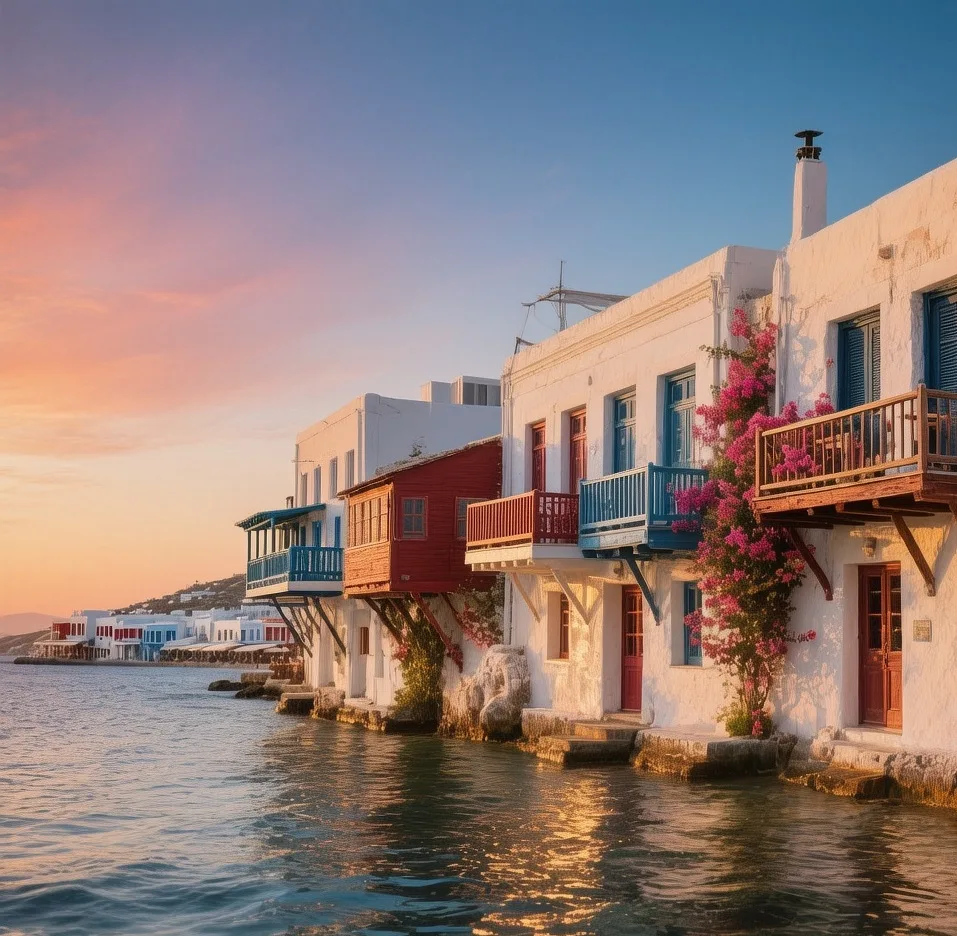
Little Venice: Where Colorful Balconies Meet Aegean Twilight
The late afternoon sun bathes Little Venice in liquid gold as you stroll the narrow waterfront promenade, where the air carries the crisp scent of sea salt mingled with bougainvillea and the faint mineral tang of whitewashed stone. Before you, a row of vibrant Cycladic houses—painted in shades of cobalt, coral, and saffron—cascade directly to the water's edge, their wooden balconies cantilevered over the Aegean at heights of 3 to 5 meters above the waves. The only sounds are the gentle lap of water against stone foundations, the distant chime of chapel bells from Mykonos Town, and the soft murmur of travelers sharing cocktails at waterfront cafés. These iconic structures, built by wealthy merchants between the 17th and 19th centuries, solve a fundamental human need: the desire to inhabit beauty at the intersection of land and sea, creating a visual poetry where architecture appears to float upon the water. Standing on this windswept quay as the sun dips toward the horizon, you understand: Little Venice matters because it embodies the delicate balance between human habitation and natural drama—a place where colorful facades, azure waters, and golden light collaborate to create something that transcends mere scenery and awakens profound wonder.
Why Little Venice Embodies Cycladic Romance
Little Venice represents one of the Aegean's most enchanting examples of adaptive coastal architecture—a waterfront enclave that solved the fundamental challenge of creating luxurious merchant residences on limited shoreline while maximizing panoramic sea views. Originally constructed between the 17th and 19th centuries by wealthy Mykonian captains and traders, these distinctive houses were deliberately positioned with their rear facades built directly over the water, supported by stone foundations that extend 2 to 3 meters into the sea. The architectural design—featuring thick stone walls (50–70 centimeters) for thermal regulation, wooden balconies with ornate railings, and vibrant lime-based paints that reflect 80% of solar radiation—creates a luminous foreground that enhances the natural drama of the Aegean backdrop.
The waterfront's visual impact stems from precise geographical alignment: the houses face west at latitude 37.44°N, ensuring that sunset illuminates the colorful facades in ever-changing hues while the sea reflects the sky's palette. The cantilevered balconies—projecting 1.5 to 2 meters over the water—were engineered with traditional joinery techniques that allow slight movement during strong meltemi winds without compromising structural integrity. This intentional aesthetic, developed over centuries of Cycladic building tradition, solves the practical need for coastal defense and ventilation while creating an architectural language that has become synonymous with romantic Greek island beauty.
Today, Little Venice fulfills multiple roles: it serves as a cultural landmark that anchors Mykonos' visual identity, a social hub where travelers gather for sunset cocktails, and a contemplative space where visitors confront the intersection of maritime heritage and contemporary island life. The ongoing preservation efforts by the Greek Ministry of Culture—using traditional materials and techniques to maintain the colorful facades and stone foundations—ensure that these iconic structures continue to inspire while honoring their historical function. Every glance at these waterfront houses connects you to generations of sailors and merchants who built prosperity upon the sea—a reminder that human creativity has deep roots in this windswept archipelago.
The Best Time to Experience Little Venice
Timing transforms a visit to Little Venice from scenic photo stop to immersive encounter with Cycladic romance. The optimal windows stretch from May 18–June 12 and September 15–October 20, when temperatures hover between 18–25°C (64–77°F), atmospheric clarity allows the colorful facades to glow with maximum intensity, and visitor numbers remain manageable enough for unhurried contemplation at the waterfront promenade. During these shoulder seasons, you'll experience comfortable conditions for walking the stone pathways while capturing photographs in the soft, directional light that reveals the textured whitewash and vibrant paint details.
Arrive precisely at 6:30–7:30 PM for sunset—the golden hour when Little Venice's colorful balconies glow amber, the Aegean reflects the sky's changing palette, and the iconic silhouette against the colorful horizon unfolds in a spectacle that has drawn photographers for decades. The waterfront promenade operates 24 hours as a public space, but the area becomes crowded by 6:00 PM during peak season; arriving 60–90 minutes early secures optimal positioning for photography and café seating. Winter months (November–February) offer minimal crowds and dramatic storm-washed skies, though temperatures drop to 10–14°C (50–57°F) with increased rainfall and occasional strong winds that can make the exposed waterfront challenging to navigate.
Avoid July 15–August 31 unless absolutely necessary: temperatures regularly exceed 28°C (82°F), humidity climbs above 70%, and cruise ship schedules create crushing crowds at sunset viewpoints, making leisurely photography nearly impossible. Also skip Greek Orthodox Easter week and major public holidays when domestic tourism swells visitor numbers. For the most current information on ferry schedules, weather conditions, and special events.
Approximate Budget for a 7-Day Trip
Mykonos offers exceptional value for travelers seeking iconic Cycladic beauty combined with vibrant island culture. The following breakdown reflects mid-range travel—comfortable boutique accommodations, authentic taverna dining mixed with occasional upscale meals, and comprehensive island exploration—based on current pricing for a single traveler experiencing Little Venice and greater Mykonos.
- Accommodation: €120–€300 per night in Mykonos Town, Ornos, or Platis Gialos (€840–€2,100 total). Budget studios start at €60; luxury cave suites with sea views run €500+.
- Food: €50–€80 per day total. Breakfast: €8–€12 (Greek coffee €4, bougatsa pastry €3.50, fresh fruit €4.50). Lunch: €15–€25 (Greek salad €10, grilled octopus €18, moussaka €14). Dinner: €25–€45 (seafood platter €35, lamb kleftiko €22, Assyrtiko wine €8/glass, dessert €8).
- Transportation: €130 total. Ferry from Athens: €45–€75 one-way (€90–€150 round-trip). Local bus day pass: €9. ATV rental: €30/day. Occasional taxi rides: €15–€35 each.
- Attractions: €90 total. Little Venice viewpoint: free. Windmills visit: free. Delos archaeological day trip: €25. Mykonos Folk Museum: €6. Beach club access: €20.
- Miscellaneous: €130 total. Water/snacks €6/day, handmade jewelry €60–€150, local honey €15, windmill-themed souvenirs €20, tips €30.
Total: €1,750–€2,700 for 7 days (excluding international airfare and Athens-Mykonos ferry)
7 Essential Little Venice Experiences
- Photograph the colorful facades at golden hour: Position yourself on the waterfront promenade at 6:30–7:30 PM when the setting sun casts warm light across the vibrant balconies. The iconic composition—cobalt shutters, coral walls, and Aegean backdrop—requires careful timing to avoid crowds. Use a telephoto lens (70–200mm) to compress the scene, or a wide-angle (24mm) to include the windmills on the hill above. Visit on weekdays for fewer tourists.
- Enjoy sunset cocktails at a waterfront café: Reserve a table at one of the charming bars lining the promenade for sunset drinks. Order a local Assyrtiko wine (€8–€12) or traditional mastiha liqueur (€7) while watching the colors unfold from a comfortable seat. While prices reflect the premium location, the experience of enjoying the sunset without jostling crowds justifies the splurge for a special evening.
- Walk the promenade at sunrise: Begin at 6:30 AM when the site is quiet and follow the stone pathway that runs parallel to the waterfront houses. Morning light illuminates the facades from the east, revealing the textured whitewash and vibrant paint details. The 15-minute walk offers constantly shifting perspectives as you stroll the quay. Carry water and wear sturdy shoes with grip for the uneven marble pathway.
- Study the architectural details up close: Approach the colorful houses (maintaining respectful distance as many are private residences) and examine the craftsmanship: the precisely fitted stone blocks, the ornate wooden balcony railings, and the vibrant lime-based paints. Notice how the whitewash has weathered in patterns that tell stories of decades of meltemi exposure. Visit between 9:00–10:00 AM when morning light reveals textural details most clearly.
- Experience the meltemi winds firsthand: Stand on the waterfront at midday to feel the powerful northern winds that shape Mykonos' climate. The meltemi typically reaches 25–40 km/h between May and September—strong enough to create dramatic wave action against the stone foundations but gentle enough for comfortable observation. Bring a light layer as winds increase significantly at the exposed waterfront.
- Combine with the windmills viewpoint: After visiting Little Venice, ascend the gentle slope to the nearby windmills for panoramic views of the colorful waterfront from above. The 5-minute walk reveals how the merchant houses were positioned to maximize sea access while the windmills monitored approaching ships. Visit between 5:00–6:00 PM when afternoon light creates dramatic shadows on the hillside.
- Watch the blue hour transition: Remain at the waterfront for 20–30 minutes after sunset—the sky often produces its most ethereal colors during this transition. The colorful facades silhouette beautifully against the deepening blue sky while Mykonos Town's lights begin to sparkle behind. Use a tripod for long exposures that capture both the illuminated architecture and the fading sky.
3 Hidden Gems Most Travelers Miss
- The Paraportiani Church viewpoint: Just 200 meters north of Little Venice, the iconic whitewashed Paraportiani Church offers an elevated perspective of the colorful waterfront against the Aegean. The church's asymmetrical architecture—five interconnected chapels built between the 15th and 17th centuries—frames Little Venice in ways impossible from street level. Access: Follow the coastal path north from Little Venice; open for prayer 7:00–8:00 AM and 6:00–7:00 PM. Best visited at 6:00–7:30 PM when the evening light illuminates both the church and waterfront. Dress modestly (shoulders and knees covered) and speak softly to honor the sacred space.
- The Merchant House Museum: Tucked into a narrow alley behind Little Venice, a restored 18th-century merchant residence showcases traditional Cycladic interiors with original furniture, maritime artifacts, and period photographs. The museum reveals how wealthy captains lived and worked in these waterfront homes. Access: Enter from the alley behind the waterfront cafés; open Tuesday–Sunday 10:00 AM–2:00 PM; admission €5. Most visitors focus on the exterior facades and miss this intimate glimpse into Mykonian maritime history. Allow 30 minutes to appreciate the craftsmanship of traditional Cycladic craftsmanship.
- The Sunset Fishing Boat Departure: At the small harbor adjacent to Little Venice, traditional caique fishing boats depart at 5:30 PM for evening excursions that offer unique water-level views of the colorful waterfront. The 2-hour journey includes swimming stops and a simple Greek meal onboard. Access: Book through waterfront vendors or your accommodation; prices range €45–€65 per person. Best reserved 24 hours in advance during peak season. This often-overlooked experience transforms the familiar Little Venice vista into something entirely new—viewed from the sea that shaped its history.
Cultural & Practical Tips
- Photography etiquette: Personal photography is permitted throughout Little Venice. Respect private property—many colorful houses are private residences with balconies belonging to hotels or restaurants. The best light for facade photography occurs during the first and last hours of daylight; avoid shooting directly into the sun to prevent lens flare on the whitewashed surfaces.
- Footwear and terrain: The waterfront promenade features uneven marble, loose gravel, and occasional steps. Wear sturdy, closed-toe shoes with excellent grip—avoid sandals or smooth-soled footwear. The exposed location can be windy; secure hats and loose clothing.
- Hydration essentials: Carry at least 1.5 liters of water per person for waterfront visits; there are limited vendors along the promenade during peak hours. Fill bottles at public fountains in Mykonos Town—tap water is safe for brushing teeth but bottled water is recommended for drinking due to mineral content.
- Local phrases: Kalimera (kah-lee-MEH-rah) = Good morning; Kalispera (kah-lee-SPER-ah) = Good evening; Efharisto (ef-hah-REE-stoh) = Thank you; Parakalo (pah-rah-kah-LOH) = Please/You're welcome; Yassou (YAH-soo) = Hello. Using these greetings earns warm smiles from Mykonos' hospitality-focused residents.
- Crowd management strategy: Popular viewpoints become crowded 90 minutes before sunset. Arrive early to secure positioning, or choose alternative angles from Paraportiani Church for equally stunning views with fewer people. Bring a light layer—winds increase significantly at the exposed waterfront after sunset.
- Weather awareness: Little Venice's waterfront location is exposed to strong meltemi winds, especially July–August. Secure hats, loose clothing, and camera equipment. Check wind forecasts before planning sunset viewing; gusts can exceed 40 km/h. Winter visits may experience sudden rain—marble pathways become extremely slippery when wet.
- Respectful tourism: Little Venice's preservation depends on visitor care. Stay on marked paths to prevent erosion of the stone foundations. Do not climb the colorful facades or attempt to enter restricted areas. Support local businesses in Mykonos Town rather than international chains.
Conclusion: Travel with Presence, Not Just Checklists
Little Venice demands more than a hurried photograph and a quick checkmark—it asks for your patience, your presence, your willingness to stand on a windswept quay and let the story of maritime heritage unfold gradually. When you watch the sun paint the colorful balconies in colors no pigment can replicate, or feel the sea breeze carry the scent of bougainvillea across the waterfront, you participate in a moment as old as Cycladic culture itself. This is not passive tourism; it is active communion with a landscape shaped by wind, stone, and time.
Responsible travel here means understanding that this iconic waterfront is fragile: every footprint on unmarked paths accelerates erosion, every discarded item mars the pristine vistas, every disrespectful action diminishes the experience for those who follow. Walk gently. Speak softly. Take only images; leave only gratitude. Support conservation efforts by respecting site guidelines and choosing eco-conscious accommodations that honor Mykonos' delicate balance between tourism and preservation.
This is not a backdrop to be consumed but a meditation to be experienced—a place where architectural heritage and natural forces converge to create something transcendent. Slow down. Sit on a sun-warmed stone. Watch light change across colorful facades. Let Little Venice reveal its story gradually, as weathered stone reveals its history to patient observers. The view will still be here tomorrow, but your opportunity to encounter it with wonder and respect exists only in this moment. Choose presence over haste, connection over completion, and carry not just photographs but a deeper appreciation for the enduring power of human adaptation to natural forces.