
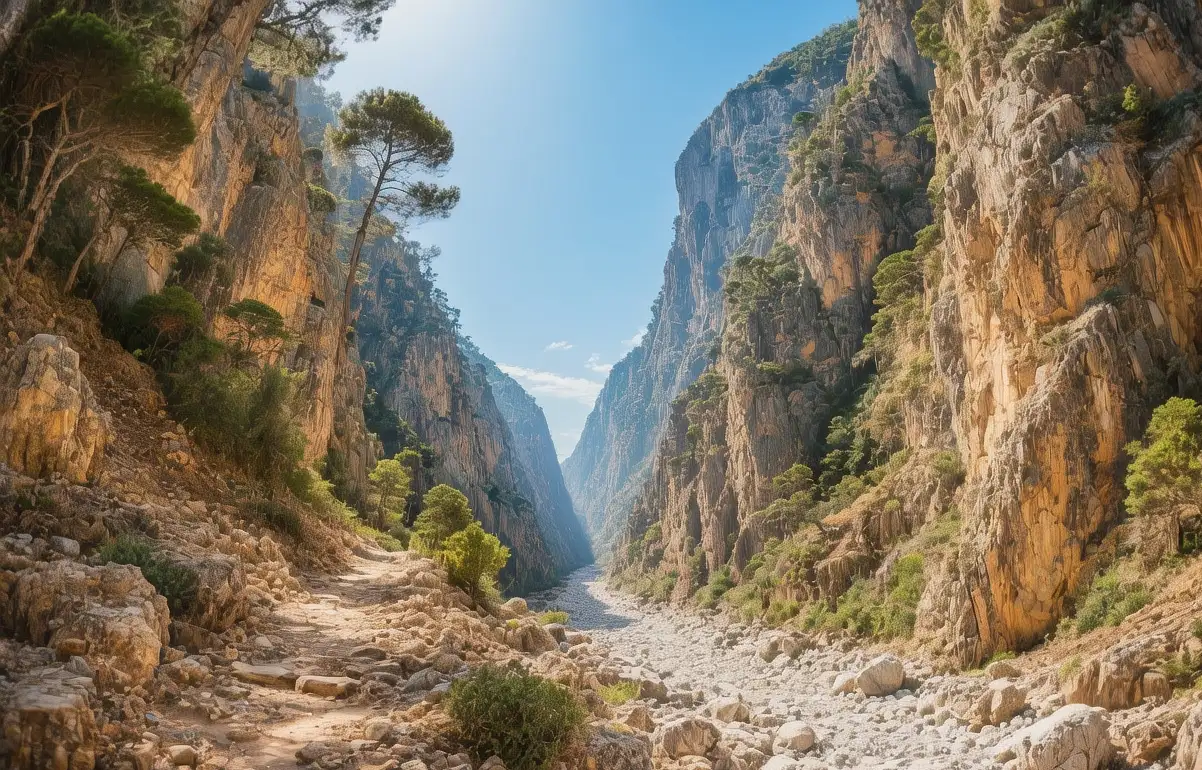
Samaria Gorge: Where Ancient Forests Meet Cretan Wilderness
The morning sun filters through ancient cypress and pine as you stand at the entrance to Samaria Gorge, where the air carries the crisp scent of wild thyme, damp limestone, and the faint mineral tang of mountain streams flowing toward the Libyan Sea. Before you unfolds one of Europe's most dramatic natural corridors—a 16-kilometer canyon carved through the White Mountains over millions of years, where sheer limestone cliffs rise 300 to 500 meters on either side, where the path narrows to just 3 meters at the famous Iron Gates, and where the endangered kri-kri (Cretan wild goat) still roams the high ridges unseen. The only sounds are the gentle rush of the Tarraios River over smooth stones, the distant call of golden eagles circling the thermal updrafts, and the soft footsteps of hikers beginning their descent from 1,230 meters at Xyloskalo to sea level at Agia Roumeli. This extraordinary wilderness—designated a National Park since 1962 and UNESCO Biosphere Reserve—solves a fundamental human need: the desire to experience raw, untamed nature where geological time, ecological diversity, and physical challenge converge into something transformative. Standing on this ancient trail as light illuminates moss-covered boulders, you understand: Samaria Gorge matters because it offers a rare encounter with Earth's creative power—a place where hiking becomes pilgrimage, where every step connects you to millennia of natural history, and where the simple act of walking through wilderness awakens profound reverence for our planet's enduring beauty.
Why Samaria Gorge Embodies Untamed Wilderness
The Samaria Gorge represents one of the Mediterranean's most extraordinary examples of natural preservation—a canyon that solved the fundamental challenge of protecting fragile mountain ecosystems while providing accessible adventure for travelers seeking authentic wilderness experiences. Established as Greece's first National Park in 1962 and designated a UNESCO Biosphere Reserve in 1981, the gorge spans 48.5 square kilometers of the White Mountains (Lefka Ori), protecting over 450 plant species—including 14 endemic to Crete—and providing critical habitat for the endangered kri-kri (Capra aegagrus cretica), the only wild goat species native to Europe.
The gorge's geological significance lies in its dramatic formation: carved by the Tarraios River over 2 million years through limestone and dolomite bedrock, the canyon descends from 1,230 meters at the Xyloskalo entrance to sea level at Agia Roumeli, creating an elevation change of 1,230 meters over 16 kilometers. The famous Iron Gates—where the gorge narrows to just 3 meters wide with cliffs rising 300 meters vertically—demonstrate the raw power of water erosion acting on soluble limestone. The trail itself, engineered with stone steps, wooden railings, and drainage channels, follows the ancient path used by charcoal burners and goatherds for centuries, now maintained by the Greek Forestry Service to minimize environmental impact while ensuring hiker safety.
Today, Samaria Gorge fulfills multiple roles: it serves as a living laboratory for ecological research, an adventure destination drawing over 200,000 hikers annually during peak season, and a contemplative space where visitors confront the sublime power of natural forces. The ongoing conservation efforts—including seasonal closures (November–April) to protect nesting birds and prevent flooding, designated camping restrictions, and mandatory guided groups for scientific research—ensure that this extraordinary landscape continues to inspire while preserving the delicate mountain ecosystem. Every step along this ancient trail connects you to a wilderness shaped by water, time, and geological patience—a reminder that human adventure has deep roots in respect for nature's grandeur.
The Best Time to Experience Samaria Gorge
Timing transforms a hike through Samaria Gorge from challenging trek to transcendent wilderness encounter. The optimal windows stretch from May 18–June 12 and September 15–October 20, when temperatures at the gorge entrance hover between 18–25°C (64–77°F), water levels in the Tarraios River remain safe for crossing, and visitor numbers stay manageable enough for peaceful hiking without excessive crowds. During these shoulder seasons, you'll experience comfortable conditions for the 4–7 hour descent while capturing photographs in the soft, directional light that reveals the limestone cliffs' textured surfaces and the forest's vibrant greens.
Arrive precisely at 7:00–8:00 AM at the Xyloskalo entrance—this early start delivers cooler temperatures for the initial descent, minimal crowds on narrow trail sections, and the mental freshness needed for the challenging 16-kilometer hike. The gorge operates daily from 7:00 AM during open season (May 1–October 31), with last entry at 3:00 PM to ensure hikers complete the descent before sunset. Ferry connections from Agia Roumeli to Sougia or Chora Sfakion depart at 5:30 PM; missing this boat requires overnight accommodation in the small coastal village. Winter months (November–April) see the gorge closed due to flooding risk, though the surrounding White Mountains offer exceptional winter hiking for experienced mountaineers.
Avoid July 15–August 31 unless absolutely necessary: temperatures at the gorge entrance regularly exceed 30°C (86°F), midday heat in the narrow canyon sections can become oppressive, and cruise ship excursions create trail congestion that diminishes the wilderness experience. Also skip periods of heavy rainfall when the gorge may close temporarily for safety due to flash flood risk. For the most current information on gorge status, weather conditions, and ferry schedules, always check the official Greek tourism portal at https://samaria-gorge.gr/ before your visit.
Approximate Budget for a 7-Day Trip
Crete offers exceptional value for travelers seeking profound natural adventures combined with authentic Mediterranean culture. The following breakdown reflects mid-range travel—comfortable boutique accommodations in Chania or nearby mountain villages, authentic Cretan taverna dining, and comprehensive exploration of Samaria Gorge and greater western Crete—based on current pricing for a single traveler.
- Accommodation: €70–€150 per night in Chania old town or mountain villages near Omalos (€490–€1,050 total). Budget studios start at €40; luxury mountain lodges run €200+.
- Food: €35–€55 per day total. Breakfast: €5–€8 (Greek coffee €2.50, bougatsa pastry €2, fresh fruit €3.50). Lunch: €10–€18 (Greek salad €7, dakos €9, grilled octopus €15). Dinner: €18–€30 (lamb kleftiko €16, fresh fish €20, Cretan wine €5/glass, dessert €6).
- Transportation: €140 total. Ferry from Athens: €45–€75 one-way (€90–€150 round-trip). Car rental for western Crete: €35/day. Samaria Gorge transfer bus from Chania: €15 round-trip. Ferry from Agia Roumeli: €17.
- Attractions: €75 total. Samaria Gorge entry fee: €5. Guided hiking tour (optional): €45. Balos Lagoon boat trip: €25. Elafonissi Beach access: free. Hiking equipment rental: €10.
- Miscellaneous: €110 total. Water/snacks €4/day, handmade pottery €35–€80, local honey €12, hiking accessories €20, tips €25.
Total: €1,250–€1,800 for 7 days (excluding international airfare and Athens-Crete ferry)
7 Essential Samaria Gorge Experiences
- Begin the descent at Xyloskalo at sunrise: Arrive at the 1,230-meter entrance by 7:00 AM when the gorge opens. Morning light filters through the ancient cypress and black pine forest, illuminating moss-covered boulders and wildflowers. The initial 2-kilometer descent features 600 stone steps carved into the mountainside—allow 45 minutes for this section while your legs warm up. Carry water and wear sturdy hiking boots with ankle support for the uneven terrain.
- Pass through the Iron Gates: At the gorge's narrowest point—approximately 12 kilometers from the entrance—the limestone walls converge to just 3 meters wide while rising 300 meters vertically. The dramatic scale creates a natural cathedral of stone; pause here to appreciate the geological forces that carved this corridor over 2 million years. Visit between 10:00–11:00 AM when sunlight filters through the narrow opening, creating dramatic light beams on the canyon floor.
- Spot the elusive kri-kri: Scan the high ridges and rocky outcrops for the endangered Cretan wild goat (Capra aegagrus cretica), identifiable by its curved horns and agile movement across steep terrain. These shy animals are most active at dawn and dusk; bring binoculars for distant viewing. Never approach or feed wildlife—maintain a respectful distance of at least 50 meters to avoid stressing these protected animals.
- Cross the Tarraios River: Follow the gentle path alongside the mountain stream that has carved the gorge over millennia. The river's clear, cool water offers refreshing foot dips during warmer months; the smooth stones create natural massage for tired feet. Listen for the rhythmic rush of water over limestone—a meditative soundtrack that accompanies much of the hike. Cross using the designated wooden footbridges to protect the riverbed ecosystem.
- Photograph the limestone formations: Position yourself at viewpoints along the trail at 2:00–4:00 PM when afternoon light creates dramatic shadows on the canyon walls. The interplay of light and shadow reveals the limestone's layered textures, erosion patterns, and mineral color variations from pale cream to deep ochre. Use a wide-angle lens (24mm) to capture the gorge's scale, or a telephoto (70–200mm) to isolate dramatic rock formations.
- Rest at Agia Roumeli: Complete the 16-kilometer descent at the small coastal village of Agia Roumeli, where the gorge meets the Libyan Sea. The contrast between mountain wilderness and Mediterranean coastline creates a powerful sense of arrival. Enjoy a well-earned meal at a waterfront taverna—try grilled octopus (€15) and local Cretan salad (€8) while watching fishing boats return to harbor. Allow 30 minutes to rest before boarding the ferry.
- Take the ferry to Sougia or Chora Sfakion: Board the afternoon ferry (departs 5:30 PM) for the scenic coastal journey back to civilization. The 30-minute crossing offers panoramic views of Crete's southwestern coastline, with opportunities to spot dolphins and seabirds. The ferry ride provides time to reflect on the day's wilderness experience while your legs recover from the 1,230-meter descent.
3 Hidden Gems Most Travelers Miss
- The Ancient Chapel of Agios Nikolaos: Tucked into a rocky alcove approximately 8 kilometers from the gorge entrance, this small 14th-century chapel dedicated to St. Nicholas offers a peaceful resting spot with panoramic views of the canyon. The simple stone structure features original frescoes and a cool interior perfect for mid-hike reflection. Access: Located just off the main trail; follow signs for "Agios Nikolaos." Best visited between 11:00 AM–1:00 PM when morning light illuminates the frescoes through the small windows. Most hikers rush past this spiritual oasis; allow 10 minutes to appreciate the chapel's serene atmosphere and historical significance.
- The Wildflower Meadow at Xyloskalo: Near the gorge entrance at 1,230 meters elevation, a small alpine meadow blooms with over 30 endemic Cretan plant species between May and June, including the rare Cretan maple (Acer sempervirens) and purple orchids found nowhere else on Earth. The meadow offers exceptional photography opportunities and birdwatching for golden eagles and Cretan sparrows. Access: Located 200 meters before the official trailhead; follow the marked path through the forest. Best visited at 7:00–8:00 AM when morning light reveals flower details most clearly. Bring a field guide to Cretan flora to identify the remarkable botanical diversity.
- The Abandoned Village of Samaria: Deep within the gorge, the ruins of the original village of Samaria—abandoned in 1962 when the area became a National Park—offer a haunting glimpse into traditional Cretan mountain life. Stone houses, terraced fields, and an old church remain remarkably preserved, telling stories of goatherds and charcoal burners who once called this wilderness home. Access: Located approximately 10 kilometers from the entrance; follow the marked side path (adds 20 minutes to hike). Best visited between 3:00–4:00 PM when afternoon light creates dramatic shadows on the stone ruins. Respect the historical site by not removing artifacts or disturbing the structures.
Cultural & Practical Tips
- Hiking preparation: Samaria Gorge requires moderate physical fitness; the 16-kilometer descent with 1,230 meters elevation change takes 4–7 hours depending on pace. Wear sturdy hiking boots with ankle support, moisture-wicking clothing, and a wide-brimmed hat. Carry at least 2 liters of water per person—there are no vendors along the trail.
- Trail etiquette: Stay on marked paths to protect fragile vegetation and prevent erosion. Yield to uphill hikers on narrow sections. Keep noise levels respectful to avoid disturbing wildlife. Pack out all trash—there are limited bins along the trail. Never remove plants, rocks, or historical artifacts.
- Weather awareness: Check forecasts before hiking; sudden rainfall can cause dangerous flash floods in the narrow canyon sections. Temperatures vary significantly with elevation—dress in layers. The gorge can be 5–7°C cooler at the entrance than at sea level. Strong meltemi winds may affect ferry schedules; confirm return transportation in advance.
- Local phrases: Kalimera (kah-lee-MEH-rah) = Good morning; Kalispera (kah-lee-SPER-ah) = Good evening; Efharisto (ef-hah-REE-stoh) = Thank you; Parakalo (pah-rah-kah-LOH) = Please/You're welcome; Signomi (see-GNO-mee) = Excuse me. Using these greetings earns warm smiles from park staff and Cretan locals.
- Photography guidelines: Personal photography is permitted throughout the gorge. Tripods are allowed but use caution on uneven trail sections. The best light for canyon photography occurs during early morning and late afternoon when shadows accentuate rock textures. Avoid using flash near wildlife to prevent startling animals.
- Safety considerations: The trail is well-marked but includes steep sections, loose stones, and river crossings. Hike with a companion when possible. Carry a basic first-aid kit and emergency contact information. Park rangers patrol the trail; note their contact number (+30 28210 67179) for emergencies. Never attempt the hike in poor weather conditions.
- Accessibility considerations: Samaria Gorge is not suitable for wheelchairs, strollers, or visitors with significant mobility challenges due to steep, uneven terrain and 600+ stone steps. The trail requires moderate physical fitness; consult a physician before attempting if you have health concerns. Alternative viewpoints are available at the Xyloskalo entrance for those unable to complete the full hike.
Conclusion: Travel with Reverence, Not Just Checklists
The Samaria Gorge demands more than a hurried hike and a summit photo—it asks for your reverence, your willingness to slow down and truly experience the simple pleasure of ancient forest beneath your feet, of mountain air filling your lungs, of wilderness surrounding your spirit. When you surrender to the rhythm of the trail and the meditative power of walking through geological time, you participate in a tradition as old as human curiosity itself. This is not passive tourism; it is active pilgrimage through nature's cathedral.
Responsible travel here means understanding that Samaria's beauty is fragile: every footprint off marked paths accelerates erosion, every discarded item mars the pristine wilderness, every careless action diminishes the experience for future generations. Walk gently. Leave no trace. Take only memories; leave only footprints. Support conservation efforts by respecting park guidelines and choosing eco-conscious operators for transfers and accommodations.
This is not merely a hike to be completed but a sanctuary to be experienced—a place where geological drama and human humility converge to create something transcendent. Slow down. Listen to the river. Watch light move across limestone cliffs. Let Samaria reveal its story gradually, as erosion reveals Earth's history to patient observers. The gorge will still stand tomorrow, but your opportunity to encounter it with wonder and presence exists only in this moment. Choose reverence over haste, connection over completion, and carry not just photographs but a deeper appreciation for the enduring power of wilderness and the transformative gift of walking through Earth's ancient corridors.