
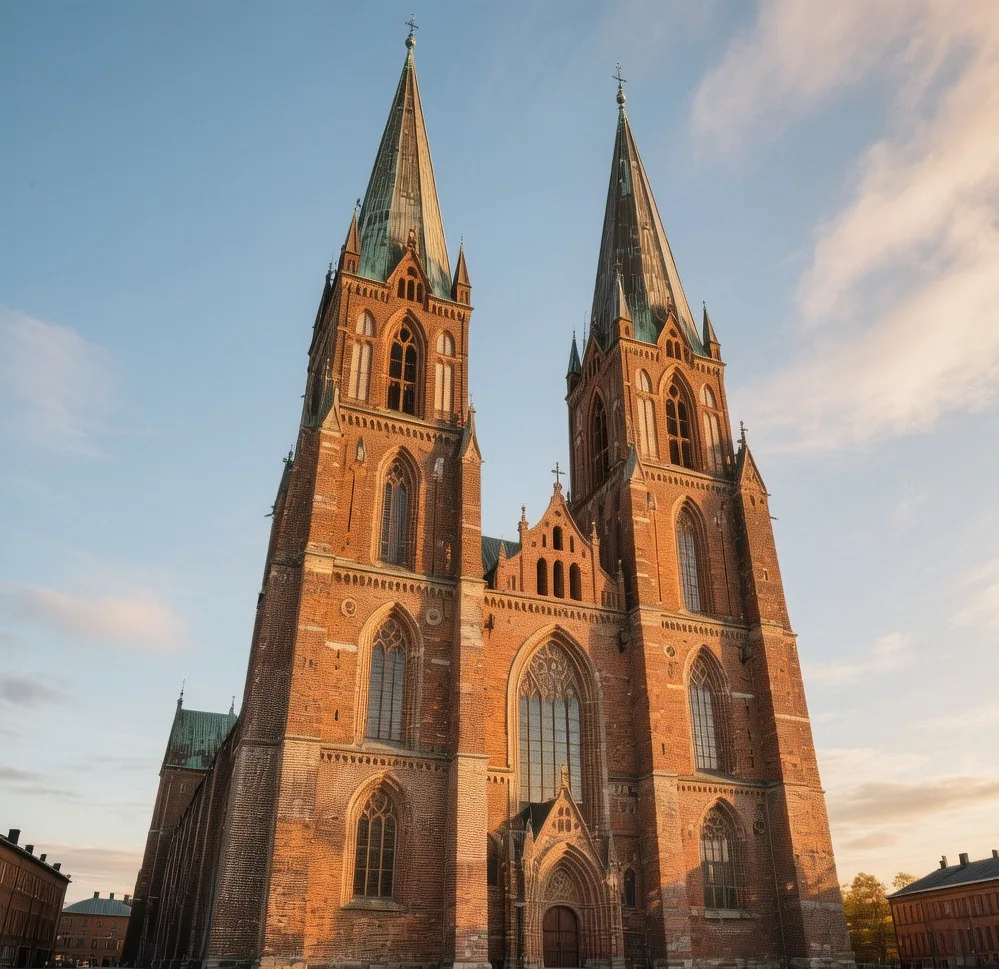
Uppsala Cathedral Gothic Brick Meets Swedish Spirit
The great bell of Uppsala Cathedral tolls across the Fyrisån River at 12:00 PM—a deep, resonant sound that has vibrated through this university town since the consecration in 1435. You stand before the western façade, where red brick rises 118.7 meters into the Scandinavian sky, marking the tallest church spire in all of Northern Europe. The air carries the faint scent of old incense and polished wood, while shafts of Nordic light pierce through narrow Gothic windows, illuminating dust motes dancing above pillars that have supported this sacred space for nearly six centuries. This is not merely a church; it is the spiritual heart of Sweden, the coronation site of kings, and the final resting place of Gustav Vasa and Carl Linnaeus. In 2026, as mass tourism reshapes European heritage sites, Uppsala Cathedral remains refreshingly authentic—a place where you can still hear your footsteps echo through the nave and feel the weight of history without fighting through crowds. This matters now: in an age of digital distraction and superficial travel, Uppsala offers something increasingly rare—the chance to stand in genuine continuity with the past.
Why Uppsala Cathedral Embodies Scandinavian Religious Majesty
Uppsala Cathedral stands as the architectural crown jewel of Sweden, representing a pivotal moment when the nation transitioned from Viking Age paganism to Christian kingdom. Construction began in 1287 under the guidance of French architect Étienne de Bonneuil, introducing Brick Gothic style to Scandinavia—a technical shift from stone to fired brick that solved the problem of scarce natural stone in the Uppland region. The cathedral measures 118.7 meters in length with a nave height of 27 meters, its walls up to 1.5 meters thick to support the massive vaulted ceilings. The structure solved a critical political need: establishing Uppsala as the archbishopric for all of Sweden in 1164, elevating this settlement into a power center rivaling Stockholm. Inside, you'll find the royal burial chapels, including the ornate sarcophagus of Gustav Vasa, who unified Sweden in the 16th century. The cathedral's organ, built by Grönlunds Orgelbyggeri in 1908 and upgraded in 1975, features 5,408 pipes and represents one of the largest mechanical instruments in Europe. This is engineering as theology—medieval craftsmen encoding the cosmos into brick and mortar, creating a space that literally lifts the eyes toward heaven while grounding the nation's identity in stone.
The Best Time to Experience Uppsala Cathedral
For the optimal Uppsala Cathedral experience, target May 15–June 20 or September 5–October 10 when tourist numbers remain manageable and the Swedish light creates magical atmospheric conditions. During these windows, daytime temperatures hover between 14–20°C (57–68°F), perfect for walking the cobblestone streets before seeking the cathedral's cool interior. The cathedral opens daily at 8:00 AM for prayer and 10:00 AM for tourists, with tower climbs available between 10:00 AM–4:00 PM. Arrive between 8:30–9:30 AM for morning light streaming through the eastern windows—this golden hour illuminates the chapels without the midday crowds. Avoid April 30–May 1 (Walpurgis Night) when student celebrations bring peak visitor numbers, and steer clear of December 23–26 when the cathedral closes for Christmas preparations and family services. Winter visits (November–February) offer atmospheric candlelit services but limited daylight—sunset occurs as early as 3:00 PM in December. For current opening hours and service schedules, verify at www.svenskakyrkan.se/uppsala before your visit, as special events and restoration work can affect access. The cathedral remains open Monday–Saturday 8:00 AM–6:00 PM (April–September) and 10:00 AM–4:00 PM (October–March), with Sunday hours beginning at 12:30 PM following services.
Approximate Budget for a 7-Day Trip (2026)
Uppsala offers moderate pricing compared to Stockholm, with costs reflecting its university town character rather than capital city premiums. The following estimates assume moderate travel style—comfortable but not luxury accommodations, mix of self-catering and restaurant meals, and use of public transportation. Prices reflect 2026 rates with approximately 3% annual inflation from 2024 baseline data.
- Accommodation: €90–€150 per night for a double room in central Uppsala (near Fyrisån or Saluhallen); budget hostels start at €40/night; upscale hotels near the cathedral average €200–€280/night
- Food: €50–€70 per day total
- Breakfast: €10–€15 (hotel buffet or café smörgås with coffee)
- Lunch: €16–€22 (dagens lunch—daily special including main, salad, bread, and drink)
- Dinner: €24–€35 (restaurant main course; try Uppsala sausage or Baltic herring)
- Transportation:
- Stockholm Arlanda Airport to Uppsala: €20 one-way via Flygbussarna (20 minutes)
- Local buses in Uppsala: €3.80 single ticket; €10 day pass
- Bicycle rental: €15/day (Uppsala is extremely bike-friendly)
- Day trip to Stockholm: €25 round-trip train ticket (35 minutes)
- Attractions:
- Uppsala Cathedral: Free entry (donations welcome); tower climb €8
- Gustavianum Museum: €12 adults, free under 19
- Linnaeus Garden: €8 adults
- Carolina Rediviva Library: €10 adults
- Gamla Uppsala Museum: €10 adults
- Miscellaneous:
- Cathedral guidebook: €7
- Local crafts at Saluhallen market: €15–€45
- Fika (coffee + cinnamon bun): €6–€8
- Evening organ concert: €20–€30
Total estimated cost for 7 days: €950–€1,400 per person (excluding international flights)
7 Essential Uppsala Cathedral Experiences
- Climb the North Tower for Panoramic Views: Purchase your €8 tower ticket at the cathedral shop, then ascend 276 narrow stone steps to the viewing platform at 85 meters. The climb is steep and claustrophobic in sections, but the reward is a 360-degree vista across Uppsala's red-tiled roofs, the Fyrisån river winding through the city, and the distant Gamla Uppsala mounds. Best lighting for photography occurs between 4:00–6:00 PM in summer when the low sun creates dramatic shadows across the university buildings. The bell chamber houses the massive Bell of Gustav Vasa, cast in 1635, which you can see up close during the ascent.
- Visit the Royal Burial Chapels: Located in the northern transept, these chapels house the remains of Swedish monarchs including Gustav Vasa and his queens. The sarcophagi are crafted from solid silver and copper, weighing over 2 tons each. Stand quietly before the monuments to read the Latin inscriptions detailing the unification of Sweden. The chapels are open during general visiting hours but close during services. Allow 30 minutes to absorb the historical weight of the space. This is where modern Sweden was forged in stone and metal.
- Attend an Evening Organ Concert: The cathedral's magnificent Grönlunds organ—featuring 5,408 pipes and 75 stops—comes alive during Wednesday evening concerts (June–August, 7:00 PM). The acoustics in this 600-year-old space create an otherworldly sound experience; Bach's Toccata and Fugue in D Minor resonates through the vaulted ceilings in ways that recordings cannot capture. Arrive 20 minutes early for seating. Tickets are available at the door or online. This is the best way to experience the cathedral as a living instrument rather than a museum.
- Explore the Cathedral Treasury (Skattkammaren): Hidden in the cathedral's southwest corner, the small treasury (€6 entry) displays medieval liturgical objects including a 15th-century silver chalice, embroidered vestments, and fragments of the original 13th-century wooden doors. The highlight is the tapestry donated by Queen Kristina in 1650, depicting biblical scenes in vivid wool. Photography is prohibited here to preserve the delicate textiles. Open Tuesday–Sunday 11:00 AM–3:00 PM. Allow 45 minutes for a thorough visit. This collection reveals the wealth that once flowed through Uppsala.
- Trace the Linnaeus Grave: Near the southern entrance, locate the simple marble slab marking the grave of Carl Linnaeus, the father of modern taxonomy. The inscription reads Princeps Botanicoorum—Prince of Botanists. This is a quiet spot often overlooked by tourists rushing to the royal chapels. Leave a small flower if you wish to honor his contribution to science. The grave dates to 1778, when his remains were moved from Hammarby. This connects the cathedral to Sweden's scientific heritage as well as its religious history.
- Walk the Fyrisån Riverbank: Exit the cathedral and follow the river south toward the university main building. The path is lined with historic mills and weeping willows that frame the cathedral spire perfectly. The walk takes 20 minutes to the Student Nation buildings. Best visited between 5:00–7:00 PM when students gather on the banks. The reflection of the cathedral in the water offers a unique photographic perspective. This route connects the sacred space to the academic life that defines modern Uppsala.
- Experience the Student Nations: While not inside the cathedral, the 13 Student Nations surround the church and define the town's culture. Visit Uppsala Student Union for a traditional dinner (€15) in historic dining halls. Many nations date to the 1600s and retain original frescoes. Open to visitors during specific hours (check websites). This experience shows how the cathedral remains the center of a living university community. The contrast between medieval stone and student life is uniquely Uppsala.
3 Hidden Gems Most Travelers Miss
- Carolina Rediviva University Library: Located 500 meters east of the cathedral at Dag Hammarskjölds väg 1, this neoclassical building houses the Codex Argenteus (Silver Bible). The reading room features a dome painted with celestial maps often overlooked by tourists. Access via guided tour only (€10, daily at 2:00 PM). Contact ub@ub.uu.se for private group bookings. The 4th-century Gothic manuscript is written in silver ink on purple parchment—a treasure rivaling any cathedral relic. This is where faith meets scholarship in Uppsala.
- Gamla Uppsala Museum and Mounds: Located 5 kilometers north via Bus 2, this site features three massive burial mounds from the 6th century AD. The museum displays artifacts excavated from the site including gold foil figures and gaming pieces. Open daily 10:00 AM–4:00 PM (May–September), €10 entry. The mounds predate the cathedral by 700 years, offering context for the pagan history the church replaced. Walk the King's Path between the mounds at sunset for a mystical experience. Most tourists never venture beyond the city center, missing this authentic piece of Swedish prehistory.
- The Deanery Garden (Domkyrkoträdgården): Tucked behind the cathedral's eastern apse, this walled garden is a peaceful sanctuary often closed to the public but open during summer weekends. The garden contains medicinal herbs used in medieval times and offers a quiet bench facing the cathedral's rear architecture. Access through the gate on Sankt Eriks torg (open Saturday 1:00–4:00 PM June–August). The site includes informational panels explaining the garden's historical layout. This is where cathedral staff find respite—a quiet space for reflection away from tourist crowds. Bring a book and enjoy the silence.
Cultural & Practical Tips
- Photography etiquette: Photography is permitted in the main nave without flash, but prohibited during services and in the treasury. The tower climb allows photography but tripods are not permitted due to narrow stairs. Be mindful of other visitors when composing shots—wait for gaps in crowds. Sunrise and sunset offer the best light without harsh shadows.
- Dress code: While Sweden is generally casual, the cathedral requests modest attire—shoulders and knees covered. This is strictly enforced during services but loosely applied during tourist hours. Carry a light scarf to drape over tank tops in summer. Remove hats upon entering the nave as a sign of respect.
- Swedish church customs: It's acceptable to sit in the pews for quiet reflection even if you're not attending a service. Light a candle (€2 donation) in the memorial chapel if you wish to honor someone. During services, stand when others stand—this typically occurs during hymns and the Gospel reading. Silence is expected in the transepts.
- Essential Swedish phrases:
- "Tack" (tahk) = Thank you
- "Ursäkta" (oor-shek-tah) = Excuse me
- "Var ligger domkyrkan?" (var lig-er doom-cheer-kan) = Where is the cathedral?
- "En kaffe, tack" (en kaf-fe tahk) = One coffee, please
- Accessibility: The main nave is wheelchair accessible via the southern entrance, but the tower climb and treasury are not accessible to those with mobility limitations. The cathedral has a ramp entrance on the west side. Hearing loop systems are installed throughout for those with hearing aids. Contact the cathedral office at +46 18 16 90 00 for detailed accessibility maps.
- Weather considerations: Uppsala's inland location means weather can shift rapidly—carry layers even in summer. The cathedral interior remains 16–18°C (61–64°F) year-round due to thick brick walls, so bring a light jacket regardless of outdoor temperature. Rain is possible year-round—pack a waterproof jacket.
- Safety: Uppsala is exceptionally safe, but watch for bicycles—they have right of way everywhere and move silently. The cathedral area is well-lit and patrolled, but keep valuables secure during crowded events. Emergency number: 112 (works throughout EU). Tourist police speak English and can be reached at the station on Kungsgatan.
Conclusion: Travel with Reverence, Not Just Tourism
Uppsala Cathedral demands something different from you than the checklist mentality of modern travel. This is not a place to snap a selfie and move on; it's a space that asks you to slow down, to listen to the silence between the bell tolls, to trace with your eyes the tool marks left by bricklayers who died six centuries ago. When you stand before the royal sarcophagi, watching light shift across silver and copper, you're witnessing a continuous tradition—people have gathered at this exact spot, for this exact purpose, since before America was discovered. That continuity is fragile. Every year, the brick façade erodes another millimeter; every touch leaves microscopic oils that accelerate decay; every flash photograph fades medieval pigments by imperceptible degrees. Travel here with reverence: speak softly, move deliberately, contribute to the preservation fund, and leave only your gratitude. In return, Uppsala Cathedral offers something increasingly precious in our accelerated world—the chance to stand in deep time, to feel the weight and wonder of human continuity, to remember that we are temporary custodians of beauty that outlasts us all. This is why we travel: not to consume places, but to be transformed by them.