
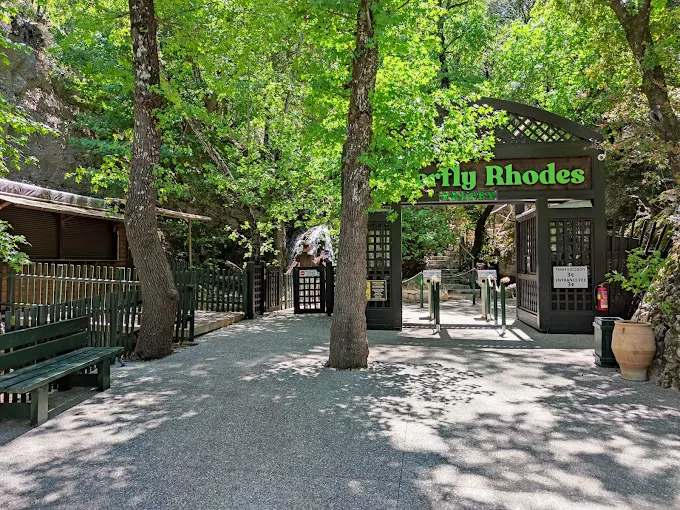
Valley of the Butterflies: Where Fragile Wings Meet Dappled Mediterranean Canopy
Midday light filters through the dense canopy of Oriental plane trees, casting a mosaic of shifting shadows on the damp earth below. The air is heavy, thick with humidity and the faint, resinous scent of crushed pine needles. A sudden, rustling whisper rises from the undergrowth—not wind, but the synchronized flutter of thousands of resting wings. The Valley of the Butterflies stretches approximately 600 meters (1,968 feet) along the Pelekanos River, carving a narrow, humid gorge through the rocky hillsides of western Rhodes. Here, the Jersey Tiger moth—scientifically known as Panaxia Quadripunctaria—gathers in staggering densities, clinging like jeweled scales to the trunks of ancient trees. It matters because this 6-hectare (15-acre) reserve represents one of the few remaining refuges in Europe where such an immense, delicate ecological phenomenon survives entirely untouched by industrial encroachment.
Why the Valley of the Butterflies Embodies Ecological Resilience
The valley solves a critical biological imperative: thermoregulation and survival during the moth's fragile reproductive diapause phase. From mid-June through September, up to 500,000 moths converge on this specific microclimate, driven by an ancient, hardcoded migratory instinct. The steep, north-facing gorge traps moisture evaporating from the river, maintaining a constant humidity level of 70 to 80 percent. This extreme moisture is a strict necessity, as the moths lack functional mouthparts and survive entirely on fat reserves stored during their caterpillar stage; the humid air prevents them from desiccating. The Oriental sweetgum trees exude a sticky, aromatic resin that researchers believe helps mask the moths' scent from predatory bats. The site was formally recognized by the Italian authorities during their occupation of the Dodecanese, when systematic logging threatened to destroy the grove. They instituted the first protective ordinances, constructing the initial wooden walkways—spanning roughly 1,200 meters (3,937 feet)—to prevent soil compaction from human foot traffic. Today, the valley is rigidly protected under the Natura 2000 network, fulfilling the dual need of preserving an endemic life cycle while providing a sustainable economic resource for the local community through carefully managed ecotourism.
The Best Time to Experience the Valley of the Butterflies
To witness the Jersey Tiger moths at their absolute peak density, plan your visit between July 20 and August 25. During this precise window, daytime temperatures in the shaded gorge sit between 26°C and 29°C (79°F–84°F), which is perfectly calibrated to keep the moths dormant and clinging to the tree trunks. Arrive precisely at 8:30–10:00 AM, right as the park opens, to experience the valley in profound silence before the ambient chatter of tourists disturbs the colonies. A secondary window occurs at 5:00–6:30 PM, when the lowering sun casts a dramatic, golden light through the canopy. You should actively avoid June 1–July 10, as the moths are still arriving and the visual density is incredibly sparse. Similarly, avoid September 10–30; by this time, the moths are actively mating, laying eggs, and dying, resulting in a stark decline in numbers and a visibly degraded environment. For the most accurate ticketing updates and conservation guidelines, consult the official regional tourism portal: https://butterfliesrhodes.gr/.
Approximate Budget for a 7-Day Trip
Exploring the natural wonders of western Rhodes requires a budgeting strategy that prioritizes local village life and independent transit over the premium pricing of organized coastal resorts.
- • Accommodation: €55–€85 per night (family-run stone studio in the village of Theologos, located a 10-minute drive from the valley entrance)
- • Food: €45 per day (breakfast €6 for Greek yogurt and thyme honey, lunch €12 for a souvlaki pita at a local stand, dinner €27 for grilled calamari and gemista stuffed tomatoes at a village taverna)
- • Transportation: €35 total (€20 for a 7-day regional KTEL bus pass from Rhodes Town; €15 for a one-way taxi ride from Theologos directly to the valley gates)
- • Attractions: €14 individual prices listed (Valley of the Butterflies entrance: €5; Seven Springs Epta Piges: €3; Kalithea Springs: €6)
- • Miscellaneous: €30 (jar of local pine honey from a roadside apiary: €8; natural sea sponge from a market stall: €12; eco-friendly insect repellent: €10)
Total: €584–€824
6 Essential Valley of the Butterflies Experiences
- Walking the Elevated Boardwalks: Feel the slight, rhythmic bounce of the timber path underfoot as you enter the cool microclimate. The wooden slats are intentionally designed to minimize vibrations, allowing you to glide silently past the resting colonies without startling them.
- Observing the Resting Colonies: Stop at the main sweetgum grove, roughly 400 meters from the entrance. Look closely at the tree trunks—they appear coated in dark, grayish bark until a stray beam of light hits them, suddenly revealing the intricate, kaleidoscopic patterns of thousands of overlapping wings.
- Listening to the Rain Effect: Close your eyes near the deepest part of the gorge. The collective fluttering of wings when a shadow passes overhead sounds exactly like a sudden summer rainstorm falling on a canvas tent, a mesmerizing auditory illusion.
- Climbing to the Kalopetra Monastery: Ascend the 250-step stone staircase at the valley's terminus. This eighteenth-century whitewashed chapel sits on a rocky precipice, offering sweeping panoramic views of the Aegean Sea and a quiet space to escape the crowds below.
- Visiting the Natural History Museum: Located at the entrance, this small facility provides vital context. Examine the detailed entomological displays to understand the exact morphological differences between the moths' active and dormant states before you walk into the gorge.
- Photographing the Dappled Canopy: Shoot directly upward through the interlocking branches of the Oriental plane trees. The harsh midday sun fractures into a million points of light, creating an ethereal, cathedral-like atmosphere that perfectly captures the valley's essence.
3 Overlooked Wonders Most Travelers Miss
- The Pelekanos River Headwaters: Walk past the main wooden boardwalks until you reach the fenced boundary at the end of the valley. Most tourists turn around here, but if you look through the dense fern fringes just before the fence, you can spot the actual spring where the river emerges from the rock. It is special because the water is crystal-clear and nearly freezing, offering a stark contrast to the humid gorge.
- The Ruins of the Old Watermills: A 15-minute hike upstream along an unmarked, rocky animal trail leads to the crumbling stone foundations of medieval watermills. They are overlooked because there is zero signage directing visitors away from the main path. Insider tip: wear waterproof shoes, as the trail requires crossing the shallow river twice.
- The Natura 2000 Interpretive Trail: Branching left just before the entrance museum, this narrow dirt path skirts the outer perimeter of the valley. It is ignored by the crowds rushing to see the moths. It features placards detailing the region's endemic flora, including the rare Rhodes oak, and is the only place in the park where you are permitted to quietly sit on the ground.
Cultural & Practical Tips
- • Observe the absolute strict silence rule; clapping, shouting, or whistling to make the moths fly is strictly prohibited and deeply frowned upon by the local caretakers who view the moths as a natural heritage. • • Flash photography is entirely forbidden; the sudden burst of light causes the moths to panic, expend vital energy, and sometimes break their fragile wings. Rely entirely on high-ISO settings and natural light.
- • Wear sturdy, closed-toe shoes with gripped rubber soles; the wooden boardwalks can become incredibly slick from the high humidity and occasional dripping condensation from the canopy above.
- • Pack a high-quality reusable water bottle; while there is a small canteen near the entrance, prices are steep, and you will quickly dehydrate during the uphill walk to the monastery.
- • Learn a respectful Greek phrase: say "Min petas ti fotografia" (min PEH-tahs tee foh-toh-grah-FEE-ah), meaning "Do not use flash photography," to politely remind other visitors of the rules.
- • Apply eco-friendly, biodegradable insect repellent before entering the gorge; standard chemical sprays are highly toxic to the sensitive moth colonies and can contaminate the protected water table.
- • Be mindful of the meltemi winds; if the strong northern winds are blowing, the valley acts as a funnel, and the elevated wooden bridges can feel surprisingly unstable in the gusts.
Conclusion: Travel with Reverence, Not Just Spectacle
The Valley of the Butterflies is not a theme park designed for human amusement, nor is it merely a photographic backdrop to be consumed and discarded. To walk this gorge is to enter a fragile, ancient nursery where survival hangs by a microscopic thread. When you choose to travel with reverence rather than seeking superficial spectacle, you actively participate in the preservation of a miracle. Slow down. Resist the urge to clap your hands or trigger a flash to force a reaction from the moths. Instead, stand perfectly still on the wooden boardwalk and let the humid air settle around you. Mindful tourism recognizes that our presence in delicate ecosystems is an intrusion, and we must minimize our footprint to ensure the Jersey Tiger moth continues this migratory ritual. By choosing patience over impulse, you shift from being a passive observer to a vital guardian of this extraordinary ecological refuge.