
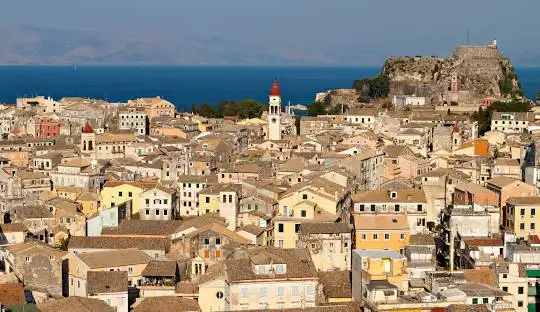
Corfu Old Town: Where Venetian Grandeur Meets Ionian Vitality
Morning light spills over the Liston Promenade, gilding the repetitive arches and warming the pale ochre facades. The air tastes faintly of sea brine and roasted coffee. Below the esplanade, water laps against the mossy Venetian sea walls—rhythmic, dark, and ancient. Corfu Old Town awakens not with a jolt, but with a slow, atmospheric inhale. You stand at the edge of the Spianada, a vast green expanse spanning 42,000 square meters (452,000 square feet), flanked by colonnades that echo the Rue de Rivoli in Paris. This is not a ruin preserved behind glass; it is a living labyrinth of cobblestone alleys, or kantounia, where Byzantine foundations support Venetian skeletons dressed in pastel Neoclassical stucco. It matters because this compact peninsula represents the most intact surviving example of a heavily fortified Mediterranean trading port—a physical palimpsest where four centuries of Venetian rule, followed by French and British occupations, fused seamlessly into a singular, breathing Grecian identity.
Why Corfu Old Town Embodies Mediterranean Syncretism
To understand Corfu Old Town is to recognize the strategic dilemma it solved for the Republic of Venice. For centuries, the Serenissima needed a heavily fortified naval outpost to protect its maritime trade routes from the expanding Ottoman Empire. The solution was an architectural marvel of military engineering: a double-walled Venetian citadel, the Old Fortress, constructed on a rocky peninsula, alongside a massive landward bastion, the New Fortress. Commissioned by Venetian military architect Michele Sanmicheli in the sixteenth century, the fortifications utilize angular bastions designed to deflect cannon fire, featuring walls up to 18 meters (59 feet) thick at their base. But defense was only half the equation; the town also had to function as an aristocratic trading hub. This necessity birthed an architectural syncretism entirely unique to Corfu. When a devastating earthquake leveled the medieval timber-framed houses, the Venetian Senate mandated a radical rebuilding program. They enforced strict urban planning codes requiring ground floors built of porous local sandstone, capable of withstanding seismic tremors, while upper floors utilized lightweight timber lattices covered in plaster. Following the Napoleonic conquest, French administrators added the iconic Liston Promenade and planted the Spianada's elm trees, while the subsequent British administration introduced Georgian-style verandas and the Palace of St. Michael and St. George. It fulfills a profound historical need: transforming a vulnerable island outpost into an invincible, cosmopolitan melting pot of Mediterranean culture.
The Best Time to Experience Corfu Old Town
To appreciate the layered architecture without the suffocating crush of peak-season tourism, you must time your arrival with absolute precision. Plan your visit between May 18 and June 12, or from September 25 to October 15. During these specific windows, the ambient temperature hovers between 22°C and 26°C (72°F–79°F)—warm enough to enjoy an afternoon freddo espresso al fresco, but cool enough to comfortably navigate the steep, sun-baked alleys. Arrive at the Old Fortress precisely at 8:00–9:00 AM to experience the massive drawbridge and damp, echoing vaults in total solitude. Avoid July 15 through August 25 at all costs. During this brutal period, temperatures routinely spike above 34°C (93°F), and the humidity turns the dense pedestrian corridors into sweltering wind tunnels. Furthermore, massive cruise ships disgorge thousands of day-trippers into the Spianada, entirely overwhelming the narrow streets. For the most current information on fortress hours and cultural events, always reference the official municipal portal: www.corfu.gr.
Approximate Budget for a 7-Day Trip
Calculating the cost of a cultural immersion in Corfu requires balancing the premium prices of the UNESCO-protected center with the accessible daily rhythms of Greek street life. By staying just steps from the bustling lanes, you save on transit while maximizing your time among the pastel facades.
- • Accommodation: €90–€140 per night (boutique renovated townhouse in the Campiello neighborhood, featuring original Venetian stone walls)
- • Food: €55 per day (breakfast €5 for a spinach pie and Greek coffee at a local bakery, lunch €14 for a souvlaki wrap and local beer, dinner €36 for grilled sea bream, bourdeto spicy fish stew, and a carafe of Robola wine)
- • Transportation: €35 total (€10 for the Blue Line urban bus from the airport to San Rocco Square; €25 for a 7-day regional bus pass to access outer beaches)
- • Attractions: €20 individual prices listed (Old Fortress: €8; New Fortress: €6; Museum of Asian Art: €3; Palace of St. Michael and St. George: €3)
- • Miscellaneous: €40 (hand-painted ceramic plate from an artisan workshop on Armeni Street: €22; bottle of local kumquat liqueur: €12; woven straw sun hat from the open-air market: €6)
Total: €760–€1,110
6 Essential Corfu Old Town Experiences
- Crossing the Old Fortress Drawbridge: Walk across the wide, stone-paved moat at exactly 8:15 AM. Listen to the hollow echo of your footsteps against the massive Venetian ramparts. Look up to see the British-era Doric additions crowning the original battlements.
- Strolling the Liston Promenade: Sit at a sidewalk table under the repetitive French-designed arcades at 6:00 PM. Order a glass of crisp Assyrtiko wine and watch the local corfioti families perform the evening volta—a slow, elegant promenade down the pedestrian avenue.
- Navigating the Kantounia: Lose yourself in the Campiello district, the oldest residential quarter. Run your fingers along the crumbling pastel stucco; step over the raised stone thresholds designed to keep out historic floodwaters. The narrowness of these alleys forces you to walk slowly, absorbing the scent of jasmine hanging from wrought-iron balconies.
- Exploring the Church of Saint Spyridon: Enter the single-aisled basilica just as the afternoon light illuminates the interior. Gaze upward at the gilded, suspended silver coffin holding the relics of the island's patron saint, separated from the nave by a spectacular seventeenth-century silver screen.
- Photographing the Town from the New Fortress: Climb to the upper battlements of the British-built stronghold at 5:00 PM. The elevated vantage point offers an unobstructed view across the terracotta rooftops, framed by the deep blue Ionian Sea and the jagged peaks of mainland Albania in the distance.
- Tasting Bourdeto in a Hidden Taverna: Seek out a tiny, family-run kitchen tucked away from the main squares. Order the bourdeto, a fiery, scarlet-red scorpion fish stew thickened with rocca flour. The intense heat of the chili and the tender, flaking flesh provide a profound connection to the island's Venetian-era culinary roots.
3 Overlooked Wonders Most Travelers Miss
- The Banknote Museum of the Ionian Bank: Located on Kapodistriou Street, just a block from the Liston. It is frequently overlooked because its unassuming facade looks like a standard financial institution. Inside, it houses an extraordinary collection of engraved banknotes and printing plates from the island's autonomous period. Insider tip: entry is usually free, but it closes precisely at 2:00 PM, so arrive by 1:00 PM.
- The ANEMOS Old Perithia Exhibition: Tucked in a quiet alley near the Town Hall, this small cultural space showcases the abandoned Venetian village of Old Perithia in the island's mountainous north. It is ignored because there is no exterior signage. It offers a sobering, beautiful photographic look at how Corfiot culture once thrived in isolated, fortified mountain communities.
- The Venetian Well at Kofineta Square: A genuine hidden gem sits in a tiny, triangular plaza buried deep within the Campiello labyrinth. The stone well, featuring a carved Venetian lion crest, dates back to the fifteenth century. It is overlooked simply because the alleyways leading to it are too narrow for tourist maps to accurately depict. Access requires wandering aimlessly toward the sound of trickling water.
Cultural & Practical Tips
- • Dress modestly when visiting the churches; bare shoulders and shorts are strictly prohibited, and caretakers will politely but firmly deny entry to those not respecting the dress code.
- • Learn a few local phrases: say "Kalimera" (kah-lee-MEH-rah) for good morning, and "Signomi" (SEEG-noh-mee) to say excuse me when squeezing past locals in the narrow kantounia.
- • Be prepared for steep, uneven cobblestones; wear shoes with exceptional arch support and rubber soles, as the polished stone pathways become treacherously slick when it rains.
- • Beware of the meltemi winds that can suddenly blast through the narrow alleys in late summer; secure your hat and hold your phone tightly, as the wind funnels through the corridors with surprising force.
- • Ask for permission before photographing shopkeepers or elderly residents sitting outside their homes; a smile and a simple "Mporo na ti pixno?" (BOH-roh nah tee PIX-noh) meaning "May I take a photo?" goes a long way.
- • Carry a lightweight scarf or pashmina; it solves the church dress code issue instantly, doubles as a shield from the midday sun, and provides a barrier against the dust blown through the streets by passing mopeds.
Conclusion: Travel with Reverence, Not Just Itinerary
Corfu Old Town is not merely a collection of picturesque facades designed for effortless digital consumption. It is a living, breathing archive of Mediterranean resilience—a palimpsest of Venetian stone, French elegance, and British pragmatism layered over an unbreakable Grecian foundation. When you choose to travel with reverence rather than rushing through a checklist of monuments, you begin to honor the complex history that built this place. Slow down. Resist the urge to photograph every pastel doorway and instead sit on the steps of the Liston, feeling the cool sea breeze as the afternoon light shifts across the Spianada. Mindful travel recognizes that the worn cobblestones and fragile stucco require our physical and psychological respect. By engaging deeply—listening to the local dialect, understanding the seismic engineering that saved these walls, supporting family artisans—you transition from a transient visitor to a temporary steward of this UNESCO sanctuary. Let the weight of the fortifications settle into your perspective; that is where the true magic of Corfu Old Town quietly resides.
.