
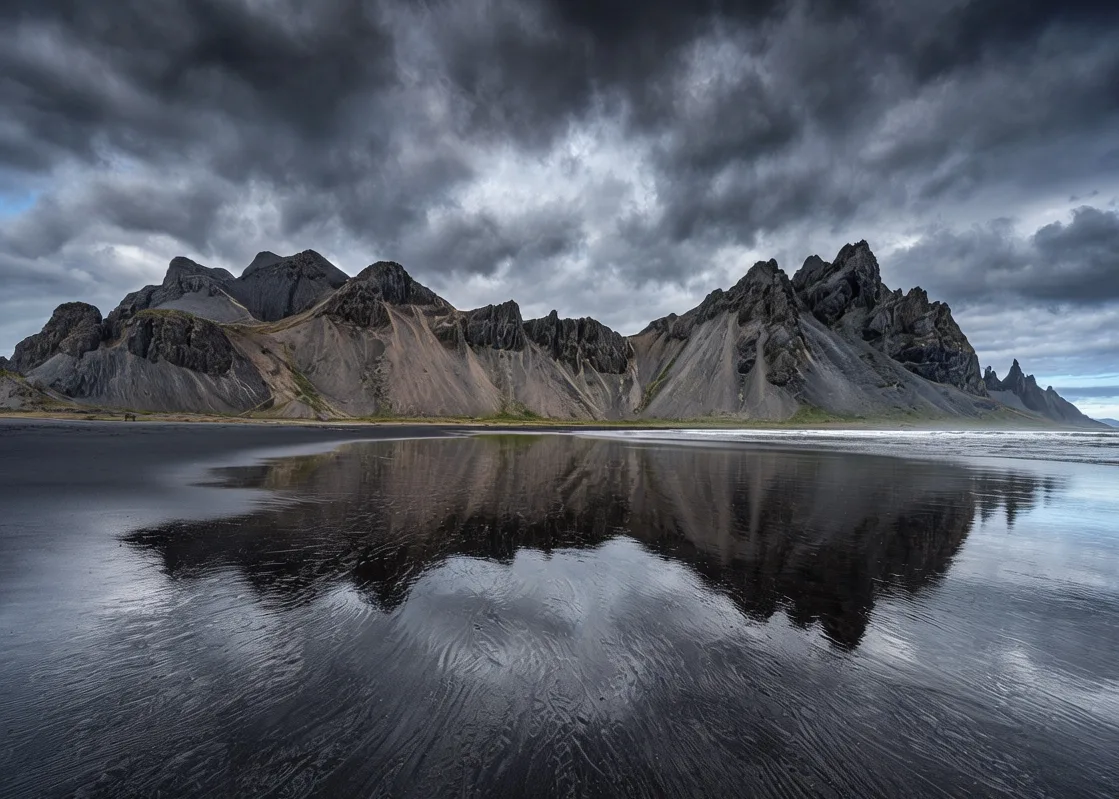
Vestrahorn Mountain Jagged Peaks Meet Black Sand Shores
The wind howls across the dunes—a relentless, gale-force companion that whips your jacket and carries the salty spray of the North Atlantic. You stand on the black sand of Stokksnes peninsula, looking up at the Vestrahorn mountain, a jagged spine of dark gabbro rock that rises 454 meters (1,490 feet) from the sea. The tide is low, leaving behind shallow pools that mirror the mountain's serrated peaks in perfect symmetry. Mist clings to the lower slopes, shifting like a living veil, while the gray sky presses down on the horizon. This isn't just a mountain; it's a geological fortress formed 10 million years ago, standing sentinel over a coastline where the ocean crashes against volcanic stone. In 2026, as iconic landscapes face the dual threats of climate change and overtourism, the Vestrahorn mountain matters now more than ever—a fragile masterpiece where the choice to respect private land and natural rhythms determines whether this view survives for future generations to witness.
Why Vestrahorn Mountain Embodies Icelandic Drama
The Vestrahorn mountain represents far more than a photographer's backdrop—it is Iceland's most striking example of intrusive igneous geology meeting coastal erosion. Formed approximately 10 million years ago, the mountain consists of gabbro, a coarse-grained rock that cooled slowly beneath the Earth's surface before being exposed by glacial and marine erosion. This geological history solves a critical scientific need: providing a visible cross-section of magma chamber processes that built the Icelandic crust. The mountain's four distinct peaks—Horn (454 meters), Lómagnúpur (660 meters), and others—create a skyline that has become synonymous with Icelandic wilderness in global media.
Technical specifications highlight the engineering of nature itself. The slopes rise at angles exceeding 45 degrees, making climbing dangerous and restricted. The peninsula covers 15 square kilometers, with black sand beaches stretching 5 kilometers along the shore. During the Cold War, the site served as a NATO radar station from 1971 to 2006, adding a layer of military history to the natural landscape. The abandoned radar domes still stand near the summit, rusting sentinels of a bygone era. Designated as private land owned by the family at Vestrahorn farm, the site draws 200,000+ visitors annually. The Vestrahorn mountain fulfills a human need for connection to raw, untamed beauty, offering a visual link to the volcanic forces that built the island. It proves that preservation requires active management, including entry fees that fund road maintenance and environmental protection.
The Best Time to Experience Vestrahorn Mountain
Timing your visit to the Vestrahorn mountain requires balancing light conditions, tide schedules, and road accessibility. For optimal photography with midnight sun, target June 15–July 15. During these weeks, temperatures range from 8–14°C (46–57°F), and daylight stretches 21 hours, allowing shoots between 10:00 PM–12:00 AM when the light is soft and golden. The tides are predictable; check local tables for low tide to ensure reflective pools on the beach. Crowds are manageable if you arrive before 6:00 AM or after 8:00 PM.
For winter storm photography and aurora opportunities, visit between November 1 and March 31. Temperatures drop to -5–5°C (23–41°F), and the mountain often wears a cap of snow. The dark skies offer northern lights visibility above the peaks. Plan your visit between 11:00 AM–3:00 PM for maximum daylight. However, avoid December 20–January 10 unless prepared for extreme weather; storms can close Route 1 temporarily, and the gravel road to Stokksnes becomes impassable. Also skip July 1–10 if you dislike congestion; this peak window brings 1,000+ daily visitors. For real-time road conditions and weather.
Approximate Budget for a 7-Day Trip (2026)
Exploring the Vestrahorn mountain anchors a week-long Southeast Iceland adventure. This budget assumes a 7-day trip based in Höfn with day trips to the peninsula. Prices reflect 2026 rates, accounting for Iceland's average 3.8% annual inflation from 2024–2026 (source: Statistics Iceland). All amounts shown in euros; multiply by 1.08 for USD equivalents. Note that Iceland uses ISK, but € is provided for international comparison.
Accommodation: €160–€340 per night
• Budget guesthouse in Höfn (near Vestrahorn): €160–€210
• Mid-range hotel (Town center): €240–€300
• Luxury (Hotel Edda or similar): €400–€550
• Camping (seasonal, Höfn): €30 per person
Food: €70–€120 per day
• Breakfast: €15–€20 (hotel buffet or bakery pastry + coffee)
• Lunch: €25–€35 (langoustine soup or fish sandwich)
• Dinner: €45–€70 (grilled langoustine or Arctic char)
• Groceries (self-catering): €45/day
Transportation:
• Keflavík Airport to Reykjavík Flybus: €35 round-trip
• Rental car (4x4 SUV, 7 days): €450 + €180 fuel
• Southeast Iceland day tour: €110
• Reykjavík city bus (Strætó): €3.50 per ride
• Stokksnes entry fee: €9 per person
Attractions:
• Vestrahorn access: €9
• Glacier hike: €95
• Ice cave tour: €120
• Perlan Museum: €30
• Blue Lagoon day trip: €110
• Golden Circle tour: €95
• Jökulsárlón boat tour: €65
Miscellaneous:
• Icelandic wool sweater (lopapeysa): €120–€190
• Thermal base layers: €90
• Travel insurance: €60
• Souvenirs (salt, handicrafts): €50
• Tips (not expected but appreciated): €30
Total for 7 days (mid-range): €2,600–€2,950 per person
Total (budget-conscious): €1,750–€2,000 per person
6 Essential Vestrahorn Mountain Experiences
1. Photograph the Reflection: Position yourself on the black sand beach during low tide. The shallow pools create mirror images of the peaks. Visit at 5:00–7:00 AM for calmest water. Use a wide-angle lens (16–35mm) to capture the full mountain. Bring a tripod; the wind is constant. This is the iconic shot that defines Southeast Iceland photography.
2. Explore the Abandoned Radar Station: Walk the gravel road toward the summit where NATO domes stand. The structures date from 1971–2006. Visit at 2:00–4:00 PM when light hits the metal. Do not enter the buildings; they are unstable. This experience reveals the Cold War history hidden in the landscape.
3. Hike the Lower Slopes: Follow the marked paths at the base of the mountain. Do not attempt to summit; the terrain is dangerous and restricted. Visit at 10:00 AM–12:00 PM for visibility. The hike gains 100 meters elevation over loose scree. Wear sturdy boots. This perspective emphasizes the scale of the gabbro rock face.
4. Watch Sunset from the Dunes: Return to the sand dunes between 8:00–10:00 PM in summer. The low sun casts golden light on the grass and black sand. The crowds thin dramatically after 6:00 PM. The warm light creates a completely different atmosphere than midday visits. This is the most peaceful time to experience the Vestrahorn mountain.
5. Visit the Farm Shop: Located at the entrance to Stokksnes. Open 9:00 AM–6:00 PM (summer). Entry: Free. Buy local wool or snacks. The family who owns the land manages the site. This interaction supports the private conservation efforts maintaining the road.
6. Combine with Hvalnes Lighthouse: Drive 10 kilometers west to Hvalnes. The lighthouse offers a different angle of Vestrahorn. Visit at 12:00–2:00 PM. The black sand beach here is less crowded. This combination reveals the full scope of the peninsula's coastline.
3 Hidden Gems Most Travelers Miss
• Hvalnes Nature Reserve: Located 10 kilometers west of Vestrahorn on Route 1. This area features black sand beaches and bird cliffs without the entry fee. Access is free. Why overlooked: Tourists focus on Vestrahorn; Hvalnes is quieter. Best visited at 7:00–8:00 AM for sunrise. Insider tip: Watch for Arctic terns nesting in the grass; keep your distance.
• Lónsöræfi Wilderness: Located 20 kilometers east of Vestrahorn. This uninhabited valley offers hiking trails into the interior. Access requires a 4x4 vehicle. Why overlooked: Road conditions are challenging; tour buses skip it. Coordinates: 64.2500° N, 15.5000° W. Best visited at 9:00–10:00 AM. The silence is profound.
• Old Fishing Huts: Located on the beach near the radar station. These wooden structures date back to the 1950s. Access via the main gravel road. Why overlooked: Often ignored for the mountain view. Best visited at 3:00–4:00 PM. Insider tip: Photograph the peeling paint against the black sand for texture contrast.
Cultural & Practical Tips
• Respect private land: The Vestrahorn mountain sits on private property. Pay the entry fee at the booth. Do not drive off-road; fines are severe. Stay on marked paths. This ensures the landowners continue allowing access to photographers and visitors.
• Weather preparation: Southeast Iceland experiences rapid weather changes. Even in summer, bring waterproof layers and windproof jackets. Temperatures at the beach average 3–5°C cooler than Höfn. Check www.vedur.is for forecasts before visiting.
• Learn these Icelandic phrases:
— Takk (tahk): Thank you
— Góðan daginn (go-than dy-in): Good day
— Vestrahorn (ves-tra-horn): The mountain's name
— Fallegt (fah-lekt): Beautiful
Icelanders appreciate effort; pronunciation matters less than attempting the language.
• Photography guidelines: Tripods permitted on the beach but cannot block paths. Drone use requires permission from the landowner. Best light: Sunrise (4:00–6:00 AM summer); golden hour (8:00–10:00 PM). Respect other visitors; don't monopolize the prime spots.
• Tide awareness: The beach is tidal. Check tables before descending. Incoming tides can trap you against the cliffs. The water rises quickly. Never turn your back on the ocean. Safety is your responsibility.
• Vehicle requirements: The road to Stokksnes is gravel. A 4x4 is recommended but not mandatory in dry summer conditions. Drive slowly to avoid dust. Parking is available near the beach. In winter, ensure your vehicle is secured against wind; doors can slam shut violently.
Conclusion: Travel with Reverence, Not Just Photography
The Vestrahorn mountain demands more than a perfect Instagram shot—it asks for reverence. As you stand before those jagged peaks reflected in the black sand, recognize that you're not just visiting a landmark; you're entering a private landscape where access is a privilege, not a right. In 2026, as overtourism strains fragile ecosystems, Vestrahorn offers both beauty and boundary: that nature's splendor is finite, that respect outweighs curiosity, and that future generations deserve to experience this view safely. Slow down. Listen to the wind that shapes the dunes. Feel the cold that preserves the rock. Understand that this mountain exists as both masterpiece and home. When you visit the Vestrahorn mountain in 2026, don't just capture the reflection for social media—contemplate the forces that created it. Don't just check a box—honor the landowners who protect it. Iceland preserves this site not as a public park, but as a legacy. Learn. Reflect. Carry this reverence home. The world needs more guardians of wild places, not just conquerors of views.