
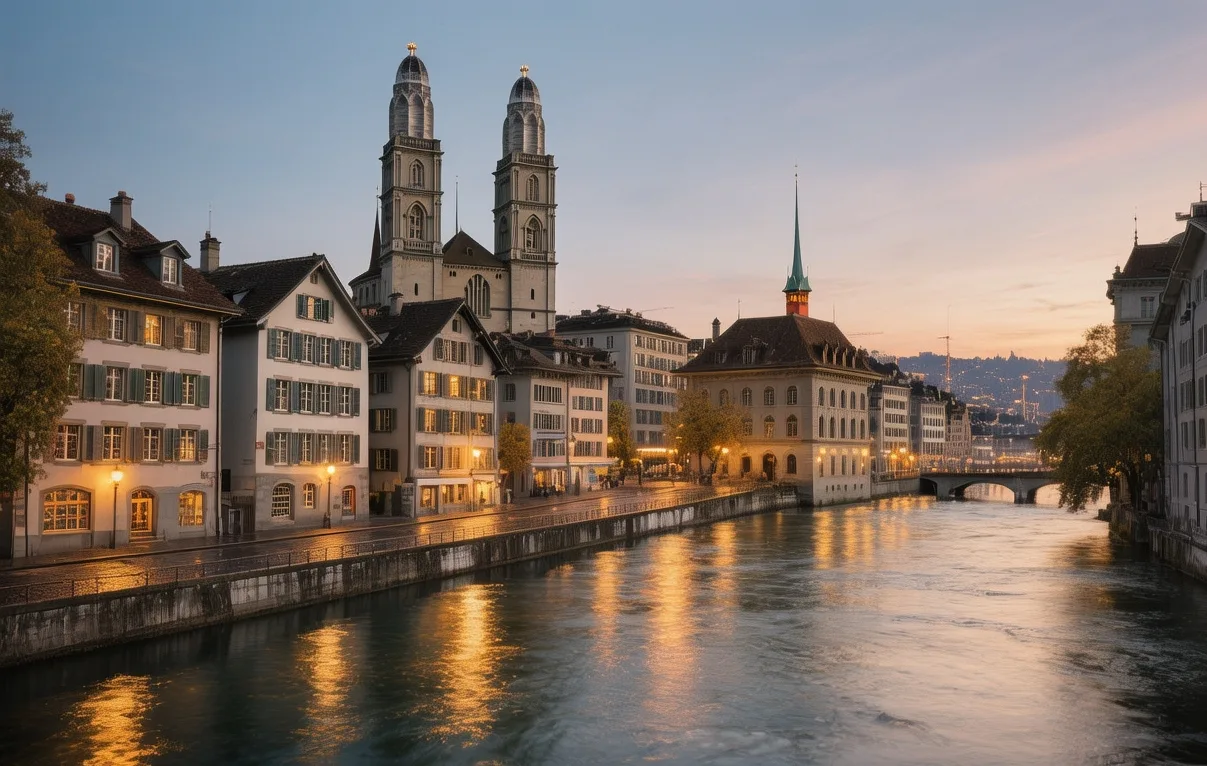
Zurich Old Town Medieval Cobblestones Meet Limmat Reflections
The bronze bells of the Grossmünster chime across the water—six distinct tones vibrating against the sandstone facades of guild houses that have stood sentinel since the 13th century. You walk along the Limmatquai, where the river flows dark and swift beneath your feet, carrying reflections of streetlamps that flicker like distant stars against the rippling surface. The air smells of roasted chestnuts and river mist, a sensory blend that defines this compact peninsula of history known as the Zurich Old Town. Cobblestones worn smooth by 800 years of footsteps guide your path through the Niederdorf district, where timber-framed buildings lean slightly inward, creating intimate alleyways that shield you from the modern world just meters away. In 1519, Huldrych Zwingli preached reform from these very pulpits, changing the course of European history; today, the same stones witness a different revolution—the quiet resistance of slow travel against the rush of digital tourism. In 2026, as cities worldwide surrender to homogenization, the Zurich Old Town remains a fortress of authenticity—a place where medieval boundaries still dictate the rhythm of life, demanding that you walk slowly, listen closely, and respect the weight of history embedded in every stone.
Why Zurich Old Town Embodies Swiss Urban Heritage
The Zurich Old Town represents a meticulously preserved urban ecosystem, solving the modern problem of historical erasure through strict preservation laws enacted in 1979. Spanning 1.5 square kilometers across both banks of the Limmat River, this district contains over 1,200 protected buildings, including the Grossmünster (built 1100–1220) and the Fraumünster (founded 853). The architecture utilizes local sandstone and oak timber, materials chosen for durability against the humid river climate and harsh Alpine winters. The guild houses—Zunfthaus zur Meisen, Zur Waag, and zur Saffran—were constructed between 1700 and 1750 to house the powerful trade associations that once governed the city's economy and politics.
Beyond aesthetics, the Old Town fulfills a cultural need for continuity in a financial capital known for innovation. The street layout remains unchanged since the Middle Ages, with narrow thoroughfares like Augustinergasse measuring only 4 meters wide, forcing pedestrian prioritization over vehicular traffic. This design naturally limits congestion, preserving the acoustic environment where church bells and fountain water dominate over engine noise. The restoration projects completed in 2018 reinforced building foundations without altering facades, ensuring structural integrity for another century. Today, the district balances function with heritage: ground floors house cafes and boutiques, while upper levels remain residential or administrative, preventing the area from becoming a sterile museum. This living heritage proves that historical preservation can coexist with modern urban vitality while maintaining the soul of the city.
The Best Time to Experience Zurich Old Town
For optimal conditions combining clear visibility, comfortable walking weather, and active cultural programming, visit between May 20–June 10 or September 5–September 20. During these windows, daytime temperatures range from 16–23°C (61–73°F), while evenings cool to 10–14°C (50–57°F). The ideal time to walk the cobblestones is 8:00–9:30 AM, when delivery trucks have cleared the streets and tour groups haven't yet arrived at the Grossmünster.
Winter visits (December–February) offer a magical atmosphere with Christmas markets, but temperatures drop to -2–5°C (28–41°F), and daylight shrinks to 8.5 hours. The Sechseläuten spring festival in April brings crowds, while summer peak season (July 15–August 15) brings temperatures up to 26°C (79°F) but also queues exceeding 45 minutes for church towers. The river breeze can make perceived temperatures feel 5°C cooler than recorded values.
Avoid these periods: August 1 (Swiss National Day fireworks create congestion and noise), December 23–26 (holiday closures limit dining options), and late July (peak tourist influx diminishes contemplative atmosphere). For real-time event schedules and weather warnings, verify conditions at zuerich.com or check the Swiss Meteo Office at meteoswiss.admin.ch before departure.
Approximate Budget for a 7-Day Trip (2026)
This budget estimate reflects mid-range travel preferences for a solo traveler or couple, based on 2026 pricing adjusted for Switzerland's 2.5% annual inflation rate (Swiss Federal Statistical Office data). Zurich is one of Europe's most expensive cities, but strategic planning with the Zurich Card offers significant value for extensive exploration including the Old Town.
Accommodation:
• Budget hostel (dorm bed): CHF 60–CHF 85 per night (Youth Hostel Zurich, near Sihlquai)
• Mid-range hotel (3-star, Old Town edge): CHF 220–CHF 310 per night (Hotel Schweizerhof or St. Gotthard)
• Upscale boutique (4-star, lake view): CHF 400–CHF 600 per night (Baur au Lac or Dolder Grand)
Food: CHF 80–CHF 120 per day
• Breakfast: CHF 20–CHF 30 (hotel buffet with Swiss muesli and cheeses)
• Lunch: CHF 30–CHF 45 (Old Town café schnitzel or street market sausage)
• Dinner: CHF 50–CHF 75 (traditional fondue at Swiss Chuchi or Zeughauskeller)
• Coffee/pastry: CHF 8–CHF 14
Transportation:
• Swiss Travel Pass (8 days, 2nd class): CHF 432 (covers trains, buses, boats, museums)
• Zurich Card (72 hours): CHF 68 (includes public transport and 50+ museum entries)
• Airport transfer (Zürich HB to Old Town): covered by Zurich Card or CHF 6.80 train ticket
• Local tram (Line 4, 11): CHF 3.80 per ride (free with Zurich Card)
Attractions:
• Grossmünster Tower Climb: CHF 10
• Fraumünster Chagall Windows: CHF 5
• Swiss National Museum: CHF 20 (free with Swiss Travel Pass)
• Lindt Home of Chocolate: CHF 25 (free with Zurich Card)
• Guided Old Town Walking Tour: CHF 35
Miscellaneous:
• Souvenirs (Swiss knife, chocolate, watch): CHF 70–CHF 200
• Travel insurance (7 days): CHF 50–CHF 80
• SIM card/data (Swisscom 10GB): CHF 45
• Emergency fund: CHF 150
Total estimated cost (mid-range): CHF 2,600–CHF 3,400 for 7 days
Budget traveler option: CHF 1,300–CHF 1,600
Luxury experience: CHF 5,500–CHF 8,000+
7 Essential Zurich Old Town Experiences
1. Grossmünster Tower Ascent: Climb the 187 steps of the Karlsturm tower at 9:00 AM for panoramic views. The spiral staircase is narrow and stone-walled, opening to a viewing platform 65 meters above the river. You see the Old Town's red-tiled roofs stretching toward the Alps. The climb takes 20 minutes. Cost: CHF 10. Wear sturdy shoes; heels are difficult on the steps.
2. Fraumünster Chagall Viewing: Enter the main nave at 10:30 AM when sunlight illuminates the five stained-glass windows designed by Marc Chagall in 1970. The blue and ruby hues cast colored shadows on the stone floor. Photography without flash is permitted. The windows depict biblical scenes in modernist style. Entry fee: CHF 5. Allow 30 minutes for contemplation.
3. Niederdorf Cobblestone Walk: Stroll the pedestrian-only Niederdorfstrasse at 2:00 PM. This 500-meter lane is lined with boutiques, cafes, and historic guild houses. Stop at Confiserie Sprüngli for Luxemburgerli macarons. The street slopes gently toward the river, offering changing perspectives of the Grossmünster. Free access. Best photographed from the middle of the street.
4. Limmat River Boat Ride: Board the white electric boat at Burkliplatz for the 30-minute cruise to Zurich HB. The vessel passes directly under the Rathausbrücke, offering low-angle views of the guild houses. Departures every 30 minutes from 10:00 AM–5:00 PM. Cost: CHF 9 (free with Zurich Card). Sit on the upper deck for unobstructed views.
5. Swiss National Museum Visit: Explore the castle-like building near Zurich HB at 11:00 AM. The collection covers Swiss cultural history from prehistoric times to present. Highlights include medieval armor and the Room of Reformation. The courtyard garden is serene. Entry: CHF 20 (free with Swiss Travel Pass). Allow 2 hours for the main exhibits.
6. Guild House Dining: Reserve a table at Zunfthaus zur Meisen for 7:00 PM. The rococo hall features original 1750 frescoes and crystal chandeliers. Order the Zürcher Geschnetzeltes (veal in cream sauce) with Rösti. The porcelain collection adorning the walls is museum-quality. Main courses: CHF 45–CHF 65. Dress code: Smart casual.
7. Lindt Home of Chocolate: Take tram 7 to Kilchberg (15 minutes) for the interactive museum. The 9-meter chocolate fountain dominates the entrance hall. Workshops teach tempering techniques. The tasting includes unlimited chocolate samples. Open daily 9:00 AM–6:00 PM. Cost: CHF 25 (free with Zurich Card). Book workshops 1 week in advance.
3 Hidden Gems Most Travelers Miss
• Wasserkirche Crypt: Located beneath the Wasserkirche church on the Limmatquai, this archaeological site reveals Roman and medieval foundations. Most visitors photograph the exterior without knowing the underground excavation exists. Access: Enter via the stairwell on the river side. Open Tuesday–Friday 11:00 AM–5:00 PM. Free entry. Insider tip: The acoustic resonance in the crypt is remarkable; speak softly to hear the echo.
• Augustinergasse Courtyard: Behind the colorful facades of Augustinergasse lies a secluded courtyard with a 16th-century fountain and views of the cathedral towers. Most tourists walk the street but miss the arched passageway between numbers 2 and 4. Access: Walk from Rennweg towards the river. Open daily 8:00 AM–7:00 PM. Quiet photography only; this is a residential space. Best visited: Early morning for soft light.
• Zunfthaus zur Waag Terrace: While the dining room is famous, the small riverside terrace offers the best view of the Fraumünster without the crowds. Access: Enter the guild house and ask for terrace access (non-diners welcome for drinks). Open April–October 11:00 AM–10:00 PM. Order a Swiss white wine (CHF 12). Insider tip: Visit at sunset when the church windows glow from internal lighting.
Cultural & Practical Tips
• Tram etiquette: Trams are punctual to the second. Wait behind the yellow line on the platform. Validate tickets before boarding if using paper tickets; digital tickets via SBB Mobile app are scanned by inspectors. Fines for fare evasion are CHF 100.
• Water fountains: Zurich has over 1,200 public fountains with potable water. Carry a reusable bottle; the water is sourced from Alpine springs and is safer than bottled water. Look for the green signs indicating drinking water quality.
• Language basics: The region speaks Swiss German. Learn these phrases: "Grüezi" (GRÜE-tsi) for hello, "Merci vilmal" (MAIR-see feel-mahl) for thank you very much, "Entschuldigung" (ent-SHOOL-dee-goong) for excuse me. English is widely spoken in tourist areas.
• Photography guidelines: Tripods are permitted in public squares but not inside churches during services. Drone usage requires FOCA authorization and is rarely granted over the Old Town. Respect privacy; do not photograph residents' windows or private courtyards.
• Sunday closures: Most shops and supermarkets close on Sundays. Museums and restaurants remain open. Plan your shopping for Monday–Saturday. Bakeries open Sunday mornings from 8:00 AM for bread and pastries.
• Tipping customs: Service charges are included in prices. Rounding up is appreciated. For a CHF 47 meal, paying CHF 50 is appropriate. For tour guides, tip 5–10% if service was exceptional. Never tip excessively.
Conclusion: Travel with Reverence, Not Just Checklists
The Zurich Old Town stands not merely as a collection of buildings, but as a living chronicle of Swiss identity—where every cobblestone remembers the footsteps of reformers, merchants, and artists who shaped a nation. As you walk the Limmatquai in 2026, listening to the tram bells mingle with church chimes, remember that this district survives because visitors respect its rhythm. Responsible travel means choosing the walking path over the tour bus, speaking softly in the courtyards, and understanding that the silence of the Wasserkirche crypt is a fragile resource worth protecting. Slow down. Sit by the fountain long enough to watch the light change on the sandstone. Leave no trace on the medieval streets. This Old Town will endure long after your visit ends, carrying the stories of future generations who seek connection with the past. Carry forward not just photographs, but a deeper appreciation for the balance between sharing our world's wonders and preserving them for those who will walk these stones in 2126.
r