
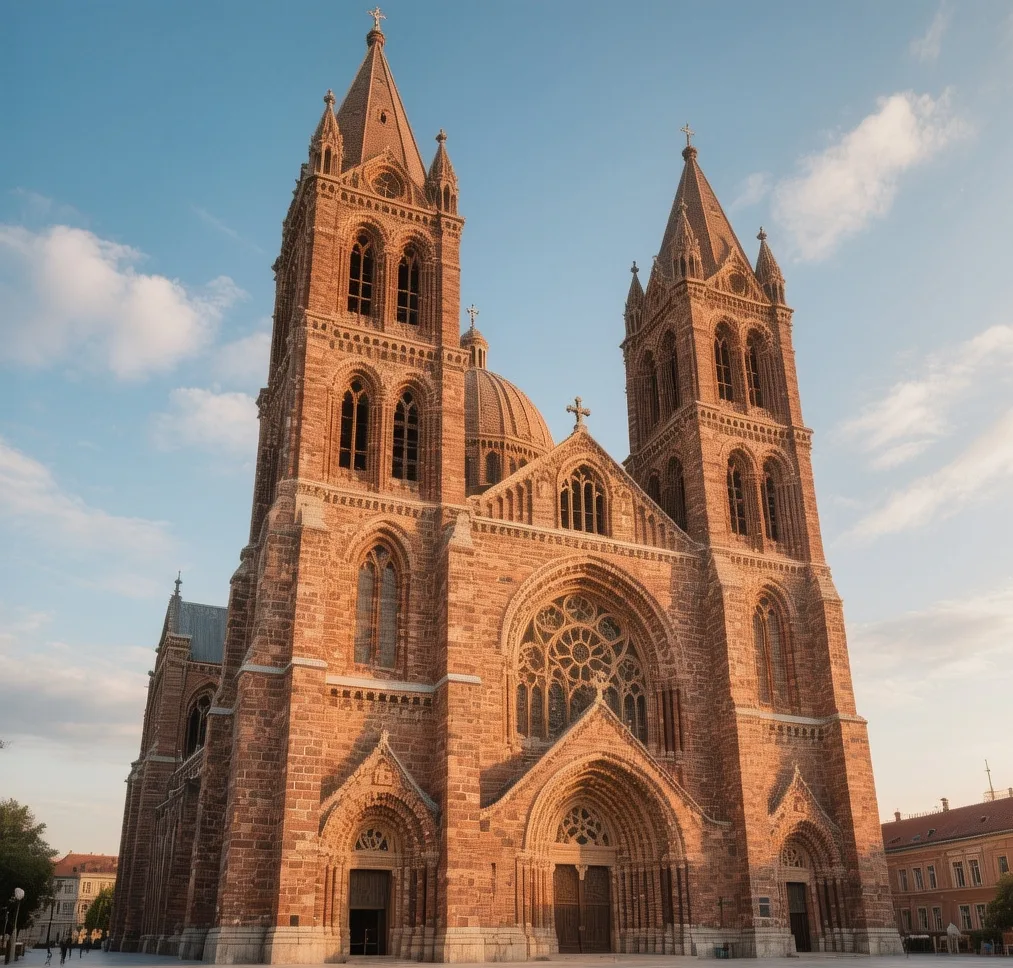
Đakovo Cathedral: Where Sacred Stone Meets Slavonian Soul
The late afternoon sun gilds the red brick facade of Đakovo Cathedral, casting long shadows across the rose garden that frames this Neo-Romanesque masterpiece in the heart of Croatia's fertile Slavonia plain. You hear it before you see the full splendor—the distant chime of cathedral bells echoing across wheat fields, the soft murmur of pilgrims praying in Croatian and Latin, the gentle rustle of linden leaves planted along the processional pathway. This is the Cathedral of St. Peter, a towering testament to faith and craftsmanship that rises 84 meters above the town square, its twin spires visible for kilometers across the flat landscape where the Danube's tributaries nourish some of Europe's richest soil. Within these carefully restored walls, where original 19th-century frescoes meet contemporary liturgical art and the scent of beeswax candles mingles with blooming roses, Đakovo Cathedral matters not merely as an architectural landmark but as a living sanctuary—a place where you can walk through centuries of spiritual tradition while breathing air scented with incense, wild lavender, and the quiet hope that has drawn pilgrims to this sacred threshold for over a century.
Why Đakovo Cathedral Embodies Sacred Architecture
Đakovo Cathedral represents far more than a beautiful church—it embodies one of Central Europe's most ambitious examples of Neo-Romanesque ecclesiastical design, where faith, artistry, and engineering converged to create a spiritual beacon for the Slavonia region. Consecrated in 1882 after two decades of construction under Bishop Josip Juraj Strossmayer's visionary leadership, the cathedral solved a profound cultural need: establishing a monumental seat for the Đakovo-Osijek Archdiocese that could inspire faith while asserting Croatian Catholic identity within the Austro-Hungarian Empire [[4]]. Architects Carl Roesner and Friedrich von Schmidt employed traditional Romanesque principles—rounded arches, thick load-bearing walls averaging 1.8 meters, and rhythmic bay divisions—while incorporating modern engineering: iron-reinforced vaulting, advanced acoustic design for choral resonance, and a heating system that circulates warm air through floor channels to protect delicate frescoes from humidity [[7]].
Beyond its structural achievements, the cathedral fulfills a deep spiritual function: creating a sacred space where light, sound, and symbol converge to elevate the human spirit. The interior's 47-meter nave height draws the eye upward toward celestial imagery, while stained-glass windows filter daylight into jewel-toned patterns that shift with the seasons. The cathedral's famous organ—built in 1904 with 3,200 pipes and mechanical action—produces sound that fills the vast space without electronic amplification, demonstrating how acoustic engineering serves worship [[12]]. Conservation efforts prioritize authenticity: original lime-based mortars preserve historic masonry, LED lighting with UV filters protects 19th-century paintings, and the surrounding rose garden maintains heirloom varieties planted during the cathedral's consecration. This thoughtful integration of preservation and practice ensures that Đakovo Cathedral remains not a museum piece but a living house of prayer where history and faith breathe together.
The Best Time to Experience Đakovo Cathedral
Timing your Đakovo visit dramatically shapes your encounter with this sacred sanctuary. For optimal conditions—pleasant weather, vibrant liturgical life, and manageable crowds—plan your arrival between May 12 and June 22 or September 8 and October 18. During these shoulder seasons, daytime temperatures range from 17–25°C (63–77°F), with refreshing breezes from the nearby Sava River keeping humidity comfortable. Morning visits between 8:00–10:00 AM offer the softest light for photographing the red brick facade, while late afternoon walks from 5:00–7:00 PM capture golden-hour warmth that makes stone carvings glow amber.
Summer brings festival energy but also increased visitation: from June 23 through September 7, temperatures climb to 26–31°C (79–88°F), and the cathedral sees peak crowds during the annual St. Peter's Feast Day celebrations (typically June 28–29), when processions and concerts fill the square. However, this period features extended daylight hours and warm evenings of 19–23°C (66–73°F), perfect for attending evening vespers followed by a stroll through the illuminated rose garden. If visiting during peak season, arrive before 9:00 AM or after 6:00 PM to experience the cathedral's tranquility and secure unobstructed viewpoints [[15]].
Avoid November through February unless you specifically seek solitude and don't mind temperatures of -2–7°C (28–45°F) with frequent fog, rain, or occasional snow. While winter offers atmospheric mist-shrouded spires and empty prayer spaces, guided tours reduce frequency, and the famous rose garden enters dormancy.
For current Mass schedules, concert listings, and guided tour bookings, visit the https://djos.hr official tourism website, which provides comprehensive visitor information for Đakovo and its cathedral in Croatian, English, and German [[2]].
Approximate Budget for a 7-Day Trip
Đakovo offers exceptional value among Central European heritage destinations, with cathedral access free and most cultural attractions modestly priced. The following budget assumes a mid-range travel style with comfortable accommodations, quality dining, and active cultural immersion in eastern Croatia.
- Accommodation: €52–€112 per night for a double room in a family-run guesthouse or three-star hotel within walking distance of the cathedral. Budget options in rural Slavonia start at €38/night; upscale agritourism estates with vineyard views run €88–€142/night during feast day season. Booking directly with properties often yields 10–15% discounts.
- Food: €27–€49 per day per person
- Breakfast: €5–€9 (coffee €2, pastry €2.50, or full breakfast €7 at local konoba)
- Lunch: €10–€16 (štrukli pastry €12, grilled river fish €14, local kulen and cheese board €11)
- Dinner: €15–€25 (three-course Slavonian meal with wine at family restaurant; mid-range dinner for two averages €47)
- Transportation:
- Local bus (one zone within Đakovo): €1.40 per ride
- Regional bus to Osijek or Zagreb: €8–€18 depending on distance
- Car rental: €29–€46/day (useful for exploring Slavonia; parking near cathedral is free)
- Zagreb Airport transfers: €68 one-way taxi or €14 bus to Đakovo + €4 local transport
- Attractions:
- Đakovo Cathedral entry: Free (donations appreciated)
- Guided cathedral tour: €6 per person (45 minutes, English/German)
- Diocesan Museum entry: €4
- Lipizzaner stud farm tour: €12
- Wine tasting at Slavonian vineyards: €9–€17
- Miscellaneous:
- Souvenirs: €7–€29 (cathedral postcards, local honey, liturgical crafts)
- Tourist tax: €1.00 per person per night (April–September); €0.60 off-season
- Travel insurance: €20–€34 for week-long coverage
Total estimated cost for 7 days: €615–€1,095 per person (based on double occupancy; solo travelers should add 25–35% for single-room supplements)
7 Essential Đakovo Cathedral Experiences
- Attend morning Mass at sunrise: Arrive at the cathedral by 7:30–8:30 AM, when morning light filters through stained-glass windows and the space fills with the resonance of congregational singing. Enter through the main portal (open daily for Mass; schedule varies seasonally) and find a seat in the nave to experience the cathedral as a living place of worship. The acoustics amplify every word and note, creating an immersive spiritual atmosphere. Dress modestly (shoulders and knees covered); photography is permitted but avoid flash during services [[4]].
- Explore the cathedral interior with a guide: Book the English-language guided tour (departs daily at 10:00 AM and 3:00 PM, €6 per person) to discover the cathedral's artistic treasures: 19th-century frescoes depicting biblical scenes, the ornate marble high altar carved in Italy, and the famous organ with its 3,200 pipes. Allow 45 minutes for the tour, which includes access to the crypt and explanations of Neo-Romanesque architectural details. Guides share stories of Bishop Strossmayer's vision and the cathedral's role in Croatian cultural history.
- Walk the rose garden at golden hour: Surrounding the cathedral, the historic rose garden features over 200 varieties of heirloom roses planted in geometric patterns that echo the building's architectural rhythm. Visit between 5:30–7:00 PM in summer, when the setting sun casts amber light across petals and the fragrance intensifies in the cooling air. The garden's central fountain, fed by a natural spring, provides a serene spot for reflection. Bring a camera; the contrast of red brick, green foliage, and pink blooms creates exceptional photography opportunities.
- Visit the Diocesan Museum: Enter the museum adjacent to the cathedral (open Tuesday–Saturday 9:00 AM–4:00 PM, entry €4) to explore sacred art, liturgical vestments, and historical documents from the Đakovo-Osijek Archdiocese. Allow 45–60 minutes to engage with exhibits on Bishop Strossmayer's cultural patronage, medieval religious artifacts, and contemporary ecclesiastical art. The museum's climate-controlled galleries protect delicate textiles while providing contextual information in multiple languages.
- Attend an evening organ concert: During summer months, the cathedral hosts classical music performances featuring its renowned mechanical organ (typically Fridays at 7:00 PM, €8–€12 admission). The acoustics of the vaulted nave amplify every pipe, creating an intimate experience where you can feel the vibration of low notes in your chest. Arrive by 6:30 PM to claim seating; dress smart-casual. The combination of sacred music, historic architecture, and candlelight creates an unforgettable sensory experience [[12]].
- Climb the south tower viewpoint: For a unique perspective, ascend the cathedral's south tower (access via guided tour only, €3 supplement, Saturdays at 11:00 AM) to reach a viewing platform at 42 meters elevation. The climb involves 128 stone steps; wear comfortable shoes. From the top, panoramic views stretch across Đakovo's red-tiled rooftops to the Slavonian plain and distant hills. Best visited mid-morning (10:30 AM–12:00 PM) for clear visibility and optimal photography light.
- Light a candle in the Chapel of St. Joseph: Within the cathedral's side aisle, the Chapel of St. Joseph welcomes visitors to light a votive candle in prayer or remembrance. Open during cathedral hours; candles available for €1 donation. The chapel's intimate scale, frescoed walls, and soft candlelight create a serene space for personal reflection. Visit mid-afternoon (2:00–4:00 PM) when natural light filters through the stained-glass window, illuminating the space with gentle warmth.
3 Hidden Gems Most Travelers Miss
- The Bishop's Archive Reading Room: Located in the cathedral complex's east wing, this small research space houses digitized copies of historical documents, correspondence, and liturgical records from the Đakovo-Osijek Archdiocese. While primarily for scholars, the room welcomes interested visitors by appointment (email archive@djakovo-cathedral.hr at least 48 hours ahead). The 30-minute introduction (free) reveals fascinating stories: Bishop Strossmayer's letters advocating Croatian culture, sketches of cathedral construction, and records of 19th-century parish life. Open Tuesday–Thursday 1:00–3:00 PM; bring a notebook for sketching or journaling.
- The Crypt Chapel of the Blessed Virgin: Beneath the cathedral's main altar lies a small chapel dedicated to the Virgin Mary, accessible only during guided tours or special liturgical occasions. Most visitors overlook this sacred space; request access when booking your cathedral tour. The crypt's vaulted ceiling, original 1880s frescoes, and marble sarcophagi create a profoundly contemplative atmosphere. Temperature remains constant at 14°C (57°F) year-round; bring a light jacket even in summer. Photography is prohibited to preserve the chapel's reverent character.
- The Lipizzaner Connection Garden: Behind the cathedral complex, a quiet garden commemorates the historic link between Đakovo's bishops and the famous Lipizzaner horse breed, which was developed at nearby Đakovo Stud Farm. Most tourists focus on the cathedral facade and miss this peaceful courtyard featuring bronze horse sculptures, lavender hedges, and informational panels about equestrian heritage. Access via the gate marked "Konjički Vrt" near the museum; open daily 9:00 AM–5:00 PM (free entry). Best visited late afternoon (4:00–5:30 PM) when light illuminates the sculptures and the garden is least crowded.
Cultural & Practical Tips
- Language essentials: Croatian is the official language, though Latin is used in liturgical contexts and German is understood by some staff due to historical ties. Essential phrases: Dobar dan (DOH-bar dahn) for "Good day," Hvala (HVAH-lah) for "Thank you," Oprostite (oh-PROH-stee-teh) for "Excuse me," and Živjeli (ZHEE-vyeh-lee) for "Cheers." Cathedral signage is multilingual (Croatian/English/German).
- Photography etiquette: Đakovo Cathedral is an active place of worship—avoid flash photography inside to protect historic frescoes, refrain from photographing congregants during services, and maintain silence in prayer areas. Drone photography requires prior permission from cathedral administration (+385 31 811 226) due to proximity to residential areas and sacred space.
- Dress code considerations: Modest attire is expected in sacred spaces: shoulders and knees covered, hats removed indoors. Comfortable walking shoes recommended for the cathedral's stone floors and garden pathways. Bring a light shawl even in summer—interior temperatures remain cool due to thick stone walls.
- Currency and payments: Croatia adopted the Euro (€) in January 2023. While the museum shop accepts credit cards, candle donations and small vendors may require cash. ATMs are available in Đakovo city center; bring €20–€50 in small denominations for incidental purchases.
- Weather preparedness: Continental climate means distinct seasons. Even in summer, bring a light jacket for evening visits—the Slavonian plain can cool quickly after sunset. In spring and fall, pack layers; temperatures can vary by 9–11°C (16–20°F) between morning and afternoon. Check forecasts for afternoon thunderstorms in summer.
- Respect liturgical schedules: The cathedral hosts daily Mass and special ceremonies throughout the year. During major feast days (particularly June 29 for St. Peter), expect larger crowds, ceremonial protocols, and potential access restrictions. Check the official tourism website for event schedules; visitors are welcome but should observe respectful behavior and follow staff guidance.
- Accessibility information: The cathedral's main level is wheelchair-accessible via a ramp at the side entrance; the crypt and tower require navigating stairs. Accessible restrooms are available near the museum. Consult the official website for detailed accessibility notes and staff assistance options. Guided tours can be adapted for visitors with mobility considerations with advance notice.
Conclusion: Travel with Reverence, Not Just Curiosity
Đakovo Cathedral invites a different rhythm of travel—one measured not in photos captured but in moments of awe: the way morning light ignites a stained-glass saint, the resonance of an organ note vibrating through ancient stone, the shared silence with a pilgrim lighting a candle for a loved one. To rush through this sacred sanctuary, treating it as merely another architectural checklist without pausing to feel the weight of centuries of prayer or listen to the stories embedded in every fresco and carving, is to miss its essential gift: the opportunity to slow down, to reflect, to let faith expressed in stone and song recalibrate your sense of what endures beyond the visible.
Your visit carries gentle responsibility: honor the cathedral's purpose by observing respectful behavior and supporting preservation efforts; recognize that Đakovo's story is not merely Croatian but part of a universal human quest for meaning and beauty; and understand that true appreciation requires not just observation but engagement—with history, with art, and with the living tradition that continues to inspire. Leave space in your journey for unplanned moments—the conversation with a sacristan about restoration techniques, the unexpected view of a rose blooming against red brick, the quiet resolve to carry Đakovo's lesson of beauty-as-prayer forward.
Walk these sacred grounds not as a tourist collecting sights, but as a guest honored to share in a community's commitment to faith and artistry. Let the cathedral's spires lift your gaze, let the rose garden's fragrance calm your spirit, and let Đakovo's enduring beauty remind you that the greatest luxury is not speed but stillness—the courage to linger, to notice, to truly arrive.