
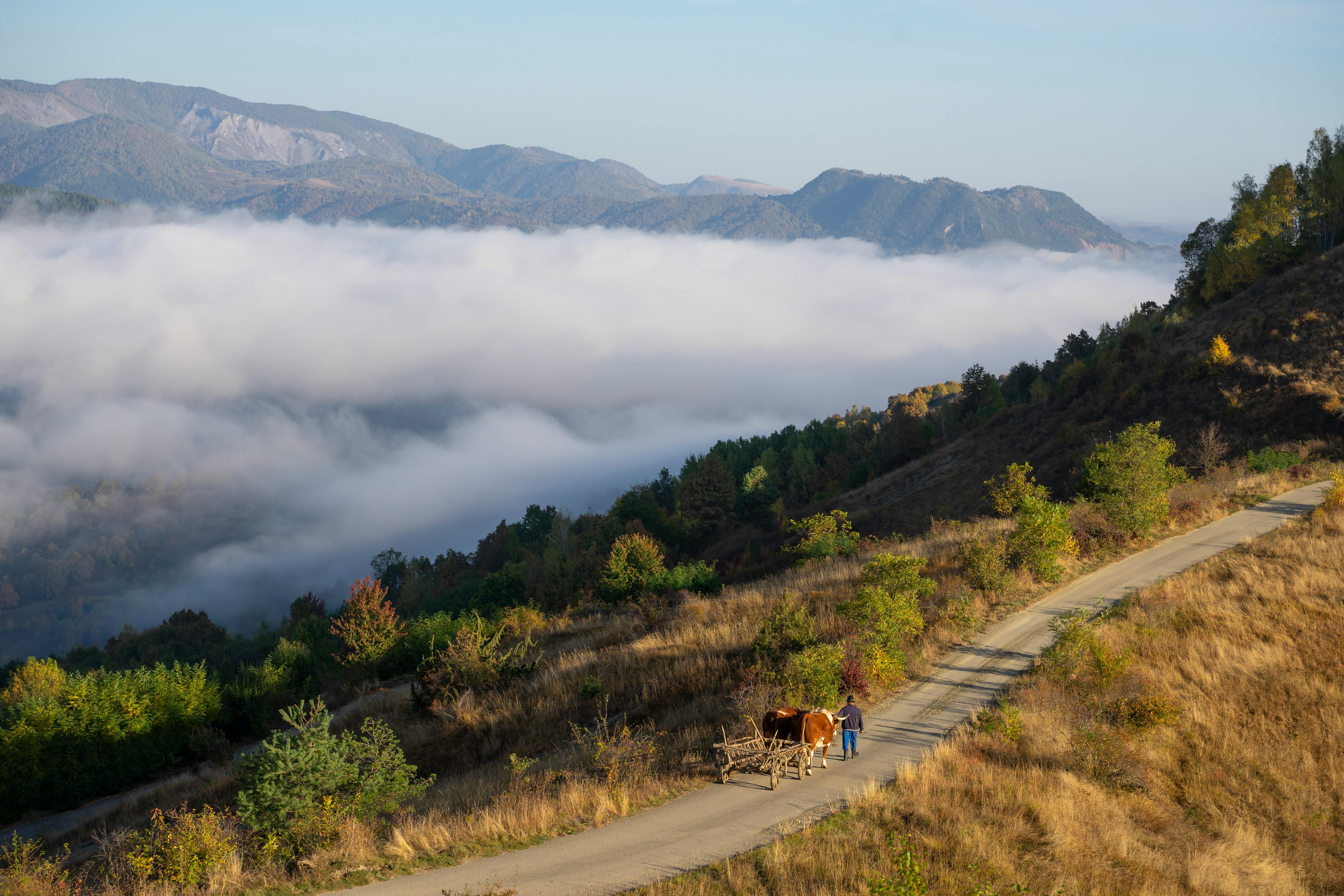
Apuseni Mountains: Where Underground Glaciers Meet Ancient Karst
The air turns cold at the cave mouth—a sudden drop from summer's warmth to a perpetual 0°C (32°F) inside. You zip your jacket, flick on your headlamp, and step into Scarisoara Ice Cave, where a 25,000-cubic-meter block of glacial ice has remained frozen for over 3,500 years . The Apuseni Mountains—Romania's "Western Mountains"—are home to approximately 400 caves, one of Europe's densest concentrations of karst formations, their limestone bedrock carved by eons of water into a labyrinth of underground rivers, vertical shafts, and cathedral-like chambers . The highest peak, Bihorul, rises to 1,849 meters (6,066 feet), but the true wonders lie beneath the surface . Here, you will find Europe's second-largest cave hall—the Hall of Giants in Humpleu Cave, measuring 750 meters long, 111 meters wide, and 35 meters high . You will descend into Romania's deepest cave, V5, which plunges 653 meters (2,142 feet) into the earth . The Apuseni are not a single range but a collection: the Bihor Mountains with their high-altitude Padiș Plateau, the Trascău Mountains with their dramatic gorges, and the Metaliferi ("Ore") Mountains, named for the gold and silver that once drew Roman miners . This is not just caving; it is a journey to the center of Transylvania.
Why the Apuseni Caves Embody the Majesty of European Karst
The Apuseni Mountains solved a geological paradox: how to create the densest concentration of ice caves on the continent without permafrost . The answer lies in the region's unique "cold trap" phenomenon. Winter air, dense and frigid, flows into cave entrances and sinks to lower chambers, where it becomes trapped by warmer air above, creating permanent ice accumulations even at altitudes as low as 1,000 meters . At Scarisoara Ice Cave, discovered in 1863, this process has preserved an underground glacier that scientists have dated to over 3,500 years using radiocarbon analysis of buried plant remains . The cave's three separate ice blocks—one of which is 22 meters (72 feet) thick—contain layers of climate history stretching back to the Bronze Age . On the Padiș Plateau, a 36-square-kilometer karst wonderland, water behaves in ways that defy surface logic . Rain that falls on the plateau vanishes into sinkholes, travels underground for kilometers, and resurfaces at unexpected points—such as the Ponor spring, where a stream emerges from the rock, meanders across a meadow, and then disappears back into a sinkhole in a continuous loop . The region also holds the deepest cave in Romania, V5, discovered in 1986, with 20 kilometers of mapped passages and a 653-meter vertical drop . The connection between V5 and the Frigiderul lui Gigi (Gigi's Refrigerator) cave, discovered in 2008, suggests a 50-kilometer underground network beneath the plateau . These are not tourist attractions; they are active research sites, where speleologists continue to push deeper into the earth.
The Best Time to Experience the Apuseni Underground
The caves of the Apuseni Mountains offer two distinct seasons, each with advantages and challenges. Summer—from May 1st through September 15th—is the prime window for cave exploration and hiking combined. During these months, surface temperatures range from 19°C to 26°C (66°F–79°F), while cave interiors remain at a constant 0°C to 10°C (32°F–50°F) depending on depth . The warm surface weather makes the approach treks comfortable, but you will need warm layers underground—Scarisoara Ice Cave maintains temperatures below freezing even in August. July and August offer the longest daylight hours for hiking, but crowds at the most accessible caves (Scarisoara, Bear Cave, Vârtop) peak. Autumn—September 15th through October 31st—provides cooler hiking temperatures (14°C–20°C/57°F–68°F) and thinner crowds, but some cave tours may operate on reduced schedules . For photographers, the late afternoon (3:00–5:00 PM) at Scarisoara is magical, when sunlight streams through the collapsed ceiling opening, illuminating the ice block in shifting colors . Winter—December through February—is for experienced mountaineers only; the access roads to the Padiș Plateau are often impassable due to snow at altitudes above 1,200 meters . Spring—March through April—brings snowmelt, which can make cave approaches muddy and dangerous. Always check with the Apuseni Nature Park administration before planning your visit.
Approximate Budget for a 7-Day Apuseni Caving & Hiking Trip
This budget assumes a mid-range trip based in the Padiș Plateau, Arieșeni, or Chișcău villages, including guided cave tours and self-guided hiking. Romania remains one of Europe's most affordable destinations for adventure travel.
- Accommodation: 150–350 RON (€30–€70) per night. Budget: Cabana Cetățile Ponorului (mountain refuge on Padiș Plateau), 60–80 RON (€12–€16) per night in dormitory . Mid-range: Pensiunea Casa de Piatră in Gârda Seacă, 200–300 RON (€40–€60) for a double room . Luxury: Pensiunea Aurora in Arieșeni, 350–500 RON (€70–€100) with spa facilities.
- Food: 100–180 RON (€20–€36) per day. Breakfast 25–35 RON (€5–€7): included in most guesthouses—local cheeses, bread, eggs, and house-made jams. Lunch 40–60 RON (€8–€12): packed picnic from village markets or a hot meal at a mountain cabana. Dinner 50–70 RON (€10–€14): traditional ciorbă de burtă (tripe soup), grilled trout, or mici (grilled sausages) with mămăligă (polenta). Warm cheese pies from roadside vendors: 8–12 RON (€1.60–€2.40) each—perfect for cave approach snacks .
- Transportation: Car rental from Cluj-Napoca or Oradea airports: 150–200 RON (€30–€40) per day. The Transapuseana road (DJ750) connects the main bases but is narrow and winding; avoid night driving. Local bus to Arieșeni from Cluj: 40–60 RON (€8–€12).
- Attractions: Scarisoara Ice Cave entry: 25 RON (€5). Bear Cave (Chișcău): 30 RON (€6) including guide. Coiba Mare (self-guided, no fee). Cetățile Ponorului (free access). Humpleu Cave: not open to tourists (scientific reservation). V5 vertical cave: closed to non-speleologists . Helmets and headlamps are provided at show caves; bring your own if visiting undeveloped caves.
- Miscellaneous: Detailed hiking map of Padiș Plateau (1:25,000 scale): 30 RON (€6). Headlamp with extra batteries (essential for undeveloped caves): 50–150 RON (€10–€30) at local sports shops. Hand-carved wooden souvenir from Arieșeni market: 15–40 RON (€3–€8).
Total estimated 7-day budget (including accommodation, meals, car rental, and cave entries): 1,900–3,300 RON (€380–€660) per person. (Excluding international flights.)
7 Essential Apuseni Cave Experiences
- Descend into Scarisoara Ice Cave at Midday: The oldest and most accessible ice cave in the Apuseni—and one of Europe's most remarkable—Scarisoara contains an underground glacier that has persisted for over 3,500 years [citation:8]. Descend the 110 steps into the cavern and walk on the 22-meter-thick ice block, its surface carved by centuries of melt-and-freeze cycles into ripples and terraces. The cave's three chambers: the Great Hall, the Church, and the Muddy Chamber. No photography with flash; the ice reflects light intensely, and the guides will enforce this rule. Wear warm clothes, even in July.
- Stand Beneath Coiba Mare's "Great Portal" at Golden Hour: Located in the Gârda Seacă Valley, Coiba Mare—"Big Hut"—holds the largest cave portal in Romania [citation:10]. The entrance measures approximately 40 meters wide and 25 meters high (131 by 82 feet), a gaping limestone mouth that feels cathedral-like even before you step inside. The walk from the parking area (at the official Apuseni Natural Park entry point) takes 2-3 minutes. Descend carefully; the trail can be slippery. Inside, daylight penetrates only the first few meters; bring a strong headlamp to explore the main chamber. Coiba Mică lies 200 meters away, its water flowing underground toward the resurgence at Izbucul Tăuz [citation:10].
- Explore the "Wonder Fortress" of Cetățile Ponorului: The signature sight of the Padiș Plateau, Cetățile Ponorului (translated as "Fortresses of Ponor" or "Wonder Fortress") is a massive collapse sinkhole where a cave ceiling has fallen in, leaving vertical limestone walls that expose multiple cave passages at different heights . Access requires descending by chains—a thrilling but safe descent for reasonably fit hikers. The main chamber, called "Csodavár" (Wonder Fortress) in Hungarian, has an opening of approximately 60 by 40 meters and a depth of about 50 meters. From the bottom, you can see three cave mouths at different levels, including the one that marks the underground course of the Ponor stream. The site is free, unticketed, and unforgettable.
- Tour the Bear Cave at Chișcău—A Fossil Treasure: One of Romania's most famous show caves, Bear Cave (Peștera Urșilor) was discovered in 1975 during quarrying operations and opened to the public in 1980 [citation:8]. The cave earned its name from the remains of over 140 cave bears (Ursus spelaeus), an extinct species that used the cavern as a den—and, for some, a grave. The fossils, now mounted in the cave's "Bear Cemetery," date back approximately 15,000 years. The guided tour takes 45 minutes, follows a 500-meter loop, and includes the stunning "Candelabra" stalagmite formation. The cave maintains a constant 10°C (50°F); a light jacket is sufficient.
- Seek the "Living Fire" Reflection at Focul Viu Cave: On the Padiș Plateau, the Focul Viu Cave—"Living Fire"—is named for the way sunlight reflects off the ice surfaces during midday hours, creating the illusion of flickering flames [citation:2]. The cave contains 25,000 cubic meters of permanent ice structures, studied by scientists for decades. The two-hour approach trek crosses the plateau; proper footwear is essential. Unlike Scarisoara, which is developed for tourism, Focul Viu retains a wilder character, with fewer visitors and no stairs or railings. The cave functions as a natural cold trap, where winter air flows inside and remains captured, maintaining freezing temperatures throughout the year [citation:2].
- Find the Great Cave on Jilip Hill—Accessible from the Road: The Great Cave on Jilip Hill (Peștera Mare de pe Dealul Jilip) is a hidden treasure located just two meters from the roadside in the Gârda Seacă Valley . Unlike the major show caves, this one is undeveloped: no ticket booth, no guides, no lights. Bring a strong headlamp. Inside, the damp walls shimmer like diamond-encrusted surfaces in the beam of your flashlight, thanks to naturally formed condensation. Several families of bats find shelter in the darkness . Visitors are asked to remain quiet inside to avoid disturbing them. Access is free, but the cave's unmarked entrance is easy to miss; look for a small opening in the limestone wall about chest height, then crawl through the short passage into the main chamber.
- Follow the Ponor Water Loop from Spring to Sinkhole: The Padiș Plateau's most remarkable above-ground karst feature is the Ponor meadow, where water performs an impossible trick. The Ponor spring (Izbucul Ponor) emerges from the limestone, forming a small stream that meanders across a broad, grassy meadow . After flowing on the surface for several hundred meters, the stream encounters a series of sinkholes—"ponors"—and disappears back underground, continuing its subterranean journey toward the Galbena Gorge. This is not a cave; it is a karst phenomenon visible on the surface. The walk from the Glavoj meadow to the Ponor meadow takes approximately 40 minutes on a marked trail. The best time to see the full loop is in April–June, when spring snowmelt increases the flow. By late August, the surface stream may be dry, the water having found a deeper subterranean route.
3 Hidden Gems Most Travelers Miss
- Humpleu Cave—Europe's Second-Largest Hall (Closed to Tourists, but You Can Stand at the Entrance): Humpleu Cave (Peștera Humpleu) is a Category A scientific reservation—the highest level of protection—and is not open for tourist visits . However, the trail to its entrance is accessible, and standing at the cave mouth looking into the darkness is an experience in itself. Inside, the Hall of Giants measures 750 meters long, 111 meters wide, and 35 meters high—the second-largest cave chamber in Europe—and the cave's explored passages exceed 35 kilometers in length [citation:9]. Three levels of passages include an upper dry level with the most beautiful formations, a middle level, and a lower active level with a river flowing at 3,000 liters per second . Entry is prohibited without authorization from the Apuseni Nature Park; the cave is strictly protected for scientific research. But the approach trail from the Firei Valley is worthwhile even without entering.
- Izbucul Tăuz—The Turquoise Karst Spring: Most tourists rushing between caves miss this hidden gem entirely. Located just outside Remetea Village in Bihor County, Izbucul Tăuz is a karst spring where underground water emerges from the limestone into a pool of astonishing turquoise blue [citation:10]. The color is natural, caused by dissolved limestone particles suspended in the water. In summer, the turquoise is vivid; in autumn, lower water levels reveal the spring's layered geology. The walk from the road is easy (approximately 15 minutes round trip). Locals here know the secret connections: the water that vanishes underground at Coiba Mică resurfaces here, having traveled 5 kilometers through the mountain's veins .
- The "Labyrinth of Giants" Legend at Vârtop Cave: While Vârtop Cave (Wind Cave) is a show cave, most visitors rush through the developed section without asking about the "Labyrinth of Giants." According to local legend, the cave was once inhabited by a race of giants, and the massive stalagmites in the undeveloped eastern branch—visible only to researchers and invited cavers—are their petrified bodies . The developed section is impressive enough: a complex network of passages formed by an underground river, with stalactite curtains that rang like bells when struck (touching is now prohibited). Ask the guide about the Labyrinth; if they have time and are willing, they may point out the narrow side passage that leads to the restricted zone. You will not be allowed in, but hearing the story adds a layer of myth to the stone.
Cultural & Practical Tips
- Guided Show Caves Require Patience (and Cash): Scarisoara, Bear Cave, and Vârtop operate on guided tours only—you cannot enter independently. Arrive early (before 10:00 AM) to secure a spot; summer weekends fill by midday. Tickets are cash-only; the nearest ATMs are in Arieșeni (for Scarisoara) or Chișcău (for Bear Cave) and may not always function . Bring small bills; guides often cannot make change for large notes.
- Undeveloped Caves Demand Preparation: Coiba Mare, Coiba Mică, Cetățile Ponorului, and the Great Cave on Jilip Hill have no lights, no railings, no guides. You must bring: a headlamp (not a phone flashlight—you need both hands free), ideally two sources of light, sturdy boots with ankle support, and a helmet for low passages. Never enter undeveloped caves alone; never exceed your competence level; always tell someone your route and expected return time . The Apuseni karst is riddled with vertical shafts (avenuri) that drop 50 meters or more; stay on marked paths unless you are an experienced caver.
- Cold Inside—Even in August: Ice caves maintain 0°C (32°F) year-round. Dry caves (Bear Cave, Coiba Mare) are cooler than the surface but not freezing—approximately 8°C–12°C (46°F–54°F). Bring layers: a fleece or light down jacket, a warm hat, and gloves for ice caves. Leave the cotton at home; synthetics or wool perform better in damp cave environments.
- Respect the Bats: Many caves in the Apuseni shelter bat colonies, including several species of horseshoe bats (Rhinolophus) and mouse-eared bats (Myotis). If you see them—clustered on cave ceilings or walls—do not shine your light directly at them; disturbance can wake them from hibernation, depleting the fat reserves they need to survive winter. In caves with visible bat colonies (the Great Cave on Jilip Hill, certain chambers of Bear Cave), remain quiet, move slowly, and minimize time inside . The bats were here first; you are a guest.
- The Padiș Plateau Roads Are Not for Beginners: The road to the Padiș Plateau—starting from Pietroasa—is unpaved for the last 12 kilometers, narrow, winding, and subject to washouts after heavy rain. A standard car can manage it in dry conditions, but clearance helps. After rain, the road becomes slippery and deeply rutted; many tour operators recommend four-wheel drive . Monitor weather forecasts before attempting the drive, and plan to arrive before dark. Night driving on these roads is not recommended; guardrails are absent, and drops are sheer.
- Learn Two Romanian Phrases for the Caves: "Mulțumesc" (Mool-tzu-mesk) means thank you—essential after every guide's explanation. "Peșteră" (Pesh-teh-ruh) means "cave." "Unde este intrarea?" (Oon-deh yes-teh een-tra-reh-ah?) means "Where is the entrance?"—useful for undeveloped caves. A friendly "Noroc" (No-roke) to shepherds you meet on the plateau means "Cheers" and serves as a general greeting.
Conclusion: Travel With Wonder, Not Just a Headlamp
There is a temptation to treat the Apuseni caves as a checklist—to see the ice at Scarisoara, the fossils at Bear Cave, the portal at Coiba Mare, and consider the underworld "done." But the true value of this limestone labyrinth lies not in its individual chambers but in its continuity. The 25,000 cubic meters of ice in Focul Viu did not freeze in a single winter; they accumulated over millennia, one molecule at a time, each layer capturing a history of climate and faith. The 35 kilometers of passages in Humpleu were carved not by human hands but by water—patient, indifferent, relentless water, working for eons to create a hall that can hold a football field and still have room for spectators. To explore these caves is to understand scale: your life measured against an ice block's 3,500 years, your height against a stalagmite's 15,000-year growth. Step carefully. Touch nothing that is not already broken. Leave the caves as you found them—dark, cold, and full of wonder. The Apuseni do not need you to conquer them. They only ask that you remember, when you emerge blinking into the sunlight, that most of the world is still underground, hidden, and patient.