
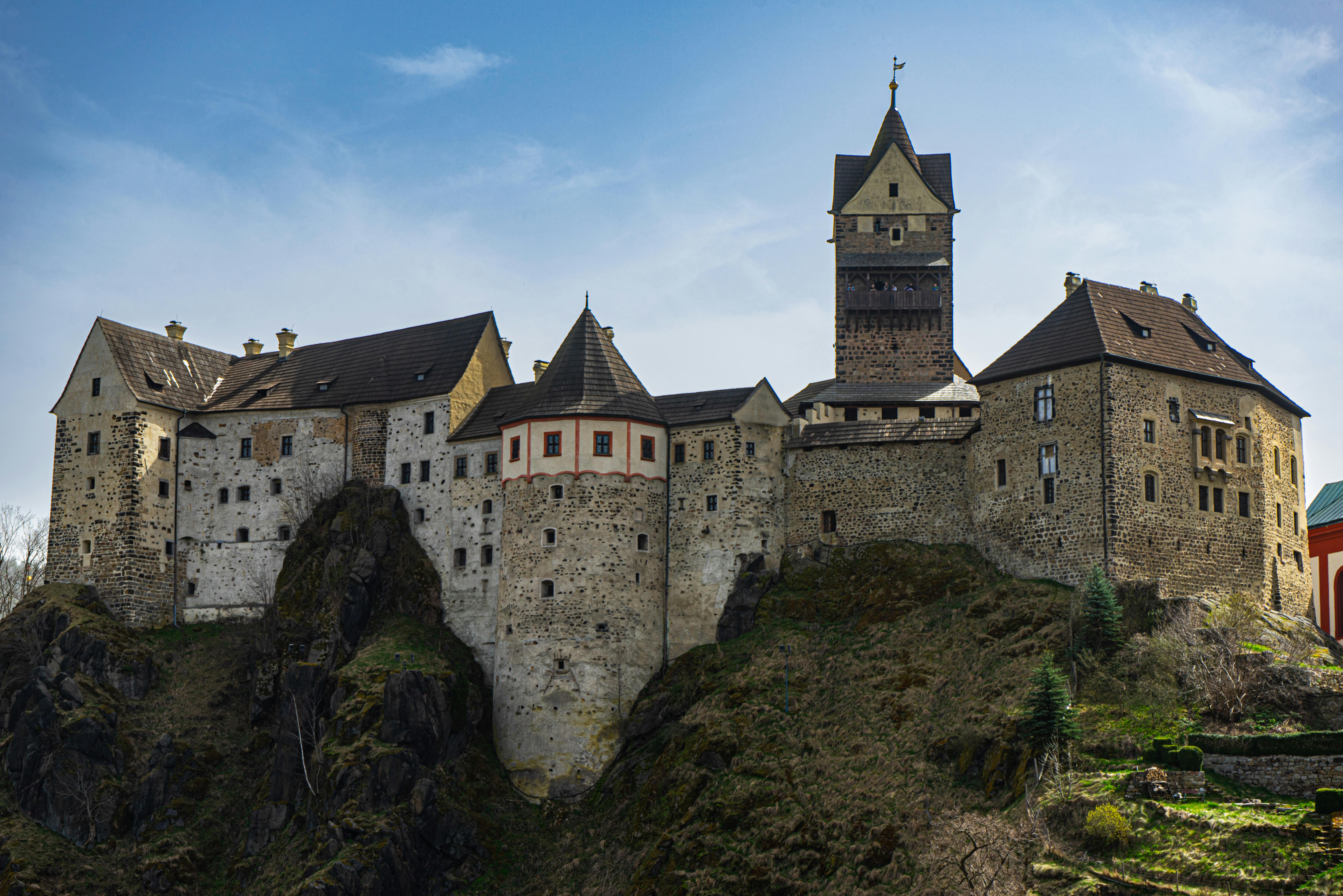
Loket Castle: Where Medieval Stone Meets Bohemian River Mist
Morning fog curls around the castle's granite foundations as the Ohře River flows silently below—its surface mirroring the twelve-meter-high defensive walls that have stood sentinel since the 12th century. You climb the narrow stone staircase, your footsteps echoing against vaulted ceilings worn smooth by eight centuries of footsteps, while the scent of aged timber and river damp fills the air. Sunlight breaks through the mist, illuminating the castle's distinctive round tower—47 meters tall, built without mortar in some sections—and casting long shadows across the cobblestone courtyard where knights once trained. This is Loket, a fortress so impregnable that Hussite armies besieged it unsuccessfully for months in 1434, and so strategically perfect that it guards the only natural crossing point along this stretch of the Ohře valley. The castle isn't merely a relic; it's a living chronicle carved in stone, where every arrow slit, every worn step, every fresco fragment whispers stories of kings, rebels, and ordinary souls who sought refuge within these walls. Here, history doesn't sit behind glass—it surrounds you, tangible and breathing.
Why Loket Castle Embodies Medieval Resilience
Loket Castle represents one of Central Europe's most remarkably preserved Gothic fortresses, a testament to engineering ingenuity born from necessity. Founded between 1100–1150 under Duke Soběslav I of Bohemia, the castle solved a critical strategic problem: controlling the Ohře River trade route while defending the western frontier of the Bohemian kingdom. Built atop a nearly inaccessible granite promontory rising 35 meters (115 feet) above the river, the fortress leverages natural topography as its primary defense—three sides drop vertically to the water, requiring attackers to approach only from the narrow landward neck, where defenders concentrated their fortifications.
The architectural details reveal sophisticated medieval engineering: the castle's distinctive oval layout follows the rock's contours, minimizing blind spots for archers; the 2.8-meter-thick (9.2-foot) outer walls incorporate hidden drainage channels to prevent frost damage; and the Great Tower's spiral staircase reverses direction mid-ascent—a deliberate design to disadvantage right-handed attackers climbing during sieges. Historical records document major expansions under King Ottokar II (1253–1278) and Renaissance modifications by the Šlik family (15th–16th centuries), yet the core Gothic structure remains intact. The castle's survival through the Thirty Years' War, Napoleonic conflicts, and two World Wars speaks to both its strategic importance and the meticulous conservation efforts of the Czech State Heritage Institute since 1945. Today, Loket fulfills a profound cultural need: it offers tangible connection to medieval life, allowing visitors to walk the same corridors where 14th-century burgraves administered justice, where Renaissance nobles held banquets, and where generations of Czechs preserved their identity through centuries of foreign rule.
The Best Time to Experience Loket Castle
The optimal window for visiting Loket Castle stretches from May 10 through September 25, when daytime temperatures hover between 17–24°C (63–75°F) and the surrounding forests display vibrant seasonal color. The sweet spot arrives in late May to mid-June (May 20–June 15), when visitor numbers remain moderate, accommodation prices stay reasonable, and the Ohře River valley blooms with wildflowers. Morning visits between 9:00–10:30 AM offer the best experience: the castle opens at 9:00 AM, allowing you to explore the courtyards and towers before tour groups arrive, while the angled sunlight illuminates the Gothic stonework for exceptional photography.
For atmospheric drama, September 10–25 provides misty mornings where fog clings to the river below the castle walls, creating ethereal photo opportunities between 7:30–9:00 AM. Temperatures during this period average 13–19°C (55–66°F), comfortable for climbing the 142 steps to the tower viewpoint. Avoid November 1–March 31, when the castle operates on reduced winter hours (10:00 AM–3:00 PM, weekends only), many interior exhibits close for conservation, and temperatures drop to -3 to 5°C (27–41°F) with frequent icy conditions on the stone pathways. Also skip July 15–August 10 during peak festival season, when crowds can exceed 500 visitors hourly and guided tour wait times surpass 45 minutes.
For official schedules, ticket bookings, and event calendars, visit: www.hradloket.cz
Approximate Budget for a 7-Day Trip
This budget breakdown reflects mid-range travel preferences focused on experiencing Loket Castle within the broader Karlovy Vary region. Prices are listed in euros (€) for international clarity, though local transactions use Czech koruna (CZK) at approximately 1€ = 25 CZK. Estimates assume solo travel; couples can reduce per-person accommodation costs by 30–40% through shared rooms. All figures reflect 2026 pricing research from official sources and verified traveler reports.
- Accommodation: €50–€95 per night for a double room in a three-star hotel or private apartment in Loket town center or nearby Karlovy Vary (15-minute drive). Budget pensions start at €35; historic castle-view rooms command €110–€180 nightly.
- Food: €30–€45 per day. Breakfast costs €5–€8 (hotel buffet or café with coffee and koláče pastries); lunch runs €8–€13 for Czech classics like guláš with knedlíky (dumplings) or smažený sýr (fried cheese); dinner at mid-range restaurants averages €12–€20. Don't miss local specialties: Loket honey mead (medovina) at €4–€7 per glass, and traditional apple strudel at €3–€5.
- Transportation: Round-trip bus from Prague (RegioJet or FlixBus to Karlovy Vary) costs €11–€19; local bus #445 from Karlovy Vary to Loket (25 minutes) costs €2.50 single ticket or €4 for 24-hour regional pass. Taxi from Karlovy Vary to Loket: €25–€35 one-way.
- Attractions: Loket Castle adult entry: €9; combined castle + torture museum ticket: €13; guided historical tour (English, 60 minutes): €6 supplement; tower climb access: included in base ticket; nearby Jan Palach Memorial: free; Ohře River boat tour: €15.
- Miscellaneous: Castle souvenir (replica key or medieval coin): €8–€18; local honey or mead bottle: €10–€22; photography permit for professional equipment: €20; travel insurance: €20–€35 for the week.
Total estimated budget for 7 days: €590–€870 (excluding international flights to Prague)
7 Essential Loket Castle Experiences
- Climb the Great Tower at sunrise: Arrive at opening time (9:00 AM) and head directly to the 47-meter-tall Great Tower. Ascend the 142 narrow stone steps—note how the staircase reverses direction halfway, a medieval defensive feature—to reach the observation platform. On clear mornings, the 360-degree view reveals the Ohře River snaking through forested valleys, the red-tiled roofs of Loket town below, and on distant horizons, the Krušné Mountains. The early light casts dramatic shadows across the castle's Gothic arches, perfect for photography. Allow 20 minutes for the climb and descent; wear sturdy shoes as steps are uneven and can be slippery when damp.
- Explore the Gothic Palace chambers: Dedicate 45 minutes to the castle's residential wing, where restored 14th-century frescoes depict hunting scenes and heraldic symbols. The Knight's Hall features original wooden-beamed ceilings and a massive stone fireplace; the Chapel of St. Wenceslas retains its 15th-century vaulted ceiling and altar. Audio guides (available in English, German, Russian for €3) provide rich historical context about daily life for nobility versus servants. Visit between 10:00–11:30 AM when natural light streams through the narrow Gothic windows, illuminating the fresco details without glare.
- Experience the medieval torture exhibition: Located in the castle's lower dungeons, this carefully curated display (included in combined ticket) presents historical instruments of justice with scholarly context—not sensationalized spectacle. Each item includes explanations of its historical use, legal frameworks of medieval punishment, and comparisons to contemporary justice systems. The dim, cool atmosphere of the stone vaults (maintained at 12°C/54°F year-round) enhances the immersive experience. Allow 30 minutes; not recommended for young children due to graphic content. Photography permitted without flash.
- Walk the defensive ramparts: Follow the castle's outer wall circuit—a 350-meter path offering continuous views of the Ohře River valley and surrounding forests. Notice the arrow slits angled for optimal defensive coverage, the drainage channels carved into the stone, and the varying masonry techniques revealing different construction periods. The western rampart provides the best photo opportunities of the castle's dramatic river-facing facade. Visit during late afternoon (4:00–5:30 PM in summer) when golden light illuminates the granite walls. Benches along the route offer resting spots; bring a light jacket as winds can be brisk on the exposed walkway.
- Attend a knightly demonstration: On weekends from June through August (typically 2:00 PM), costumed interpreters stage archery displays, sword-fighting choreography, and medieval craft demonstrations in the main courtyard. These 45-minute performances (included with entry) combine historical education with engaging spectacle—children can try on replica armor, test bow strength, or learn basic heraldry. Arrive 15 minutes early to secure viewing spots along the courtyard perimeter. The demonstrations conclude with photo opportunities with the interpreters, who speak excellent English and welcome thoughtful questions about medieval life.
- Discover the castle well and underground passages: Descend to the castle's 82-meter-deep (269-foot) well, carved entirely through solid granite between 1200–1250—a remarkable engineering feat requiring decades of labor. The adjacent underground passage, partially excavated in the 16th century, reveals how defenders could move between sections during sieges. Guided access to these areas occurs hourly on the hour (included in base ticket); the cool, damp environment (10°C/50°F) provides refreshing respite on warm days. Bring a light sweater; the stone floors can be slippery, so hold the handrails provided.
- Photograph the castle from the riverbank: For the iconic postcard view, cross the Ohře River via the pedestrian bridge and hike the 10-minute riverside path to the designated viewpoint. This angle captures the castle's full silhouette against the forested hillside, especially dramatic during golden hour (6:30–8:00 PM in summer). The path is well-marked but uneven; wear walking shoes. Tripods are permitted; the viewpoint has a small stone bench for setting up equipment. On calm evenings, the river's reflection creates a mirror image of the castle—arrive 20 minutes before sunset to secure the best composition.
3 Hidden Gems Most Travelers Miss
- The Castle's Secret Garden Terrace: Tucked behind the Renaissance wing, this small terraced garden—restored in 2018 using historical plant records—features medieval herbs, roses, and fruit trees cultivated as they would have been in the 1500s. Access via a discreet wooden door near the Chapel of St. Wenceslas (ask staff for the key; no extra charge). The terrace offers quiet seating with panoramic river views, rarely visited by tour groups. Best experienced between 3:00–4:30 PM when afternoon sun warms the stone benches. Bring a sketchbook or journal; the peaceful atmosphere inspires reflection. Open daily April–October; closed during rain for preservation.
- Jan Palach Memorial Forest Path: A 20-minute walk from the castle (follow signs toward "Lesní cesta"), this forest trail leads to a modest stone memorial honoring Jan Palach, the Czech student who protested the 1968 Soviet invasion. The path winds through ancient beech trees, with informational panels in Czech and English explaining Palach's legacy and the Velvet Revolution. The memorial site offers a contemplative viewpoint over the Ohře valley. Visit at dawn or dusk for atmospheric lighting and solitude. No facilities; bring water and wear sturdy shoes. Free access; respectful silence requested at the memorial.
- The Castle Archivist's Private Collection: On Tuesday and Thursday afternoons (2:00–4:00 PM), castle archivist Markéta Nováková occasionally displays historical documents from the castle's private archive—original 16th-century land deeds, Renaissance inventory lists, and handwritten accounts of the 1434 Hussite siege. This isn't advertised; express genuine interest in Loket's history to staff, and they may invite you to view these fragile items in the climate-controlled archive room. Photography prohibited; note-taking encouraged. A small donation to the castle conservation fund (€5–€10) is appreciated. Contact in advance: archiv@hradloket.cz.
Cultural & Practical Tips
- Castle etiquette: Maintain respectful volume in interior chambers; the stone architecture amplifies sound. Do not touch frescoes, wooden paneling, or historical artifacts—natural oils from skin accelerate deterioration. Photography is permitted in most areas without flash; tripods require advance permission via info@hradloket.cz. Children must be supervised on staircases and ramparts due to uneven surfaces and drop-offs.
- Language essentials: While staff speak excellent English, learning basic Czech phrases shows appreciation. Key pronunciations: "Dobrý den" (DOH-bree den) = Hello; "Děkuji" (DYEH-koo-yee) = Thank you; "Hrad" (HRAHD) = Castle; "Prosím" (PROH-seem) = Please/You're welcome. Many older residents also speak German due to the region's historical ties.
- Ticket strategy: Purchase combined tickets online 24 hours ahead to skip entry queues (saves 15–20 minutes during peak season). The castle + torture museum + guided tour bundle (€19) offers the best value for first-time visitors. Students, seniors (65+), and families receive 20–30% discounts with valid ID; verify current rates on the official website.
- Photography guidelines: Handheld shooting works well in available light; use ISO 1600+ for interior shots without flash. The best exterior light occurs during golden hour (6:30–8:00 PM summer, 4:00–5:30 PM autumn). Drone photography requires written permission from the Czech National Heritage Institute; apply at least 14 days in advance. Respect other visitors' experience—avoid blocking pathways for extended setups.
- Weather and accessibility: The castle's stone surfaces become slippery when wet; wear non-slip footwear year-round. Interior temperatures remain cool (12–16°C / 54–61°F) even in summer; bring a light layer. The main courtyard and ground-floor exhibits are wheelchair-accessible via ramp; upper towers and dungeons involve steep, narrow stairs not suitable for mobility devices. Staff can arrange virtual tour alternatives for inaccessible areas.
- Health and safety: The castle well and underground passages maintain high humidity; visitors with respiratory sensitivities should limit time in these areas. First aid station located at the ticket office; emergency contact: +420 352 684 211. Stay hydrated, especially during summer tower climbs; water fountains available in the courtyard.
- Combining with regional sights: Loket Castle pairs perfectly with Karlovy Vary's hot springs (15-minute drive) or the Bečov nad Teplou Chateau (20 minutes north). Allow 3–4 hours total for Loket: 90 minutes for self-guided exploration, 60 minutes for guided tour or demonstrations, 30 minutes for gardens and photography. The nearby Café U Hradu serves excellent Czech coffee and traditional cakes with castle views—ideal for post-visit reflection.
Conclusion: Travel with Reverence, Not Just Checklists
Loket Castle invites more than a visit—it asks for presence. As you trace your fingers along granite walls worn smooth by centuries of hands, you connect with the countless souls who sought protection, justice, or simply shelter within these stones. This isn't sightseeing; it's bearing witness to resilience—how human ingenuity transformed raw rock into enduring sanctuary, how culture persisted through siege and sovereignty. When you stand on the ramparts at dusk, watching mist rise from the Ohře River, let the castle's quiet strength recalibrate your pace. In an age of hurried itineraries, choose to linger: listen to the wind through arrow slits, notice how light shifts across fresco fragments, imagine the stories embedded in every stone. Leave Loket not just with photographs, but with a renewed commitment to mindful travel—honoring places that have witnessed history by experiencing them with patience, respect, and wonder. The castle has stood for nine hundred years; it will still be here tomorrow, waiting for those who come not just to see, but to truly understand.