
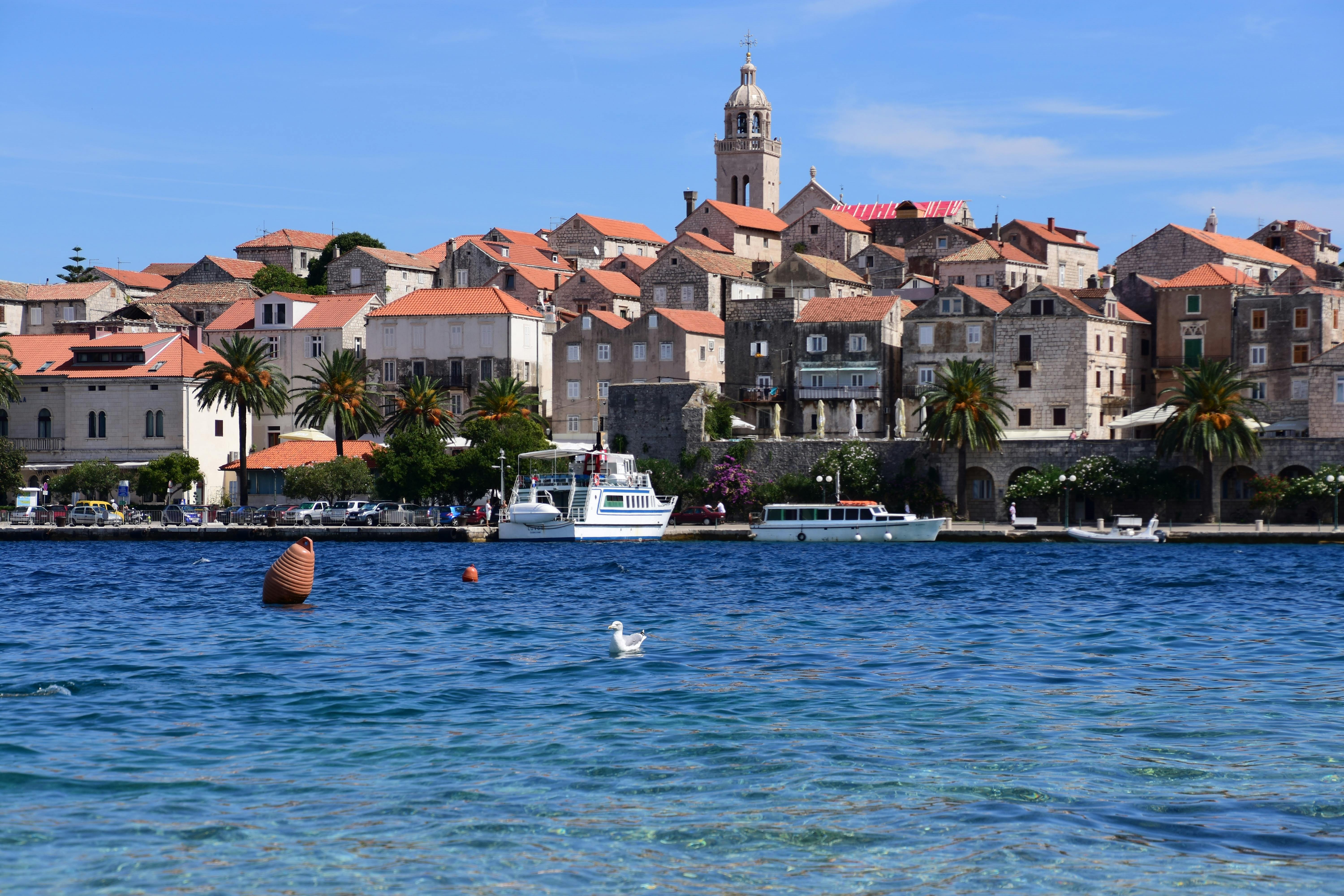
Korčula Marco Polo Birthplace: Where Venetian Architecture Meets Dalmatian Stone
The golden hour light slants low across the Adriatic, striking the pale limestone battlements of the old town and setting the terracotta rooftops ablaze. Stepping through the Land Gate—capped by a heavy, weathered Venetian relief—you enter a geometric labyrinth. The streets are barely 3 meters (10 feet) wide; they angle sharply, designed like a fishbone to trap the howling Bura wind and funnel cool maritime air into the dense urban core. You hear the distant, rhythmic clinking of rigging against aluminum masts in the port, the echo of leather soles on polished stone, the muffled clatter of espresso cups from a hidden courtyard. This walled peninsula is the Korčula Marco Polo birthplace, a fortified outpost stretching 900 meters (2950 feet) into the Pelješac Channel. While Venice claims the famous explorer as its own, this Dalmatian settlement provides the visceral, tactile reality of his origins. This place matters not for its disputed archival records, but because its very architecture encapsulates the restless, seafaring ambition that defined an era of global discovery.
Why Korčula Marco Polo Birthplace Embodies Maritime Ambition
The Republic of Venice desperately needed a formidable naval outpost to protect its eastern trade routes from local pirates and rival empires; the Korčula Marco Polo birthplace solved this problem with brutal architectural efficiency. The town is built on an islet, completely encircled by defensive walls averaging 4 meters (13 feet) thick and punctuated by 14 cylindrical towers designed to deflect cannon fire. The true genius of the settlement lies in its street plan—a masterwork of medieval engineering. The parallel lateral streets run east-to-west, intersected perpendicularly by a central transverse spine running north-to-south. This herringbone layout forces the prevailing northeasterly gale to break into scattered, harmless eddies, preventing the wind from howling down the corridors and tearing off roof tiles. It was within this militarized, highly organized maritime crucible that the Polo family, prominent local merchants, operated their trading vessels. The physical structure of the town fulfilled a profound psychological need: it provided a secure, geometrically perfect womb from which generations of sailors could launch themselves into the terrifying vastness of the unknown ocean.
The Best Time to Experience Korčula Marco Polo Birthplace
To fully appreciate the Korčula Marco Polo birthplace without the obstruction of dense crowds, plan your visit between May 18–June 12. During this precise window, the air temperature sits at an ideal 22°C–25°C (72°F–77°F), and the surrounding vineyards are vibrant with spring growth. Arrive at the main entrance between 8:00–9:30 AM to experience the fishbone streets entirely devoid of foot traffic, allowing you to photograph the smooth limestone facades in soft, unobstructed light. A secondary window occurs from September 10–28, when the grape harvest is underway and the sea retains its summer warmth. Avoid July 15–August 20 completely. During these weeks, daytime temperatures frequently exceed 32°C (90°F), the stone walls radiate oppressive heat long into the evening, and the narrow alleys become gridlocked with cruise ship passengers, destroying the contemplative atmosphere. For official ferry schedules, monument opening hours,
Approximate Budget for a 7-Day Trip
Calculating the cost of visiting the Korčula Marco Polo birthplace requires factoring in the logistics of island travel and the premium placed on accommodation inside the pedestrian-only old town. This budget assumes a culturally immersive, mid-tier experience for two people.
- • Accommodation: €150–€220 per night (restored traditional stone studio inside the old town walls, featuring original timber beams and a view of the cathedral bell tower)
- • Food: €90 per day (breakfast of espresso and a local pašta-fjura pastry €8, lunch of šurlice pasta with fresh scampi at a family tavern €32, dinner of slow-roasted lamb with blitva at a seaside konoba €50)
- • Transportation: €110 total (return Jadrolinija ferry from Split to Dominče port €40 per person; local shuttle bus from Dominče to the old town entrance €5 per person)
- • Attractions: €40 total (Marco Polo Tower museum entry €12 per person; Cathedral of St. Mark entry €8 per person)
- • Miscellaneous: €60 total (bottle of local Pošip white wine €22, traditional Korčula sword dance replica souvenir €18, artisanal olive wood cutting board from a town artisan €20)
Total: €1,620–€2,240 for one week (for two people)
6 Essential Korčula Marco Polo Birthplace Experiences
- Ascending the Marco Polo Tower: Located just inside the Land Gate, this sturdy cylindrical tower claims to be the explorer's childhood home. Climb the narrow, spiraling stone staircase—barely 1 meter (3 feet) wide—to the top. You are rewarded with a sweeping vista over the terracotta rooftops, the deep green Pelješac Channel, and the distant mountains of the mainland.
- Navigating the Fishbone Grid: Walk the central street of Ulica Gradskog Pjace at dawn. Notice how the lateral alleys slope gently downward toward the sea. This subtle grade was engineered to channel rainwater directly into the harbor for washing the streets and vessels—a brilliant fusion of urban planning and naval practicality.
- Tasting the Indigenous Grk Wine: Duck into a dimly lit, stone-walled konoba on a side alley and order a glass of Grk (pronounced "gurk"). This ancient, amber-hued varietal grows exclusively on the sandy soils of the nearby Lumbarda peninsula. Expect a crisp, saline minerality that pairs perfectly with the local salted anchovies.
- Studying the Stonework of St. Mark's: Stand before the main facade of the Cathedral of St. Mark. Examine the intricate, fluted corbels supporting the roofline—each one carved with a different grotesque face, animal, or floral motif by medieval stonemasons. The tactile quality of the pale Korčula limestone is extraordinary under direct sunlight.
- Witnessing the Moreška Sword Dance: Attend an evening performance of this traditional mock-combat dance in the open-air atrium of the Arneri Palace. Listen to the rhythmic clashing of heavy steel blades and the thundering beat of the drum; the dancers enact a dramatic battle between a Moorish and a Christian king with intense, theatrical precision.
- Walking the Battlements at Dusk: Circle the entire perimeter of the old town along the seaward walls just before sunset. The waves crash directly against the foundations 4 meters (13 feet) below. Feel the cool sea spray on your face as you trace the exact defensive perimeter that protected the Polo family's maritime assets.
3 Hidden Gems Most Travelers Miss
- • The Gabrielis Palace Courtyard: Located within the Town Museum complex, this Renaissance courtyard is frequently overlooked because visitors focus solely on the interior exhibits. Access is included in the museum ticket; walk through the main exhibition hall and exit into the cloistered garden. It features an exquisite, asymmetrical stone well and a collection of Romanesque capitals repurposed as decorative elements, offering profound silence just meters from the bustling main square.
- • The Kanavelić House: The birthplace of the revered local poet Petar Kanavelić is entirely overlooked because it is a private residential structure with no signage. To find it, walk down Ulica Široka and look for a plain wooden door flanked by a carved stone lintel depicting a navigational compass. Stand respectfully in the doorway to view the internal Renaissance courtyard; do not enter without explicitly asking the current residents for permission.
- • The Hidden Swimming Cove at Luka: Located just outside the eastern walls, this tiny pebble beach is ignored by tourists who never leave the old town center. Access it by walking down the steep stone steps near the Revelin Tower. The water here is exceptionally calm because it sits inside the protective curve of the old town's eastern bulwark, making it the perfect spot for a quiet, reflective morning swim.
Cultural & Practical Tips
- • Greet the local shopkeepers and tavern owners with "Dobar dan" (DOH-bar dahn)—Good day. This simple gesture of politeness is deeply appreciated in a town that sees thousands of transient visitors pass through its gates.
- • Do not touch the delicate limestone reliefs on the cathedral and secular palaces. The porous stone is highly susceptible to degradation from the oils in human skin; maintain a respectful distance when examining the carvings.
- • Photography inside the Cathedral of St. Mark is strictly prohibited; do not attempt to use your phone. Instead, focus your lens on the intricate external stonework and the play of light against the blind arcades in the surrounding square.
- • Beware of the Bura wind. If this fierce northeasterly gale begins to blow, the stone alleyways become dangerous wind tunnels. Secure your hat, hold your camera tightly, and avoid walking near the cliff-edge battlements, as the gusts can easily knock an adult off balance.
- • Respect the afternoon sjesta. Between 1:00 PM and 5:00 PM, the old town effectively shuts down. Use this time to leave the walls, swim at a nearby cove, or simply sit in the shade of the cathedral square with a book; attempting to shop or tour during these hours will only result in frustration.
- • Dress modestly when entering any religious site. Bare shoulders and shorts above the knee are strictly frowned upon; carry a lightweight scarf or shawl in your day bag to drape over your shoulders when entering St. Mark's.
Conclusion: Travel with Historical Empathy, Not Just Itinerary Checking
To stand in the shadow of the Marco Polo Tower is to stand at the exact intersection of the known and the unknown. The Korčula Marco Polo birthplace is not merely a collection of old stones and disputed plaques; it is a physical manifesto of human curiosity, built by people who understood that survival required looking outward toward the horizon. Traveling with historical empathy means recognizing that these limestone streets were not paved for your convenience, but for the urgent, dangerous commerce of an empire. When you refuse to rush through the fishbone grid, when you pause to feel the salt spray on the battlements, and when you listen to the clashing swords of the Moreška dance rather than simply recording it on a screen, you honor the profound ambition of this place. Slow down. Let the geometry of the alleys guide you. In a modern world obsessed with instant gratification, this fortified peninsula still demands the patience and courage required to truly set sail into the past.