
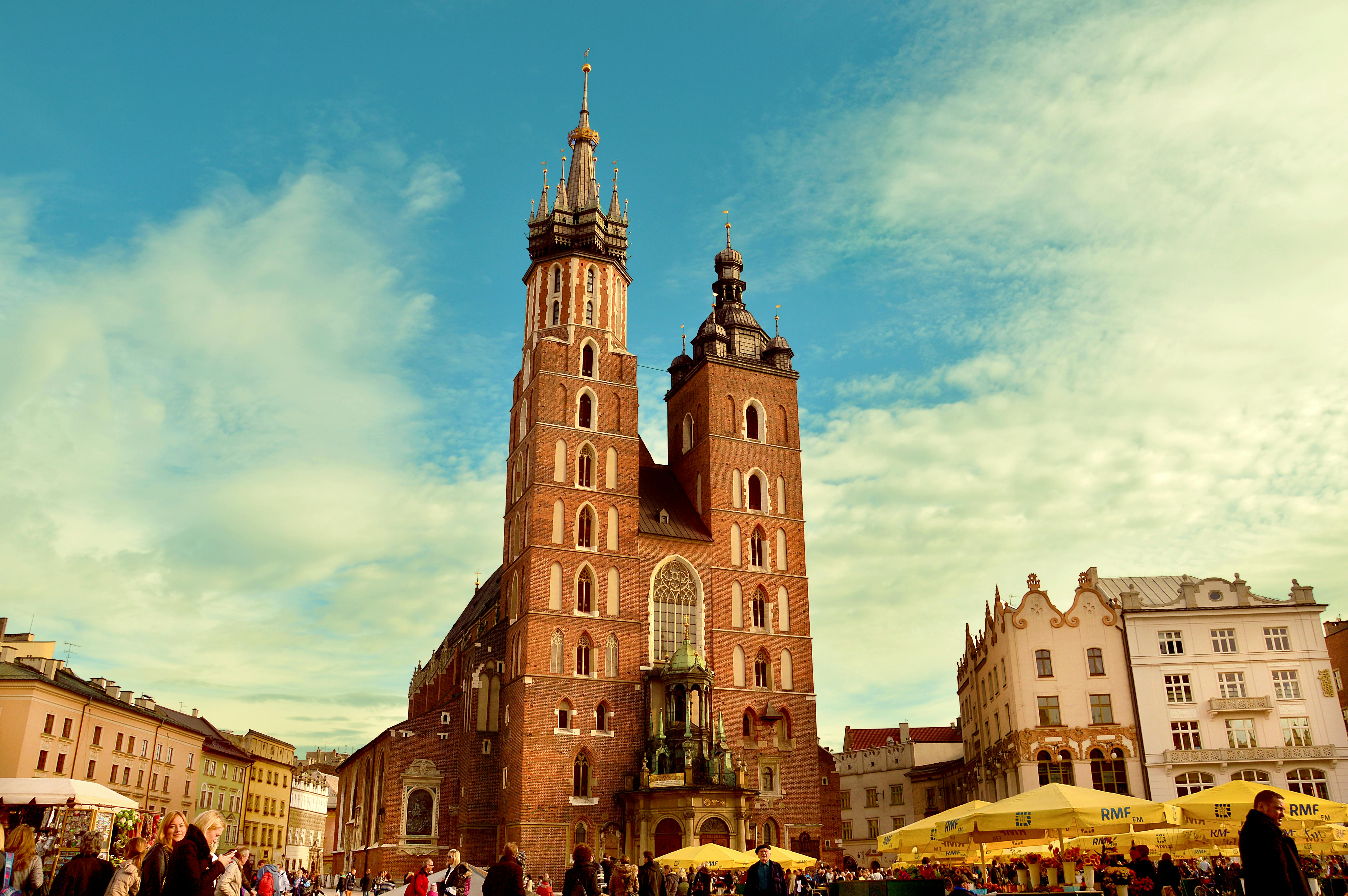
Kraków Main Square: Where Medieval Stone Meets Living History
The first light of dawn spills across cobblestones worn smooth by eight centuries of footsteps as you stand in the heart of Kraków's Main Market Square—Europe's largest medieval town square, stretching 200 by 200 meters of open sky framed by honey-hued tenements and the twin Gothic spires of St. Mary's Basilica. The air carries the faint scent of fresh obwarzanek bagels from blue carts, the distant chime of the hejnał trumpet call echoing from the taller tower, and the crisp promise of a Polish morning. You hear the gentle clatter of horse-drawn carriages on stone, the murmur of early-rising locals ordering kawà at sidewalk cafés, and beneath it all, the quiet hum of a city that has witnessed coronations, revolutions, and the steady pulse of everyday life since 1257. This isn't merely a plaza—it's a living chronicle where every cobblestone holds a story, where the Cloth Hall's Renaissance arcades once echoed with the bargaining of silk merchants from Venice and spices from the East, and where today's travelers can touch the same limestone that witnessed the birth of Polish democracy.
Why Kraków Main Square Embodies Enduring Heritage
Kraków Main Square represents far more than architectural grandeur—it embodies the extraordinary resilience of urban culture through centuries of change. Established in 1257 under Prince Bolesław V the Chaste, the square was designed on a precise orthogonal grid by the city's first urban planners, creating a 40,000-square-meter expanse that became the commercial, political, and spiritual heart of the Kingdom of Poland [[37]]. The square solved a fundamental challenge of medieval urbanism: how to create a public space flexible enough to host markets, coronation processions, public executions, and daily social exchange—all within a single, harmonious framework. The Cloth Hall (Sukiennice), rebuilt in Renaissance style after a fire in 1556, stretches 108 meters in length and features a ground-floor arcade of 42 bays where merchants once traded Flemish cloth, Hungarian copper, and Ottoman silks. St. Mary's Basilica, with its asymmetrical towers (the taller reaching 81 meters), showcases the Brick Gothic style unique to the region, while the Town Hall Tower—standing 70 meters tall—offers panoramic views after climbing its 110 narrow stone steps. What makes this square unique is its layered authenticity: unlike many European centers reconstructed after war, Kraków's Main Square survived World War II largely intact, preserving original medieval foundations beneath Renaissance facades and Baroque details—a palimpsest of history you can literally walk upon.
The Best Time to Experience Kraków Main Square
To experience Kraków Main Square at its most atmospheric, plan your visit between May 18–June 12 or September 20–October 10, when daytime temperatures range from 16–24°C (61–75°F) and the square blooms with chestnut blossoms or glows with autumn gold [[11]]. During these windows, you'll enjoy comfortable conditions for exploring the expansive plaza, photography, and walking the uneven cobblestones without summer's crowds or winter's chill. For optimal photography of St. Mary's Basilica and the Cloth Hall, arrive at 7:00–8:30 AM when morning light strikes the eastern facades, illuminating Gothic details with soft, directional illumination. Alternatively, visit at 5:30–7:00 PM during golden hour when warm light transforms limestone into amber tones and long shadows emphasize the square's dramatic geometry. You should firmly avoid July 15–August 20 when temperatures can exceed 30°C (86°F), the square becomes congested with tour groups, and harsh overhead light flattens architectural textures. For live event schedules, opening hours, and official guided tours, visit krakow.travel [[7]].
Approximate Budget for a 7-Day Trip
Visiting Kraków requires basing yourself in the Old Town or Kazimierz district, with easy walking access to the Main Square and surrounding attractions. The following budget assumes moderate travel style—comfortable boutique hotels, authentic Polish cuisine, and a mix of public transportation and occasional taxi rides. Prices are listed in Polish Złoty (PLN) with euro equivalents for international travelers (1 EUR ≈ 4.3 PLN in 2026) [[19]].
- Accommodation: 87–214 PLN (20–50€) per night in Old Town or Kazimierz. Budget pensions start at 44 PLN; boutique hotels with historic charm run 218–437 PLN (50–100€) [[26]].
- Food: 44–66 PLN (10–15€) per day total. Breakfast: 15–20 PLN for traditional śniadanie with jajecznica, local cheese, and fresh bread. Lunch: 20–30 PLN for pierogi or żurek at a milk bar like Tomasza. Dinner: 40–60 PLN for sit-down meals featuring oscypek cheese, duck with apples, and craft beer [[21]].
- Transportation: Local tram/bus: 2.80 PLN (0.65€) for 20 minutes; one-day pass: 15 PLN (3.50€). Taxi from airport: ~70 PLN (16€); Uber/Bolt often cheaper [[26]].
- Attractions: Rynek Underground Museum: 19 PLN (4.50€); St. Mary's Basilica entry: 10 PLN (2.30€); Cloth Hall galleries: free entry, paid exhibitions 15 PLN; Town Hall Tower climb: 12 PLN [[33]].
- Miscellaneous: Handcrafted amber jewelry: 115–160 PLN (26–37€); local vodka tasting: 44 PLN (10€); obwarzanek bagel: 3.50 PLN (0.80€) [[22]].
Total 7-Day Budget: 2,450–3,500 PLN (570–815€) per person (excluding international flights)
7 Essential Kraków Main Square Experiences
- Stand Beneath St. Mary's Basilica at Dawn: Arrive at 7:00 AM to witness the square awakening. Listen for the hejnał mariacki—the historic trumpet call played hourly from the taller tower, which abruptly stops mid-note to commemorate a 13th-century watchman slain by Tartar invaders. Step inside the basilica to see Veit Stoss's monumental wooden altarpiece (1477–1489), carved from linden wood and standing 13 meters tall. The interior's cobalt-blue vaulting and stained glass create a celestial atmosphere. Allow 30 minutes; entry 10 PLN.
- Explore the Cloth Hall's Renaissance Arcades: Walk the full 108-meter length of the Sukiennice, admiring the symmetrical arcade of 42 bays. Visit the upper-floor National Museum gallery (entry 15 PLN) to see 19th-century Polish paintings, then descend to the ground floor where artisans sell amber jewelry, wooden crafts, and traditional lace. The central passage connects the square's north and south sides—a perfect vantage point for people-watching. Best visited mid-morning (10:00 AM–12:00 PM) when light filters through the arches.
- Descend into the Rynek Underground: Enter beneath the square at the southwest corner of the Cloth Hall to access this archaeological museum built over original medieval foundations. Walk glass pathways suspended above 13th-century merchant stalls, drainage channels, and burial sites. Interactive displays reconstruct daily life in medieval Kraków. Allow 60–90 minutes; entry 19 PLN, book online to skip queues [[33]].
- Climb the Town Hall Tower: Ascend the 110 narrow stone steps of the 70-meter Gothic tower for panoramic views of the square's geometric layout, Wawel Castle on the horizon, and the Tatra Mountains on clear days. The top platform features a small exhibition on the square's history. Visit late afternoon (4:00–5:30 PM) for golden-hour photography. Entry 12 PLN; wear sturdy shoes.
- Taste an Obwarzanek at a Blue Cart: Join locals at one of the iconic blue carts scattered around the square. Order a fresh obwarzanek krakowski—a ring-shaped bread protected by EU geographical indication—sprinkled with salt, poppy seeds, or sesame. Cost: 3.50 PLN. Eat while standing near the Adam Mickiewicz Monument, watching the square's rhythm unfold. Best enjoyed mid-morning as a light snack.
- Attend the Hourly Hejnał Performance: Position yourself beneath St. Mary's taller tower at :00 past each hour to hear the historic trumpet call. The melody—four notes played five times—commemorates the 1241 Tartar invasion. Listen closely: the fifth repetition cuts off abruptly, honoring the watchman who warned the city before being struck by an arrow. Free; allow 5 minutes; respectful silence appreciated.
- Photograph the Square from the Adam Mickiewicz Monument: Stand at the base of the bronze poet's statue (erected 1898) in the square's center. Frame your shot to include the Cloth Hall's Renaissance attic, St. Mary's twin towers, and the colorful facades of historic tenements. Visit at blue hour (just after sunset) when building lights create warm contrast against the twilight sky. Use a wide-angle lens; tripods permitted with care.
3 Hidden Gems Most Travelers Miss
- The Lost Souls Alley (Ulica Kanonicza): Tucked behind the square's eastern edge, this narrow, cobblestoned lane leads to Wawel Castle but is often overlooked by visitors focused on the main plaza. Lined with 14th-century canon houses and quiet courtyards, it offers a peaceful counterpoint to the square's bustle. Access: From the Cloth Hall's east exit, turn right onto ul. Grodzka, then left onto Kanonicza. Best visited early morning (8:00–9:30 AM) or late evening for atmospheric photography. Free; allow 15 minutes.
- Collegium Maius Courtyard: The oldest building of Jagiellonian University (founded 1364) features a serene Gothic courtyard just two blocks from the square. Most tourists miss it because the entrance is unmarked from the street. Access: From the square, walk south on ul. Jagiellońska; the courtyard entrance is through an arched passage at number 15. Inside, see the university's historic library, astronomical instruments, and Copernicus's study chair. Entry 16 PLN; open 10:00 AM–3:30 PM weekdays.
- The St. Wojciech Church Crypt: Beneath the small Romanesque church at the square's southeast corner lies an archaeological crypt displaying 10th-century foundations and medieval artifacts. Overlooked because the church appears modest compared to St. Mary's. Access: Enter through the church door; crypt access via stairs inside. Best examined midday when natural light illuminates the stone exhibits. Entry included with church donation (5 PLN suggested); allow 10 minutes.
Cultural & Practical Tips
- Respect Sacred Spaces: When entering St. Mary's Basilica or other churches, dress modestly (shoulders and knees covered), speak quietly, and avoid photography during services. Remove hats as a sign of respect.
- Essential Polish Phrases: "Dzień dobry" (jen doh-brih) = Good day; "Dziękuję" (jen-koo-yeh) = Thank you; "Proszę" (proh-sheh) = Please/You're welcome; "Przepraszam" (psheh-prah-sham) = Excuse me. Locals appreciate the effort, even if pronunciation isn't perfect.
- Payment Practices: Contactless card payment is widely accepted, even at small vendors. When using international cards, select "Pay in PLN" to avoid dynamic currency conversion fees. Keep small bills (10–20 PLN) for markets and tips.
- Photography Guidelines: Photography is permitted throughout the square, but avoid tripods during peak hours to prevent obstructing foot traffic. Drone flights require advance permission from local authorities (contact: turystyka@um.krakow.pl).
- Weather Preparedness: Kraków experiences continental climate: summer highs reach 25–30°C (77–86°F); winter lows drop to -5°C (23°F). The square offers minimal shade—carry sun protection in summer, warm layers in winter. Afternoon rain showers are common May–September; a compact umbrella is wise.
- Accessibility Notes: The cobblestone surface is uneven and challenging for wheelchairs. Accessible routes exist along the perimeter; the Rynek Underground museum has elevator access. Request assistance at the tourist information center (Cloth Hall, ground floor).
- Combine with Nearby Sites: Enhance your Main Square visit with walking-distance attractions: Wawel Castle (10 minutes south), Kazimierz Jewish Quarter (15 minutes southeast), and the Planty Park ring encircling the Old Town. A regional perspective enriches understanding of Kraków's historical layers.
Conclusion: Travel with Reverence, Not Just Checklists
Kraków Main Square invites you to do more than photograph Gothic spires against a blue sky. This is a place to stand where merchants once bartered silks from Constantinople, where poets recited verses beneath chestnut trees, where citizens gathered to celebrate independence and mourn loss. When you walk the same cobblestones trodden by Copernicus and Chopin, when you hear the hejnał's truncated melody echo through centuries, when you taste an obwarzanek baked using a recipe unchanged since the Middle Ages, you participate in a living tradition that transcends tourism. Travel to Kraków with reverence for the craftsmanship that built these stones, for the resilience that preserved this heritage through partitions and wars, for the community that keeps this square vibrantly alive. Respect the fragility of medieval masonry—eight centuries of weathering have softened edges, and every careless touch accelerates erosion. Understand that the contemplative atmosphere you cherish depends on the mindfulness of every visitor who comes after you. Let the square's timeless geometry humble your expectations, let its layered history slow your pace, and let the convergence of commerce, faith, and art remind you that the most profound journeys are those that deepen our connection to human continuity across ages.