
Meteora Monasteries: Where Byzantine Devotion Meets Towering Sandstone Pinnacles
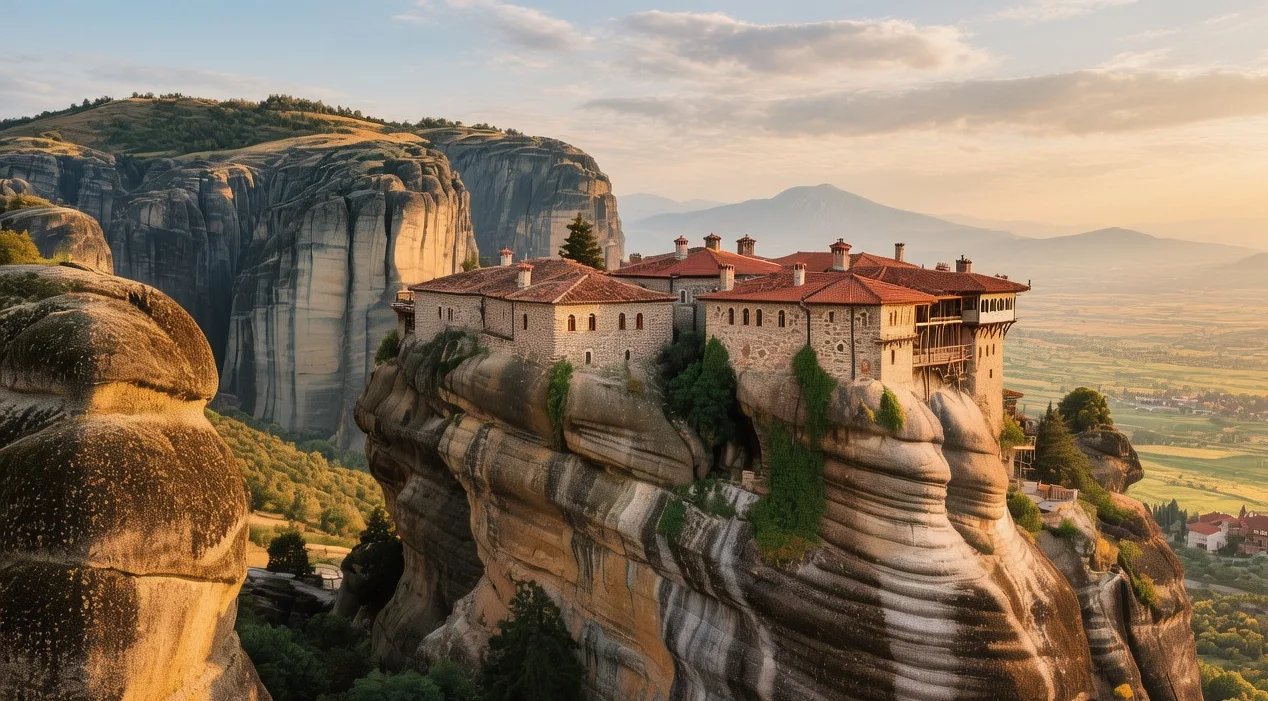
Dawn breaks over the Thessalian plain, spilling liquid gold across a forest of stone. The air is frigid, carrying the scent of damp pine and ancient dust. Far below, the Pinios River winds lazily through the valley, but up here—perched precariously at 300 meters (984 feet) above the basin—there is only the sound of wind whistling through narrow fissures and the distant, rhythmic tolling of a bronze bell. You stand on a narrow outcropping, staring up at the Great Meteoron. Its ochre walls seem to grow organically from the conglomerate rock, a seamless fusion of human masonry and geological violence. Monks first ascended these unreachable pillars in the fourteenth century, seeking absolute isolation from a fractured Byzantine world. It matters because this suspended sanctuary remains one of the most staggering intersections of human faith and natural architecture on the planet—a place where the desire for spiritual permanence conquered gravity itself.
Why the Meteora Monasteries Embody Spiritual Fortification
To comprehend the Meteora monasteries is to understand a profound existential crisis. In the mid-fourteenth century, the expanding Ottoman Empire rendered the lowlands of northern Greece exceptionally dangerous for Orthodox monks; they faced a stark choice between conversion, death, or escape. The towering sandstone pillars of Thessaly solved this problem perfectly. These rock spires, formed by ancient river deltas and sculpted by seismic activity and wind erosion over 60 million years, presented sheer, vertical walls up to 400 meters (1,312 feet) high. Initially, ascetic hermits scrambled up the pinnacles using footholds carved into the soft stone. By the late fifteenth century, monastic communities began constructing elaborate complexes atop these summits. The engineering required was astonishing. Monks hauled timber, mortar, and stone up the vertical faces using hand-cranked windlasses and rudimentary nets. When the Grand Meteoron was completed, its walls were built directly into the bedrock, utilizing the natural cliff faces as load-bearing structural elements. The architectural vocabulary of these sanctuaries reinforces their defensive purpose. Small, slit-like windows dominate the lower floors, designed to repel invaders rather than invite light. The primary building material is local dark schist, quarried from the valley floor and hauled upward, framed by heavy timber beams harvested from the Pindus mountain forests. Inside the cathedrals, the naves are intentionally compact and low-ceilinged, fostering an atmosphere of intense, claustrophobic intimacy that sharply contrasts with the vast, open voids of the surrounding canyons. Every stone laid was an act of supreme defiance against both terrestrial empires and the relentless pull of gravity.
The Best Time to Experience the Meteora Monasteries
To walk the sacred grounds without the friction of dense crowds requires precise timing. Plan your visit between May 18 and June 12, or from September 22 to October 8. During these precise windows, the morning temperatures settle between 14°C and 18°C (57°F–64°F)—cool enough to comfortably ascend the hundreds of steep, carved steps without physical exhaustion. Arrive at the main parking areas at 8:00–9:30 AM, just as the heavy iron doors of the active monasteries swing open. At this early hour, the golden morning light strikes the eastern rock faces, and the only sounds echoing through the canyons are the bells calling the remaining monks to prayer. Avoid July 15 through August 25 at all costs. During this deep-summer period, temperatures routinely exceed 32°C (90°F), and the exposed rock faces radiate intense heat. Additionally, this timeframe coincides with massive international bus tours, turning the narrow monastic corridors and stairwells into suffocating bottlenecks. For official visiting hours, route closures, and religious holiday schedules, consult the primary regional heritage portal: https://meteora.com/.
Approximate Budget for a 7-Day Trip
Calculating the cost of a cultural immersion in Meteora requires prioritizing the village of Kastraki. Nestled directly in the shadow of the pillars, staying here eliminates the daily friction of transit from the larger, more commercialized town of Kalambaka. This strategic positioning allows you to wake up mere steps from the ancient hiking trails, maximizing your time among the sandstone spires rather than navigating traffic.
- • Accommodation: €60–€100 per night (traditional stone guesthouse in Kastraki, featuring panoramic balcony views of the rock formations)
- • Food: €40 per day (breakfast €5 for Greek yogurt and local thyme honey, lunch €12 for a hearty kontosouvli pork spit wrap, dinner €23 for slow-braised wild boar stew with handmade hilopites pasta and a carafe of Meteora wine)
- • Transportation: €22 total (€12 for a local KTEL bus from Trikala to Kalambaka; €10 for a private taxi transfer directly to the Kastraki trailhead)
- • Attractions: €18 individual prices listed (Great Meteoron: €3, Varlaam Monastery: €3, Rousanou Monastery: €3, St. Nicholas Anapafsas: €3, Museum of Greek Education: €3, Natural History Museum: €3)
- • Miscellaneous: €30 (replica Byzantine icon from a local Kastraki woodcarver: €15, jar of wildflower honey harvested from the rock crevices: €10, insulated water bottle for the steep hikes: €5)
Total: €610–€920
6 Essential Meteora Monasteries Experiences
- Ascending to the Great Meteoron: Climb the 145-step rock-hewn staircase leading to the oldest and largest monastery. Feel the coarse, cold conglomerate stone beneath your palms as you round the final corner, coming face-to-face with the imposing, dark-schist facade. Breathe in the faint scent of burning beeswax drifting from the open windows.
- Standing in the Katholikon of Varlaam: Enter the main chapel of Varlaam Monastery and immediately look up. The sweeping, sixteenth-century frescoes depicting the Passion of Christ cover every inch of the vaulted ceiling, painted in a hyper-realistic, post-Byzantine style. Notice the intricate gold leaf detailing on the saints' halos, which catches the sparse candlelight.
- Crossing the Rousanou Bridge: Walk across the slender, modern wooden bridge that spans a dizzying 30-meter (98-foot) chasm to reach the Monastery of Rousanou. Look straight down through the planks to see the sheer drop into the dense pine forest below. The bridge sways slightly in the wind, demanding a steady stride.
- Examining the Ancient Windlass at St. Stephen's: Peer into the old net-hauling mechanism in the tower courtyard. Visualize the terrifying reality of monks climbing into fragile rope nets to be hauled 100 meters (328 feet) up the sheer rock face. The original wooden beam is deeply grooved from centuries of abrasion by heavy hemp ropes.
- Hiking the Footpath of the Fathers: Trek the 3-kilometer (1.8-mile) trail connecting the monasteries through the dense oak forest. The path features original cobblestones laid centuries ago, offering a shaded, silent alternative to the paved access roads. The canopy filters the harsh sunlight into dappled patterns on the mossy stones.
- Watching Sunset from Agios Nikolaos: Stand on the narrow terrace of St. Nicholas Anapafsas as the sun dips below the Pindus mountains. Watch the sandstone pillars shift in color from pale ochre to deep, bruised purple in a matter of minutes. The silence is profound, broken only by the distant echo of a shepherd's dog in the valley below.
3 Hidden Gems Most Travelers Miss
- The Badovas Hermitage Caves: Located halfway up a distinct, isolated pillar visible from the main road. It is overlooked because there are no signs, and the access point begins behind a local goat farm. You must scramble up a steep, unmarked dirt path for 20 minutes. It is special because you can actually enter the caves where anchorite monks lived in total isolation, still featuring original stone ledges used as beds. Insider tip: wear thick pants, as the path is overgrown with thorny briars.
- The Chapel of the Ypapanti at St. Stephen's: Most tourists rush through St. Stephen’s main courtyard, completely ignoring the small, lower chapel dedicated to the Presentation of the Virgin. It is special because it houses completely unrestored, fifteenth-century frescoes that are slowly fading into the plaster—a haunting, beautiful display of entropy that feels far more authentic than the polished main cathedrals.
- Theopetra Cave: Located a 15-minute drive from the monasteries. It is missed because it is a prehistoric site rather than a Byzantine one. It features a massive chamber with a dramatic opening in the roof, and it holds the distinction of containing the oldest known human remains in Greece. Insider tip: call ahead (+30 24320 78654) to confirm afternoon opening hours, as they fluctuate by season.
Cultural & Practical Tips
- • Women must wear long skirts that cover the knees; if you arrive in pants or shorts, the monasteries provide wrapped skirts at the entrance, but bringing your own lightweight sarong is far more respectful and hygienic.
- • Men are strictly required to wear long trousers; shorts of any length are absolutely prohibited inside the sacred enclosures.
- • Learn a polite Greek phrase: say "Evlogite" (eff-vloh-EE-teh), meaning "bless me" or "greetings," when addressing the monks or nuns at the ticket kiosks.
- • Photography is strictly forbidden inside the chapels; the flash and even the act of taking a photo disrupts the active worship spaces. Keep your smartphone securely in your pocket while viewing the frescoes.
- • Pack layers regardless of the season; the microclimate at the top of the pillars is drastically different from the valley floor, and a biting wind constantly sweeps off the Pindus range.
- • Start your hikes early in the morning; there is virtually zero shade along the exposed staircases leading up to the monasteries, making midday ascents physically dangerous during warmer months.
- • Do not leave the marked trails to climb the unmonitored rock formations; the local conglomerate stone is highly friable, meaning handholds can easily crumble under body weight.
Conclusion: Travel with Reverence, Not Just Spectacle
The Meteora monasteries are not merely dramatic backdrops for adventure photography; they are active, living monuments to the extremes of human endurance and spiritual dedication. When you choose to travel with reverence rather than simply rushing to the next scenic overlook, you begin to honor the staggering physical labor required to build a civilization in the sky. Slow down. Resist the urge to snap a hurried photo of the sweeping valley and instead sit quietly on a carved stone bench inside a monastery courtyard. Listen to the wind funneling through the ancient rock fissures. Mindful tourism recognizes that these fragile frescoes and worn stone steps have a finite tolerance for the friction of modern foot traffic. By engaging deeply—understanding the terrifying history of the rope nets, respecting the strict dress codes, pausing to appreciate the architectural genius of the masonry—you shift from being a passive sightseer to a temporary guardian of a Byzantine masterpiece. Let the sheer verticality of the pillars humble you; that is where the true magic of Meteora resides.