
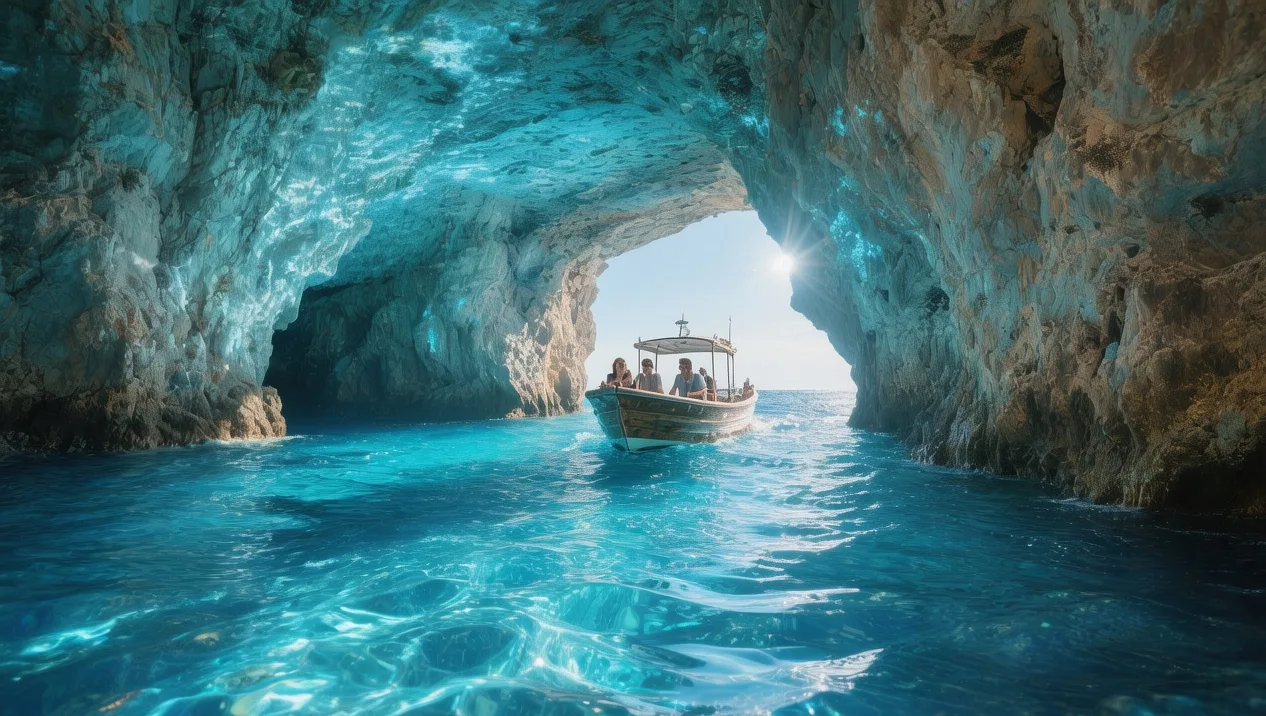
Blue Caves: Where Limestone Arches Meet Ionian Luminescence
Morning light fractures through the water’s surface, scattering into a thousand brilliant, shifting shafts beneath the curved ceiling of rock. The only sound is the rhythmic, hollow slap of water against porous stone, amplified by the cavernous acoustics. You crouch low on the wooden deck of a small skiff as the captain navigates through a jagged, seawater-carved aperture barely 2 meters (6.5 feet) high. Suddenly, the darkness breaks. The Blue Caves of Zakynthos reveal themselves—not as static geological formations, but as a living, breathing optical illusion. Stretching along the island’s northwestern cape near Skinari, this complex network of sea grottos spans roughly 3 kilometers (1.8 miles) of coastline. The water here does not merely reflect the sky; it absorbs the sunlight, filtering it through white limestone to produce a violent, glowing cyan that seems to originate from the seabed itself. It matters because this intersection of geology and light creates a sensory dissonance that fundamentally challenges your perception of the natural world.
Why the Blue Caves Embody Natural Alchemy
To understand the Blue Caves is to grasp the relentless, corrosive patience of the Ionian Sea. The caves solve a geological paradox: how soft rock survives against relentless wave action. Over millennia, the sea exploited the structural weaknesses in the region’s Eocene limestone, dissolving the calcium carbonate along vertical fault lines. This process created not deep caverns, but a series of massive, interconnected arches and tunnels. The largest chamber, the Kianou Cave, features a vaulted ceiling soaring to a height of 18 meters (59 feet), while its entrance spans an imposing 30 meters (98 feet) across. Historically, these formations fulfilled a critical practical need. Local sailors and contraband runners used the deep, shadowed recesses as concealed anchorages, safe from the sudden, violent meltemi winds that rip across the open sea. The specific alchemy of the water, however, relies on precise optical physics. The white limestone acts as a massive, natural diffuser. When sunlight strikes the water at a steep, mid-morning angle, the surface reflects the sky, while the light penetrating the water bounces off the pale seabed and illuminates the cavern from below. This dual-light phenomenon transforms ordinary saltwater into a hyper-saturated, luminous liquid.
The Best Time to Experience the Blue Caves
To witness the optical phenomenon at its absolute peak intensity, you must synchronize your visit with the sun’s trajectory. Plan your excursion between May 18 and June 12, or from September 22 to October 8. During these precise windows, the ambient air temperature ranges from 22°C to 25°C (72°F–77°F), and the water calms to a glassy stillness. Book a private or small-group boat departing from the port of Agios Nikolaos precisely at 9:00–10:30 AM. At this specific hour, the sun sits at an optimal 40-degree angle, driving the light directly into the primary arches and igniting the electric blue glow. You must avoid July 15 through August 25. During this period, temperatures exceed 32°C (90°F), but more critically, the sun sits too high in the sky at midday, causing the light to bounce off the water’s surface rather than penetrating it, which dulls the famous luminescence into a flat, ordinary turquoise. Additionally, heavy tourist traffic creates choppy wake turbulence inside the caves. For accurate sea conditions and local marine regulations.
Approximate Budget for a 7-Day Trip
Experiencing the northern cape of Zakynthos requires a budgeting strategy that prioritizes specialized maritime access over luxury accommodations. By staying in the rustic village of Agios Nikolaos, you position yourself at the departure point, entirely eliminating costly transit fees from the island's southern resort towns.
- • Accommodation: €70–€110 per night (family-run stone inn in Agios Nikolaos, featuring simple Aegean decor and a balcony overlooking the local harbor)
- • Food: €50 per day (breakfast €6 for fresh tsoureki bread and Greek coffee, lunch €14 for a grilled sardine wrap at the port, dinner €30 for slow-cooked rabbit stew and a carafe of local Avgoustiatis wine)
- • Transportation: €45 total (€15 for a shared KTEL bus from Zakynthos Town to the northern village; €30 for a dedicated, 90-minute private boat rental to navigate the caves at your own pace)
- • Attractions: €25 individual prices listed (Blue Caves boat entry: €15; Navagio Shipwreck viewing from the cliffs: free; Askos Stone Park: €6; Museum of Diving in Laganas: €4)
- • Miscellaneous: €35 (natural sea sponge harvested by local divers: €15; bottle of local Verdea white wine: €12; reef-safe biodegradable sunscreen to protect the cave's water clarity: €8)
Total: €725–€1,045
6 Essential Blue Caves Experiences
- Navigating the Kianou Arch: Sit at the very bow of the small boat as the captain cuts the engine, letting the momentum glide you through the towering 18-meter (59-foot) entrance. Feel the sudden, sharp drop in temperature as the wind ceases, replaced by the heavy, damp air trapped inside the limestone vault.
- Swimming Through the Cyan Void: Slip into the water from the boat’s stern. The shock of the cold saltwater instantly gives way to visual disbelief; look down at your hands and forearms, which will appear to glow with a ghostly, bioluminescent silver due to the intense refracted light bouncing off the pale seabed.
- Photographing the Light Shafts: Position yourself near the darker rear wall of the main grotto. Aim your camera toward the entrance to capture the stark, geometric contrast between the blinding white Ionian sky outside and the impossibly saturated blue light flooding the interior arches.
- Spotting the Mediterranean Monk Seal: Keep your eyes fixed on the shadowy, inaccessible recesses at the back of the secondary caves. The critically endangered Mediterranean monk seal occasionally rests on the tiny, hidden beaches within the grotto network, recognizable by its sleek, dark gray silhouette.
- Passing Through the Eye of the Needle: Guide the boat through a narrow, vertical fissure in the rock where the limestone has split entirely. The passage is so tight that you can reach out and touch the barnacles and rough karst on both sides simultaneously.
- Listening to the Acoustic Echo: Ask the captain to kill the engine inside the deepest cavern. Clap your hands once; the sound ricochets off the curved walls, layering into a deep, resonant hum that reverberates for nearly four seconds, demonstrating the perfect parabolic acoustics of the space.
3 Hidden Gems Most Travelers Miss
- The Smuggler’s Reef Tunnel: Located 200 meters (656 feet) southwest of the main Blue Caves entrance. It is overlooked because large commercial tour boats cannot safely navigate its narrow, rocky approach. This low, half-submerged tunnel requires a small kayak or a very agile private skiff. Insider tip: attempt this passage only at 8:00 AM on a windless day; the tidal surge can push small boats forcefully against the sharp limestone ceiling.
- The Roman Anchor Drop-Off: A submerged plateau just outside the final sea arch. Snorkelers entirely ignore this spot because they are fixated on the illuminated caves. However, looking straight down into 8 meters (26 feet) of water reveals ancient, encrusted lead anchor stocks resting on the seabed—a testament to the sailors who hid here millennia ago.
- Cape Skinari’s Western Promontory: A jagged, unmarked rock outcrop positioned just past the lighthouse. Tourists rarely disembark here because there is no official dock. If your captain can anchor briefly, you can stand on the raw limestone point where the land drops violently into the deep blue, offering a sweeping, unobstructed panorama of the entire Ionian coastline without a single building in sight.
Cultural & Practical Tips
- • Respect the marine environment by strictly avoiding the use of chemical sunscreens before swimming; the caves are a delicate, enclosed ecosystem, and standard lotions quickly create an oily film that dulls the famous water clarity.
- • Learn a nautical Greek phrase: say "Kalo taksidi" (kah-loh TAHK-see-thee), meaning "good journey," to your boat captain as you board; this simple gesture of respect often results in a more leisurely, informative tour of the harder-to-reach grottos.
- • Protect your camera gear with a waterproof housing; even on calm days, the boat’s sudden entry into the low cave arches can send splashes of cold saltwater directly onto the deck and your equipment.
- • Wear a high-quality polarizing filter on your camera lens; standard auto-settings will overexpose the intense reflections on the water’s surface, completely washing out the electric blue luminescence in your photographs.
- • Monitor the wind direction relentlessly; if the meltemi blows from the northwest for more than two consecutive days, the sea state at Cape Skinari becomes dangerously turbulent, and local port authorities will abruptly cancel all cave access without advance notice.
- • Dress in quick-dry layers; the temperature differential between the warm Ionian sun on the open boat and the freezing, shadowed interior of the deep caves can be shockingly severe.
Conclusion: Travel with Awe, Not Just Itinerary
The Blue Caves are not a manufactured theme park designed for effortless digital consumption; they are a wild, dynamically shifting optical phenomenon carved by the patient, relentless violence of the sea. When you choose to travel with awe rather than rushing to check a location off a list, you begin to honor the complex geological timeline that created this space. Slow down. Resist the urge to immediately pull out your phone as the boat enters the arch. Instead, let your eyes adjust to the sudden darkness, feel the cold dampness on your skin, and allow the impossible color of the water to wash over your senses without the barrier of a lens. Mindful tourism recognizes that natural wonders are inherently fragile; every careless splash of chemical sunscreen or disruptive shout inside the caverns degrades the very magic we came to witness. By engaging deeply—listening to the echoing silence, understanding the physics of the light refraction—you shift from being a passive sightseer to a temporary, respectful guest in a sacred marine sanctuary. Let the sheer scale of the limestone vaults humble you; that is where the true essence of the Blue Caves quietly resides.