
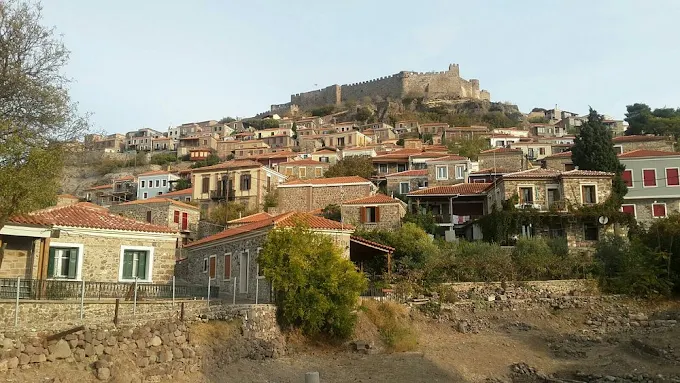
Molyvos Castle: Where Byzantine Stone Meets Aegean Sea Majesty
Golden afternoon light spills across weathered Byzantine walls as you ascend the ancient stone pathway—Molyvos Castle awakens with the gentle crash of Aegean waves against rocky shores below, the distant cry of seagulls wheeling above terracotta rooftops, and the soft murmur of visitors discovering a fortress that has guarded this corner of Lesbos for over fifteen centuries. You breathe air scented with wild thyme and blooming jasmine, feel the cool stone beneath your palm as you trace medieval battlements, and watch sunlight illuminate the sprawling complex where Byzantine engineering meets Genoese craftsmanship in perfect harmony. This extraordinary fortress, perched atop a rocky promontory overlooking the traditional village of Mithymna, rises forty meters above the Aegean Sea, its thick stone walls and cylindrical towers bearing witness to empires risen and fallen since the sixth century [[15]][[22]]. The castle's strategic position commands panoramic views across the turquoise waters toward the Turkish coast, while below, the village's narrow cobblestone streets and neoclassical mansions create a living tapestry of Greek island life. But Molyvos Castle matters because it preserves not just a military structure, but an entire chapter of Mediterranean history—a testament to how Byzantine ambition, Genoese ingenuity, and Ottoman resilience converged to create one of the Aegean's most enduring fortifications, reminding us of the enduring power of stone, strategy, and the sea.
Why Molyvos Castle Embodies Mediterranean Heritage
Molyvos Castle represents the pinnacle of Byzantine military architecture, solving a fundamental need to defend Lesbos against maritime threats while creating an enduring symbol of power that shaped the island's destiny for over a millennium. When Byzantine Emperor Justinian I commissioned the fortress in the sixth century AD, he faced a profound challenge: how to protect this strategic Aegean outpost from Persian raids, Arab invasions, and pirate attacks while maintaining control over vital shipping lanes between Constantinople and the eastern Mediterranean [[15]][[20]]. His visionary solution—constructing a formidable fortress on the site of the ancient acropolis, utilizing massive stone blocks and strategic positioning—established a defensive legacy that would serve successive rulers for fifteen centuries.
The castle's evolution showcases medieval military engineering at its finest: original Byzantine walls up to three meters thick, Genoese modifications in the fourteenth century under the Gattilusi family who added cylindrical towers and reinforced battlements, and Ottoman repairs that maintained the structure's defensive capabilities [[18]][[24]]. The fortress spans approximately 15,000 square meters, featuring a complex system of gates, courtyards, cisterns carved into bedrock, and a commanding keep that rises above the village. Technical preservation efforts include sustainable restoration using traditional stone masonry techniques, climate-controlled archaeological displays maintaining 20°C (68°F) and 50% humidity to preserve Byzantine artifacts, and structural monitoring systems that track wall stability while ensuring visitor safety. Molyvos fulfilled a dual purpose: militarily, it served as Lesbos's primary defense against seaborne invasion; culturally, it became a symbol of the island's complex heritage where Byzantine, Genoese, and Ottoman influences merged. Today, managed by the Greek Ministry of Culture alongside the Ephorate of Antiquities of Lesbos, the castle stands as a testament to how medieval fortifications can inspire modern wonder, how ruins can educate without reconstruction, and how a single fortress can anchor regional identity through centuries of change.
The Best Time to Experience Molyvos Castle
Timing your visit to Molyvos Castle profoundly influences both atmospheric immersion and practical accessibility. The optimal window falls between May 20 and June 15, when Lesbos enjoys extended daylight—sunset occurs around 8:45 PM—and temperatures range from 20°C to 27°C (68°F to 81°F), creating ideal conditions for exploring ancient walls, climbing to the keep, and photographing the village below [[68]][[72]]. During this period, wildflowers bloom along the castle pathways, outdoor tavernas operate at full capacity, and summer crowds remain manageable before peak season. For photographers, visit between 6:30–8:30 AM when soft morning light illuminates the stone walls with minimal crowds, or 7:00–9:00 PM for dramatic golden-hour shots where Byzantine stone glows against twilight skies.
Molyvos Castle operates seasonally with varying hours: summer season (June–September) extends opening hours to 8:00 AM–8:00 PM daily; winter hours (November–February) reduce to 8:30 AM–3:30 PM. For current opening times, ticket information, and visitor resources, Avoid visiting during late November through early March, when temperatures drop to 8°C to 15°C (46°F to 59°F), daylight shrinks to nine hours, and winter rains can make stone pathways slippery and dangerous. Also steer clear of mid-July to mid-August when cruise ship crowds peak and midday heat reaches 30°C+ (86°F+). Standard admission costs €6 for adults, €3 for students and seniors, with children under 18 admitted free [[24]]. The castle café is particularly rewarding between 2:00–4:00 PM when afternoon light enhances the panoramic Aegean views from the battlements.
Approximate Budget for a 7-Day Trip
Exploring Molyvos Castle and northern Lesbos requires moderate budgeting, as Greece offers excellent value compared to many European destinations. Strategic planning—including staying in Mithymna village and utilizing local transportation—can optimize your experience. The following breakdown reflects mid-range preferences with cultural and nature immersion priorities.
- Accommodation: €45–€85 per night for a double room in Mithymna village (walking distance to castle); budget guesthouses €25–€45 per night; boutique sea-view hotels €95+ per night
- Food: €28–€48 per day total
- Breakfast: €4–€7 (Greek coffee, bougatsa pastry, or village bakery items)
- Lunch: €8–€14 (Greek salad, grilled octopus, or moussaka at taverna)
- Dinner: €14–€25 (fresh fish, lamb kleftiko, or mezze platter at seaside restaurant)
- Taverna option: €6–€10 for souvlaki, tzatziki, and Greek coffee
- Transportation:
- Ferry from Piraeus to Mytilene: €35–€55 one-way (8–10 hours)
- Local bus to Mithymna: €8 per ride (2 hours from Mytilene)
- Car rental for Lesbos exploration: €35 per day including fuel
- Taxi from Mytilene to Mithymna: €60 one-way
- Attractions:
- Molyvos Castle admission: €6 adults; €3 students/seniors [[24]]
- Guided castle tour: €12 per person
- Petrified Forest of Lesbos: €6 adults
- Lesbos Olive Oil Museum: €5
- Boat tour to nearby islets: €25 per person
- Miscellaneous:
- Local craft souvenirs and ouzo: €8–€35
- Audio guide rental: €3
- Photography permit for professional use: €20
Total estimated budget for 7 days: €620–€950 per person (excluding international flights)
7 Essential Molyvos Castle Experiences
- Climb to the Keep at Sunrise: Arrive at opening time (8:00 AM) and ascend to the castle's highest point where the cylindrical keep commands panoramic views across the Aegean. The morning light reveals the Turkish coast in the distance and illuminates Mithymna's terracotta rooftops below. Allow 30 minutes for this ascent; wear sturdy shoes as stone steps can be uneven. Listen for the wind moving through ancient battlements and imagine the sentries who once guarded these walls.
- Walk the Byzantine Ramparts: Follow the perimeter walls that showcase original sixth-century construction alongside fourteenth-century Genoese modifications. Visit between 10:00 AM–12:00 PM when natural light reveals the different stone textures and construction techniques. Allow 45 minutes for the full circuit; interpretive panels explain how Byzantine engineers utilized massive stone blocks while Genoese builders added cylindrical towers for improved defense [[22]].
- Explore the Underground Cisterns: Descend into the castle's remarkable water storage system, carved directly into bedrock to sustain garrisons during sieges. Visit between 1:00–3:00 PM when lighting is optimal for appreciating the engineering precision. Allow 20 minutes; the cool, echoing chambers reveal how medieval engineers solved the critical challenge of storing fresh water on a rocky promontory.
- Photograph the Village from the Battlements: Position yourself at designated viewpoints between 6:30–8:30 AM when soft light highlights Mithymna's neoclassical architecture and narrow cobblestone streets. Use a polarizing filter to manage reflections; a wide-angle lens captures the village cascading toward the harbor. The iconic view—white-washed houses, red-tiled roofs, blue Aegean—defines Mithymna's charm.
- Attend a Sunset Concert: During summer months, the castle hosts outdoor concerts and cultural events in the main courtyard. Check the schedule at the visitor center; performances typically begin at 8:30 PM. The experience combines medieval atmosphere with live Greek music, creating unforgettable memories as the sun sets over the Aegean.
- Visit the Archaeological Exhibition: Explore the small museum within the castle walls where artifacts from excavations reveal the site's continuous occupation from ancient times through the Byzantine, Genoese, and Ottoman periods. Visit between 11:00 AM–1:00 PM when natural light illuminates pottery, coins, and architectural fragments. Allow 30 minutes; displays explain how each civilization modified and expanded the fortress.
- Walk the Coastal Path to the Harbor: Descend from the castle through Mithymna's narrow streets to the picturesque harbor where fishing boats bob in turquoise waters. Visit between 5:00–7:00 PM when the village comes alive with evening activity. Allow 30 minutes; stop at waterfront tavernas for fresh ouzo and meze while watching the sunset paint the castle walls golden.
3 Hidden Gems Most Travelers Miss
- The Secret Postern Gate: Tucked away on the castle's seaward side, a small hidden gate once provided emergency access to the sea during sieges. Most visitors focus solely on the main entrance without exploring this historical feature. Access: From the main courtyard, follow signs toward "Sea Gate"; accessible during regular hours; included with admission. Best visited between 11:00 AM–1:00 PM when the space is least crowded. The gate's interpretive panel explains its strategic importance, creating a tangible connection to medieval defensive tactics.
- The Genoese Tower Interior: Beyond the exterior walls, one of the cylindrical towers added by the Gattilusi family in the fourteenth century contains original stone staircases and arrow slit chambers rarely accessed by tourists. Most visitors admire the towers from outside without exploring their interiors. Access: Inquire at the visitor center for guided tower access; typically available Tuesday and Thursday 10:00 AM–12:00 PM; included with admission. Best visited between 10:00 AM–12:00 PM when guides are available. Climbing the narrow stone staircase reveals the ingenuity of Genoese military architecture.
- The Olive Grove Terrace: Beyond the castle walls, a terraced olive grove planted during the Ottoman period offers secluded viewpoints and ancient trees over 400 years old. Most tourists focus on the fortress without exploring this agricultural heritage. Access: Exit through the northern gate and follow the path marked "Ελαιώνας" (Olive Grove); accessible daily 8:00 AM–sunset; free. Best visited between 4:00–6:00 PM for golden-hour photography. The grove's ancient trees and stone terraces reveal how successive civilizations cultivated this rocky landscape.
Cultural & Practical Tips
- Photography Guidelines: Photography for personal use is permitted throughout Molyvos Castle, but drones require special permission from the Greek Ministry of Culture—contact +30 22510 28333 in advance. The castle walls and village views are ideal for photography; visit during golden hour for optimal light. Respect other visitors when capturing candid moments.
- Language: While signage includes English, learning Greek phrases enhances your experience: efharistó (ef-ha-ree-STO = thank you), parakaló (pa-ra-ka-LO = please/you're welcome), yasou (YA-soo = hello). Greek pronunciation emphasizes the second-to-last syllable.
- Footwear: Sturdy walking shoes with good grip are essential—exploring ancient stone pathways involves uneven surfaces, loose gravel, and weathered steps. The main circuit involves moderate climbing; allow 90 minutes for full exploration.
- Hydration: Bring water, especially during summer months when temperatures exceed 30°C (86°F). The castle has limited shade, and climbing stone walls in midday heat can be exhausting. A refillable water bottle and sun hat are essential.
- Weather Considerations: Lesbos's coastal location means strong meltemi winds during July and August. Check the forecast before visiting; winds can make the upper battlements challenging. Spring (April–June) and fall (September–October) offer the most reliable conditions with comfortable temperatures.
- Combining with Athens: Molyvos is accessible via ferry from Piraeus (8–10 hours) or flight to Mytilene followed by a 2-hour bus ride. Consider spending 3–4 nights in Mithymna to fully explore the castle alongside the village's beaches, tavernas, and nearby attractions like the Petrified Forest.
- Respectful Engagement: Molyvos Castle is a protected archaeological monument and active heritage site. Stay on marked paths, never climb on unstable walls, and respect the site's historical significance. The community values visitors who engage thoughtfully with the fortress's heritage while honoring its preservation.
Conclusion: Travel with Reverence, Not Just Observation
Molyvos Castle invites more than passive sightseeing—it demands engagement with the layered narratives embedded in Byzantine stone, Genoese brick, and Aegean sea: the ambition of emperors who built fortresses to control maritime trade, the resilience of stonemasons who shaped local rock into defensive masterpieces, and the ongoing stewardship that keeps heritage alive for future generations. When you stand on those battlements watching terracotta rooftops meet turquoise waters, you're not merely viewing a ruin; you're connecting with a model for sustainable preservation, a testament to how medieval engineering can inspire modern wonder, and a reminder that the most meaningful places honor both past and future. This isn't a place to rush through, checklist in hand, snapping photos before racing to the next attraction. Slow down. Feel the warm stone beneath your palm; listen to the wind whispering through arrow slits; contemplate how a single fortress could shape the destiny of an island for fifteen centuries. Travel here with curiosity about how places shape identity and how identity gives meaning to places. Support preservation by respecting the site, choosing experiences that employ local guides, and sharing not just images but understanding. The most transformative journeys leave you not just with memories of what you saw, but with deeper appreciation for continuity—and Molyvos Castle, with its seamless fusion of Byzantine power and Aegean majesty, offers precisely that invitation to those willing to wander, to wonder, and to simply connect across time.
Image Description: Molyvos Castle Byzantine fortress overlooking traditional village and Aegean Sea at golden hour on Lesbos Greece