
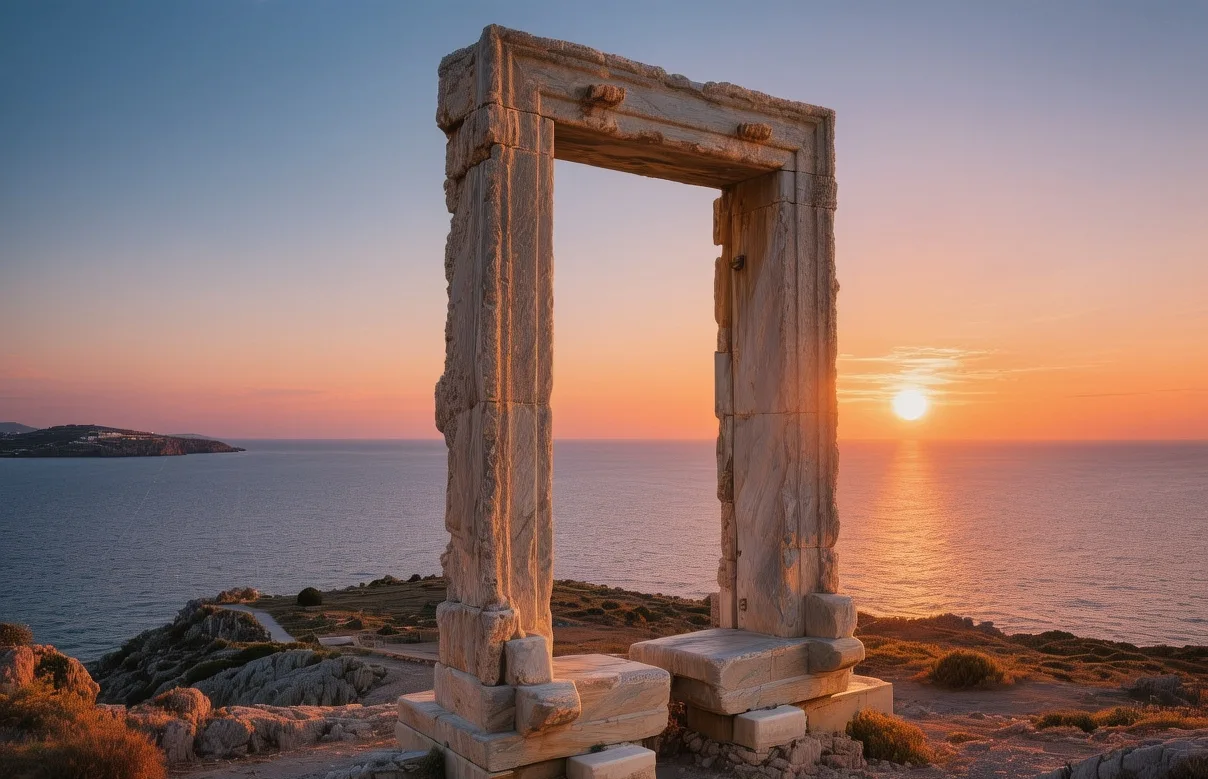
Naxos Portara: Where Ancient Marble Meets Aegean Sunset
Golden light spills across weathered Naxian marble as you walk the stone causeway—sea breezes carry the scent of wild oregano and salt, while the gentle lap of waves against the islet's rocky shore creates a rhythmic underscore to your approach. You stand before the Portara, a monumental marble doorway soaring 6 meters high and 3.5 meters wide, all that remains of an unfinished Temple of Apollo begun over 2,500 years ago. The massive lintel, weighing nearly 10 tons, frames the distant silhouette of Delos—birthplace of the very god this sanctuary once honored—as the sun descends toward the horizon in a blaze of amber and rose. This is Naxos Portara, Greece's most iconic sunset viewpoint, where ancient engineering meets natural beauty in perfect harmony. The Portara matters because it preserves not just architectural ambition, but a moment frozen in time: a testament to human aspiration where every weathered groove and sun-warmed surface whispers of craftsmen who carved divine beauty from island stone, and of a temple that, though never completed, still commands reverence beneath the endless Cycladic sky.
Why Naxos Portara Embodies Ancient Architectural Ambition
The Naxos Portara represents one of the most evocative examples of unfinished ancient architecture—a monumental marble gateway that solves the fundamental question of how civilizations express devotion through stone. Construction began circa 530 BCE under the tyrant Lygdamis, who envisioned a Temple of Apollo rivaling those of Delos and Delphi. The project employed master craftsmen from Naxos's renowned marble quarries, where the island's distinctive crystalline stone—prized throughout the ancient Mediterranean—was extracted using iron wedges and wooden levers.
Architecturally, the Portara showcases sophisticated engineering: four colossal marble blocks form the doorway, with the horizontal lintel alone measuring 4.5 meters long and weighing approximately 10 tons. The blocks were joined using iron clamps encased in lead to prevent corrosion—a technique that has preserved the structure's integrity for over two millennia. The doorway's precise orientation toward Delos (11 kilometers northwest) reflects careful astronomical planning, aligning with Apollo's mythological birthplace to create a sacred visual axis.
Beyond aesthetics, the Portara fulfilled profound cultural needs: it projected Naxos's wealth and piety to rival city-states, provided a focal point for religious processions arriving by sea, and demonstrated technical mastery that attracted skilled artisans to the island. When construction halted—likely due to the overthrow of Lygdamis and subsequent political instability—the unfinished temple became an unintended monument to impermanence. Over centuries, the structure was repurposed: early Christians converted it into a church, Venetians quarried its stones for castle construction, and Ottoman rulers used the site as a defensive outpost. Today, this free-access landmark offers an unparalleled window into ancient Greek ambition, where every weathered surface tells a story of divine aspiration, political upheaval, and the enduring power of marble to capture light, time, and human longing.
The Best Time to Experience Naxos Portara
Timing your visit to the Naxos Portara requires balancing light quality for photography, crowd dynamics, and seasonal weather patterns. The optimal window runs from May 10 through June 18, when temperatures range 19–27°C (66–81°F) and wildflowers—caper bushes, sea daffodils, and cyclamen—bloom along the causeway. During this period, sunset occurs between 7:45–8:15 PM, providing extended golden-hour light that bathes the marble in warm amber tones perfect for photography.
A second exceptional season spans September 12 through October 22, with temperatures of 18–26°C (64–79°F) and clearer atmospheric conditions that enhance visibility across the Aegean. Sunset during this window falls between 6:45–7:30 PM, creating dramatic contrasts as the sun descends behind the distant silhouette of Paros.
For the most atmospheric experience, arrive at the causeway entrance by 7:00 PM during summer months to secure a prime viewing position. The marble absorbs daytime heat and radiates warmth during sunset, creating a uniquely sensory experience. Midday visits between 12:00–4:00 PM should be avoided during July and August, when temperatures exceed 32°C (90°F) and the exposed limestone causeway offers minimal shade.
Avoid visiting during peak cruise excursion season (July 20–August 15) when the islet becomes congested with day-trippers, limiting photography opportunities and creating long waits for the iconic sunset view. Winter months (November–February) bring frequent winds and temperatures of 10–16°C (50–61°F); while crowds thin dramatically, strong meltemi gusts can make the exposed islet uncomfortable for extended viewing.
Approximate Budget for a 7-Day Trip
Exploring Naxos Portara as part of a Cycladic island itinerary offers exceptional value compared to Santorini or Mykonos, combining ancient heritage with beach relaxation at accessible prices. The following breakdown assumes a mid-range travel style with comfortable accommodation in Naxos Town (Chora), dining at traditional tavernas, and a mix of independent exploration and guided experiences.
- Accommodation: €50–€90 per night for boutique guesthouses or traditional Cycladic hotels in Naxos Town (near the Old Market or Agios Georgios beach). Budget rooms start at €35; luxury sea-view suites reach €140.
- Food: €26–€36 per day. Breakfast €4 (Greek coffee, honey yogurt, fresh bread); lunch €10 (horiatiki salad, grilled calamari, house wine); dinner €15–€20 (slow-cooked lamb, fresh catch of the day, local Assyrtiko wine).
- Transportation: Ferry from Athens (Piraeus) to Naxos €35–€55 (4–5.5 hours, depending on vessel); local bus to Portara €1.80 each way; rental car €35/day (recommended for island exploration); scooter rental €15/day.
- Attractions: Naxos Portara entrance free; Temple of Demeter €4; Apollo's Cave exploration free; guided Naxos history tour €38; Kouros statue site free; combined island heritage experiences €25.
- Miscellaneous: Handmade Naxian marble souvenirs €15–€35; local citron liqueur 500ml €12; traditional woven textiles €20; travel insurance €35/week; water/snacks at site €4.
Total for 7 days: €680–€880 per person (excluding international flights to Athens and ferry costs)
7 Essential Naxos Portara Experiences
- Witness sunset through the marble gateway: Arrive at the Portara by 7:00 PM during summer months to secure a position directly beneath the 6-meter-high doorway. As the sun descends toward the horizon, frame the golden orb within the ancient marble opening—a photographic moment that has defined Naxos for centuries. Bring a wide-angle lens to capture both the structure and the Aegean panorama; a tripod is permitted but must not obstruct other visitors.
- Walk the causeway at sunrise: Experience the Portara in near-solitude by arriving at 6:00 AM when the islet is quiet and morning light illuminates the marble's crystalline texture. The soft pink glow of dawn reveals tool marks and weathering patterns invisible at midday. Allow 20 minutes to absorb the peaceful atmosphere before day-trippers arrive.
- Explore the temple foundation ruins: Circle the Portara to examine the exposed limestone foundations of the unfinished temple complex. Interpretive signage (in Greek and English) explains the original 60-meter-long temple plan and construction techniques. Visit mid-morning (9:00–10:30 AM) when angled light accentuates the stonework's texture without harsh glare.
- Photograph the marble details with macro lens: Focus on architectural elements: the precise joinery of marble blocks, iron clamp impressions, and centuries of weathering patterns. The best light for texture photography occurs mid-morning (10:00–11:30 AM) when side lighting reveals surface grain. Use a polarizing filter to reduce glare on sunlit marble surfaces.
- Attend an outdoor classical music performance: During summer months, the Hellenic Culture Ministry occasionally hosts evening concerts at the Portara, where ancient acoustics amplify string quartets and traditional Greek music. Check the official Naxos cultural calendar for dates; performances typically begin at 8:30 PM and last 90 minutes. Arrive early to secure seating on the grassy slopes.
- Combine with Naxos Town exploration: After your Portara visit, walk the 10-minute causeway back to Naxos Town (Chora). Explore the Venetian Kastro district, browse the Old Market for local crafts, and end with dinner at a seaside taverna. The transition from ancient monument to living village provides rich cultural context for the island's layered history.
- Stargaze from the islet after sunset: Remain at the Portara 30 minutes after sunset to experience the Cycladic night sky. With minimal light pollution, constellations appear with exceptional clarity; the Milky Way is visible on moonless nights. Bring a light blanket—the marble retains daytime warmth but sea breezes cool evenings. Download a stargazing app to identify celestial landmarks ancient Greeks once navigated by.
3 Hidden Gems Most Travelers Miss
- The Hidden Byzantine Chapel of Agios Georgios: Tucked behind olive groves 400 meters inland from the Portara, this tiny 11th-century chapel features remarkably preserved frescoes depicting Saint George and the dragon. The entrance is unmarked; ask locals for "to ekklisaki tou Agiou Georgiou." Visit mid-morning (10:00–11:00 AM) when light filters through the small western window to illuminate the frescoes. Bring a small donation for preservation efforts; the chapel remains an active worship space for local families.
- The Ancient Quarry Pathway: A little-known footpath behind the Portara leads to the marble quarries where craftsmen extracted stone for the Temple of Apollo. The 15-minute walk reveals tool marks, partially extracted blocks, and panoramic views of the Aegean. Access via the unmarked trail to the left of the temple foundations; follow signs for "Latomia." Visit early afternoon (2:00–4:00 PM) when dappled light creates atmospheric photography opportunities. Wear sturdy shoes for the rocky terrain.
- The Secret Swimming Cove of Palatia: On the islet's eastern side, a secluded pebble beach sheltered by limestone cliffs offers crystal-clear waters and minimal crowds. Most visitors focus on the Portara and miss this refreshing escape. Access via the path behind the temple ruins; follow the sound of waves. Visit late afternoon (4:00–5:30 PM) when sunlight warms the rocks while water remains refreshingly cool. Bring water shoes for the rocky entry and respect the fragile coastal ecosystem.
Cultural & Practical Tips
- Respect the archaeological site: The Portara is a protected monument. Do not climb on the marble blocks, carve initials, or remove stones—these actions accelerate weathering of irreplaceable heritage. Stay on marked pathways and follow all signage to preserve the site for future generations.
- Carry cash for small purchases: While Naxos Town accepts cards widely, vendors near the Portara (selling water, snacks, or souvenirs) often prefer cash. Withdraw €50–€100 upon arrival; ATMs are plentiful in Chora but limited near the islet.
- Learn essential Greek phrases: "Yassou" (YAH-soo) = hello; "Efharisto" (ef-hah-REE-stoh) = thank you; "Poso kani?" (POH-soh KAH-nee) = how much?; "Nero parakalo" (neh-ROH pah-rah-kah-LOH) = water please; "Pou ine i Portara?" (poo EE-neh ee por-TAH-rah) = where is the Portara?
- Prepare for sun and wind exposure: The islet offers zero shade and frequent meltemi breezes. Wear a wide-brimmed hat, apply SPF 30+ sunscreen, and carry a light windbreaker even in summer. Bring at least 1.5 liters of water per person; refill stations exist in Naxos Town but not on the islet.
- Photography guidelines: Handheld photography is unrestricted throughout the site. Tripods are permitted but cannot obstruct pathways or other visitors' views. Drone use requires written permission from the Hellenic Ministry of Culture (+30 210 8211000) and is rarely granted for heritage sites. Commercial shoots require permits obtained 48 hours in advance from the Cyclades Ephorate of Antiquities.
- Weather considerations: Strong meltemi winds can reach 45 km/h (28 mph) on the exposed islet, especially July–August. Secure loose items and be cautious near unprotected edges. Afternoon thunderstorms develop rapidly in late summer; descend from the islet immediately if you hear thunder—the causeway becomes slippery when wet.
- Accessibility considerations: The causeway and islet feature uneven stone paving not suitable for wheelchairs. However, the Portara viewpoint is reachable via the main path with assistance. Visitors with mobility issues can experience the monument from the causeway entrance. Request assistance at the Naxos tourist information office; staff can suggest accessible viewing angles.
Conclusion: Travel with Reverence, Not Just Sightseeing
The Naxos Portara asks for more than a quick photograph and a checklist mark—it invites reverence for the human aspiration that transformed island marble into divine architecture. This isn't merely a sunset viewpoint; it's a threshold where ancient craftsmen once envisioned a temple to Apollo, where political upheaval froze ambition in stone, and where every weathered surface whispers of civilizations that measured time in epochs, not minutes. When you stand beneath that massive lintel and watch the sun descend through the marble frame, you're not just viewing history—you're participating in a continuum of wonder that has inspired travelers for over two millennia.
Responsible travel here means understanding that you're a guest in a space where legacy breathes through every groove. It means moving quietly to preserve the meditative atmosphere, following guidelines that protect irreplaceable marble, and supporting the local community that stewards this heritage. Purchase directly from Naxian artisans, dine at tavernas sourcing ingredients from island farms, and respect the quiet rhythms of Cycladic life beyond the iconic gateway.
Slow down. Sit on sun-warmed stone and watch light shift across the Aegean. Listen to waves lapping the islet's shore, mingling with the distant chime of church bells from Naxos Town. Share a moment of silence with fellow travelers, letting the Portara's timeless beauty inspire not just admiration, but stewardship. This marble gateway will endure—if we treat it not as a backdrop for selfies, but as a teacher of patience, a witness to human aspiration, a legacy to protect. Travel here with humility, and the stones will share their ancient song.