
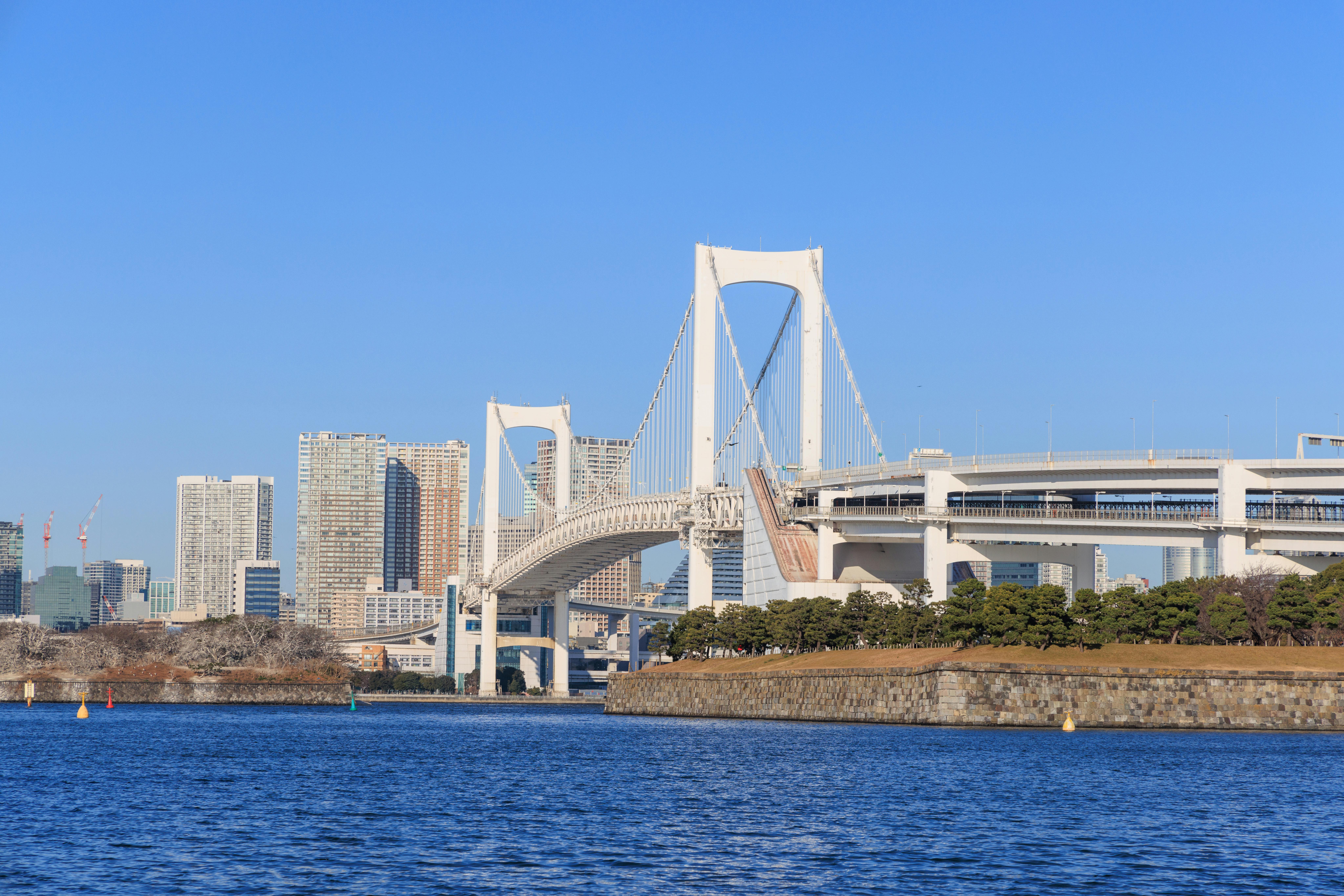
Rainbow Bridge: Where Suspension Steel Meets Tokyo Bay Romance
The Yurikamome driverless train glides silently across the lower deck as the sun dips behind Mount Fuji—presenting its iconic silhouette on clear winter evenings—and suddenly, the bridge's white towers ignite in a soft, solar-powered radiance. It is 5:30 PM on a December evening, and you are suspended 52 meters above Tokyo Bay, the Statue of Liberty replica (a 1998 symbol of Japan-France friendship) glowing gold at your feet . This is the Rainbow Bridge, officially known as the Tokyo Bay Connector Bridge—a 798-meter-long, three-span suspension marvel that has connected the artificial island of Odaiba to the Shibaura Pier since its opening on August 26, 1993 . From its construction between 1987 and 1993 by Kawasaki Heavy Industries to its nightly solar-powered illuminations, this bridge solves a simple yet profound engineering problem: how do you move 500,000 vehicles and thousands of pedestrians across Tokyo Bay while creating a landmark that captures the heart of a city?
Why Rainbow Bridge Embodies Tokyo's Post-Bubble Engineering Poetry
The bridge solves a logistical problem: how to connect a burgeoning entertainment district to the mainland in the post-bubble era. Designed by structural engineer Kazuo Ohgaki and built by Kawasaki Heavy Industries, the bridge's construction began in 1987 and concluded in 1993—a period when Japan was recovering from the economic bubble's burst . The solution was a suspension bridge with a main span of 580 meters and a total length of 798 meters, sweeping 49 meters wide across the bay . The towers rise 126 meters (413 feet) high, their white-painted steel designed to harmonize with the Tokyo skyline as seen from Odaiba . But the true engineering poetry lies in the three-tiered transport system: the upper deck carries the Shuto Expressway (Metropolitan Expressway No. 11), the lower deck houses the Yurikamome automated transit line, a regular roadway (Tokyo Prefectural Route 482, once a toll road), and—crucially—pedestrian walkways flanking both sides . What problem does this solve? It proves that a single structure can move 500,000 people daily across Tokyo Bay by car, train, foot, and bicycle . The bridge's nightly illumination—solar panels collecting energy by day, powering rainbow-hued lights by dark—adds environmental consciousness to its urban utility . The romantic scenery that results has made the Rainbow Bridge a beloved film location for countless Japanese TV dramas . Tokyo's resilience, ambition, and aesthetic sensitivity are all suspended in 580 meters of steel.
The Best Time to Experience the Rainbow Bridge
To witness the Rainbow Bridge at its most transcendent—when the sunset paints the Tokyo skyline amber and the solar-powered lights begin their evening glow—plan your arrival on the Odaiba side between 4:30 PM and 5:30 PM (October–March) or 5:30 PM and 6:30 PM (April–September) . The pedestrian walkway opening hours vary: 9:00 AM–9:00 PM (April–October) and 10:00 AM–6:00 PM (November–March), with last entry 30 minutes before closing . For the famous rainbow illumination, December is the prime month—the bridge displays rainbow colors nightly, usually from sunset until midnight . The Odaiba Rainbow Fireworks (December 2025) add spectacular bursts over the bay for five nights (December 6, 13, 20, 24, 27) . Spring (March–May) offers mild temperatures of 10-20°C (50-68°F) and clear skies, while autumn (September–November) provides similar conditions with fewer crowds. Summer (June–August) brings humidity (23-31°C / 73-88°F) and the rainy season—though the bay breezes offer some relief. Winter (December–February) is the coldest (2-10°C / 36-50°F) but offers the clearest views of Mount Fuji from the bridge's midpoint . Avoid crossing on rainy or windy days—the walkway becomes slippery, and the overhead expressway amplifies noise .
Approximate Budget for a 7-Day Trip Including the Rainbow Bridge
This breakdown treats the Rainbow Bridge as a free, iconic experience within a broader Tokyo itinerary. Prices in Japanese Yen (¥) and US Dollars ($), based on 2026 data.
- Accommodation: ¥10,000–¥18,000 ($65–$120) per night near Odaiba or Shinagawa. Budget options near Tamachi Station (walking distance to the bridge) start at ¥8,000 ($53). Mid-range: Grand Nikko Tokyo Daiba (¥20,000–¥30,000 / $135–$200) with direct bridge views from rooms.
- Food: ¥3,500–¥6,000 ($23–$40) daily. Convenience store breakfast on the go: ¥600 ($4). Lunch in Odaiba's Aqua City or Decks malls: ¥1,500–¥2,500 ($10–$17). Pre-walk takeaway coffee from Starbucks near the Statue of Liberty: ¥500 ($3.30). Dinner in Odaiba: ¥2,000–¥3,500 ($13–$23).
- Transportation: Yurikamome Line day pass: ¥820 ($5.50) for unlimited rides . Single trip from Shimbashi to Odaiba: ¥320–¥380 ($2.10–$2.50). One-week Tokyo Metro pass: ¥1,500 ($10) (though Yurikamome is separate).
- Attractions (Bridge-focused): Walking across the Rainbow Bridge: FREE . Odaiba Seaside Park entrance: FREE . Statue of Liberty photo spot: FREE . "Art Spot ODAIBA" illuminated swings at Decks Tokyo Beach: FREE .
- Miscellaneous: Panoramic photo of bridge from Fuji TV Building observatory: ¥700–¥1,000 ($4.60–$6.60). Souvenir "Rainbow Bridge" keychain: ¥800 ($5). Odaiba Lantern Festival (April 25 or May 9, 2026): single-lantern package (up to 4 people) ¥5,980 ($40) .
Total 7-day mid-range budget including a bridge crossing and Odaiba exploration: ¥85,000–¥115,000 ($560–$760) per person, excluding international flights. Budget travelers can reduce the cost significantly by staying on the Shibaura side—and walking the bridge for free—before returning to mainland.
7 Essential Rainbow Bridge Experiences
- Walk the Bridge at Golden Hour (Shibaura to Odaiba): Enter the pedestrian walkway from the Shibaura side (15-minute walk from Shibaura-Futo Station) or the Tamachi side (20-minute walk from Tamachi Station). Take the elevator to the 7th floor to access the start of the crossing. The walkway spans 1.7 kilometers, and the crossing takes about 20-30 minutes—but budget an hour to linger. Time your entry so that you reach the midpoint (with benches) exactly at sunset. From here, you can watch Tokyo Tower and the skyscrapers transition from silhouettes to illuminated constellations. The south-facing walkway gives you sweeping views of Odaiba Seaside Park; the north-facing walkway frames the skyline perfectly.
- Photograph the Statue of Liberty Against the Bridge at Dusk: On the Odaiba side, at Odaiba Seaside Park, stands a replica of the Statue of Liberty, built in 1998 to commemorate the friendship between Japan and France. Position yourself at the water's edge so that the statue's torch aligns with the bridge's central span. The golden hour light—just before the solar-powered rainbow illumination begins—creates the iconic Tokyo postcard shot. The best months for this shot are December (when the bridge lights are rainbow-hued) or clear winter evenings (when Mount Fuji may appear behind the bridge).
- Catch the Odaiba Rainbow Fireworks (December 2025): On select nights in December (6, 13, 20, 24, 27), "Odaiba Rainbow Fireworks" illuminate the sky above Odaiba Beach—a 5-minute spectacle of color and music. The fireworks launch from the waters near the Statue of Liberty, directly framed by the Rainbow Bridge. On these nights, the Decks Tokyo Beach building's exterior facing the sea glows in rainbow colors as well. Arrive by 6:30 PM to secure a spot on the beach or the Decks Tokyo Beach seaside deck (free access, though busy).
- Ride the Yurikamome Line at Night: While walking the bridge is intimate, riding the Yurikamome driverless train across the lower deck at night offers a futuristic spectacle. The train glides silently across the bridge with floor-to-ceiling windows, offering unobstructed views of the illuminated bridge cables, the bay, and the Odaiba skyline. Board at Shimbashi Station (terminal) and sit in the front row for a "driver's eye view." The ride from Shimbashi to Daiba Station costs ¥380 and takes about 15 minutes.
- Attend the Odaiba Lantern Festival (April 25 or May 9, 2026): On two spring evenings—April 25 and May 9, 2026—Odaiba Beach transforms into a floating garden of LED-lit paper lanterns. Dozens of battery-powered lanterns (no open flame, helium-lift, tethered for recovery) rise above the sand, their soft light drifting against the illuminated silhouette of the bridge. Tickets are required: single-lantern package for up to 4 people costs ¥5,980, two-lantern package for up to 6 people costs ¥8,980 . Check-in for the April 25 event is at 6:15 PM (launch ~7:15 PM), and for May 9 is at 6:30 PM (launch ~7:30 PM).
- Walk the Bridge After Dark (Bring a Windbreaker): Even in summer, the bay breeze can be surprisingly cold and strong. The walkway—especially the second half, which has open fencing without glass or solid barriers—becomes intensely windy after dark. Dress in layers, and secure your phone/hat. The view, however, is worth the chill: the bridge's illuminated cables reflect in the dark waters below, and you can see Tokyo Tower and the Skytree in the distance. The walkway closes at 9:00 PM in summer and 6:00 PM in winter, so time your return accordingly. If you don't want to walk back, disembark on the opposite side and take the Yurikamome or a taxi to your dinner spot.
- Picnic at Odaiba Seaside Park's Tidal Beach: Odaiba Beach is an artificial 800-meter stretch of sand with a rocky "Isohama Zone" where you can fish. Pack a simple bento box and a blanket, and claim a spot on the sand with a direct view of the bridge. The park is free, open 24 hours, and has vending machines and benches. Come at 4:00 PM, watch the sunset, and stay for the bridge's illumination. This is the way locals enjoy the bridge—without the crowds of the walkway. The beach also has a running course if you want to combine sunset jogging with sightseeing.
3 Hidden Gems Most Travelers Miss
- The "Art Spot ODAIBA" Illuminated Swings (Decks Tokyo Beach): On the 3rd floor of Decks Tokyo Beach shopping mall, facing the bay, lies "Art Spot ODAIBA," an installation that includes illuminated swings and seesaws that glow in the dark. Year-round, from 5:00 PM to midnight, you can swing with the Rainbow Bridge directly behind you. In winter (November 14–February 27), the illumination transforms with blue LED decor, creating a "luxury cruise ship" atmosphere. Access is free, and there's no time limit. Most tourists walk past this on their way to the mall's restaurants—but the swings are right there, waiting. Open during mall hours .
- Kawasaki Heavy Industries Bridge Exhibit (Limited Access): The company that built the bridge, Kawasaki Heavy Industries, occasionally opens a small exhibition room near the Shibaura side elevator bank—showing original blueprints, scale models, and construction photographs from 1987–1993. The exhibit is free when open, but hours are erratic (usually weekdays, 10:00 AM–2:00 PM). Ask at the pedestrian walkway entrance. If you're an engineering enthusiast, seeing the original stress-test diagrams and the 1:100 scale model of the bridge's suspension cable anchoring system is genuinely thrilling.
- Fuji TV Building's Spherical Observatory at Sunset: Most tourists photograph the Rainbow Bridge from sea level—but the Fuji TV Building's iconic golden sphere (Observation Deck "Hachitama") offers a completely different perspective: the bridge laid out below you, like a model train set. The 25th-floor indoor observatory costs ¥700, but the 7th-floor outdoor terrace (free) also offers excellent framing. Time your visit for 30 minutes before sunset, ascend to the sphere, watch the sun drop behind the bridge's suspension cables, then descend to the free terrace for twilight photos. The sphere's mirrored surface also reflects the bridge—a creative shot that few capture.
Cultural & Practical Tips
- Walkway Access Is Tricky—Follow the Elevators: To access the pedestrian walkway, you don't simply walk onto the bridge. On both sides, you'll enter a small building, take an elevator to the 7th floor, and then walk through a security checkpoint. On the Odaiba side, the entrance is near the Fuji TV Building; on the Shibaura side, it's near Shibaura-Futo Station. The walkway is free, but you must pass through this process—and it's easy to miss the elevators if you're not looking for a nondescript building.
- Bicycles Allowed: You Must Walk Them: Cyclists can cross the bridge—but you must walk your bicycle, not ride it. Staff will provide a special trolley at the entrance (free) that attaches to your bike, making it easier to push. The walkway is shared by pedestrians and cyclists, so stay alert. There are also bicycle rental ports near both entrances if you want to cycle across.
- Check Walkway Hours Before Going: The pedestrian walkway is open 9:00 AM–9:00 PM (April–October) and 10:00 AM–6:00 PM (November–March). Last entry is 30 minutes before closing. If you arrive after 5:30 PM in winter, you will not be allowed to start the crossing. Plan your sunset timing carefully, and always check the official website before heading out, as hours can change for maintenance or weather .
- Essential Japanese Phrases for the Bridge: Hodoukyō wa doko desu ka? (Hoh-doh-kyoh wah doh-koh dess kah?)—"Where is the pedestrian walkway entrance?" (Useful when arriving at the Odaiba side). Koko kara Fuji-san ga miemasu ka? (Koh-koh kah-rah Foo-jee-sahn gah mee-eh-mahs kah?)—"Can you see Mount Fuji from here?" (Ask locals on clear winter days). Kaze ga tsuyoi desu ne (Kah-zeh gah tsoo-yoi dess neh)—"The wind is strong, isn't it?" (A universal observation on the bridge).
- What to Wear Crossing the Bridge: Even in August, the exposed walkway can be surprisingly cool and windy. Wear layers, and definitely bring a windbreaker or light jacket in spring and autumn. In winter, gloves and a scarf are essential—the wind chill near the bay can drop temperatures by 5-10°C. Wear comfortable walking shoes; the walkway is paved and smooth, but open fencing means you'll feel every gust.
- Cash vs. Card on Odaiba: The walkway, Odaiba Seaside Park, and the Statue of Liberty are all free—no payment required. However, the Fuji TV Building observatory (¥700), the Yurikamome train (¥320–¥380 per ride), and most Odaiba restaurants accept credit cards. Smaller vendors near the beach may be cash-only, so carry ¥2,000–¥5,000 ($13–$33). ATMs available at Aqua City mall (first floor) and 7-Eleven near Decks Tokyo Beach .
Conclusion: Travel with Wonder, Not Just a Photo Op
You could photograph the Rainbow Bridge from Odaiba Beach, post it to Instagram with a heart emoji, and leave. But pause on the walkway's midpoint, where the open fencing falls away and you're suspended above the bay with nothing between you and the water. Feel the wind. Watch the Yurikamome glide silently beneath you. Notice how the bridge's white towers—designed to harmonize with Tokyo's skyline—anchor you between the island's artificial lights and the mainland's natural curves . This bridge has carried millions of cars and dreams across Tokyo Bay since 1993 . It survived the Tōhoku earthquake's tremors, the economic fluctuations of three decades, and the city's endless reinvention. It continues to light itself with solar power every night—a quiet commitment to sustainability in a city of neon. The Rainbow Bridge asks nothing of you but your attention. Walk slowly. Don't just take a photo—take a breath. Stand at the railing. Watch the city exhale. That exhale is Tokyo. And you are now part of its story.