
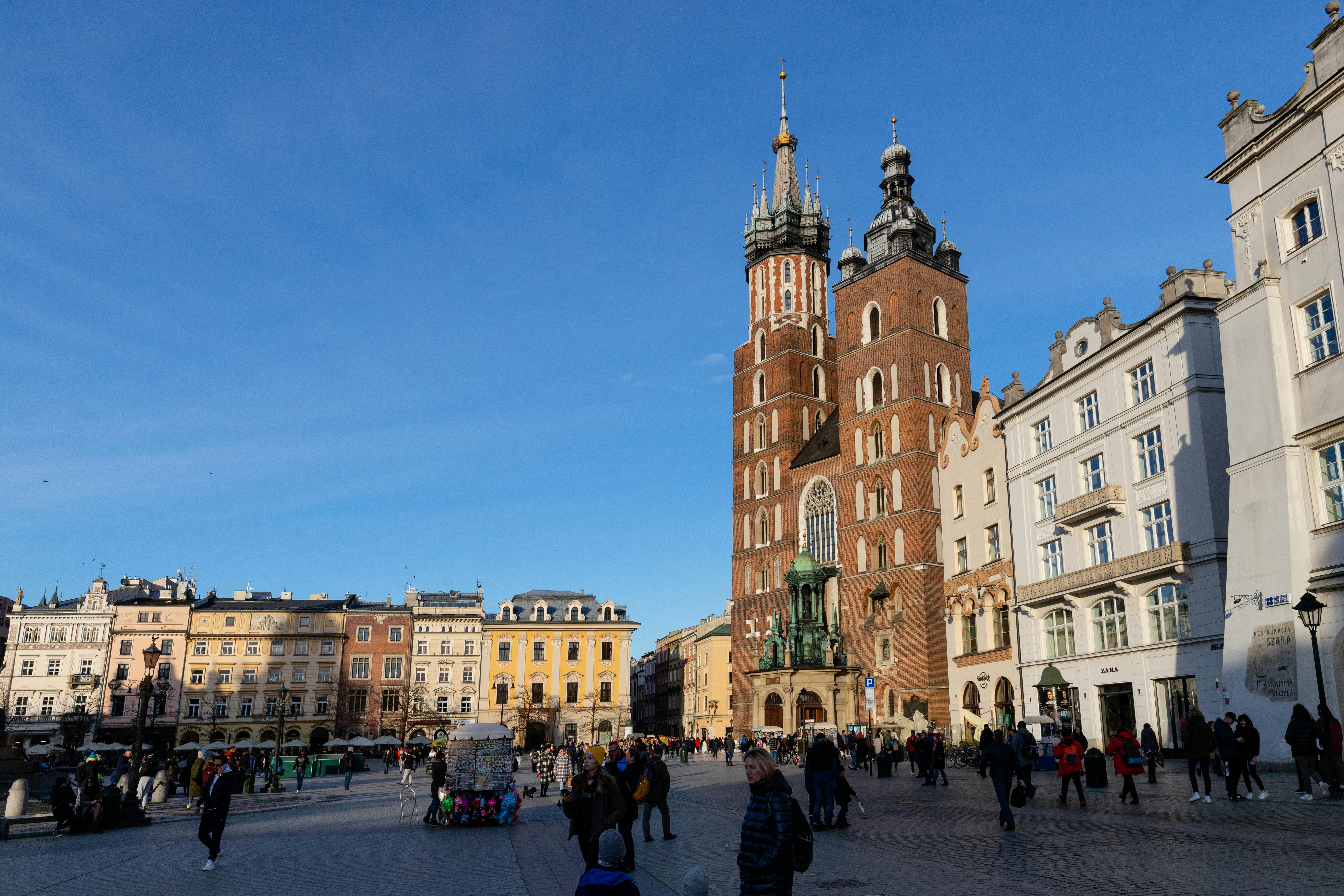
St. Mary's Basilica: Where Gothic Faith Meets Kraków's Heartbeat
The first notes of the hejnał mariacki pierce the crisp morning air as you stand beneath the asymmetrical towers of St. Mary's Basilica—a 14th-century Gothic masterpiece rising 81 meters above Kraków's Main Market Square. The scent of beeswax candles mingles with river mist drifting from the Vistula, while sunlight filters through stained glass to cast jewel-toned patterns across limestone floors worn smooth by six centuries of pilgrims. You hear the soft shuffle of footsteps on stone, the distant murmur of Polish prayers, and the rhythmic strike of the hourly trumpet call—a melody that abruptly ends mid-note to honor a watchman slain by Tartar invaders in 1241. This isn't merely a church—it's a living testament to faith, resilience, and artistic devotion, where Veit Stoss's monumental wooden altarpiece (1477–1489) stands 13 meters tall as one of Europe's finest examples of late Gothic sculpture, and where every stone whispers stories of coronations, wars, and the quiet persistence of hope.
Why St. Mary's Basilica Embodies Sacred Craftsmanship
St. Mary's Basilica represents far more than architectural splendor—it embodies the extraordinary fusion of spiritual devotion and artistic mastery that defined late medieval Kraków. Construction began in 1347 on the foundations of an earlier 13th-century church destroyed during the Mongol invasion, and the present Gothic structure was consecrated in 1397 after five decades of meticulous craftsmanship [[15]]. The basilica solved a fundamental challenge of sacred architecture: how to create a space that inspired awe through verticality while maintaining acoustic clarity for liturgical music and congregational prayer. The taller north tower (81 meters) houses the historic trumpet call, while the shorter south tower (69 meters) contains five bells including the 11-ton Great Mary, cast in 1525. Inside, the three-nave interior spans 40 meters in length and 23 meters in width, with ribbed vaulting rising 27 meters to create a sense of celestial ascent. What makes this basilica unique is Veit Stoss's High Altar—a polyptych carved from linden wood between 1477–1489, featuring over 200 sculpted figures depicting the Life of the Virgin Mary. The altar's intricate details—gilded robes, expressive faces, and delicate floral motifs—were achieved using chisels no wider than a fingernail, a testament to craftsmanship that transcends time.
The Best Time to Experience St. Mary's Basilica
To experience St. Mary's Basilica at its most atmospheric, plan your visit between May 20–June 15 or September 15–October 12, when daytime temperatures range from 16–24°C (61–75°F) and the square blooms with chestnut blossoms or glows with autumn amber [[10]]. During these windows, you'll enjoy comfortable conditions for exploring the basilica's interior, photography, and walking the uneven cobblestones without summer's crowds or winter's chill. For optimal photography of the Gothic facade and stained glass, arrive at 7:30–9:00 AM when morning light strikes the eastern windows, illuminating biblical scenes with soft, directional illumination. Alternatively, visit at 5:00–6:30 PM during golden hour when warm light transforms brick into amber tones and long shadows emphasize the towers' dramatic silhouette. You should firmly avoid July 18–August 22 when temperatures can exceed 30°C (86°F), the basilica becomes congested with tour groups, and harsh overhead light flattens the texture of Gothic stonework. For Mass schedules, guided tours, and concert information, visit krakow.travel [[8]].
Approximate Budget for a 7-Day Trip
Visiting St. Mary's Basilica requires basing yourself in Kraków's Old Town or Kazimierz district, with easy walking access to the Main Square and surrounding attractions. The following budget assumes moderate travel style—comfortable boutique hotels, authentic Polish cuisine, and a mix of public transportation and occasional taxi rides. Prices are listed in Polish Złoty (PLN) with euro equivalents for international travelers (1 EUR ≈ 4.3 PLN in 2026) [[19]].
- Accommodation: 87–214 PLN (20–50€) per night in Old Town or Kazimierz. Budget pensions start at 44 PLN; boutique hotels with historic charm run 218–437 PLN (50–100€) [[26]].
- Food: 44–66 PLN (10–15€) per day total. Breakfast: 15–20 PLN for traditional śniadanie with jajecznica, local cheese, and fresh bread. Lunch: 20–30 PLN for pierogi or żurek at a milk bar like Tomasza. Dinner: 40–60 PLN for sit-down meals featuring oscypek cheese, duck with apples, and craft beer [[21]].
- Transportation: Local tram/bus: 2.80 PLN (0.65€) for 20 minutes; one-day pass: 15 PLN (3.50€). Taxi from airport: ~70 PLN (16€); Uber/Bolt often cheaper [[26]].
- Attractions: St. Mary's Basilica entry: 10 PLN (2.30€); Tower climb: 12 PLN (2.80€); Hejnał trumpet experience: free; Audio guide: 8 PLN (1.90€) [[33]].
- Miscellaneous: Handcrafted amber rosary: 65–115 PLN (15–27€); local candle souvenir: 12 PLN (2.80€); classical concert ticket: 40–80 PLN (9–19€) [[22]].
Total 7-Day Budget: 2,400–3,450 PLN (560–800€) per person (excluding international flights)
7 Essential St. Mary's Basilica Experiences
- Witness the Hourly Hejnał Mariacki: Position yourself beneath the taller tower at :00 past each hour to hear the historic trumpet call. The melody—four notes played five times—commemorates the 1241 Tartar invasion. Listen closely: the fifth repetition cuts off abruptly, honoring the watchman who warned the city before being struck by an arrow. Free; allow 5 minutes; respectful silence appreciated.
- Marvel at Veit Stoss's High Altar: Stand before the monumental wooden polyptych (1477–1489) and observe the intricate carving of over 200 figures depicting the Life of the Virgin Mary. The central panel shows the Dormition of Mary surrounded by apostles, while side panels unfold scenes from her life. Notice the gilded details and expressive faces carved with chisels no wider than a fingernail. Visit mid-morning (10:00 AM–12:00 PM) when natural light illuminates the gold leaf. Allow 20 minutes; included with basilica entry.
- Climb the North Tower for Panoramic Views: Ascend the 230 narrow stone steps of the 81-meter tower for breathtaking views of Kraków's red-tiled rooftops, the Main Square's geometric layout, and the Tatra Mountains on clear days. The top platform features a small exhibition on the trumpet tradition. Visit golden hour (5:00–6:30 PM) for photography; entry 12 PLN; wear sturdy shoes.
- Explore the Stained Glass Windows: Walk the nave to observe the 19th- and 20th-century stained glass windows by renowned artists including Stanisław Wyspiański and Józef Mehoffer. The windows depict biblical scenes and Polish saints with vibrant colors that transform with the daylight. Visit midday (12:00–2:00 PM) when overhead light maximizes color saturation. Free with entry; allow 15 minutes.
- Attend an Evening Organ Concert: Experience the basilica's renowned acoustics during a classical organ recital featuring works by Bach, Chopin, and Polish composers. The 19th-century organ, restored in 2018, fills the vaulted space with resonant sound. Concerts typically begin at 7:00 PM; tickets 40–80 PLN; book online to secure seats.
- Light a Candle in the Side Chapel: Visit the Chapel of the Blessed Sacrament to light a votive candle and offer a quiet prayer. The flickering flames create a contemplative atmosphere against the backdrop of Gothic arches and stone carvings. Best experienced early morning (8:00–9:30 AM) or late evening for peaceful reflection. Candle donation: 5 PLN suggested.
- Photograph the Gothic Facade at Blue Hour: Position yourself in the Main Square's center to frame the basilica's twin towers against the twilight sky. The brick facade, flying buttresses, and pointed arches create dramatic silhouettes when building lights illuminate the stonework. Visit just after sunset (7:00–8:00 PM in summer); use a tripod with care; wide-angle lens recommended.
3 Hidden Gems Most Travelers Miss
- The Crypt of National Bards: Beneath the basilica's floor lies a crypt honoring Poland's greatest poets and writers, including Adam Mickiewicz and Juliusz Słowacki. Most visitors miss it because access requires a special guided tour. Access: Book in advance via the parish office; tours depart at 2:00 PM weekdays. Best examined mid-afternoon when guide explanations enhance appreciation. Entry included with special tour (additional 15 PLN); allow 20 minutes.
- The Medieval Foundation Stones: In the basilica's western nave, exposed sections of the original 13th-century church foundations reveal Romanesque stonework beneath the Gothic structure. Overlooked because signage is subtle. Access: Included with basilica entry; visit mid-morning (10:00 AM–12:00 PM) when natural light illuminates the stone textures. No additional fee; allow 10 minutes.
- The Bell-Ringing Chamber: On rare occasions, visitors can observe the historic bell-ringing mechanism in the south tower, including the 11-ton Great Mary bell cast in 1525. Most tourists miss it because access is limited to special heritage days. Access: Check krakow.travel for "Open Monument Days" (typically September); no advance booking required. Best visited midday; free; allow 15 minutes.
Cultural & Practical Tips
- Respect Sacred Spaces: When entering St. Mary's Basilica, dress modestly (shoulders and knees covered), speak quietly, and avoid photography during Mass. Remove hats as a sign of respect; silence mobile devices.
- Essential Polish Phrases: "Dzień dobry" (jen doh-brih) = Good day; "Dziękuję" (jen-koo-yeh) = Thank you; "Proszę" (proh-sheh) = Please/You're welcome; "Przepraszam" (psheh-prah-sham) = Excuse me. Locals appreciate the effort, even if pronunciation isn't perfect.
- Entry Strategy: Purchase basilica entry tickets at the side door (ul. Mariacka) to avoid main entrance queues. Tower climb tickets are sold separately at the base of the north tower; morning slots fill quickly.
- Photography Guidelines: Photography is permitted in most areas, but flash is prohibited to protect historic artwork. Tripods require advance permission (contact: parafia@mariacka.com).
- Weather Preparedness: Kraków experiences continental climate: summer highs reach 25–30°C (77–86°F); winter lows drop to -5°C (23°F). The basilica interior remains cool year-round; carry a light layer even in summer.
- Accessibility Notes: The basilica's main nave is wheelchair accessible via a side entrance; however, the tower climb and crypt are not accessible due to historic stone stairs. Request assistance at the parish office for alternative viewing options.
- Combine with Nearby Sites: Enhance your basilica visit with walking-distance attractions: Kraków Main Square (adjacent), Cloth Hall (50 meters), and Wawel Castle (10 minutes south). A regional perspective enriches understanding of Kraków's historical layers.
Conclusion: Travel with Reverence, Not Just Checklists
St. Mary's Basilica invites you to do more than photograph Gothic spires against a blue sky. This is a place to stand where artisans carved faith into wood and stone, where trumpeters have sounded warning and welcome for eight centuries, where the quiet persistence of prayer meets the vibrant pulse of a living city. When you gaze upon Veit Stoss's altarpiece, when you hear the hejnał's truncated melody echo through the square, when you light a candle in the flickering chapel, you participate in a tradition that transcends tourism. Travel to St. Mary's with reverence for the craftsmanship that built these vaults, for the resilience that preserved this sanctuary through wars and partitions, for the community that keeps this sacred space vibrantly alive. Respect the fragility of medieval artistry—six centuries of candle smoke and human touch have softened details, and every careless contact accelerates erosion. Understand that the contemplative atmosphere you cherish depends on the mindfulness of every visitor who comes after you. Let the basilica's vertical grandeur humble your expectations, let its layered history slow your pace, and let the convergence of faith, art, and community remind you that the most profound journeys are those that deepen our connection to human continuity across ages.