
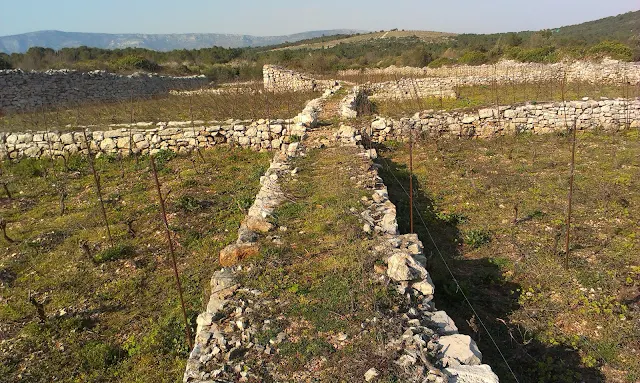
Stari Grad Plain: Where Ancient Geometry Meets Dalmatian Soil
The early morning light spills over the island of Hvar—soft, honeyed, and utterly still—illuminating a vast expanse of geometric perfection. Dew clings to the wild fennel and dry grass; beneath your boots, the limestone earth crunches with a satisfying, gritty resonance. Ahead of you, a labyrinth of dry-stone walls stretches toward the horizon, dividing 1372 hectares of fertile land into an impossibly neat orthogonal grid. The air tastes of salt carried on a faint breeze from the distant Adriatic, mingling with the resinous scent of Aleppo pines bordering the plain. Cicadas begin their rhythmic whir as the temperature rises. You are standing on the Stari Grad Plain, a living agricultural canvas carved out by Greek colonists more than two millennia ago. This place matters not because it is picturesque, but because it represents one of the most intact ancient land divisions in all of the Mediterranean—a testament to human ingenuity that refuses to be erased by time.
Why Stari Grad Plain Embodies Agricultural Permanence
When Greek settlers from the island of Paros established the colony of Pharos on Hvar, they faced an immediate, existential challenge: how to feed a growing population on a rugged, water-scarce karst landscape. The Stari Grad Plain solved this problem through sheer mathematical precision. The colonists surveyed the flat, alluvial valley and imposed a rigid chora—a standardized system of land division that split the territory into 73 precisely measured rectangular plots. Each plot was separated from its neighbor by dry-stone walls constructed entirely from locally quarried limestone, stacked without mortar to a height of roughly 1.2 meters (4 feet). This engineering marvel served multiple functions: it cleared the rocky surface for planting, prevented soil erosion during the fierce winter rains, and established indisputable property boundaries. The resulting grid, oriented perfectly to the cardinal directions, measures approximately 900 meters (2950 feet) by 500 meters (1640 feet). Recognized by UNESCO as a World Heritage Site, the plain fulfills a profound cultural need—it provides a tangible, unbroken link to the Hellenic world, proving that sustainable agriculture can endure for centuries when rooted in geometric harmony and deep respect for the terrain.
The Best Time to Experience Stari Grad Plain
To witness the Stari Grad Plain in its most evocative state, plan your visit between May 18–June 12. During this precise window, the soil retains enough moisture to paint the olive groves a vivid, vibrant green, and the ambient temperature sits at a comfortable 22°C–25°C (72°F–77°F). Arrive at the plain’s edge by 8:00–9:30 AM, when the light is perfectly diffused and the distant shadows of the stone walls create dramatic, elongated patterns across the earth. A secondary window occurs from September 10–28, when the grapevines turn copper and crimson, and the harvest season brings an infectious, bustling energy to the fields. You should entirely avoid July 15–August 20. During this period, daytime temperatures routinely exceed 32°C (90°F), the vegetation desiccates into a pale yellow, and walking the exposed plain becomes physically exhausting. Furthermore, agricultural vehicles kick up thick clouds of white dust that obscure the very geometric lines you came to see. For the most current conditions and local cultural events occurring on the plain, consult the official tourism portal at https://www.visit-stari-grad.com.
Approximate Budget for a 7-Day Trip
Experiencing the Stari Grad Plain does not require excessive luxury; rather, the pricing methodology here assumes a comfortable, culturally immersive stay focused on local wine, olive oil, and heritage accommodation within the nearby town of Stari Grad, which serves as the gateway to the plain.
- • Accommodation: €110–€170 per night (renovated traditional stone house in the Stari Grad outskirts, featuring local limestone accents and a private courtyard)
- • Food: €75 per day (breakfast of fresh pastry and local cheese at a pekara €7, lunch of pašticada at a family tavern €28, dinner of grilled fresh fish with blitva €40)
- • Transportation: €60 total (round-trip ferry from Split to Stari Grad €40 per person, daily bicycle rental to traverse the plain €20)
- • Attractions: €35 total (guided UNESCO heritage walking tour of the plain €18, tasting fees at three local wineries €17)
- • Miscellaneous: €45 total (bottle of premium local extra virgin olive oil €15, a jar of lavender honey from a roadside stand €10, SPF 50 sunscreen and water €20)
Total: €1,015–€1,475 for one week (for two people)
6 Essential Stari Grad Plain Experiences
- Walking the Chora Grid at Dawn: Start at the eastern edge of the plain near the intersection of the Stari Grad-Vrbanj road. Walk directly west along the ancient boundary lines at 6:30 AM. The low angle of the sun transforms the stone walls into sharp, cinematic corridors of light and shadow, allowing you to fully comprehend the sheer scale of the Greek surveying effort.
- Tasting Bogdanuša in the Vineyards: Seek out a local winemaker in the village of Svirče, located at the southern boundary of the plain. Bogdanuša is an indigenous white grape cultivated here since antiquity—its name translates to "gift of God." The wine pours a pale gold; expect crisp saline notes and a distinct, slightly bitter almond finish that pairs perfectly with the local sea salt.
- Examining the Dry-Stone Masonry Up Close: Stop at a crossroads in the center of the plain and crouch down to inspect the wall construction. Notice the absence of mortar; the stones are meticulously interlocked by weight and friction alone. Run your fingers over the lichen-covered surfaces—it is a tactile connection to the anonymous stonemasons who built these barriers by hand.
- Visiting the Greek Tower Remnants: Hike 7 kilometers (4.3 miles) northeast from Stari Grad to the site of Maslinovik, an ancient Greek observation tower perched on a hilltop overlooking the plain. The cylindrical stone foundations remain intact, offering a strategic vantage point where you can see the entirety of the geometric grid stretched out below you like a woven textile.
- Cycling the Northern Perimeter: Rent a hybrid bicycle and ride the unpaved track that skirts the northern edge of the plain. This 12-kilometer (7.5-mile) route keeps you elevated above the agricultural grid, providing sweeping views of the purple mainland mountains across the channel. The crunch of tires on gravel is the only sound accompanying your breath.
- Picnicking Among the Olive Trees: Purchase a round of artisan sheep cheese, some dried figs, and a loaf of dense, crusty bread from the Stari Grad morning market. Walk 15 minutes into the plain, find the shade of a centuries-old olive tree with a gnarled trunk, and eat slowly. The silence here is profound, broken only by the wind rustling the dry grasses.
3 Hidden Gems Most Travelers Miss
- • The Solitary Cross at Crior: Located in the exact geographical center of the plain stands a 2-meter (6.5-foot) tall, weathered stone cross, erected to bless the harvests. It is overlooked because it requires a 20-minute walk off the main dirt track through tall, unmarked grasses. Visit at twilight, when the cross is silhouetted against the violet Dalmatian sky. There are no signs marking the path—navigate by walking due south from the solitary abandoned stone hut on the northern track.
- • The Farmhouse Cellars of Dol: The tiny village of Dol sits at the eastern terminus of the plain. Beneath several unassuming residential homes are vast, subterranean stone cellars where families still press their own olives. These cellars are overlooked because they are entirely unmarked; you must knock on unmarked wooden doors and ask "Imate li ulje?" (EE-mah-teh lee OOL-yeh—Do you have oil?). If home, the owners will happily pour you a tasting of cloudy, peppery oil directly from the stainless-steel vats.
- • The Abandoned Lime Kilns: Tucked into the treeline at the base of the surrounding hills are several ruined lime kilns (vapjenice). Farmers used these domed stone structures to burn limestone, creating the agricultural lime used to sweeten the acidic soil. They are overlooked because they look like natural rock formations from a distance. Inspect the interior walls—they are coated in a shimmering, vitrified layer of melted calcium carbonate.
Cultural & Practical Tips
- • Always greet farmers you encounter with "Dobar dan" (DOH-bar dahn)—Good day. Failing to acknowledge someone working the land is considered deeply rude in Dalmatian culture.
- • Never pick fruit from the branches overhanging the stone walls, even if the branches cross the public path. The olives and figs are privately owned, and harvesting them without permission is a serious local offense.
- • Photography of the landscape is welcomed, but pointing your camera directly at individuals working in the fields without explicit consent is intrusive. A respectful approach is to lower your camera, greet them, and ask "Smijem li?" (SMYEH-m lee—May I?).
- • Wear sturdy, closed-toe shoes with thick soles. The karst limestone of the plain is incredibly sharp, and the dry-stone walls frequently shed small, jagged rocks onto the walking paths.
- • Carry a minimum of 1.5 liters of water per person when walking the plain. There is absolutely no shade, no potable water source, and the reflective white stone intensifies the sun’s heat exponentially.
- • Be mindful of the Bura wind. This sudden, violent northeasterly gale can appear without warning between October and April, turning the plain into a dust storm. If the air suddenly feels cold and the sea churns white, seek shelter in Stari Grad immediately.
Conclusion: Travel with Rootedness, Not Just Sightseeing
To stand in the center of the Stari Grad Plain is to occupy a space where time behaves differently. The modern world—with its relentless urgency and digital noise—feels thoroughly irrelevant here. This landscape does not demand your attention with flashing lights or towering monuments; it commands your respect through sheer, quiet endurance. Traveling with rootedness means recognizing that the geometric walls beneath your feet were not built for your admiration, but for survival. It means understanding that every olive tree you pass is a living archive of agricultural labor stretching back to antiquity. When you walk these fields, you are not simply checking a UNESCO site off a list—you are bearing witness to a profound human agreement with the earth. Slow your pace. Touch the rough-hewn limestone. Let the infinite grid remind you that some of humanity’s greatest achievements are not erected upward into the sky, but patiently, humbly laid down upon the soil.
Image Description: Stari Grad Plain agricultural landscape with ancient stone walls and olive groves under a golden sunrise