
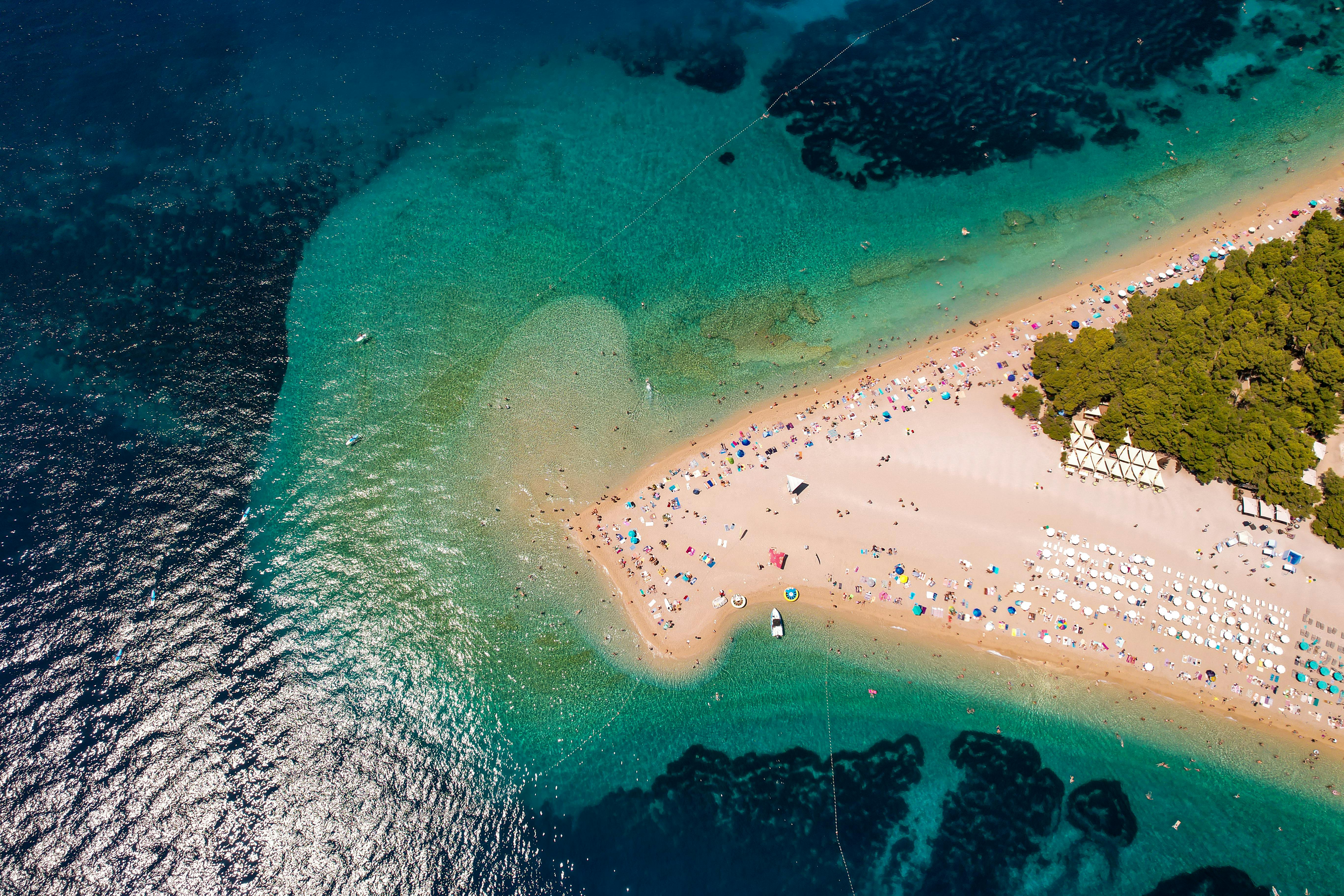
Brač Zlatni Rat Beach: Where Shifting Pebbles Meet Adriatic Currents
Midday light fractures against the crystalline shallows, casting jagged patterns of electric blue across the seafloor. The rhythmic slap of small waves against rounded white pebbles provides a steady, percussive soundtrack—a sound both soothing and strangely hypnotic. Stretching roughly 530 meters (1738 feet) into the Hvar Channel, the iconic Zlatni Rat beach undulates like a pale, sandy tongue, its tip curling ever eastward in the grip of the prevailing wind. You stand at the base of this peculiar peninsula, feeling the smooth, sun-warmed limestone pebbles shift subtly beneath your bare feet. The scent of roasted pine needles mingles with the sharp, iodine tang of saltwater. This is no ordinary coastline; it is a dynamic, living geomorphological event. Brač Zlatni Rat beach matters not merely because it resembles a golden horn—its Croatian namesake—but because it offers a visceral, undeniable reminder that the earth beneath us is not static, but perpetually sculpted by unseen maritime forces.
Why Brač Zlatni Rat Beach Embodies Geological Fluidity
To understand the profound significance of Zlatni Rat, you must look past the sunbathers and examine the ground itself. The beach is entirely devoid of sand; it is composed of millions of smooth, elliptical pebbles eroded from the nearby Vidova Gora mountain—the highest peak of the Adriatic islands at 780 meters (2559 feet). Historically, this rocky outcrop solved a unique natural problem: it acted as a self-regulating barrier that absorbed the violent energy of southern storms, protecting the fragile harbor of Bol from catastrophic wave surges. Formed at the mouth of an ancient underwater river delta, the spit is locked in a perpetual state of migration. The jugo, a powerful southeasterly wind, violently pushes the pebbles toward the west, while the maestral, a steady northwesterly summer breeze, gradually shunts them back to the east. This geological tug-of-war can alter the tip’s orientation by up to 10 degrees in a single season. Engineers and coastal authorities have long since abandoned attempts to armor the spit with concrete; they recognized that rigid structures would simply be shattered by the immense kinetic energy of the shifting tides. Instead, the beach fulfills a profound human need by serving as a monumental, accessible sculpture carved entirely by fluid dynamics—a masterpiece of natural engineering that rewrites its own blueprint with every passing tide.
The Best Time to Experience Brač Zlatni Rat Beach
To witness the Brač Zlatni Rat beach in its most transcendent state, plan your arrival between May 18–June 12. During this precise window, the water temperature hovers at a brisk but refreshing 19°C–21°C (66°F–70°F), and the surrounding pine forests emit a heady, resinous perfume. Arrive at the shoreline between 8:00–9:30 AM; at this hour, the light strikes the water at a low angle, turning the shallows a piercing, glass-like cyan, and you will share the spit with only a handful of early-morning swimmers. A secondary window occurs from September 10–28, when the sea reaches its warmest annual temperature of 24°C (75°F) and the dense summer crowds have dissipated. You should aggressively avoid July 15–August 20. During these weeks, daytime temperatures routinely exceed 32°C (90°F), turning the white pebbles into a blistering griddle that can burn bare feet in seconds. Furthermore, the narrow peninsula becomes so densely packed with umbrellas that navigating the shoreline feels akin to navigating a congested urban plaza. For real-time wind conditions and local event schedules, consult the official municipal tourism portal at www.bol.hr.
Approximate Budget for a 7-Day Trip
Experiencing Zlatni Rat does not require extravagant spending, but the beach's proximity to the upscale town of Bol dictates a moderately elevated baseline for accommodation and dining. This budget assumes a comfortable mid-tier experience for two people, balancing local authenticity with reliable quality.
- • Accommodation: €130–€210 per night (traditional stone apartment in the western reaches of Bol, offering shaded terraces and a 15-minute walking proximity to the beach)
- • Food: €90 per day (breakfast of fresh pastry and espresso at a harbor kafić €8, lunch of grilled squid and blitva at a beachside konoba €32, dinner of slow-cooked lamb peka €50)
- • Transportation: €110 total (return Jadrolinija ferry from Split to Supetar €38, onward local bus Supetar to Bol €12, daily local bus passes to the beach €10 per person)
- • Attractions: €80 total (rental of two premium sunbeds and an umbrella at the western edge of the spit €40 per day for two days, introductory windsurfing session €20)
- • Miscellaneous: €55 total (a jar of local olive oil infused with rosemary €15, protective water shoes with thick rubber soles €25, two artisanal lavender sachets from a Bol market stall €15)
Total: €1,305–€1,815 for one week (for two people)
6 Essential Brač Zlatni Rat Beach Experiences
- Swimming the Dynamic Tip: Walk to the very eastern edge of the spit at 9:00 AM and wade directly into the convergence zone where the open sea meets the sheltered harbor water. The temperature differential is palpable—a sudden, bracing chill that jolts the senses. Float on your back and look up at the sheer face of Vidova Gora towering above the town.
- Riding the Maestral Wind: By early afternoon, the maestral wind arrives with surgical precision, typically building between 1:00–3:00 PM. Book a 90-minute windsurfing lesson at the western base of the beach; the shallow, exceptionally clear water provides a safe, visually spectacular classroom where you can see the seafloor racing beneath your board.
- Photographing from the Pine Canopy: Walk to the small stone chapel perched on the headland east of the beach. Climb the worn limestone steps to the coastal path, then turn back. Framed through the dark, fragrant branches of the Aleppo pines, the white V-shape of Zlatni Rat contrasts violently against the dark blue water—a composition favored by early 20th-century Austrian painters.
- Tracing the Underwater Reef: Strap on a mask and snorkel and swim 40 meters (130 feet) out from the tip. The seafloor drops away sharply into a rocky canyon carpeted in brown algae and dotted with violet sea urchins. The visibility here frequently exceeds 20 meters (66 feet), revealing a silent, undisturbed ecosystem.
- Walking the Promenade at Dusk: As the sun dips below the island of Hvar, walk the 1.2-kilometer (0.7-mile) shaded promenade that connects Bol to the beach. The smooth stone path is flanked by century-old pines, and the fading light turns the distant Dalmatian mainland a soft, bruised purple.
- Tasting Brač Cheese by the Shore: Stop at a waterfront vendor near the beach entrance and order a small plate of viška sir—a hard, pungent sheep's cheese aged in olive oil. Eat it slowly with a chunk of crusty bread, letting the salty, crystalline texture complement the mineral-rich sea air.
3 Hidden Gems Most Travelers Miss
- • The Martinova Cave: Located 200 meters (656 feet) west of the main spit, this small, sea-level grotto is entirely overlooked because it requires swimming through a narrow, submerged fissure in the limestone. Access is strictly dictated by the tide; enter only when the water is dead calm and at its lowest ebb, typically around 10:00 AM. Inside, the cave opens into a domed chamber where the water glows an impossible neon blue from refracted sunlight.
- • The Zlatni Rat Pine Labyrinth: Directly behind the beach's public facilities lies a dense, uncultivated grove of maritime pines. Tourists ignore it because there are no signs or cleared paths. Wander 50 meters inland and you will find a natural maze of gnarled trunks and soft, needle-covered earth. It smells intensely of resin and provides the only true silence within a 2-kilometer (1.2-mile) radius.
- • The Roman Water Cistern Remnants: At the base of the hill leading to the vidikovac (viewpoint), partially obscured by macchia, sit the shattered walls of a Roman water cistern. Built to supply the nearby villa rustica, the square-cut stone blocks feature original hydraulic mortar. It is overlooked because it lacks interpretive signage, but running your fingers over the 2,000-year-old waterproof plaster connects you directly to the island's ancient inhabitants.
Cultural & Practical Tips
- • When greeting locals in Bol, say "Dobar dan" (DOH-bar dahn)—Good day. Use this from morning until dusk; switching to "Dobra večer" (DOH-brah VEH-cher) as the sun sets demonstrates cultural awareness.
- • Respect the swimmer-surfer divide. A prominent rope buoy stretches from the tip of Zlatni Rat; the eastern side is strictly for swimmers, while the western side is reserved for windsurfers. Crossing this boundary is not just rude—it is exceptionally dangerous.
- • Invest in thick-soled water shoes. The pebbles of Zlatni Rat are smooth but densely packed; walking barefoot for extended periods feels like walking on a bed of rigid ball bearings. Water shoes with robust rubber soles are mandatory for comfort.
- • Photography of the beach is encouraged, but setting up tripods on the narrow tip of the spit during peak hours blocks the pedestrian flow. Shoot from the elevated pine promenade instead, where you can use a tripod unimpeded while capturing the sweeping scale of the geomorphology.
- • Heed the wind warnings. If the jugo blows, the sea state at the tip of the beach becomes chaotic, with dangerous rip currents forming along the edges of the spit. If the local harbor buoys are bouncing violently, do not swim past your waist.
- • Pronounce the name correctly to earn immediate respect from locals: Zlatni Rat is pronounced "ZLAHT-nee raht." The "z" is soft, like the "s" in "measure," and the accent falls heavily on the first syllable.
Conclusion: Travel with Geological Reverence, Not Just Shoreline Selfies
To visit Brač Zlatni Rat beach is to stand at the mercy of the wind and the tide. This iconic spit does not exist to serve as a passive backdrop for your holiday photographs; it exists as a testament to the relentless, invisible sculpting power of the Adriatic. Traveling with geological reverence means acknowledging that the very ground you walk on is borrowed—destined to be pushed eastward by tomorrow's gale or shifted by next week's swell. When you choose to observe the changing shape of the horn, to feel the contrast of the hot pebbles against the cold current, and to respect the fragile pine ecosystem buffering the shore, you elevate your visit from a simple excursion to an act of mindful participation. Slow down. Leave the selfie stick behind. Let the shifting pebbles remind you that the most extraordinary landscapes on earth are those that refuse to stay still.