
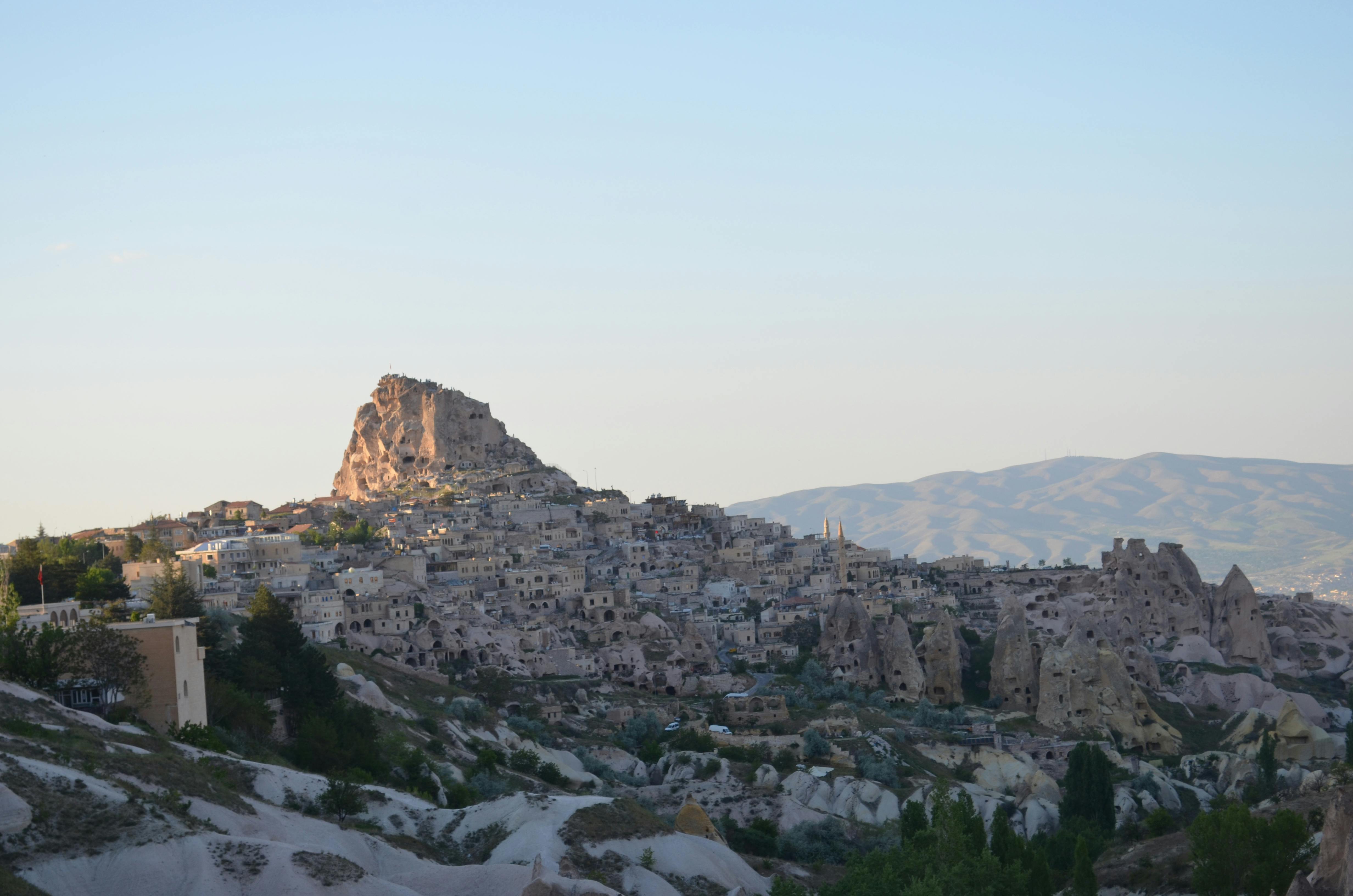
Uçhisar Castle: Where Volcanic Stone Meets Skyward Panorama
The sun dips behind Cappadocia's distant hills, casting amber light across Uçhisar Castle—a towering fortress of volcanic tuff that rises 60 meters (197 feet) above the village, its honeycomb chambers carved deep into the rock by centuries of human hands. You ascend the winding stone path, the air crisp with pine and dust, as the call to prayer from below mingles with the soft footsteps of fellow travelers exploring this ancient sentinel. Inside, narrow tunnels lead to sunlit terraces where panoramic views unfold: the Red Valley's rippling ridges, Göreme's rock-cut churches, and the distant snow-capped peak of Mount Erciyes framing the horizon. At 1,300 meters (4,265 feet) elevation—the highest point in Cappadocia—the silence is profound; only the whisper of wind through carved passages and the distant chime of goat bells break the spell. This is not merely a viewpoint; it is a testament to human resilience, where Byzantine defenders and later Ottoman families transformed a natural rock formation into a fortified refuge that could shelter entire communities during invasion. Standing here, suspended between earth and sky, you understand why this place matters: it reminds us that the most enduring fortresses are not built of mortar alone, but of vision, adaptation, and the quiet courage to carve sanctuary from stone.
Why Uçhisar Castle Embodies Strategic Harmony
The Uçhisar Castle represents one of history's most elegant solutions to a fundamental challenge: how to create a defensible refuge that leverages natural geography rather than fighting against it. Carved into a massive volcanic tuff formation during the Byzantine era (9th–12th centuries) and expanded under Ottoman rule, the castle solved the critical need for a high-ground stronghold that could monitor approaching threats across Cappadocia's vast valleys while providing shelter for local communities during periods of instability.
Technically, the fortress showcases remarkable engineering ingenuity. Artisans carved over 1,000 rooms, tunnels, and storage chambers directly into the soft volcanic rock—a material with a Mohs hardness of just 2–3, making it workable with iron tools yet durable enough to support massive overhead weight. The castle's vertical design maximizes defensive advantage: narrow entrance passages could be sealed with rolling stone doors, ventilation shafts ensured air circulation even during extended sieges, and cisterns carved into the rock stored rainwater for months. The summit terrace, accessible via a steep 150-step climb, offers 360-degree views spanning 50 kilometers (31 miles) in every direction—allowing sentinels to spot approaching armies long before they reached the valley floor. Materials were entirely local: volcanic tuff for structure, basalt caps for erosion protection, and natural mineral pigments for interior decoration.
Beyond its military function, Uçhisar Castle fulfilled a profound social need: creating a vertical community where families could maintain daily life while remaining secure. Rooms carved at different levels served as dwellings, chapels, stables, and workshops—forming a self-sustaining ecosystem within a single rock formation. Today, as visitors climb its sun-warmed pathways and gaze upon valleys painted in rose and ochre, the castle continues to inspire: a reminder that true strength lies not in isolation, but in the harmonious integration of human ingenuity with the gifts of the natural world.
The Best Time to Experience Uçhisar Castle
Timing your visit to Uçhisar Castle requires balancing light conditions, crowd levels, and seasonal weather for the optimal panoramic experience. The ideal window runs from April 15–June 12 and September 15–October 31, when Cappadocia's temperatures hover between 12–24°C (54–75°F), atmospheric conditions remain stable, and the angle of sunlight creates ideal conditions for photographing the landscape's vibrant hues without harsh glare or deep shadow.
For the most magical experience, arrive at 5:30–7:00 AM to witness sunrise from the summit terrace. This timing ensures optimal lighting: the low-angle sun casts long shadows that accentuate the fairy chimneys' textures while bathing the valleys in golden warmth. Morning light enhances the natural pigments in the volcanic rock—iron oxides create rose tones, while manganese contributes to deeper purples. Alternatively, visit between 4:00–6:00 PM for sunset photography, when the western valleys glow in amber and rose. The castle operates daily from 8:00 AM to 7:00 PM (April–October) or 5:00 PM (November–March); allow 90 minutes for the full ascent and exploration.
Avoid July 15–August 31 if possible: temperatures climb to 28–35°C (82–95°F), and midday sun can create uncomfortable heat on the exposed summit. Also skip Turkish national holidays (April 23, August 30, October 29) when domestic tourism surges, creating queues that diminish the contemplative atmosphere. Winter months (December–February) offer atmospheric mist and fewer visitors, with temperatures of -2–8°C (28–46°F), but pathways can be icy—wear shoes with good traction.
For current information on opening hours, ticket prices, and regional events, visit: https://www.castles.nl
Approximate Budget for a 7-Day Trip
Cappadocia offers exceptional value for cultural and adventure travelers, with costs remaining moderate despite recent inflation. The following budget assumes mid-range travel with comfortable cave-hotel accommodations in Uçhisar or nearby Göreme, quality Turkish cuisine, and comprehensive sightseeing including Uçhisar Castle and surrounding valleys. All prices reflect current rates in euros (€1 ≈ 35 Turkish Lira).
Accommodation: €60–€130 per night
• Budget cave pension in Uçhisar: €35–€55/night
• Mid-range cave hotel (3-star): €60–€95/night
• Luxury cave suite with castle view: €130–€220/night
7 nights total: €420–€910
Food: €22–€45 per day
• Breakfast: €5–€8 (Turkish tea, simit, menemen, olives, feta)
• Lunch: €7–€14 (testi kebab, lentil soup, pide, fresh salads)
• Dinner: €12–€25 (mezze platter, grilled lamb, stuffed eggplant)
• Street food/snacks: €3–€5 (simit, baklava, Turkish coffee)
7 days total: €154–€315
Transportation:
• Airport transfer (Nevşehir/Kayseri): €15 each way
• Local shuttle/taxi rides: €3–€8 per trip
• Car rental (optional): €35/day
• Guided valley tour: €25/day
7 days total: €95–€160
Attractions:
• Uçhisar Castle: €8
• Göreme Open-Air Museum: €12
• Red Valley hike (guided): €25
• Underground city (Derinkuyu): €8
• Pottery workshop in Avanos: €15
• Hot air balloon flight: €180–€250
Total: €248–€318
Miscellaneous:
• Travel insurance (adventure coverage): €40
• Souvenirs (ceramics, textiles, evil eye): €30–€90
• SIM card (10GB data): €12
• Tips for guides: €20–€40
Total: €102–€182
TOTAL 7-DAY BUDGET: €1,019–€1,885
7 Essential Uçhisar Castle Experiences
1. Ascend the Summit at Sunrise: Begin your climb by 5:30 AM to reach the terrace as the first light spills over Cappadocia's valleys. The 150-step ascent winds through carved tunnels and past ancient dovecotes; pause midway to catch your breath and photograph the village awakening below. At the summit, position yourself on the eastern edge for wide-angle shots that include fairy chimneys silhouetted against the brightening sky. Bring a light jacket—the elevation amplifies morning chill even in summer.
2. Explore the Carved Tunnels: Navigate the castle's labyrinthine passages, noting how rooms widen and narrow strategically for defense. Look for carved niches that once held oil lamps, ventilation shafts that still circulate fresh air, and stone benches where sentinels kept watch. The cool, mineral-scented air inside contrasts with the sun-warmed exterior—a sensory reminder of the fortress's dual purpose as both refuge and observation point. Allow 30 minutes for this interior exploration.
3. Photograph the Panoramic Vista: From the summit terrace, capture the 360-degree panorama that makes Uçhisar legendary: the Red Valley's rippling ridges to the south, Göreme's rock-cut churches to the east, and the snow-capped peak of Mount Erciyes framing the northern horizon. Use a polarizing filter to reduce glare on the light-colored tuff; a wide-angle lens conveys the landscape's vast scale. Visit during golden hour for the most dramatic lighting.
4. Study the Ancient Dovecotes: Along the castle's lower slopes, examine thousands of small niches carved into cliff faces—ancient dovecotes that once housed pigeons whose droppings fertilized Cappadocia's vineyards. These intricate facades, often decorated with geometric patterns, represent a unique fusion of agricultural utility and artistic expression. Photograph in late afternoon when low-angle light accentuates the carved details.
5. Descend Through the Village: After exploring the castle, wander Uçhisar's cobblestone streets to discover family-run pottery studios, traditional bakeries preparing tandır bread, and cafes with terraces overlooking the valleys. This ground-level perspective complements the aerial view from the summit, revealing how the castle integrates with daily life rather than dominating it. Stop for Turkish coffee while watching the sunset paint the stone houses in amber.
6. Watch Sunset from the Western Terrace: Return to the castle's western edge 30 minutes before sunset to witness the sky blaze in rose and amber over the Pigeon Valley. The setting sun casts long shadows that transform the fairy chimneys into dramatic silhouettes—a photographer's dream. Bring a tripod for stability in low light; the phrase "Gün batımı harika" (gewn bah-tuh-muh har-ee-kah) means "The sunset is wonderful" in Turkish.
7. Reflect at the Castle's Base: Before departing, pause at the foot of the formation to appreciate Uçhisar Castle in its entirety: a natural rock fortress transformed by human hands into a monument of resilience. This moment of perspective—viewing the castle from below after experiencing it from within—mirrors the emotional journey of the communities who once called this place home. Take a final photograph of the castle framed against the twilight sky.
3 Hidden Gems Most Travelers Miss
• The Eastern Ridge Viewpoint: Just beyond the main castle entrance, an unmarked trail leads to a natural terrace offering panoramic views of the Red and Rose Valleys without the crowds. Access: Follow the path to the right of the ticket booth; allow 10 minutes to reach the viewpoint. Best visited mid-morning when light illuminates the valley's vibrant hues. This quiet spot provides the perfect alternative to the busy summit terrace.
• The Rock-Cut Chapel: Tucked on the castle's second level, a small chapel with faint fresco remnants offers a poignant glimpse into the spiritual life of Uçhisar's former residents. Most visitors rush past this quiet space, but its preservation reveals how faith sustained communities even in confinement. Access: Ask staff for directions; the chapel is typically open during castle hours. Visit mid-afternoon when light from ventilation shafts illuminates the carved apse.
• The Village's Traditional Bakery: In Uçhisar's lower streets, a family-run bakery prepares tandır bread in a wood-fired oven carved directly into volcanic rock—a technique unchanged for centuries. Access: Follow the scent of baking bread from the castle entrance; the bakery opens at 6:00 AM. Purchase a warm loaf (€1) and enjoy it while watching the sunrise over the valleys—a simple pleasure that connects you to local culinary heritage.
Cultural & Practical Tips
• Dress for variable terrain: The castle ascent involves uneven stone steps and occasional steep sections. Wear sturdy hiking shoes with good grip, layered clothing for temperature shifts, and a hat for sun protection. Even in summer, mornings and evenings can be cool—bring a light jacket.
• Photography etiquette: Photography is permitted throughout public areas, but respect other visitors when composing shots on the crowded summit terrace. Tripods are allowed but must not obstruct pathways. The phrase "Fotoğraf çekebilir miyim?" (foh-toh-raf cheh-keh-bee-leer mee-yim) means "May I take a photo?" Always ask before photographing local residents.
• Stay hydrated and protected: Cappadocia's continental climate means intense sun exposure even on cool days. Carry at least 1.5 liters of water for the climb, use broad-spectrum sunscreen (SPF 30+), and wear sunglasses. The elevation amplifies UV exposure—reapply sunscreen every two hours.
• Combine with nearby attractions: Uçhisar Castle is a 10-minute drive from Göreme Open-Air Museum and a short walk from the Red Valley trailhead. Plan a half-day itinerary: castle at sunrise, breakfast in Uçhisar village, morning hike through the valleys. This balance of panoramic and intimate exploration maximizes your Cappadocia experience.
• Learn essential Turkish phrases: "Teşekkür ederim" (teh-shek-kur eh-deh-rim) = Thank you; "Kale çok güzel" (kah-leh chok gew-zel) = The castle is very beautiful; "Yol nerede?" (yol neh-reh-deh) = Where is the path? Attempting Turkish shows respect and often sparks warm interactions with local guides and artisans.
• Respect the historic structure: Uçhisar Castle is a fragile archaeological site; avoid touching carved surfaces (oils from skin accelerate erosion), stay on marked paths, and follow all posted guidelines. Your mindfulness helps preserve this irreplaceable landmark for future generations.
• Check weather conditions: Summit views depend on clear skies; fog or dust storms can reduce visibility significantly. Check the forecast before your visit and consider flexible timing—sunrise and sunset offer the most reliable photographic conditions year-round.
Conclusion: Travel with Presence, Not Just Panorama
Uçhisar Castle demands more than a photo opportunity—it invites presence. As you stand atop this volcanic sentinel, watching light transform Cappadocia's valleys into living art, remember that you are not merely a visitor but a witness to human resilience carved in stone. This fortress offers a narrative of adaptation: geological forces shaping rock, human hands carving refuge, and light painting beauty across millennia.
Travel here with intention. Between photographs, pause to touch the sun-warmed stone, to listen to the wind whispering through ancient passages, to simply stand in silence among formations that have witnessed empires rise and fall. Support conservation by staying on marked trails, respecting sacred spaces, and choosing local guides who share both knowledge and stewardship. These small acts of mindfulness accumulate into something larger than tourism—they become participation in preserving a fragile magic for generations to come.
Uçhisar Castle will stand long after we're gone, its stone spires continuing to catch light in ways that stir the soul. Your visit should honor that continuity, supporting the delicate balance between access and preservation that allows this wonder to endure. Slow down. Breathe the pine-scented air. Let the silent grandeur of this ancient fortress remind you that the most profound perspectives emerge not from haste, but from patience—from the quiet, persistent work of seeing deeply, one moment at a time. That is how you truly experience Uçhisar Castle.