
Vikos Gorge: Where Vertical Cliffs Meet Zagori's Stone Villages
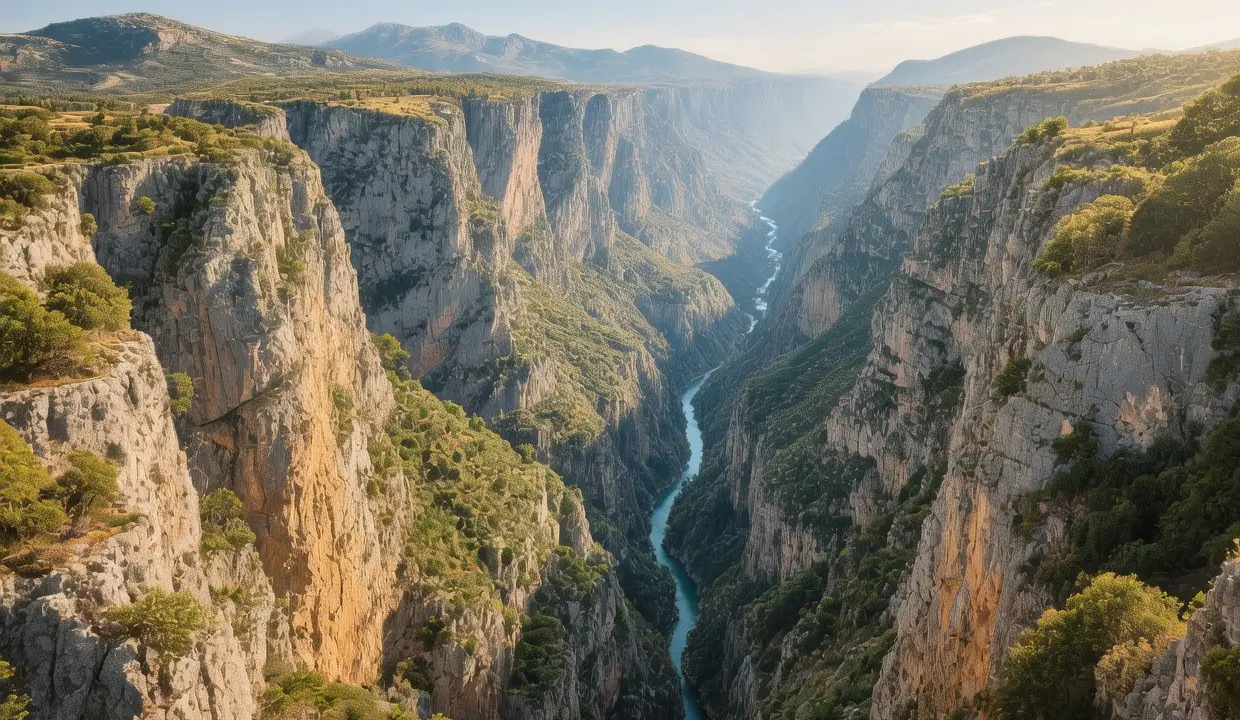
Dawn breaks over the Pindus Mountains, painting the limestone walls in shades of rose and amber—light cascades down one thousand meters of vertical rock face to touch the riverbed below. The Voidomatis River whispers through the gorge's floor, its turquoise waters carving through ancient stone that has stood since the Pliocene epoch. You stand at the viewing platform near Monodendri, where the air carries the scent of wild thyme and pine, and the silence is broken only by the distant cry of a golden eagle circling the thermal currents. This is Europe's deepest gorge relative to its width—a geological masterpiece plunging 1,000 meters (3,280 feet) while spanning just 400 meters at its narrowest point. For over two million years, water has sculpted this cathedral of stone, creating a sanctuary where Byzantine monasteries cling to clifftops and stone bridges from the Ottoman era still span mountain torrents. Vikos Gorge matters because it preserves not just a natural wonder, but a living landscape where human history and geological time converge in breathtaking harmony.
Why Vikos Gorge Embodies Raw Geological Majesty
Vikos Gorge represents one of the planet's most dramatic examples of fluvial erosion—a natural laboratory where you can witness the patient power of water shaping stone across millennia. The gorge extends approximately 20 kilometers (12.4 miles) through the heart of Zagori, cutting through limestone formations that date back 140 million years to the Mesozoic era. In 1997, the Guinness Book of Records recognized it as the world's deepest gorge relative to its width, a distinction that draws geologists and adventure seekers alike to this remote corner of Epirus.
The gorge solved a fundamental need for the isolated Zagori communities: it created a natural fortress that protected forty-six stone villages from Ottoman conquest for centuries. The Zagorochoria—as these villages are collectively known—developed a unique architectural style using local slate and limestone, building arched bridges like the iconic Kokkoris Bridge near Kipoi that still stand today. These structures weren't merely aesthetic; they served as vital connections between communities separated by the gorge's impassable walls.
From an ecological perspective, Vikos functions as a refuge for rare flora and fauna. The microclimate created by the gorge's depth supports over 1,300 plant species, including endemic varieties like the Centauria vlachorum found nowhere else on Earth. The vertical cliffs provide nesting sites for raptors—golden eagles, peregrine falcons, and griffon vultures patrol these skies with wingspans exceeding two meters. The gorge's isolation created what biologists call a "sky island" ecosystem, where species evolved independently from their lowland relatives.
Engineering marvels abound: the stone bridges employ a technique called "corbel arch" construction, where each stone projects slightly beyond the one below until they meet at the center—no mortar required. The Plakidas Bridge, built in 1814, spans 25 meters with a single arch rising 15 meters above the river, demonstrating mathematical precision that modern engineers still study. These structures solved the practical problem of crossing torrential mountain streams while withstanding flash floods that can raise water levels by several meters within hours.
The Best Time to Experience Vikos Gorge
Timing your visit to Vikos Gorge requires understanding both weather patterns and crowd dynamics. The optimal window runs from May 15 through June 20, when wildflowers carpet the gorge floor and temperatures hover between 18–24°C (64–75°F) during daylight hours. During this period, the Voidomatis River flows at moderate levels—perfect for photography yet safe for hiking. Morning light between 7:00–9:30 AM creates optimal conditions for viewing the gorge from Monodendri's Oxya viewpoint, when the sun illuminates the eastern cliff face without creating harsh shadows.
September 10 through October 15 offers a second prime season, with temperatures ranging 16–22°C (61–72°F) and autumn colors transforming the beech and oak forests into palettes of gold and crimson. The air clarity during these months exceeds 30 kilometers visibility, making it ideal for long-distance photography across the Pindus range.
Avoid July 1–August 20, when temperatures can exceed 32°C (90°F) in the gorge's lower sections and tourist numbers triple, creating bottlenecks on narrow trail sections. Winter months (November–March) bring snow and ice to higher elevations, with temperatures dropping to -5°C (23°F) at night—many mountain roads close, and the gorge trail becomes hazardous without proper mountaineering equipment.
For official information, trail conditions, and permits: www.visitgreece.gr and www.zagorihoria.gr
Approximate Budget for a 7-Day Trip
Traveling to Vikos Gorge offers exceptional value compared to Greece's island destinations, with costs reflecting the region's rural character and traditional hospitality. The following breakdown assumes a mid-range travel style—comfortable but not luxurious accommodation, local taverna dining, and independent exploration using public transport and occasional taxis.
- Accommodation: €45–€85 per night for traditional stone guesthouses in Monodendri, Papingo, or Kipoi villages. Budget rooms in family-run pensions start at €35; boutique suites with gorge views reach €120.
- Food: €25–€35 per day. Breakfast €5 (Greek coffee, honey yogurt, homemade pie); lunch €10 (horiatiki salad, grilled vegetables, fresh bread); dinner €15–€20 (slow-cooked goat, wild boar stew, local formaela cheese).
- Transportation: Bus from Athens to Ioannina €32 (5.5 hours); Ioannina to Monodendri €8; local village transfers €15–€25 per day; rental car €35/day (recommended for flexibility).
- Attractions: Gorge hiking free; guided geological tour €45; boat rental on Voidomatis €20/hour; monastery donations €2–€5; Folk Museum in Monodendri €3.
- Miscellaneous: Handwoven Zagori wool socks €12; local tsipouro (grape spirit) €8/bottle; hiking poles rental €5/day; travel insurance €35/week.
Total for 7 days: €650–€850 per person (excluding international flights to Athens)
7 Essential Vikos Gorge Experiences
- Hike the full gorge from Monodendri to Papingo: Begin at 7:00 AM from the Monodendri viewpoint, descending 600 meters via switchback trails marked with red-and-white blazes. The 12-kilometer route takes 5–6 hours, passing through beech forests, crossing the river seven times via stone bridges, and emerging at Papingo village. Carry 2 liters of water, wear ankle-supporting boots, and expect rocky terrain with 300-meter elevation changes.
- Swim in the Voidomatis River's natural pools: Near the village of Papingo, the river creates emerald pools where temperatures remain 14–16°C (57–61°F) even in summer. The clearest swimming spot lies 2 kilometers downstream from Papingo Mikro—access via an unmarked trail behind the church. Bring water shoes for the rocky entry.
- Cross the Kokkoris Bridge at golden hour: This 15th-century arched bridge near Kipoi village spans 25 meters above a turquoise pool. Arrive at 6:30 PM in summer (5:00 PM in autumn) when sunlight creates perfect reflections in the still water below. The stone's warm tones contrast dramatically with the cool river.
- Visit the Agia Paraskevi Chapel: Perched on a rocky outcrop 300 meters above the gorge floor near Monodendri, this 14th-century chapel requires a 20-minute climb up carved stone steps. The interior frescoes depict Byzantine saints, and the terrace offers panoramic views that justify every step of the ascent.
- Explore the Papingo Rock Pools (Ovires): Two natural swimming pools carved into volcanic rock near Megalo Papingo create infinity-edge basins overlooking the Astraka peaks. Hike 45 minutes from the village center; arrive before 10:00 AM to avoid crowds. The larger pool reaches 1.5 meters depth.
- Sample Zagori's slow-food specialties: Reserve a table at a traditional taverna in Dilofo village for pites (cheese pies), kontosouvli (slow-roasted lamb on horizontal spits), and galotiri (spicy cheese spread). Order local tsipouro—the region's answer to grappa—served with meze platters featuring wild mushrooms and mountain herbs.
- Witness sunrise from Oxya viewpoint: Drive or hike to this clifftop platform 2 kilometers from Monodendri. Arrive by 6:15 AM in summer to watch light transform the gorge from indigo to gold. Bring a wide-angle lens; the 180-degree panorama captures three mountain ranges and the entire gorge length.
3 Hidden Gems Most Travelers Miss
- The Forgotten Monastery of Agios Nikolaos: Accessible only via a 90-minute hike from Papingo Megalo, this abandoned 17th-century monastery clings to a cliff face 400 meters above the river. The frescoes remain remarkably preserved despite centuries of exposure. Enter through the collapsed bell tower—bring a flashlight to explore the monk cells carved into rock. Best visited Tuesday–Thursday when tour groups focus elsewhere.
- Vradeto's Hanging Footbridge: Near the highest village in Zagori (1,340 meters elevation), a metal footbridge spans a 60-meter-deep ravine. Most visitors drive past the turnoff 3 kilometers before Vradeto center. The bridge sways gently in mountain winds, offering vertigo-inducing views down to the gorge floor. Access requires a 15-minute walk from the village square; follow signs for "Gefyri" (bridge).
- The Petrified Waterfall at Koukouli: This geological anomaly—a calcium carbonate formation resembling a frozen cascade—lies 500 meters off the main road between Koukouli and Kipoi. Local shepherds call it "Neraida's Veil" (Fairy's Veil). Visit after rainfall when mineral deposits create rainbow refractions through the translucent stone. The formation grows 2–3 millimeters annually; touching it is prohibited to preserve the delicate structure.
Cultural & Practical Tips
- Respect monastery etiquette: When visiting active monasteries like Agia Paraskevi, women must wear skirts below the knee and cover shoulders; men should avoid shorts. Remove hats upon entry and speak in hushed tones. Photography inside chapels requires explicit permission—ask "Boro na fotoğrafiso?" (Can I photograph?).
- Carry cash exclusively: Many village tavernas and guesthouses don't accept credit cards. ATMs exist only in Ioannina and Konitsa—withdraw €200–€300 before entering Zagori. Small villages like Papingo operate on cash-only economies.
- Learn essential Greek phrases: "Yassou" (YAH-soo) = hello; "Efharisto" (ef-hah-REE-stoh) = thank you; "Poso kani?" (POH-soh KAH-nee) = how much?; "Nero parakalo" (neh-ROH pah-rah-kah-LOH) = water please. Locals appreciate effort even with imperfect pronunciation.
- Prepare for microclimates: Temperature differences between gorge rim and floor can exceed 8°C (14°F). Layer clothing—mornings at 1,200 meters elevation require fleece, while the gorge bottom at 500 meters demands breathable fabrics. Afternoon thunderstorms develop rapidly July–September; carry waterproof gear.
- Follow Leave No Trace principles: The gorge's ecosystem is fragile—pack out all trash, stay on marked trails to prevent erosion, and never remove rocks or plants. Wild camping is prohibited; use designated campsites in Papingo (€12/night) or Monodendri (€10/night).
- Photography guidelines: Drone use requires permission from the Vikos-Aoos National Park office (+30 26530 22612). Sunrise/sunset photography from viewpoints is unrestricted, but commercial shoots need permits. Respect private property—many stone bridges cross land owned by local families.
- Emergency preparedness: Cell coverage is spotty in the gorge bottom. Download offline maps before hiking. The nearest hospital is in Ioannina (45 minutes by car); mountain rescue contact: 100 or +30 26510 08900. Inform your guesthouse of hiking plans and expected return times.
Conclusion: Travel with Reverence, Not Just Sightseeing
Vikos Gorge demands more than casual observation—it asks for reverence. This isn't a landscape to conquer or check off a bucket list, but a cathedral of stone and time that has witnessed two million years of geological patience. When you descend into its depths, you're not merely hiking; you're walking through layers of Earth's memory, where each limestone stratum tells a story of ancient seas and tectonic upheaval.
Responsible travel here means understanding that you're a guest in a living ecosystem where golden eagles nest, where wildflowers bloom in crevices no human hand planted, where stone bridges built centuries ago still serve their purpose. It means leaving no trace, speaking softly in monasteries where monks have prayed for eight hundred years, and supporting the Zagori communities who've stewarded this landscape through Ottoman occupation and modern development pressures.
Slow down. Sit by the Voidomatis River and listen to water singing over stone. Share a meal with a taverna owner who sources ingredients from her own garden. Watch dawn break over the cliffs without reaching for your camera immediately. Vikos Gorge will still be here tomorrow, next year, next century—if we treat it not as a resource to consume, but as a masterpiece to protect. Travel here with humility, and the gorge will reveal its secrets not to your eyes alone, but to your soul.