
Mycenae Lion Gate: Where Monumental Stone Meets Bronze Age Legacy
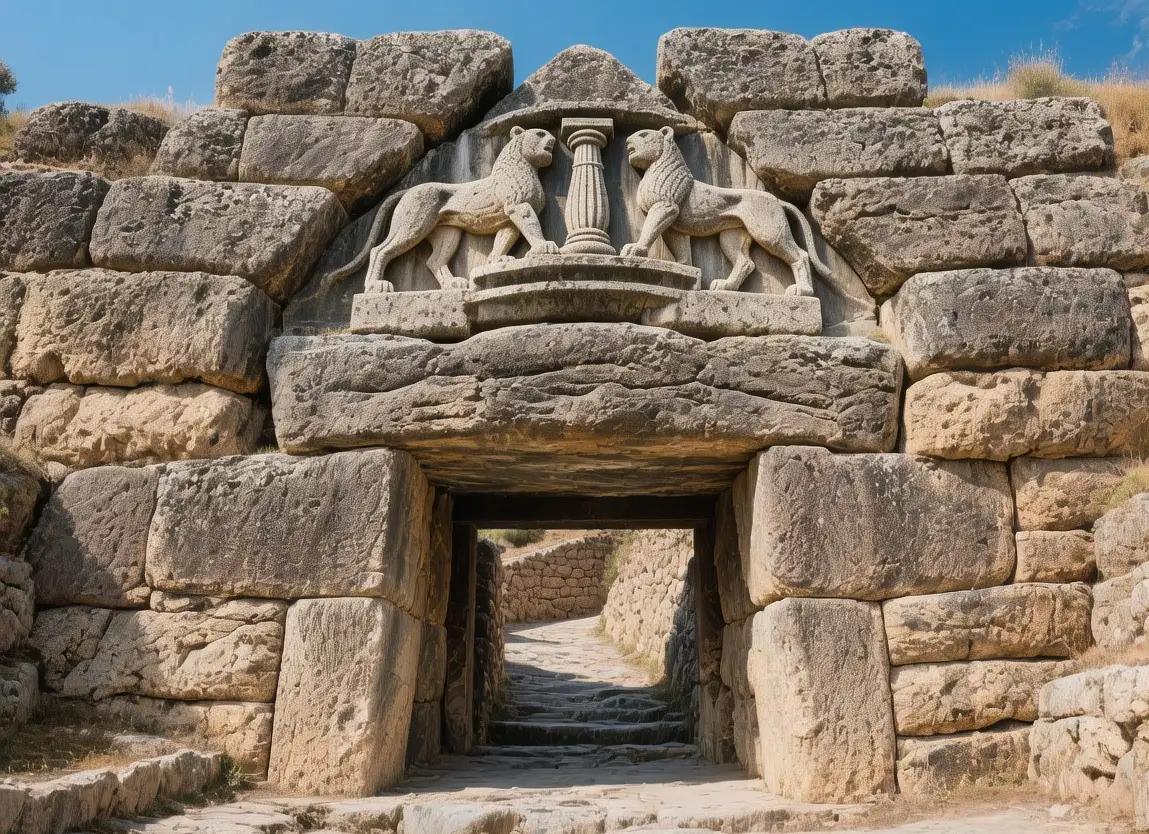
Golden light washes over the weathered limestone as you approach the massive gateway—two lionesses, their heads lost to time, stand heraldic guard above a triangular relief, their stone paws resting on a Minoan-style column that has borne witness to thirty-three centuries of history. The morning breeze carries the scent of wild thyme and sun-baked earth from the surrounding hills, while the distant call of a hoopoe echoes through the ancient citadel. You stand beneath a lintel weighing 4.5 tons, spanning 3 meters (10 feet) in width, part of cyclopean walls constructed from boulders so massive that later Greeks believed only giants could have moved them. This is the Mycenae Lion Gate, the monumental entrance to one of the most powerful Bronze Age civilizations in Europe, built circa 1250 BCE to solve the fundamental problem of defending a hilltop kingdom while projecting royal authority to all who approached. The Lion Gate matters because it embodies the birth of European monumental architecture—a threshold where mythology meets archaeology, where Homer's epics gain stone and mortar, and where the ingenuity of ancient engineers continues to inspire awe in every visitor who passes beneath its timeless watch.
Why Mycenae Lion Gate Embodies Bronze Age Engineering Mastery
The Mycenae Lion Gate represents the pinnacle of Mycenaean military architecture—a defensive masterpiece constructed around 1250 BCE during the height of the Bronze Age civilization that dominated the Peloponnese. The gate solves a critical structural challenge: how to support the immense weight of cyclopean fortification walls—some exceeding 7 meters (23 feet) in thickness and 12 meters (39 feet) in height—while creating a functional entrance 3 meters wide and 3 meters tall for chariots and foot traffic.
The solution demonstrates extraordinary engineering foresight. Two vertical monolithic limestone jambs, each weighing approximately 12 tons, support a horizontal lintel of equal mass. Above this, builders created a relieving triangle—a 3.5-meter-wide, 1-meter-high opening filled with lighter stone and crowned by the iconic lionesses relief sculpture. This architectural innovation distributes the enormous load of the walls above away from the lintel, preventing structural failure while creating a canvas for symbolic art.
The lionesses themselves—carved from a single block of greenish limestone—represent Europe's earliest example of monumental sculpture. Though their heads (likely made of separate material) have vanished, their powerful bodies remain, facing outward in a heraldic pose that conveys protection and royal authority. The central column, tapering downward in Minoan style, may symbolize a deity or sacred pillar, blending religious symbolism with defensive function.
Beyond engineering, the gate fulfilled profound cultural needs: it controlled access to the citadel's elite quarter, including Grave Circle A where Heinrich Schliemann discovered the so-called "Mask of Agamemnon" in 1876. The imposing sculpture projected power to visitors and subjects alike, while the narrow passage—flanked by 7-meter-thick walls—created a defensive chokepoint where attackers could be repelled from multiple angles. This integration of art, architecture, and military strategy defines the Lion Gate as a masterpiece of Bronze Age innovation.
The Best Time to Experience Mycenae Lion Gate
Timing your visit to the Mycenae Lion Gate requires balancing weather conditions, lighting for photography, and crowd dynamics. The optimal window runs from April 25 through June 12, when temperatures range 18–27°C (64–81°F) and the surrounding hills bloom with wild poppies and asphodel. During this period, morning light between 8:00–9:30 AM illuminates the lionesses relief without creating harsh shadows, perfect for capturing the sculpture's weathered details.
A second exceptional season spans September 18 through October 28, with temperatures of 16–25°C (61–77°F) and clearer atmospheric conditions that enhance visibility across the Argive plain. The late afternoon sun between 4:00–5:30 PM casts warm amber tones across the limestone, creating dramatic contrasts ideal for architectural photography.
For the most atmospheric experience, arrive at the site entrance by 8:00 AM when opening begins. The morning light illuminates the eastern face of the gate while temperatures remain cool for exploring the citadel's uphill paths. Midday visits between 12:00–3:00 PM should be avoided during July and August, when temperatures exceed 36°C (97°F) and the exposed limestone radiates intense heat with minimal shade.
Avoid visiting during peak cruise excursion season (July 10–August 20) when tour groups create bottlenecks at the gate and limited parking fills by 9:00 AM. Winter months (November–February) bring frequent rain and temperatures of 7–14°C (45–57°F); while crowds thin, the ancient limestone steps become slippery and hazardous when wet.
For official information and site hours: www.visitgreece.gr and www.culture.gr
Approximate Budget for a 7-Day Trip
Exploring the Mycenae Lion Gate as part of a Peloponnese cultural itinerary offers exceptional value, combining archaeological wonders with coastal charm at prices well below Greek island destinations. The following breakdown assumes a mid-range travel style with comfortable accommodation in nearby Nafplio, dining at traditional tavernas, and a mix of independent exploration and guided experiences.
- Accommodation: €50–€90 per night for boutique hotels or traditional guesthouses in Nafplio's old town (Plaka or Syntagma Square area). Budget rooms start at €35; luxury sea-view suites reach €140.
- Food: €28–€38 per day. Breakfast €5 (Greek coffee, honey yogurt, fresh bread); lunch €11 (horiatiki salad, grilled sardines, house wine); dinner €16–€20 (slow-cooked lamb kleftiko, fresh octopus, local Agiorgitiko wine).
- Transportation: Bus from Athens to Nafplio €16 (2.5 hours, KTEL route); Nafplio to Mycenae taxi €20 round-trip or local bus €4 each way; rental car €32/day (recommended for flexibility); parking at site €2.
- Attractions: Mycenae archaeological site entrance €12; combined ticket (Mycenae, Epidaurus, Ancient Corinth) €20; guided Bronze Age history tour €40; Nafplio Palamidi Fortress €8; Archaeological Museum of Nafplio €6.
- Miscellaneous: Handmade replica Bronze Age jewelry €15–€30; local thyme honey 250g €7; traditional komboloi (worry beads) €12; travel insurance €35/week; water/snacks at site €5.
Total for 7 days: €700–€900 per person (excluding international flights to Athens)
7 Essential Mycenae Lion Gate Experiences
- Stand beneath the lintel at sunrise: Arrive at opening time (8:00 AM April–October) to experience the Lion Gate with minimal crowds. Position yourself directly under the 4.5-ton limestone lintel and look upward at the relieving triangle. The morning light between 8:00–9:00 AM illuminates the lionesses relief, revealing tool marks and weathering patterns invisible at midday. Allow 10 minutes for quiet contemplation of the sculpture's enduring power.
- Examine the lionesses relief up close: Step forward to the gate's threshold and observe the carved details: the lions' muscular bodies, the tapering Minoan column, the triangular composition. Bring binoculars or a camera with zoom to study the weathered surfaces where Bronze Age chisel marks remain visible. The best viewing angle is 10 meters back from the gate, centered on the relief.
- Walk the ancient processional way: Follow the stone-paved path that Bronze Age dignitaries once traversed from the Lion Gate toward the royal palace. This 200-meter route reveals the cyclopean masonry technique—massive irregular boulders fitted without mortar—and offers panoramic views of the Argive plain from the citadel's upper terraces. Allow 20 minutes for the walk, pausing at interpretive panels.
- Explore Grave Circle A: Located just inside the walls to the right of the Lion Gate, this royal burial enclosure contains six shaft graves where Heinrich Schliemann discovered gold funeral masks, weapons, and jewelry in 1876. The site is enclosed by a circular stone wall; visit during golden hour (5:30–6:30 PM in summer) when low-angle light enhances the texture of the grave stelae.
- Photograph from the northeast bastion: Climb the path to the fortified tower northeast of the Lion Gate for the iconic postcard view: the gate framed by cyclopean walls with the Argive plain stretching beyond. The best light occurs mid-morning (9:00–10:30 AM) when the sun illuminates the relief sculpture without creating harsh shadows. Use a polarizing filter to enhance the contrast between limestone and blue sky.
- Descend to the secret cistern: Ask site staff about access to the underground water chamber accessed via a postern gate on the northern wall. A 99-step staircase carved into bedrock descends 18 meters to a spring-fed cistern that sustained the citadel during sieges. The chamber maintains a constant 16°C (61°F) temperature; bring a flashlight to explore the corbelled vault ceiling.
- Attend a guided Bronze Age storytelling session: Book a specialized tour (€40, 90 minutes) with a licensed archaeologist who brings Mycenaean history to life through Homeric epics and recent excavations. Tours depart at 10:00 AM and 4:00 PM daily; reserve 24 hours in advance at the ticket office. The guide will reveal details invisible to casual visitors, including tool marks and construction sequences.
3 Hidden Gems Most Travelers Miss
- The Northeast Postern Gate: A smaller, fortified entrance on the citadel's northern wall, this corbelled-arch gateway predates similar Roman techniques by centuries. Built circa 1250 BCE, it provided emergency access and water collection during sieges. Most visitors overlook it because guided tours focus on the Lion Gate. Access via the path behind Grave Circle B; look for the unmarked stone archway. Best visited mid-afternoon (2:00–4:00 PM) when lighting reveals the corbelled construction technique.
- The Terrace of the Cyclopean Walls: Along the eastern fortifications, an unmarked viewing platform offers intimate access to the massive limestone boulders that give "cyclopean" masonry its name. Some blocks weigh up to 6 tons and were fitted without mortar using bronze-age tools. This area receives minimal foot traffic and provides the site's best photography of construction techniques. Visit early morning (8:30–9:30 AM) when soft light reveals tool marks; bring a macro lens for detail shots.
- The Cult Center Upper Terrace: Beyond the palace ruins, a little-visited religious complex includes the Temple and the Room with the Fresco, where fragments of processional figures remain visible on plaster walls. This elevated area offers panoramic views across the Argive plain and insight into Mycenaean spiritual life. Access via the path marked "Palace" then follow signs upward; allow 15 extra minutes. Visit late morning (10:30–11:30 AM) when light illuminates the fresco fragments without glare.
Cultural & Practical Tips
- Respect the archaeological site: Mycenae is a protected UNESCO World Heritage location. Stay on marked paths, never climb on ancient walls, and do not touch the limestone reliefs—skin oils accelerate weathering. Speak softly to preserve the contemplative atmosphere for other visitors.
- Carry cash for entrance fees: The ticket office accepts cash only (no credit cards). Mycenae site entrance costs €12 for adults, €6 for students/seniors with ID, free for children under 18. The combined 3-site ticket (Mycenae, Epidaurus, Ancient Corinth) costs €20 and is valid for 5 days.
- Learn essential Greek phrases: "Yassou" (YAH-soo) = hello; "Efharisto" (ef-hah-REE-stoh) = thank you; "Poso kani?" (POH-soh KAH-nee) = how much?; "Pou ine i tourleta?" (poo EE-nee ee toor-LEH-tah) = where is the toilet?; "Ine arhea?" (EE-neh ah-REH-ah) = is it ancient?
- Prepare for sun exposure: The citadel offers zero shade. Wear a wide-brimmed hat, apply SPF 30+ sunscreen, and carry at least 2 liters of water per person. The white limestone reflects UV rays intensely, increasing sunburn risk even on cloudy days. Visit early morning or late afternoon to avoid peak heat.
- Photography guidelines: Handheld photography is unrestricted. Tripods require permission from site staff and cannot obstruct pathways. Drone use is strictly prohibited without written authorization from the Hellenic Ministry of Culture (+30 210 8211000). Commercial shoots require permits obtained 48 hours in advance from the Argolis Ephorate of Antiquities.
- Weather considerations: Afternoon thunderstorms can develop rapidly July–September. The ancient limestone becomes extremely slippery when wet—descend carefully if rain begins. Strong meltemi winds occasionally reach 35 km/h (22 mph) on the citadel's exposed terraces; secure loose items and be cautious near unprotected edges.
- Accessibility considerations: The citadel's steep, uneven paths are not wheelchair accessible. However, the Lion Gate and Grave Circle A are reachable via a paved lower path. Visitors with mobility issues can experience the gate from the approach road and view the citadel from the lower terrace. Request assistance at the entrance; staff can provide seating for rest breaks.
Conclusion: Travel with Reverence, Not Just Sightseeing
The Mycenae Lion Gate asks for more than a quick photograph and a checklist mark—it invites reverence for the human ambition that transformed raw stone into enduring symbol. This isn't merely an archaeological ruin; it's a threshold where Bronze Age kings once passed, where Homer's epics gained physical form, and where engineering genius solved problems that still challenge architects today. When you stand beneath that massive lintel and trace the weathered lionesses with your eyes, you're not just viewing antiquity—you're participating in a continuum of awe that has connected visitors to this place for three millennia.
Responsible travel here means understanding that you're a guest in a space where history breathes through every stone. It means moving slowly enough to appreciate the cyclopean masonry, pausing to imagine the chariots that once rumbled through this gateway, and supporting the local community that preserves this legacy. Purchase tickets directly, hire local guides who share stories passed through generations, and dine at family tavernas that have served the Argolid for decades.
Slow down. Sit on the ancient terrace and watch light shift across the Argive plain. Listen to the wind moving through the olive groves that Bronze Age farmers once cultivated. Share a moment of silence with fellow travelers, letting the citadel's stones speak not just of power, but of human aspiration. The Mycenae Lion Gate will endure—if we treat it not as a backdrop for selfies, but as a teacher of resilience, a witness to civilization's dawn, a legacy to protect. Travel here with humility, and the past will illuminate the present.