
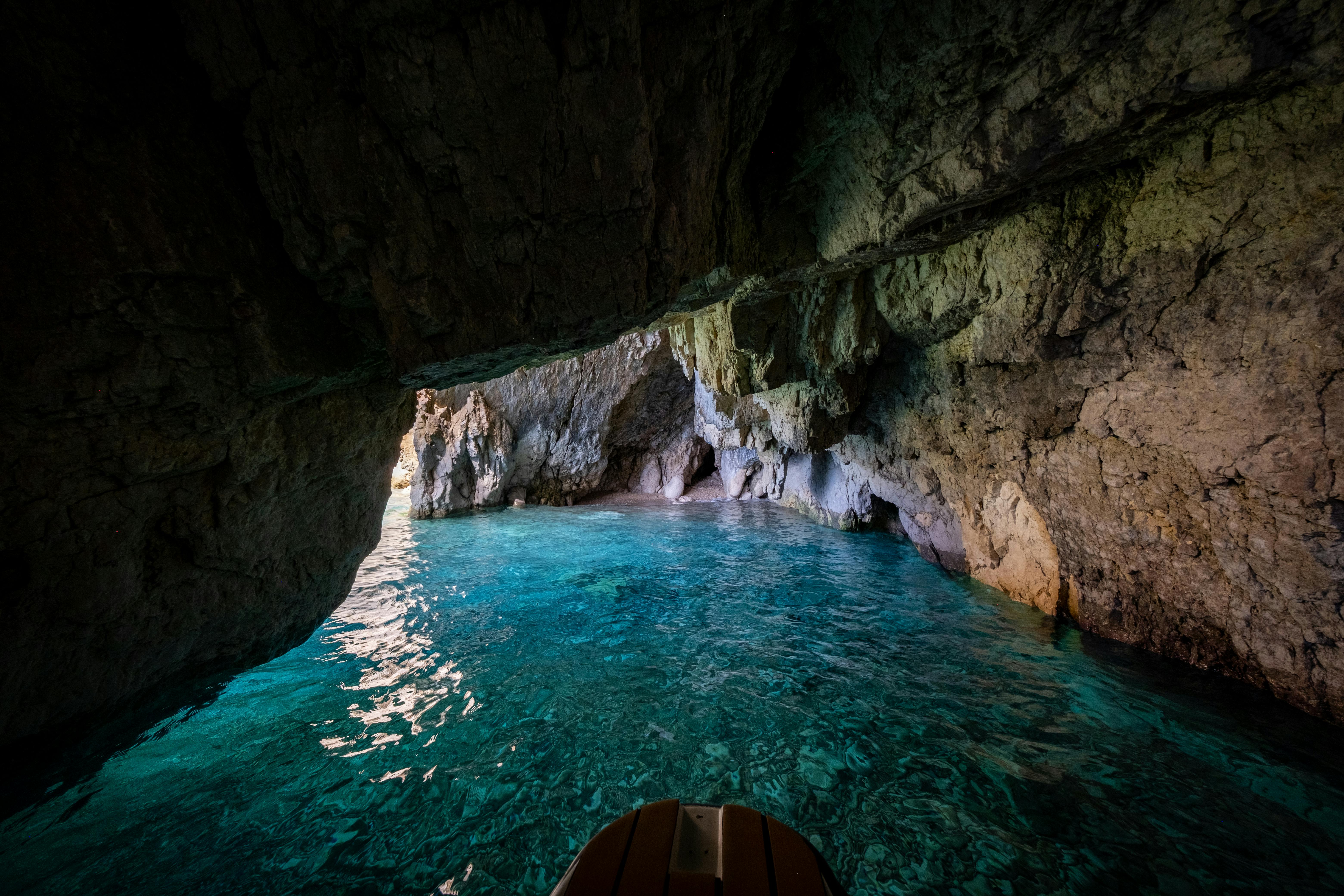
Vis Blue Cave: Where Subterranean Light Meets Dalmatian Limestone
The diesel engine cuts abruptly, leaving behind a sudden, ringing silence broken only by the slap of small waves against the fiberglass hull. You drift in the shadowed cove of Balun Bay on the islet of Biševo, surrounded by stark, weathered cliffs. Ahead, a jagged fissure in the rock—measuring a mere 1.5 meters (5 feet) high and 2.5 meters (8 feet) wide—serves as the sole entry point to the underworld. The skipper motions for you to duck; you lower your head as the skiff glides through the narrow aperture. Inside, the darkness evaporates instantly. An otherworldly, luminescent blue saturates the cavern, so vivid it appears digitally fabricated, radiating from the depths of the water itself. The air tastes of damp limestone and ancient salt. Known to local fishermen as a refuge since antiquity, the Vis Blue Cave matters not simply because it is beautiful, but because it transforms the terrifying dark of the earth into a cathedral of light using nothing more than sunlight and the sea.
Why Vis Blue Cave Embodies Natural Optics
To appreciate the Vis Blue Cave, you must look past its visual spectacle and understand the precise mechanics of its illumination. Local sailors avoided the jagged entrance for centuries, fearing the treacherous swells that crashed against the limestone. The cave remained a localized secret until Austrian Baron Eugen von Ruttner explored it, leading to the dynamiting of a safer, artificial entrance in 1884. This intervention solved a critical access problem, allowing safe passage while preserving the natural optical requirements of the chamber. The cave itself measures 28 meters (92 feet) in length, 10 to 12 meters (33 to 39 feet) in width, and drops to a depth of 15 meters (49 feet). The magic relies on a specific geological quirk: the natural floor of the cave sits below the external sea level. When sunlight strikes the water outside, it refracts through the submerged opening. The water acts as a massive liquid prism, absorbing the red and green spectrums of light while allowing the high-frequency blue light to penetrate the subaquatic passage. This blue light floods the interior, bouncing off the silicate-rich limestone walls and illuminating the cavern with an intense, almost metallic glow. It is a masterclass in natural engineering.
The Best Time to Experience Vis Blue Cave
To witness the Vis Blue Cave at its absolute luminous peak, plan your departure between May 18–June 12. During this window, the Adriatic Sea is calm, the air temperature rests at a pleasant 22°C–25°C (72°F–77°F), and the water clarity reaches an astonishing 25 meters (82 feet) of visibility. Arrive at the Komiža waterfront by 8:30–9:00 AM to secure a seat on the first departing skiff; arriving early ensures you experience the cave before the acoustic reverberations of dozens of boat engines distort the silence. A secondary window occurs from September 10–28, when the water retains its summer warmth and the tourist volume plummets. You must strictly avoid July 15–August 20. During this period, the infamous jugo wind creates dangerous swells that result in cave closures 40% of the time. Even when open, queues of 30 or more skiffs form outside the narrow entrance; you will be rushed through the cavern in under three minutes, entirely destroying the immersive atmosphere. For real-time swell forecasts and official boat schedules, consult the island tourism board at https://bluecave-bisevo.com/.
Approximate Budget for a 7-Day Trip
Experiencing the Vis Blue Cave requires staying overnight on the island of Vis, as day-trip ferries from Split do not allow sufficient time to reach Biševo. This budget assumes a comfortable, culturally immersive trip for two people, prioritizing local cuisine and flexible transport over luxury resorts.
- • Accommodation: €120–€180 per night (traditional stone kuća apartment in the Komiža harbor district, offering shaded terraces and walking access to the boat docks)
- • Food: €80 per day (breakfast of espresso and a flaky pašta-fjura pastry €6, lunch of viška pogača salted sardine bread and local cheese €12, dinner of fresh grilled squid with blitva at a konoba €62)
- • Transportation: €180 total (return Jadrolinija ferry from Split to Vis town €35 per person; return taxi boat from Komiža to the Blue Cave €25 per person; local island bus Vis to Komiža €8 per person)
- • Attractions: €55 total (Blue Cave entrance fee €18 per person; Green Cave entrance fee €15 per person; guided walking tour of Vis town military tunnels €4)
- • Miscellaneous: €60 total (bottle of local Vugava white wine €22, handmade natural olive oil soap from a Komiža artisan €8, high-quality anti-fog snorkeling mask €30)
Total: €1,315–€1,855 for one week (for two people)
6 Essential Vis Blue Cave Experiences
- Ducking the Submerged Entrance: As your skiff approaches the cliff face, lie flat against the wooden bench. The skipper will kill the engine and time the swell, pulling the boat through the jagged opening by hand. Feel the sudden, 5°C (9°F) temperature drop as you cross the threshold into the subterranean air.
- Floating in the Silver Void: The most extraordinary optical illusion occurs beneath the surface. When the skipper tosses a small object—a pebble or a wooden oar—into the water, the object does not cast a shadow. Instead, the water around it glows with an intense, silvery luminescence. Watch the ripples distort the blue light into geometric fractals.
- Listening to the Subterranean Acoustics: Keep your voice to a whisper. The vaulted, 12-meter (39-foot) ceiling creates a highly dampened, resonant acoustic chamber. A single drop of water falling from the stalactites overhead produces a sharp, crystalline ping that echoes for three to four seconds.
- Observing the Skipper’s Ritual: Watch the local boatmen work. They navigate entirely by sight and feel, reading the micro-currents at the cave's mouth to avoid scraping the hull against the limestone. Their ability to maneuver a 6-meter (20-foot) boat through a 2.5-meter (8-foot) gap in a rolling swell is a masterclass in maritime seamanship.
- Feeling the Limestone Walls: Reach out and touch the cavern walls as the boat idles in the center. The stone is extraordinarily smooth, polished by millennia of saltwater saturation and wave friction. It feels cool and almost metallic against your palm.
- Emerging into the Dalmatian Sun: The transition from the hyper-saturated blue gloom back into the blinding white light of Balun Bay is physically jarring. Shield your eyes and take a moment on the open deck to let your pupils readjust; the contrasting silence of the open sea will suddenly feel remarkably loud.
3 Hidden Gems Most Travelers Miss
- • The Monk Seal Grotto at Stončica: Located on the northeastern coast of Vis, this sea-level cavern was historically the last refuge of the critically endangered Mediterranean monk seal. It is overlooked because it requires a 45-minute hike from the village of Stončica along an unmarked goat trail. Access the cave by scrambling down a rocky embankment at the coordinates 43.0780° N, 16.2345° E. The cave is filled with smooth white sand and shallow, emerald water. Visit at low tide; at high tide, the entrance is submerged.
- • The British Fort George Tunnel System: Perched above the town of Vis, this sprawling network of 19th-century military tunnels was carved by British forces in 1813 to defend the island against Napoleon’s fleet. It is overlooked because the primary entrance is hidden behind overgrown macchia near the Vis town cemetery. Bring a strong flashlight; the unlit tunnels stretch for 400 meters (1312 feet) and terminate in a dramatic, open-air gun emplacement offering a staggering panoramic view of the Adriatic.
- • The Jaw-Dropping Green Cave (Zelena Špilja): Situated on the nearby islet of Ravnik, this cavern is often skipped because the Vis Blue Cave overshadows it entirely. However, the Green Cave features a massive, 10-meter (33-foot) vertical opening in its ceiling, allowing a physical shaft of sunlight to blast onto the water below. Access is via a steep, iron handrail bolted to the rock face. Swim directly beneath the light beam at exactly 11:30 AM, when the sun angle turns the water a glowing, radioactive green.
Cultural & Practical Tips
- • Greet the local boatmen with "Dobar dan" (DOH-bar dahn)—Good day. These skippers are the literal gatekeepers of the cave; a polite greeting often results in a slightly longer, more leisurely tour inside the grotto.
- • Wear dark clothing. Bright colors—especially white or neon swimwear—reflect the cave’s ambient light and cast harsh glares that ruin the blue illusion for photographers and other passengers. Black or navy blue absorbs the light perfectly.
- • Photography inside the cave is incredibly difficult. Do not use a flash; the burst of white light instantly destroys the blue atmosphere for everyone else. Set your camera to a high ISO (3200 or above) and brace your arms firmly against your ribs to stabilize the shot in the low light.
- • Monitor the jugo wind obsessively. This southeasterly wind creates massive groundswells that make entering the cave physically impossible. If the wind is blowing harder than 15 knots from the southeast, do not even bother buying a ticket; the local maritime authority will close the cave.
- • If you are prone to motion sickness, take medication 30 minutes before departing Komiža. The 50-minute open-water crossing to Biševo island is frequently rough, and there is no shelter from the spray on the small skiffs.
- • Life jackets are mandatory, but they are bulky. Wear your swimsuit underneath your clothes to maximize your range of motion when you are required to lie flat on the boat deck to clear the cave's entrance.
Conclusion: Travel with Subterranean Reverence, Not Just Surface-Level Tourism
To visit the Vis Blue Cave is to surrender your reliance on the sun. In this subterranean chamber, you are forced to confront the raw power of natural optics—a phenomenon that requires perfect geological alignment, pristine water clarity, and absolute stillness to function. Traveling with subterranean reverence means recognizing that you are not a customer entering a theme park attraction, but a brief guest in a highly fragile, mathematically precise environment. When you lower your voice, wear dark fabrics to respect the light, and refuse to fire a camera flash into the gloom, you are actively participating in the preservation of the cave’s magic. The Dalmatian coastline is littered with overcrowded viewpoints, but down inside the limestone belly of Biševo, there is no room for superficial haste. Slow down. Let the blue light wash over you. In a world obsessed with artificial illumination, the cave offers a profound, ancient reminder that the earth already knows how to shine in the dark.