
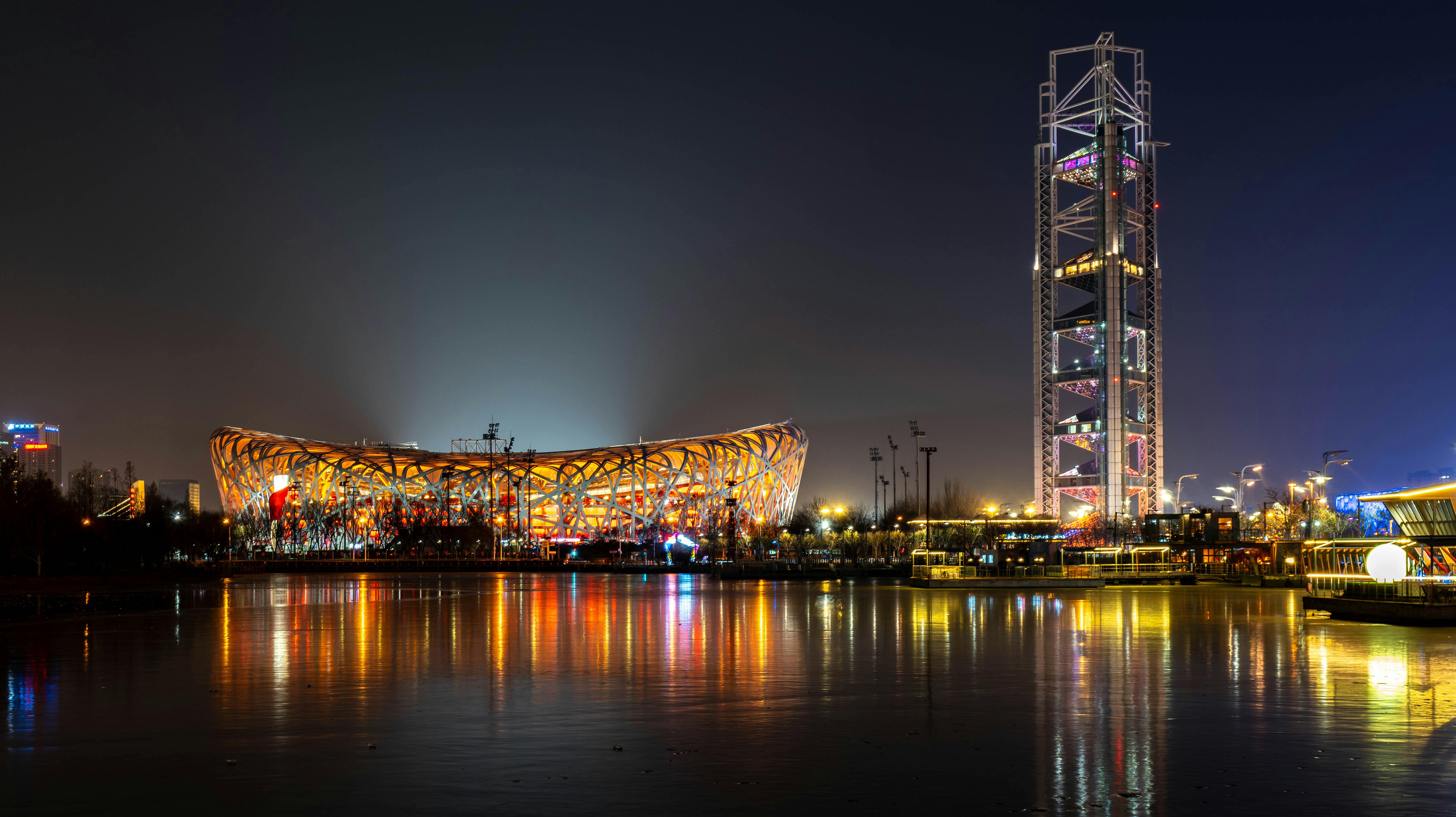
Bird's Nest Stadium: Where Architectural Innovation Meets Olympic Legacy
Golden hour bathes the 330-meter-long steel lattice of the Beijing National Stadium—42,000 tons of interwoven beams creating a nest-like exoskeleton that rises 69 meters above the Olympic Green—as the last rays of sun ignite the weathered metal in amber tones. You hear the soft echo of footsteps on the vast 110,000-square-meter plaza, the distant hum of tour groups gathering beneath the stadium's iconic arches, and the gentle ripple of water features reflecting the intricate steel web against a deepening twilight sky. This is not merely a sports venue; it is a masterpiece of structural engineering and symbolic design, a UNESCO-recognized architectural landmark where Swiss precision met Chinese artistry to create a monument that transcends its original purpose. Standing beneath the stadium's sweeping curves, you feel the profound ambition of a structure designed to hold 91,000 spectators while embodying the delicate beauty of a bird's nest—and the enduring responsibility to preserve this testament to human creativity for generations yet to come.
Why the Bird's Nest Embodies Structural Poetry
Constructed between 2003 and 2008 for the Beijing Summer Olympics, the Bird's Nest was engineered to solve a singular architectural challenge: to create a stadium that could accommodate 91,000 spectators while expressing Chinese cultural symbolism through cutting-edge engineering. The design by Herzog & de Meuron—with artistic consultation from Ai Weiwei—rejects conventional stadium aesthetics in favor of a seemingly random lattice of steel beams that actually follows precise computational modeling: each of the 24 primary trusses weighs 1,000 tons and spans 180 meters, while secondary beams interlock at angles ranging from 15 to 75 degrees to distribute seismic forces across the entire structure. The "nest" concept required 42,000 tons of steel—equivalent to four Eiffel Towers—welded at 320,000 connection points using robotic precision to achieve the organic appearance; the outer membrane of translucent ETFE panels allows natural light to filter into the bowl while reducing wind load by 30%. The stadium's elliptical footprint (330m x 290m) optimizes sightlines from every seat, while its 69-meter height creates a commanding presence without overwhelming the Olympic Green landscape. This complex fulfilled its purpose so completely that it remains one of the world's most photographed modern structures, proving that functional infrastructure can achieve the emotional resonance of fine art while serving as a versatile venue for sports, concerts, and cultural events long after the Olympic flame has dimmed.
The Best Time to Experience the Bird's Nest
For optimal conditions, target April 12–May 30 or September 15–October 28, when daytime temperatures range 16–25°C (61–77°F) with low humidity and clear skies that enhance the metallic sheen of the steel lattice against blue skies. Arrive at the main entrance on the Olympic Green between 9:00–10:30 AM when the stadium opens, morning light creates dramatic shadows through the steel web, and crowds are light enough for unobstructed photography. Avoid July 8–August 26, when temperatures reach 30–37°C (86–99°F) with high humidity that makes the exposed plaza uncomfortably hot, and October 1–7 (National Day holiday), when domestic tourism peaks and visitor numbers exceed 15,000 daily. Winter visits (December–February) offer striking frost-dusted steel against gray skies but require preparation for sub-zero temperatures averaging -6°C (21°F) and reduced outdoor access. Entry fee: ¥50 ($7) for general admission; ¥80 ($11) includes access to the upper observation deck. For real-time opening hours, event schedules, and ticket reservations, consult the official resource: www.visitbeijing.com.cn. Note: the stadium closes at 5:00 PM year-round; last entry is 4:00 PM. Special events may restrict public access—verify availability 48 hours before your visit.
Approximate Budget for a 7-Day Trip
Pricing methodology reflects mid-range travel with authentic local experiences, excluding international flights. Costs quoted in Chinese Yuan (CNY/¥) with USD equivalents (¥7.2 ≈ $1 USD).
-
• Accommodation: ¥460–¥950 ($64–$132) per night for a boutique hotel or upscale guesthouse in Chaoyang District, within 20 minutes' taxi ride of the Olympic Green
• Food: ¥180 ($25) per day: breakfast ¥30 ($4) for jianbing (savory crepe) and soy milk at a local vendor; lunch ¥62 ($9) for hand-pulled noodles or fusion bistro fare near the stadium; dinner ¥88 ($12) for contemporary Chinese cuisine or international fusion with craft beer
• Transportation: Subway single-ride fares ¥3–¥7 ($0.40–$1); Airport Express ¥25 ($3.50); DiDi ride from airport to Olympic Green ¥125–¥185 ($17–$26); 7-day transportation card deposit ¥20 ($3)
• Attractions: Bird's Nest entry ¥50 ($7) general / ¥80 ($11) with observation deck; Water Cube adjacent visit ¥30 ($4); Olympic Park entry: free; traditional acrobatics show ¥180 ($25); Forbidden City visit ¥60 ($8)
• Miscellaneous: Official stadium souvenir ¥60–¥150 ($8–$21); limited-edition architectural print ¥100–¥280 ($14–$39); travel insurance ¥50 ($7)
Total estimated budget: ¥7,200–¥10,600 ($1,000–$1,475) for one person
6 Essential Bird's Nest Experiences
- Walk the Perimeter at Sunrise: Arrive at 8:45 AM to circumnavigate the stadium's 1.2-kilometer outer ring. The low-angle morning light illuminates the intricate steel lattice, creating dramatic shadows on the plaza; pause at each of the four main entrances to photograph the varying density of the "nest" pattern.
- Ascend to the Observation Deck: Purchase the ¥80 ($11) ticket for access to the upper concourse (open 9:30 AM–4:00 PM). From 45 meters high, capture panoramic views of the Olympic Green, the adjacent Water Cube, and distant Beijing skyline; visit during late afternoon when golden light enhances the metallic texture of the steel beams.
- Photograph the Interior Bowl: Enter the stadium bowl to experience the vast 91,000-seat arena. Position yourself at field level looking up to capture the dramatic interplay of steel ribs against sky; use a wide-angle lens (16–24mm) to convey scale. Flash photography prohibited; increase ISO for low-light conditions.
- Explore the Olympic Museum Exhibit: Located in the stadium's eastern wing, this permanent exhibition (included with entry) showcases 2008 Olympic memorabilia, architectural models, and interactive displays about the construction process. Allow 45 minutes; best visited between 11:00 AM–1:00 PM when crowds thin.
- Walk the Olympic Green at Dusk: After visiting the stadium, stroll the 100-hectare park as evening light transforms the steel lattice into a glowing sculpture. The 300-meter axis between Bird's Nest and Water Cube offers perfect symmetry for photography; visit around 5:30 PM when ambient lighting activates.
- Attend a Live Event (Seasonal): Check www.visitbeijing.com.cn for concerts, sporting events, or cultural festivals hosted at the stadium. Arrive 90 minutes early to experience pre-event atmosphere; tickets range ¥200–¥1,500 ($28–$208) depending on seating.
3 Hidden Gems Most Travelers Miss
-
• Steel Detail Close-Ups at Northeast Corner: While most visitors photograph the stadium's grand facade, the northeastern junction reveals intricate weld patterns and weathering textures rarely captured. Access via the service path near Gate 3; visit between 2:00–3:30 PM when sidelight accentuates the steel's patina. Insider tip: Bring a macro lens to document the craftsmanship of individual connection points.
• Water Cube Reflection Vantage: Position yourself on the small bridge connecting the Bird's Nest and Water Cube (National Aquatics Center) for a unique perspective where both iconic structures frame each other in reflective pools. Visit during blue hour (6:00–7:00 PM in summer) when artificial lighting creates magical symmetry; use a tripod for long exposures.
• Olympic Flame Sculpture Garden: Tucked behind the stadium's western plaza, this quiet installation features abstract sculptures inspired by the 2008 Olympic torch design. Access via the pathway near the ticket office; open daily 9:00 AM–4:00 PM. Most tour groups overlook this contemplative space—ideal for quiet reflection on the Olympic legacy.
Cultural & Practical Tips
-
• Photography etiquette: Handheld photography permitted throughout public areas; tripods require advance permission from management. Flash prohibited inside the stadium bowl to protect exhibits and avoid disturbing other visitors.
• Local phrases: Learn "Zhèlǐ zhēn zhuàngguān" (jurr-lee jen jwang-gwan = this place is magnificent) and "Xièxie" (SHYEH-shyeh = thank you). Pronounce with level tones; staff appreciate cultural effort.
• Footwear matters: You'll walk 3–5 kilometers on concrete plazas and steel-grate walkways; wear comfortable, closed-toe shoes with good grip—surfaces become slippery when wet or icy.
• Weather preparedness: Beijing's air quality fluctuates; download the AirVisual app. The stadium's exposed plaza offers minimal shade—carry sunscreen, hat, and water in summer; layer thermal wear beneath a windproof jacket in winter.
• Security protocol: Allow 20–30 minutes for entry screening. Prohibited items include drones, large backpacks (>25L), and professional camera equipment without press credentials. Keep your passport accessible for ticket verification.
• Accessibility: Elevators and ramps provide access to all public levels; wheelchairs available for loan at the main entrance (deposit ¥200/$28). Signage includes English translations throughout.
• Event awareness: The stadium hosts concerts and sporting events year-round; check www.visitbeijing.com.cn before visiting. On event days, public access may be restricted after 2:00 PM.
Conclusion: Travel with Appreciation, Not Just Observation
The Bird's Nest does not surrender its architectural poetry to hurried glances. To truly engage with this monumental structure, slow your step—linger where steel beams frame the sky; pause to feel the cool metal beneath your palm; listen for the echo of history in a quiet corner of the plaza. Your visit becomes an act of cultural appreciation when you choose mindful observation over passive tourism, when you honor the craftsmanship of engineers and artists by respecting the space, when you carry home not just photos but a deeper understanding of how infrastructure can inspire wonder. This stadium has preserved its iconic status beyond the Olympic spotlight because each generation recognizes its value beyond utility. As you depart beneath the intricate lattice, let your final intention be this: we are temporary witnesses to a dialogue between engineering and art. Travel with appreciation—not just to see, but to understand; not just to visit, but to honor.