
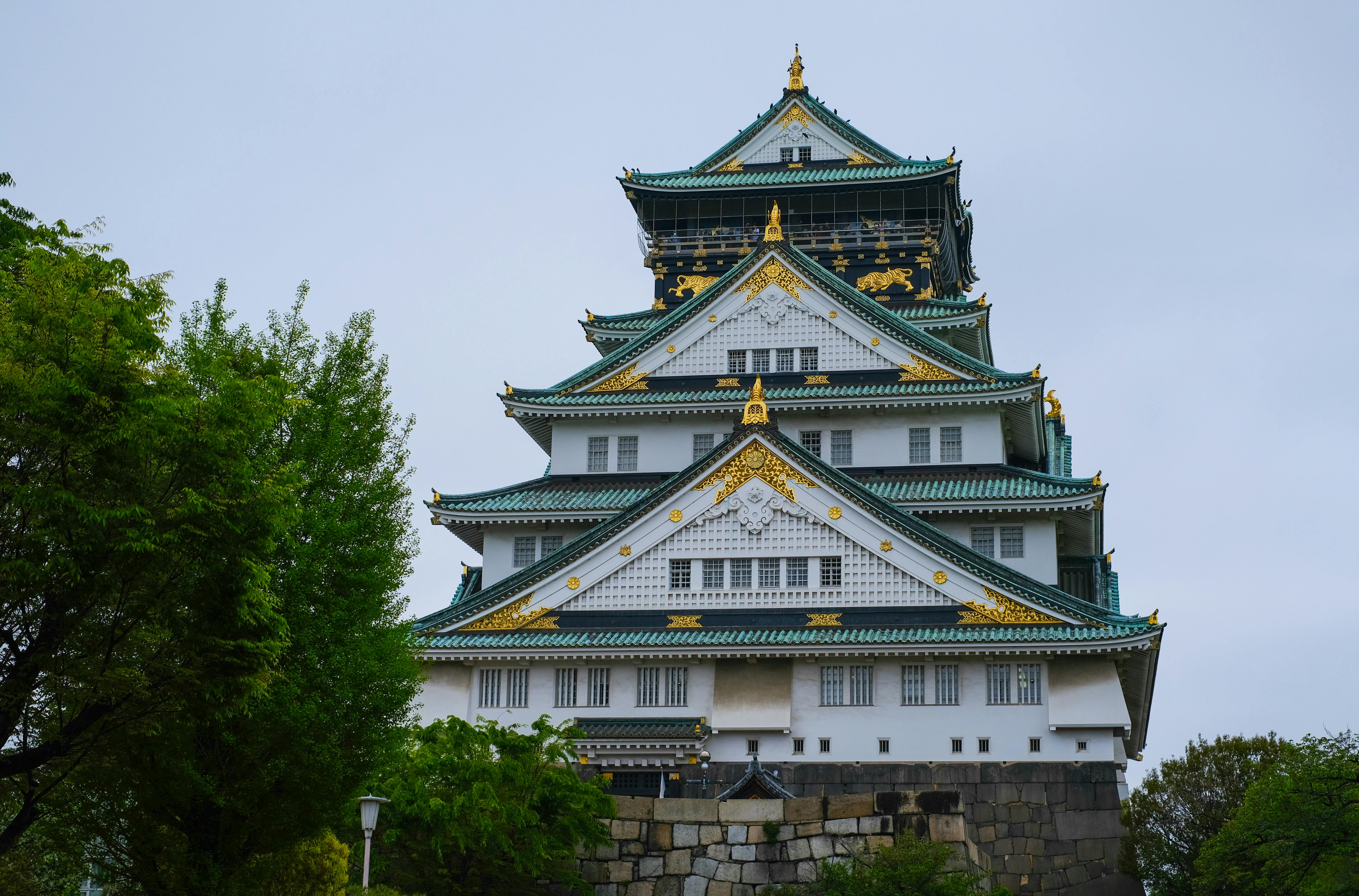
Osaka Castle: Where Samurai Legends Meet Golden Grandeur
You climb the final stone steps—chiseled from granite blocks so massive they seem impossible to have moved—and there it rises: the white-and-green tenshu (main tower), its roof adorned with golden shachihoko (mythical tiger-fish) gleaming against the Osaka sky. Below, the double moat shimmers, and beyond that, a metropolis of steel and glass sprawls to the horizon. This is Osaka Castle (大阪城), built in 1583 by the legendary warlord Toyotomi Hideyoshi, the "Great Unifier" who ended Japan's century-long Warring States period . The original construction employed 20,000 to 30,000 workers daily over two years—a workforce larger than many medieval European cities . The castle's stone walls stretch an astonishing 12 kilometers (7.5 miles) in total length, containing megaliths like the Tako-ishi ("Octopus Stone"), which measures 5.8 meters (19 feet) tall and 14 meters (46 feet) wide . Here, samurai ambition meets architectural audacity—a fortress designed not just to defend, but to intimidate and inspire.
Why Osaka Castle Embodies the Rise and Fall of a Nation
Osaka Castle solves a puzzle of imperial ambition: how to build a power base that would unify a fractured land. Hideyoshi, a peasant-born general who rose to become Japan's supreme ruler, modeled his castle after Oda Nobunaga's Azuchi Castle—but he demanded it surpass his predecessor's in every way . The original five-story main tower, covered in gold leaf, was designed to blind visitors with its opulence. But the castle's history is one of destruction and rebirth. The Toyotomi clan fell during the Siege of Osaka (1614–1615), when Tokugawa Ieyasu's forces filled the outer moat and burned the castle to the ground . The Tokugawa shogunate rebuilt it from 1620 to 1628, entrusting the project to master castle designers Tōdō Takatora and Kobori Enshū . They buried the original Toyotomi foundation beneath a new elevated keep—a literal act of architectural conquest. The tower burned again in 1665 after a lightning strike and was not rebuilt until 1931, when the city of Osaka constructed the current concrete keep . What you see today is a 20th-century replica, but the 13 Important Cultural Properties scattered across the grounds—including the Ote-mon Gate and five original turrets—whisper stories of samurai who walked these same stone paths centuries ago .
The Best Time to Experience Osaka Castle
Osaka Castle transforms with each passing season. For cherry blossoms (sakura), target late March 28–April 8, when over 4,000 trees—including the Nishinomaru Garden's famous grove—erupt in pink clouds. Daytime temperatures average 13–20°C (55–68°F) . For autumn foliage, visit mid-November to early December (November 15–December 3), with peak colors around November 22 and temperatures at 13–18°C (55–64°F) . The Osaka Castle Park Illuminations run November 15–December 1, bathing the castle in golden light from 5:30–9:00 PM (¥1,500–¥2,000 special ticket) . Summer (June–August: 24–33°C / 75–91°F) brings intense heat and humidity; visit before 9:00 AM to avoid midday intensity. Winter (December–February: 5–12°C / 41–54°F) offers crisp air, plum blossoms (late February), and dramatically reduced crowds . Avoid: December 28–January 1 (castle closed) and Golden Week (April 29–May 5). For official updates: www.osakacastle.net .
Approximate Budget for a 7-Day Trip
This budget assumes mid-range travel with a focus on cultural sites. Prices are current for 2025–2026 using ¥1 ≈ $0.0067 USD (¥150 ≈ $1). Based on a 7-day itinerary with Osaka Castle as a key attraction .
- Accommodation: ¥8,000–¥22,000 per night ($53–$147) — Stay near Umeda or Shinsaibashi for easy castle access. Hotel Hankyu RESPIRE OSAKA (connected to JR Osaka Station) starts at ¥15,000 ($100). Budget options in Namba: ¥6,000–¥10,000 .
- Food: ¥3,500–¥6,500 per day ($23–$43) — Breakfast: ¥600–¥1,000 (konbini). Lunch: ¥1,200–¥2,500 (Gyukatsu Motomura set: ¥1,930). Dinner: ¥2,000–¥4,000 (takoyaki near Dotonbori or yakiniku). Famous takoyaki from stands: ¥600–¥800 for 8 pieces .
- Transportation: ¥500–¥1,200 per day ($3–$8) — Subway Tanimachi Line from Higashi-Umeda to Tanimachi 4-chome: ¥240 (7 minutes) . JR Loop Line from Osaka Station to Osakajokoen Station: ¥170 (10 minutes). Osaka Amazing Pass (1-day): ¥2,800 (includes castle entry and 40+ attractions). ICOCA card recommended for convenience .
- Attractions: ¥600–¥1,500 total ($4–$10) — Osaka Castle Main Tower: ¥600 (adults), free with Osaka Amazing Pass . Nishinomaru Garden: ¥200 (¥3,500 during cherry blossom peak). Museum entry included in tower ticket. Kaiyodo Figure Museum (Miraiza Osaka-Jo): ¥500 .
- Miscellaneous: ¥2,000–¥5,000 ($13–$33) — Omamori charms at Hokoku Shrine: ¥500–¥800. Samurai helmet photo experience: ¥1,000. Matcha at castle tea house: ¥700. Octopus Stone rubbing kit: ¥500.
Total (7 days, excluding international flights): ¥75,000–¥170,000 ($500–$1,133)
6 Essential Osaka Castle Experiences
- Climb to the Observation Deck at Opening Hour: Arrive by 8:45 AM (castle opens at 9:00 AM) and go directly to the elevator. The 8th-floor observation deck, at 50 meters (164 feet) above ground, offers 360-degree views of Osaka—from the Umeda skyscrapers to the distant mountains. The morning light illuminates the castle's golden shachihoko roof ornaments, making them gleam against the cityscape .
- Find the Octopus Stone and Time Capsule: Near the castle's inner moat, the Tako-ishi (Octopus Stone) measures 5.8 x 14 meters and weighs an estimated 130 tons—how Edo-era engineers moved it remains a mystery . Nearby, the Expo '70 Time Capsule, buried on the castle grounds in 1971, contains artifacts meant to be opened in the year 6970. Look for the small plaque marking its location .
- Stroll Nishinomaru Garden During Cherry Blossoms: The Nishinomaru Garden (¥200 entry) is the castle's most photogenic spot—the main tower framed by weeping cherry trees. Visit during late March 28–April 8 for peak bloom; the garden opens for night illuminations (6:00–8:30 PM) during this period (special ¥3,500 ticket). Even without blossoms, the garden offers tranquil views of the castle's stone walls and the Hokoku Shrine .
- Descend into the Toyotomi Stone Wall Exhibition: In August 2024, Osaka Castle opened a new underground exhibition at the Toyotomi Stone Wall Ruins. For ¥300 (free with tower ticket), you can see the original 1585 foundation of Hideyoshi's keep—buried for 400 years beneath the Tokugawa reconstruction. Glass floors let you walk above the archaeological excavation. Look for the entrance near the Gokuraku-bashi Bridge .
- Try Samurai Armor at the Miraiza Osaka-Jo: Across from the main tower, the Miraiza Osaka-Jo building (originally the Osaka Geihinkan, built 1931) houses the Kaiyodo Figure Museum and a samurai armor rental shop. For ¥1,500, you can dress in a replica Ō-yoroi (ceremonial armor) and pose with props on the building's terrace, with the castle tower in the background. No reservation needed; open 10:00 AM–5:00 PM .
- Ride the Osaka Castle Gozabune Boat: From mid-March to November, you can cruise the inner moat on a replica of Toyotomi Hideyoshi's golden pleasure boat (gozabune). The 20-minute ride (¥1,500) departs from a pier near the Sakura-mon Gate every 30 minutes (10:00 AM–4:30 PM). The boat passes directly beneath the castle's massive stone walls—a perspective most tourists miss. Book tickets at the pier on arrival (cash only).
3 Hidden Gems Most Travelers Miss
- Kinmeisui Well and the Legend of Buried Gold: Inside the inner bailey (Hommaru), a small sign marks Kinmeisui (Golden-Water Well). Legend claims Toyotomi Hideyoshi buried a fortune in gold coins here before his death—and that a samurai named Nakama Kajisuke was crucified in 1740 for attempting to steal it . The well is covered, but you can see the stone enclosure. No explanatory sign in English; locals know the legend but most tourists walk past. Free, open during castle hours.
- Osaka Castle's "Museum of History" Behind the Tower: Most visitors rush past the unmarked entrance to Osaka Castle's annex building (south of the main tower), which houses a small but exceptional collection of Heian and Kamakura-era artifacts—including original shachihoko roof ornaments replaced during the 1997 restoration. Free with tower ticket. Look for the glass doors with a small paper sign; the staff will direct you to the display cabinets. No crowds; you'll have the exhibits to yourself.
- Hokoku Shrine's Fox Village: Tucked beside the castle's Nishinomaru Garden entrance, Hokoku Shrine (豊国神社) is dedicated to Toyotomi Hideyoshi's spirit. Most tourists pray at the main hall and leave, but behind the shrine building, hidden behind a bamboo grove, is a collection of over 50 fox statues (kitsune)—messengers of the Shinto god Inari. Each statue wears a red bib and holds a different object (a key, a scroll, a rice bale). Unmarked and accessible only via a narrow path behind the shrine's side gate. The foxes are most atmospheric in late afternoon (3:00–4:00 PM) when shadows lengthen.
Cultural & Practical Tips
- Photography Rules: Tripods are permitted outdoors but banned inside the main tower (elevators and exhibition halls are too narrow). No flash in museum areas; the gold leaf screens are light-sensitive. The observation deck allows handheld photography; the interior corridors prohibit photography entirely. For the classic cherry blossom reflection shot, use a polarizing filter to reduce glare on the moat's surface.
- Essential Japanese Phrases: "Osaka-jō wa doko desu ka?" (oh-sah-kah-joh wah doh-koh dess-kah) — Where is Osaka Castle? "Tenshukaku no nyūjōryō wa ikura desu ka?" (ten-shoo-kah-koo no nyoo-joh-ryoh wah ee-koo-rah dess-kah) — How much is entry to the main tower? "Tako-ishi wa doko ni arimasu ka?" (tah-koh-ee-shee wah doh-koh nee ah-ree-mahs-kah) — Where is the Octopus Stone?
- Access & Timing Strategy: The castle grounds are open 24/7, but the main tower operates 9:00 AM–5:00 PM (last entry 4:30 PM), extended to 7:00 PM (last entry 6:30 PM) during cherry blossom and autumn illumination seasons . Arrive before 9:00 AM to avoid queues that stretch 30–45 minutes by 10:30 AM. The JR Loop Line from Osaka Station (10 minutes, ¥170) is faster than the subway to Tanimachi 4-chome (15 minutes + 15-minute walk) .
- Footwear & Mobility: You'll walk 4–6 kilometers (2.5–3.7 miles) across gravel paths, stone stairs (the main tower has 8 floors, reachable by elevator), and uneven castle grounds. Wear comfortable walking shoes. The grounds are generally wheelchair accessible via ramps; the main tower has an elevator. Strollers are permitted but difficult on the gravel paths surrounding the outer moat.
- Rainy Season (June–mid-July): The castle's stone walls deepen dramatically in wet weather, and the moats reflect the gray sky like polished obsidian. The Osaka Castle Park is nearly empty during light rain—bring an umbrella and waterproof shoes. The museum areas (inside the main tower) are fully enclosed and dry; use rainy days for interior exploration.
- The Real Castle vs. the Replica Debate: Purists note that the current main tower is a 1931 concrete reconstruction, not an original Edo-period keep . But the 13 Important Cultural Properties scattered across the grounds—including the Ote-mon Gate, Ichiban-yagura Turret, and Sengan Turret—are authentic pre-1868 structures. Focus your attention on these. The main tower itself is best appreciated from outside at a distance (the Nishinomaru Garden provides the classic postcard view). The interior museum, however, houses an excellent collection of samurai armor and historical dioramas.
Conclusion: Travel with Curiosity, Not Just Confirmation
Osaka Castle has been destroyed and rebuilt more times than any visitor can count. Fire, lightning, war, and neglect have each taken their turn—yet the castle persists. Not because the stones are indestructible (they're not), but because each generation decides the story matters. Hideyoshi built it to unify a nation. The Tokugawa buried it to claim victory. The Meiji government turned it into an arsenal. American bombs nearly erased it in 1945. And yet, here you stand—a foreign visitor, a thousand years removed from samurai, watching a golden tiger-fish gleam in the afternoon sun. You are now part of that story too. When you leave, skip the replica armor photo for one extra minute of silence beside the Octopus Stone. Let your fingers trace the granite. Imagine the 20,000 workers who hauled these blocks. The castle will outlive you. But for this moment, you and it share the same breath.