
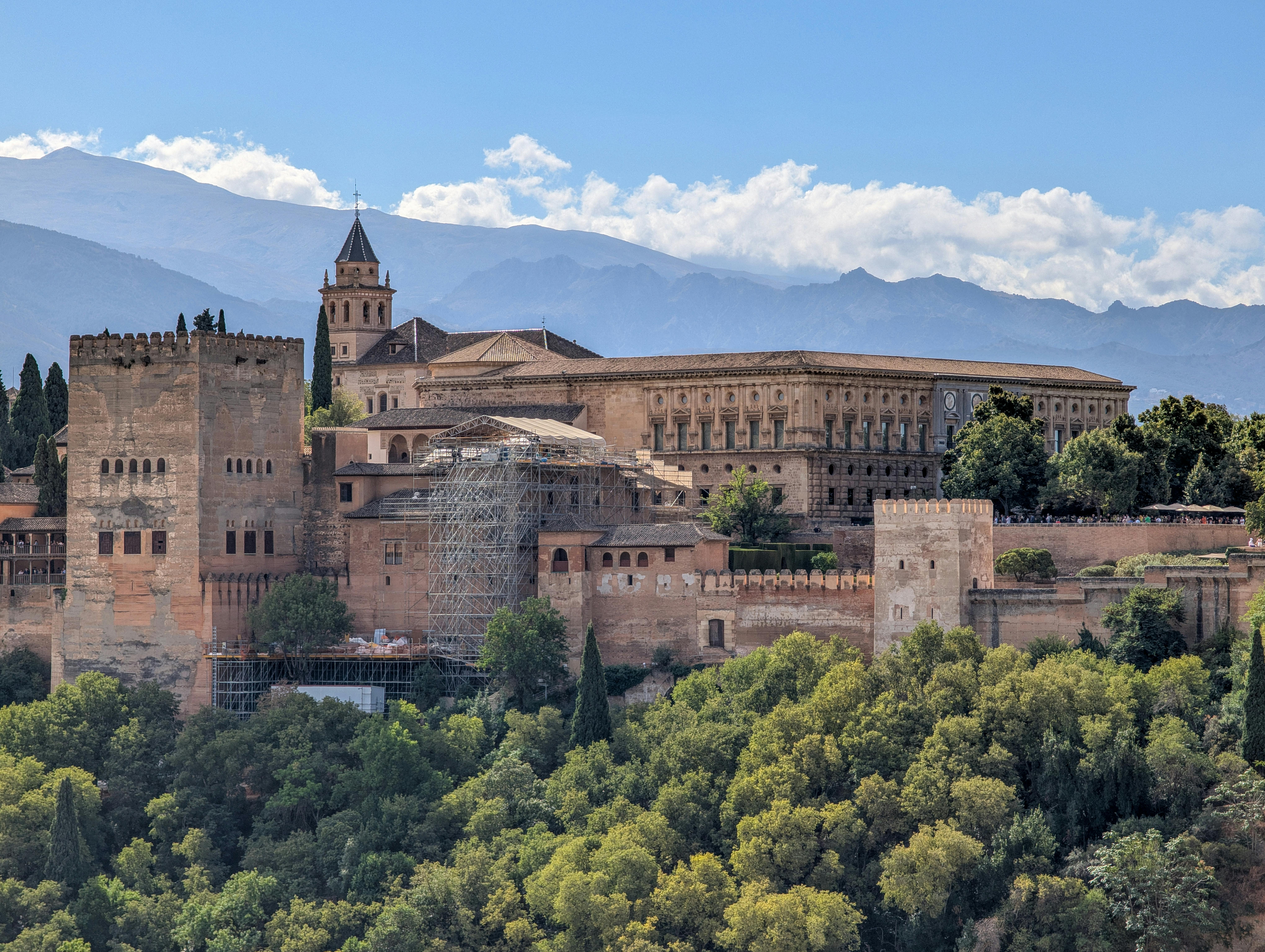
Alhambra Islamic Geometry Meets Andalusian Light
Sunrise strikes the Alhambra’s Nasrid Palaces at precisely 6:48 a.m., gilding 14th-century stucco carvings where 7,000 Arabic inscriptions proclaim “Only God is victor”—your fingers trace the cool marble of the Court of Lions’ fountain as water whispers through hidden channels designed by Ibn al-Jatib in 1362, while the scent of orange blossoms from Generalife gardens mingles with distant flamenco rhythms from Albayzín; you stand where Sultan Muhammad V received emissaries beneath muqarnas vaults that dissolve stone into honeycomb light, within walls built atop Roman foundations on Sabika Hill overlooking Granada’s red-tiled roofs; this 14-hectare fortress-palace complex, begun in 1238 by Muhammad I of the Nasrid dynasty, solved the urgent need for a defensible royal residence during the Reconquista’s final centuries—its ingenious hydraulic system channeled water from Darro River 6 kilometers away to power fountains, baths, and irrigation without pumps. Today, as overtourism strains its fragile plasterwork with 8,500 daily visitors, the Alhambra matters profoundly—not as mere monument but as testament to Islam’s golden age in Europe, demanding mindful engagement in this pivotal 2026 moment of cultural preservation.
Why Alhambra Embodies Mathematical Poetry
The Alhambra isn’t just a palace—it’s a three-dimensional Quran written in stone, geometry, and water. Commissioned in 1238 by Muhammad I after establishing the Emirate of Granada, this fortress evolved under his successors into Europe’s most sophisticated Islamic complex before the 1492 Christian conquest. The Nasrid Palaces (1333–1391) solved critical challenges through revolutionary engineering: the Court of Lions’ 12-marble-lion fountain distributed water through hidden lead pipes to 124 surrounding rooms via gravity-fed pressure, while the Hall of Ambassadors’ 24-meter-high cedar dome—composed of 8,016 interlocking wooden pieces—created perfect acoustics for royal decrees. Every surface embodies mathematical devotion: walls feature tessellated zellij tilework using 17 distinct geometric patterns (all possible in plane geometry), while stucco carvings repeat phrases like “Wa la ghalib illa Allah” (Only God is victor) in Kufic script. After the Catholic Monarchs seized Granada in 1492, they preserved the complex—adding the Renaissance Palace of Charles V but respecting Islamic structures. Saved from Napoleon’s 1812 destruction by British consul John Hookham Frere, it became Spain’s first UNESCO site in 1984. Today, with completion of the 2024–2026 conservation initiative protecting 14,000 square meters of fragile plasterwork, the Alhambra stands as testament to how faith can manifest through mathematical precision and hydraulic ingenuity.
The Best Time to Experience Alhambra
Secure timed entry between 8:00 and 9:30 a.m. during April 10–May 15 or September 20–October 25, when temperatures range 16–22°C (61–72°F) and humidity stays below 60%, allowing comfortable exploration before tourist crowds peak. Morning light through east-facing arches creates dramatic shadow patterns on stucco carvings between 8:30–10:00 a.m., while evening ambiance intensifies after 6:00 p.m. when Generalife gardens glow under vintage lamps. Avoid June 15–August 25 entirely—temperatures exceed 35°C (95°F) with heat indices reaching 42°C (108°F), and queues stretch beyond 90 minutes despite pre-booked tickets; July 20–August 10 is particularly problematic during Spanish national holidays. Winter visits (November–February) offer shortest lines but limited daylight for photography and frequent rain; the site closes at 6:00 p.m. in January. Crucially, book the "Sunrise Access" slot at 7:30 a.m. via the official website (alhambra-patronato.es)—this grants 30-minute exclusive access before general opening, allowing unobstructed photography of light patterns on the Court of Lions. Always verify current restoration schedules and special closures at the official portal minimum 48 hours before visiting.
Approximate Budget for a 7-Day Andalusia Trip with Alhambra Focus
These estimates reflect projected 2026 pricing with 4.2% annual inflation applied to 2024 baselines per Spain’s National Statistics Institute (INE) tourism indices and Granada’s municipal fiscal reports. Budget assumes moderate comfort with Albayzín district lodging, authentic Andalusian dining, and comprehensive cultural access.
- Accommodation: €130–€190 per night in Albayzín (5-minute walk to Alhambra); €100–€150 in Realejo (10-minute walk). Specific options: Hotel Casa 1800 (€185/night with Nasrid courtyard views), Parador de Granada (€190/night in converted convent), or budget alternative Hostal Veracruz (€75/night private room). SUBTOTAL: €910–€1,330 for 7 nights.
- Food: €60 per person daily average—breakfast €8 (tostada con tomate €3, café con leche €2.50 at Bar Casa Julio), lunch €22 (salmorejo €12 at Bodegas Castañeda, vermouth €4/glass), dinner €30 (ajo blanco €18 at Restaurante Ruta del Azafrán, Montilla-Moriles wine €8/glass). Includes daily pastry budget (€4 at Pastelería López). SUBTOTAL: €420 per person for 7 days.
- Transportation: €65 total—€12 for 7-day Granada Card (unlimited bus), €28 train roundtrip from Madrid (AVE high-speed), €25 taxi supplement for late-night returns via official white cabs (fixed €30 airport rate). SUBTOTAL: €65.
- Attractions: €85 per person—€20 Alhambra + Nasrid Palaces (booked direct), €12 Generalife gardens, €15 Sacromonte Caves Museum, €14 Granada Cathedral, €12 Corral del Carbón, €12 Bañuelo Arab Baths. SUBTOTAL: €85 per person.
- Miscellaneous: €120 per person—€45 guided Alhambra history tour (including hidden passages), €30 flamenco show at Cuevas Los Tarantos, €25 official Alhambra ceramic tile replica, €20 emergency horchata refuels at Heladería Sorbete. SUBTOTAL: €120 per person.
Total estimated cost: €1,600–€2,020 per person
7 Essential Alhambra Experiences
- Sunrise Court of Lions Contemplation: Book the 7:30 a.m. "Sunrise Access" ticket via alhambra-patronato.es—arrive by 7:15 a.m. to enter before general crowds. Stand at the fountain’s edge as morning light ignites the 12 marble lions’ eyes, casting liquid reflections on surrounding stucco. Duration: 45 minutes. Essential because this solitude reveals the hydraulic genius before crowds obscure acoustic details.
- Hall of Ambassadors Acoustics: Enter the throne room between 8:30–9:30 a.m. when ambient noise is minimal. Whisper at the central fountain—the acoustics engineered by Nasrid architects carry your voice to all four corners beneath the 24-meter cedar dome. Observe how 8,016 wooden pieces create star patterns symbolizing cosmic order. Duration: 35 minutes. Essential because this demonstrates how architecture amplified royal authority through sound.
- Generalife Water Staircase: Explore the summer palace between 10:00–11:00 a.m. before crowds peak. Ascend the Escalera del Agua where handrails double as water channels—feel the cool mist rising from hidden jets that once cooled sultans during summer heat. Duration: 50 minutes. Essential because this hydraulic marvel reveals Islamic engineering’s marriage of beauty and utility.
- Partal Gardens Panorama: Climb to the Partal mirador between 11:00 a.m.–1:00 p.m. Position yourself where the Torre de las Damas frames Granada’s red-tiled roofs with Sierra Nevada snowcaps in the distance. Duration: 40 minutes. Essential because this vista connects the Alhambra to its geographical context—mountains providing defensive advantage and water sources.
- Charles V Palace Contrast: Tour the Renaissance palace between 2:00–3:00 p.m. Observe how its circular courtyard (48 meters diameter) clashes yet complements Islamic geometry—note the unfinished stone blocks symbolizing Christian conquest’s interruption of Nasrid artistry. Duration: 45 minutes. Essential because this juxtaposition reveals Spain’s complex cultural layers.
- Evening Albayzín Viewpoint: Return to Mirador de San Nicolás between 7:30–8:30 p.m. Watch sunset transform the Alhambra’s red walls into liquid gold while flamenco rhythms drift from cave houses below. Duration: 60 minutes. Essential because this perspective reveals the palace as living entity within Granada’s urban fabric.
- Morning Hammam Ritual: Book the 8:00 a.m. session at Aire Ancient Baths (Carrera del Darro 11). Experience steam rooms replicating Nasrid bathing traditions—inhale eucalyptus-scented vapors in spaces echoing Alhambra’s vaulted ceilings. Duration: 90 minutes. Essential because this sensory immersion connects modern visitors to Islamic wellness practices.
3 Hidden Gems Most Travelers Miss
- Original Hydraulic Workshop: Located beneath the Generalife gardens—request access at the information desk by mentioning “taller hidráulico.” This 14th-century chamber houses reconstructed norias (water wheels) and lead pipes that powered the complex. Open 10:00 a.m.–1:00 p.m. Tuesday–Thursday; free with admission. Special because these artifacts reveal the engineering backbone of Islamic paradise gardens.
- Secret Calligraphy Archive: Overlooked because it’s accessible only via guided tour—book the €18 "Arabic Inscriptions" experience through alhambra-patronato.es. Study original plaster fragments bearing Kufic script in the conservation lab. Tours run Saturdays at 11:00 a.m.; requires advance reservation 30 days ahead. Special because these texts decode the philosophical messages woven into architectural decoration.
- Royal Mint Courtyard: Located east of the Nasrid Palaces—follow the unmarked path beside the Church of Santa María de la Alhambra. This 16th-century courtyard features original coin-stamping machinery used after the Christian conquest. Open 24/7; best explored at dawn. Special because this space demonstrates how conquerors repurposed Islamic infrastructure for new economic systems.
Cultural & Practical Tips
- Ticket booking protocol: Reserve Nasrid Palaces tickets minimum 90 days ahead via official portal—third-party vendors add 30–50% surcharges with identical access. Select exact 30-minute entry window during purchase as changes aren’t permitted.
- Photography ethics: No tripods in Nasrid Palaces (€100 fines); smartphone photography permitted but avoid flash which damages pigments. Best shots occur 8:00–10:00 a.m. when east-facing light illuminates stucco without harsh shadows.
- Essential Spanish phrases: “Buenos días” (BWEH-nos DEE-as) for good morning; “Gracias” (GRAH-thyas) for thank you; “¿Dónde está el baño?” (DON-deh es-TAH el BAH-nyo) for restroom location.
- Dress code considerations: While not enforced, modest clothing (covered shoulders/knees) shows respect in religiously significant spaces. Carry lightweight scarf for sudden sun exposure in courtyards.
- Pickpocket prevention: Highest risk at Puerta de la Justicia entrance—use cross-body bags with zippers facing inward. Municipal police maintain visible presence but cannot monitor all pockets during peak hours (10:00 a.m.–2:00 p.m.).
- Weather considerations: Summer humidity (60–75%) intensifies heat in enclosed halls; winter rains create slippery conditions on marble pathways. Always carry water—free refill stations available near Generalife exit.
- Conservation awareness: Do not touch stucco surfaces—oils from skin accelerate plaster deterioration. Report damaged sections to staff immediately; each fragment represents irreplaceable craftsmanship.
Conclusion: Travel with Reverence, Not Just Routes
To wander the Alhambra is to traverse the boundary between earth and paradise—a place where every carved phrase, water channel, and geometric pattern embodies Islam’s golden age in Europe. Your €20 ticket directly funds the 2024–2026 conservation initiative protecting 14,000 square meters of fragile plasterwork from overtourism’s wear; each respectful step honors the artisans who transformed mathematics into spiritual poetry. In an age of digital distraction, this palace demands embodied attention: feel the marble’s coolness rather than viewing it through screens; listen to water’s whisper instead of curated playlists; taste orange blossom flavors beyond Instagram aesthetics. The 1492 conquest taught us that beauty persists through cultural upheaval—your awareness becomes part of its preservation. Choose reverence over routes—linger at the Court of Lions to understand its hydraulic significance; observe how light shifts on stucco across hours. Let the Alhambra recalibrate your senses; understand that true travel here measures not photos taken, but connections forged between human ingenuity and the eternal Andalusian light.