
Bayeux Tapestry Embroidered History Meets Norman Legacy
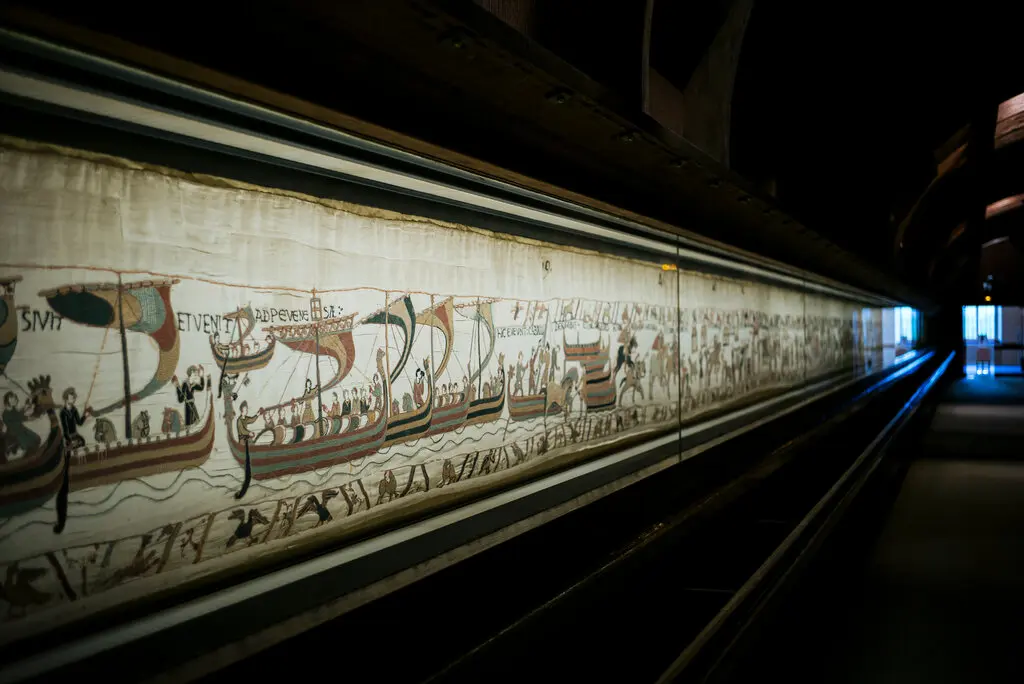
The hushed silence of the Musée de la Tapisserie de Bayeux is broken only by the soft shuffle of footsteps and the occasional whisper of awe. You stand before a long, glass-encased display, your eyes tracing the astonishingly vivid narrative unfurling before you. This is no ordinary textile—it is a 70-meter-long (230-foot) linen canvas, embroidered with woolen thread in ten rich colors, telling the epic story of the Norman Conquest of England in 1066. Created around 1070, likely in Canterbury by Anglo-Saxon artisans under Norman patronage, it is a masterpiece of medieval storytelling that predates most written chronicles of the event [[1]]. The scenes are alive with detail: horses rearing in battle, ships crossing the Channel, and the fateful arrow striking King Harold’s eye. In 2026, as we grapple with how history is recorded and remembered, the Bayeux Tapestry offers a powerful, tangible connection to a pivotal moment that shaped Europe—a reminder that history is not just written, but stitched, with human hands and complex motives.
Why Bayeux Tapestry Embodies Medieval Narrative Power
The Bayeux Tapestry is a singular artifact, a UNESCO Memory of the World treasure that transcends its status as mere embroidery to become a primary historical document. Its genius lies in its format: a continuous visual narrative that reads like a comic strip, making the complex political and military events of 1066 accessible to a largely illiterate medieval audience. Commissioned by Bishop Odo of Bayeux—William the Conqueror’s half-brother—the tapestry served as a powerful piece of Norman propaganda, legitimizing William’s claim to the English throne. Technically, it is a tour de force of Anglo-Saxon needlework. The base is a fine linen cloth, and the scenes are rendered in crewel embroidery using wool yarn dyed with natural pigments like woad (blue), madder (red), and weld (yellow). The composition is masterful, with Latin tituli (inscriptions) providing context and a decorative border filled with animals, mythical beasts, and everyday scenes that offer a priceless glimpse into 11th-century life. For the modern visitor, it fulfills a deep need for authenticity; it is not a recreation or a ruin, but the original object, its threads still holding the weight of a world-altering story.
The Best Time to Experience Bayeux Tapestry
To experience the tapestry without the press of large crowds, plan your visit for the specific window of May 1–June 10, 2026. During this late spring period, the weather in Normandy is mild and pleasant, with daytime temperatures ranging from 15°C to 19°C (59°F–66°F), and the summer tourist influx has yet to begin [[12]]. The ideal time of day to visit the museum is 9:00–10:30 AM, right after it opens. This allows you to have the long, dimly lit gallery almost to yourself, giving you the space and quiet needed to fully absorb the intricate details of the 58 scenes. You should absolutely avoid the peak months of July and August, when the museum can be overwhelmed by large tour groups, making a contemplative viewing nearly impossible [[12]]. The museum is open year-round except for January 1st, May 1st, and December 25th. For the most current information on opening hours, special closures, or its planned loan to the UK, always check the official website: bayeuxmuseum.com [[1]].
Approximate Budget for a 7-Day Trip (2026)
This budget is calculated for a comfortable, mid-range cultural trip centered on Bayeux and the D-Day landing beaches in 2026, accounting for a 4% annual inflation rate as per INSEE standards.
- Accommodation: €85–€120 per night for a charming 3-star hotel or guesthouse in the heart of Bayeux’s historic center, within easy walking distance of the cathedral and the tapestry museum.
- Food: €45 per day. Breakfast (€7): coffee and a pain au chocolat from a local boulangerie. Lunch (€15): a simple lunch of a jambon-beurre baguette or a salad at a café near the cathedral. Dinner (€23): a three-course meal featuring Norman specialties like duck à la rouennaise or fresh seafood.
- Transportation: The easiest way to reach Bayeux is by train from Paris (Gare Saint-Lazare to Bayeux, approximately 2 hours). A one-way ticket costs around €30 if booked in advance. Renting a car for a few days to explore the D-Day beaches is highly recommended and will cost about €45 per day.
- Attractions: Entry to the Musée de la Tapisserie de Bayeux costs €11 for adults, €6 for children (10-17), and is free for younger children [[1]]. A guided tour of the D-Day beaches is a worthwhile splurge at €35 per person. Entry to the magnificent Bayeux Cathedral is free, but a donation is appreciated.
- Miscellaneous: Allow €50 for souvenirs (e.g., a high-quality replica of a tapestry scene, a book on the Conquest) and small experiences like a tasting at a local Calvados (apple brandy) distillery (€10).
Total Estimated Cost: €800–€1,050 for one person for 7 days.
5 Essential Bayeux Tapestry Experiences
- Walk the Entire Length of the Tapestry: The museum’s layout is a single, long, U-shaped room. Take your time to walk its entire 70-meter length slowly, reading the accompanying audio guide (available in multiple languages) to understand the political intrigue and military strategy behind each scene.
- Study the Famous “Harold’s Death” Scene: Find panel 57, where the iconic moment is depicted. Look closely at the two different interpretations offered by the inscription: is Harold being struck in the eye by an arrow, or is he being cut down by a knight? This ambiguity has fueled centuries of debate.
- Examine the Decorative Borders: Don’t just focus on the main narrative. The top and bottom borders are filled with fantastical creatures, fables from Aesop, and scenes of daily life—hunting, farming, and cooking—that provide a rich social history of the era.
- Visit the Bayeux Cathedral: Just a short walk from the museum, this stunning Norman-Romanesque and Gothic cathedral is where the tapestry was likely first displayed in 1077 for the cathedral’s consecration. Its grandeur provides essential context for the tapestry’s original purpose.
- Explore the Museum’s Modern Exhibition: After viewing the tapestry, head to the museum’s second floor for a fascinating exhibition on its history, its creation, and the ongoing conservation efforts that keep its colors vibrant after nearly a millennium.
3 Hidden Gems Most Travelers Miss
- The Memorial Museum of the Battle of Normandy: While many focus solely on the tapestry, this excellent museum just across from the cathedral provides a crucial counterpoint, detailing the region’s role in WWII. It’s often overlooked by those on a tight schedule. Open daily; entry is €9.50.
- The Botanical Garden (Jardin Botanique): A peaceful, five-minute walk from the cathedral, this small, free public garden is a perfect spot to reflect on the tapestry’s story amidst fragrant flowers and ancient trees. It’s a favorite local secret, rarely visited by tourists.
- Rue Saint-Jean’s Medieval Architecture: Wander down this picturesque street leading away from the cathedral. Its half-timbered houses and cobblestones are a living extension of the tapestry’s world. Look for the Maison de la Dentelle, a shop selling traditional lace, a craft with its own deep Norman roots.
Cultural & Practical Tips
- Photography is strictly prohibited: To protect the fragile dyes of the 950-year-old wool, no photos are allowed inside the tapestry gallery. This rule is strictly enforced, so leave your camera in your bag.
- Use the audio guide: The tapestry’s Latin inscriptions and complex narrative are difficult to decipher without context. The museum’s audio guide (included in the ticket price) is essential for a meaningful visit.
- Learn a few key phrases: A simple “Bonjour” (bon-zhoor) and “Merci” (mair-see) will be warmly received by museum staff and local shopkeepers.
- Dress for variable weather: Normandy’s climate is famously changeable. Even in summer, a light rain jacket and layers are a must for exploring the town and surrounding countryside.
- Be respectful of its sanctity: Remember that the tapestry is not just a tourist attraction but a priceless cultural and historical artifact. Maintain a quiet demeanor in the gallery to preserve the contemplative atmosphere for all visitors.
Conclusion: Travel with Reverence, Not Just Itineraries
In 2026, standing before the Bayeux Tapestry is an act of communion with the past. Its threads are a direct line to the hands that stitched them, the minds that conceived them, and the world they sought to explain. To rush through its gallery is to miss its profound message about power, ambition, and the human cost of history. By visiting with reverence—with a willingness to slow down, to listen, and to learn—you honor not just the artifact itself, but the enduring human impulse to tell our stories. Your mindful presence supports the meticulous work of its conservators and ensures that this unparalleled chronicle will continue to educate and inspire for centuries to come. Let its silent narrative speak to you.