
Cabourg Belle Époque Gilded Elegance Meets the Normandy Coast
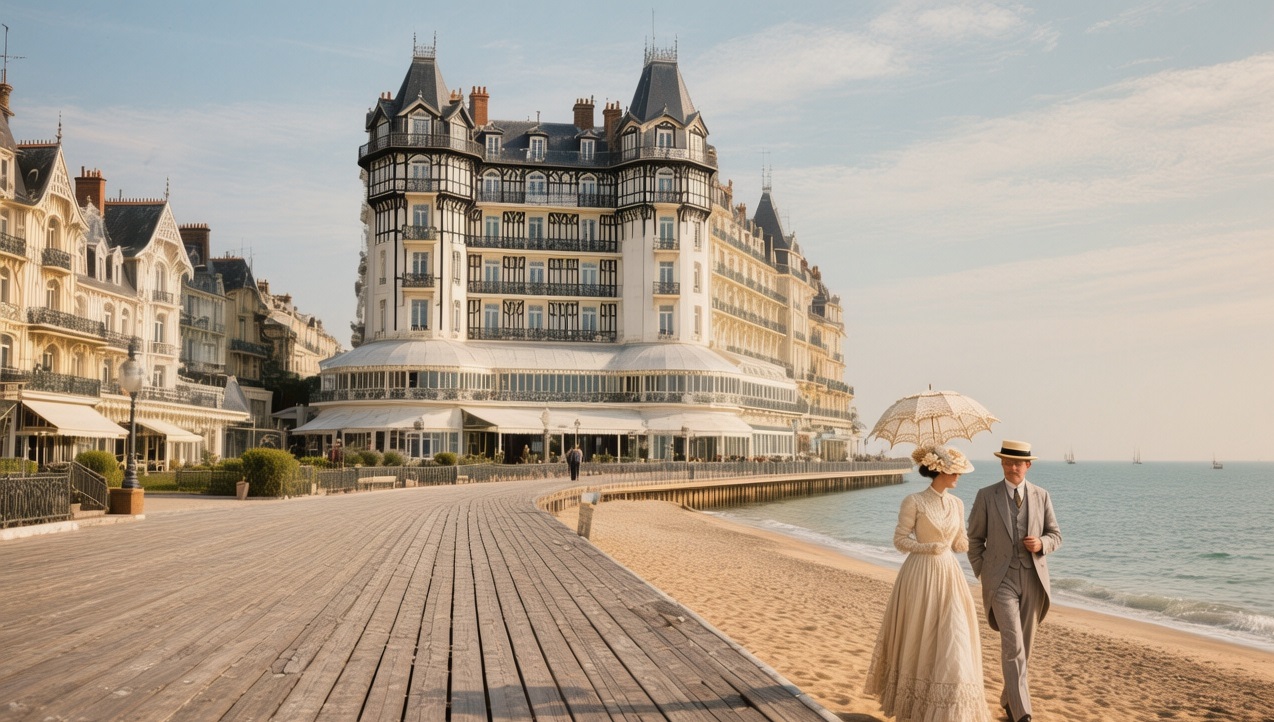
The late afternoon sun casts a honeyed glow over the Grand Plage, gilding the ornate façade of the Casino de Cabourg. You stroll along the Promenade Marcel Proust, the air scented with salt spray and the sweet perfume of roses from the meticulously tended flowerbeds. The rhythmic crash of the English Channel against the pebble beach provides a soothing soundtrack, punctuated by the distant laughter of children and the soft clink of teacups from the grand hotel terraces. This is Cabourg—a seaside town meticulously crafted during the Belle Époque (1870–1914) as a playground for Parisian high society. Its heart is a masterpiece of urban planning: a harmonious ensemble of 130 uniform, neo-Norman villas with half-timbering, slate roofs, and turrets, all radiating from the central casino like the spokes of a wheel [[3]]. In 2026, as we yearn for beauty and order in a chaotic world, Cabourg offers a perfectly preserved portal to an era of refined leisure and architectural poetry.
Why Cabourg Belle Époque Embodies Architectural Harmony
Cabourg is not a collection of random old buildings; it is a singular, planned urban masterpiece conceived by the visionary developer Léon Lecornu in the 1880s. His goal was to create the “most beautiful resort on the coast,” a rival to Deauville but with a more intimate, artistic soul [[2]]. To achieve this, he commissioned architect Alfred Demange to design a cohesive town plan centered around the seafront casino. The result is a stunning example of “urbanisme d’agrément” (pleasure-oriented urban planning), where every element—from the width of the avenues to the style of the streetlamps—was dictated by strict aesthetic codes. The predominant architectural style is a romanticized version of Norman vernacular, known as the “style néo-normand,” characterized by its use of local materials: creamy Caen stone for foundations, red brick for chimneys, and dark timber for the intricate half-timbering that adorns every gable. The town’s centerpiece, the Grand Hôtel, opened in 1907, is a 110-room palace that hosted literary giants like Marcel Proust, who used Cabourg as the model for his fictional Balbec in In Search of Lost Time. Today, this harmonious ensemble fulfills a profound need for the modern traveler: it offers a sanctuary of visual calm and historical coherence, a place where architecture itself tells a story of elegance and intentionality.
The Best Time to Experience Cabourg Belle Époque
To experience Cabourg at its most serene and luminous, plan your visit for the specific window of June 1–20, 2026. During these early summer weeks, the famous rose gardens are in full, fragrant bloom, the weather is reliably pleasant, and the massive crowds of July and August have yet to arrive [[14]]. Daytime temperatures are a comfortable 18°C to 22°C (64°F–72°F)—perfect for long walks on the promenade or lounging on the beach without the intense heat [[14]]. The ideal time of day is 5:00–7:00 PM, when the golden hour light bathes the cream-colored stone and dark timber of the villas in a warm, ethereal glow, creating the perfect conditions for photography and quiet contemplation. You should avoid the peak summer months of July 15 through August 20, when the town’s population swells dramatically, making the promenade feel congested and restaurant reservations nearly impossible to secure [[14]]. For the most current information on events like the annual Festival of the Romantic Film or the Proust Week, always consult the official tourism website: cabourg.fr/en [[5]].
Approximate Budget for a 7-Day Trip (2026)
This budget is calculated for a comfortable, mid-range cultural trip to Cabourg in 2026, factoring in a 4% annual inflation rate as reported by INSEE. It assumes a focus on the town’s unique heritage and seaside charm.
- Accommodation: €110–€160 per night for a room in a charming 3-star hotel or a guesthouse in a restored Belle Époque villa near the Grand Plage. Staying in the historic center is essential for the full experience.
- Food: €55 per day. Breakfast (€10): a leisurely café crème and croissant on a hotel terrace overlooking the sea. Lunch (€18): a fresh seafood platter or a salad nicoise at a brasserie on the Place du Marché. Dinner (€27): a three-course meal at a traditional Norman restaurant featuring dishes like sole meunière or duck breast with Calvados sauce.
- Transportation: The easiest way to reach Cabourg is by train from Paris (Gare Saint-Lazare to Dives-Cabourg station, then a 10-minute taxi ride). A one-way ticket costs around €35 if booked in advance. Within the compact town center, walking is the best and most enjoyable option.
- Attractions: Entry to the Grand Hôtel’s public areas and gardens is free. A guided “Proust Walk” through the town costs €15. A relaxing treatment at the Thalasso Spa would be a luxury splurge at €80. Visiting the small Villa Proust museum is €6.
- Miscellaneous: Allow €60 for souvenirs (e.g., a bottle of local apple brandy, a book on Belle Époque architecture) and small experiences like a horse-drawn carriage ride along the promenade (€25 for two).
Total Estimated Cost: €950–€1,250 for one person for 7 days.
6 Essential Cabourg Belle Époque Experiences
- Stroll the Promenade Marcel Proust at Sunset: Named after the town’s most famous literary resident, this wide, flower-lined boardwalk is the heart of Cabourg. Walk from the Grand Hôtel to the eastern end, feeling the cool sea breeze and admiring the symmetrical rows of elegant villas glowing in the fading light.
- Take Afternoon Tea at the Grand Hôtel: Step into a scene from a Proust novel. The hotel’s grand salon offers a traditional afternoon tea service with delicate pastries, finger sandwiches, and a view of the Grand Plage. Dress smartly; it’s an event, not just a snack.
- Explore the Rose Garden (Jardin des Roses): Located just behind the casino, this award-winning garden features over 1,200 varieties of roses. Visit in the morning when the blooms are fresh and the scent is most potent. It’s a living testament to the town’s commitment to beauty.
- Attend a Screening at the Festival of the Romantic Film: If your visit coincides with the festival (usually in June), don’t miss a classic film screening in the ornate ballroom of the Grand Hôtel. It’s a magical blend of cinema and setting.
- Walk the Beach at Low Tide: The Grand Plage transforms at low tide, revealing a vast expanse of wet sand that’s perfect for a long, reflective walk. The view of the town’s Belle Époque architecture from the water’s edge is unparalleled.
- Visit the Villa Proust: This small, charming museum in a typical Belle Époque villa offers an intimate look at Proust’s life and work, with period furniture and personal artifacts that bring his connection to Cabourg to life.
3 Hidden Gems Most Travelers Miss
- The Church of Notre-Dame de l’Assomption: Just a block from the main square, this beautiful neo-Gothic church is often overlooked. Its interior is surprisingly grand, with stunning stained-glass windows. It’s open daily from 9:00 AM to 6:00 PM for quiet reflection.
- The Covered Market (Marché Couvert): While many grab a quick bite at tourist cafes, locals shop at this charming covered market on Rue du 19 Août. Go on a Saturday morning to find the best local cheeses, oysters, and seasonal produce. It’s a sensory immersion into daily Norman life.
- The View from the Eastern Dunes: A 20-minute walk east of the Grand Plage, these natural dunes offer a wild, unspoiled contrast to the manicured town. From here, you can see the entire sweep of Cabourg’s coastline with its elegant architecture framed by nature. Go at sunrise for complete solitude.
Cultural & Practical Tips
- Dress with a touch of elegance: Cabourg has a refined atmosphere. While beachwear is fine on the sand, smart casual attire is expected in the town’s restaurants and hotels, especially for dinner.
- Learn a few key phrases: A polite “Bonjour, Madame/Monsieur” (bon-zhoor, mah-dam/muh-syuh) and “Merci beaucoup” (mair-see bo-koo) will be warmly received by local shopkeepers and hotel staff.
- Photography is encouraged, but be discreet: The town is a photographer’s dream, but remember that many of the beautiful villas are private homes. Always shoot from public spaces and avoid using drones without a permit.
- Embrace the pace of “la vie à la plage”: Life in Cabourg moves slowly. Meals are long, and shops may close for a leisurely lunch. Don’t rush; this unhurried rhythm is part of its charm.
- Check the tide schedule: The beach experience changes dramatically between high and low tide. Consult the local tide tables (available at the tourist office) to plan your beach walks for maximum enjoyment.
Conclusion: Travel with Grace, Not Just Itineraries
In 2026, Cabourg Belle Époque stands as a gentle rebuke to our hurried age. It is a place that was built not for speed, but for savoring—for long conversations over tea, for strolls without a destination, for the simple pleasure of beauty in every detail. To visit here is to be invited into a different rhythm of life, one defined by grace and intention. By traveling with grace—with respect for its history, its residents, and its carefully preserved aesthetic—you become a steward of its legacy. Your mindful presence, your support of its local artisans and hotels, ensures that this exquisite vision of a bygone era will continue to offer its timeless lesson in elegance for generations to come. Slow down. Breathe. Let Cabourg’s gilded calm wash over you.