
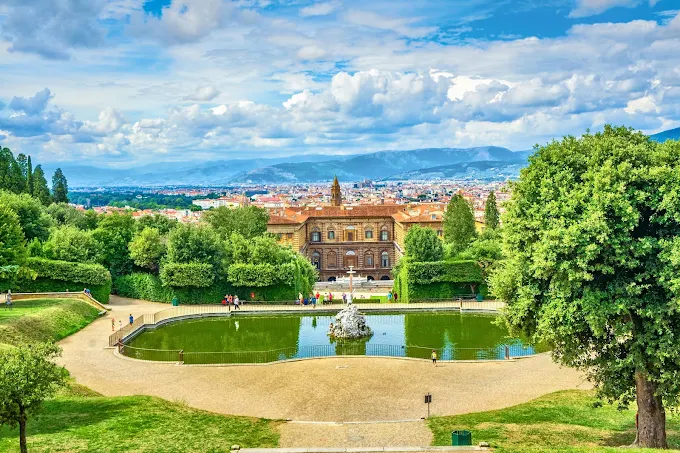
Boboli Gardens Renaissance Order Meets Tuscan Light
The late afternoon sun slants through a canopy of ancient cypresses—casting long, geometric shadows across gravel paths that crunch softly underfoot. In the heart of Florence, the Boboli Gardens unfold like a living tapestry woven with stone, water, and greenery. You hear the gentle hiss of fountains, the distant chime of church bells from the Oltrarno district, and the rustle of leaves stirred by a breeze that carries the scent of boxwood and lemon trees. Commissioned in 1549 by Eleonora di Toledo, wife of Cosimo I de’ Medici, this 111-acre (45-hectare) estate was designed as an outdoor extension of the Pitti Palace—a stage for courtly spectacle and intellectual retreat. Its layout, masterminded by Niccolò Tribolo and later refined by Giorgio Vasari and Bernardo Buontalenti, pioneered the Italian formal garden: axial symmetry, forced perspective, and mythological statuary arranged to awe and instruct. Today, as overtourism strains Florence’s historic core, the Boboli Gardens offer something increasingly rare—a sanctuary where time slows, and beauty is measured not in likes, but in centuries.
Why Boboli Gardens Embodies the Birth of the European Landscape
The Boboli Gardens are not merely a park—they are the prototype for every grand European garden that followed, from Versailles to Schönbrunn. When Eleonora di Toledo acquired the Pitti Palace in 1549, she commissioned architect Niccolò Tribolo to transform the steep hillside behind it into a theatrical landscape that would reflect Medici power and humanist ideals. The result was revolutionary: a series of terraces connected by grand staircases, alleys radiating in perfect symmetry, and grottoes adorned with frescoes and automata that delighted Renaissance sensibilities. At its core lies the Isolotto, an island-like oval pond crowned with Giambologna’s Oceanus fountain, surrounded by statues representing rivers and mythological figures. The gardens span 111 acres (45 hectares)—a vast green lung in the heart of Florence—and contain over 200 sculptures, 15 fountains, and meticulously manicured giardini segreti (secret gardens). Unlike English romantic gardens that mimic nature, Boboli imposes human order upon it: every tree is pruned to geometric perfection, every vista engineered to draw the eye toward a focal point. This was gardening as philosophy—a visual manifesto of the Renaissance belief that man, through reason and art, could shape the world into harmony.
The Best Time to Experience Boboli Gardens
To wander the Boboli Gardens in near solitude with ideal lighting for photography and comfortable temperatures, target the precise window of September 25–October 9, 2026. During these weeks, daytime temperatures range from a pleasant 17–24°C (63–75°F)—cool enough for extended walking yet warm enough for the fountains to remain operational [[23], [26]]. The golden hour between 5:00–6:30 PM transforms the gardens into a painterly dreamscape, as low-angle sunlight gilds the cypress spires and casts dramatic shadows along the Viottolone avenue. Mornings before 9:00 AM also offer tranquility, especially on Tuesdays and Wednesdays—the least crowded days. Avoid visiting during peak periods: all of May, July, and August, when heat and crowds diminish the experience, and major holidays like Easter week or Christmas markets [[28]]. For the most immersive visit, enter through the Pitti Palace courtyard and allow at least two hours to explore the upper terraces and Isolotto. Always verify current opening hours via the official Uffizi Galleries portal (uffizi.it/en/boboli-garden), as seasonal adjustments occur annually.
Approximate Budget for a 7-Day Trip
This budget reflects mid-range 2025 pricing adjusted for Italy’s projected 2026 inflation rate of 1.5% [[37]], offering a realistic estimate for a solo traveler based in the Oltrarno district near the gardens.
- Accommodation: €855–€1,140 total (€143–€190 per night) for a 3-star hotel or private apartment in the Santo Spirito or San Frediano neighborhoods—authentic, quiet, and steps from the garden entrance.
- Food: €455 total (€65 per day). Breakfast at a local bar (€3 for espresso and cornetto); lunch at a trattoria near Piazza Santo Spirito (€16 for pappa al pomodoro and mineral water); dinner at a family-run restaurant (€42 for bistecca alla fiorentina with contorno and house Chianti).
- Transportation: €20 total. The gardens are best reached on foot; this covers a few ATAF bus rides (€1.70 per ticket) if needed.
- Attractions: €95 total. Boboli Gardens (€12); Pitti Palace (€14); Uffizi Gallery (€28); Accademia Gallery (€22); and a guided Oltrarno artisan walking tour (€19).
- Miscellaneous: €105 total. A hand-bound journal from Scuola del Cuoio (€30); gelato from Gelateria dei Neri (€4); a bottle of organic olive oil from Mercato di Sant’Ambrogio (€20); and a wine tasting at a local enoteca (€50).
Total Estimated Budget: €1,530–€1,910
6 Essential Boboli Gardens Experiences
- Stroll the Viottolone at Sunset: Walk the grand central avenue lined with cypress trees as the sun dips behind the Florentine hills. The perspective draws your eye to the distant skyline, with Brunelleschi’s dome perfectly framed—a composition unchanged since the 17th century.
- Explore the Buontalenti Grotto: Step into this Mannerist masterpiece near the entrance. Its three chambers drip with stalactites, mosaic shells, and hidden water jets that once startled unsuspecting guests—an ingenious blend of art, engineering, and playful deception.
- Climb to the Belvedere Fort Viewpoint: From the upper terrace, ascend to the 16th-century fort for a sweeping panorama of Florence. This vantage point, favored by Grand Dukes, offers the most iconic view of the city with the Arno snaking below.
- Find the Isolotto’s Mythological Circle: At the garden’s heart, the oval pond features Giambologna’s Oceanus surrounded by river gods and sea creatures. Sit on the stone rim and listen to the water’s murmur—a moment of calm amid grandeur.
- Discover the Lemon House (Limonaia): Built in the 18th century to shelter citrus trees in winter, this elegant greenhouse now hosts temporary exhibitions. Its arched windows frame perfect views of the lower gardens.
- Picnic in the Amphitheatre: Beneath the ancient Roman sarcophagi that line the original garden amphitheater, spread a blanket with market-fresh bread, pecorino, and Chianti—a tradition enjoyed by Florentines for generations.
3 Hidden Gems Most Travelers Miss
- Giardino del Cavaliere: Tucked behind the Belvedere Fort, this small, elevated garden offers the most unobstructed panoramic view of Florence, often empty even on busy days. Access is included with your Boboli ticket—just follow the path past the fort’s eastern wall.
- Kaffeehaus Pavilion: Nestled in the northeastern corner, this charming 18th-century Austrian-style café pavilion is rarely visited. Its terrace overlooks a quiet grove—perfect for an espresso away from the main paths.
- Via Costa San Giorgio Secret Staircase: For a local’s approach, climb the stone steps from Porta San Giorgio up Via Costa San Giorgio. This shaded, residential lane offers intimate glimpses into historic homes and ends at a secluded garden gate with stunning downward views of the Arno.
Cultural & Practical Tips
- Enter early or late: The gardens open at 8:15 AM and close at 6:30 PM (summer hours). Arriving at opening or two hours before closing ensures fewer crowds and better light.
- Wear sturdy walking shoes: The terrain is hilly with uneven gravel paths and stone steps. Comfortable footwear is essential for exploring the upper terraces.
- Respect the flora: Do not pick flowers, climb trees, or sit on sculptural bases. These gardens are a protected cultural landscape, not a public park.
- Learn key phrases: “Dov’è l’uscita per il Forte Belvedere?” (doh-VEH loo-SHEE-tah PER il FOR-teh Bel-veh-DEH-reh?) for directions; “Grazie, buona giornata” (GRAHT-see-eh BWOH-nah jor-NAH-tah) for polite thanks.
- Photography is encouraged—but responsibly: Tripods require a permit; drones are prohibited. Early morning offers soft, diffused light ideal for capturing the gardens’ serene geometry.
Conclusion: Travel with Presence, Not Just Panoramas
In 2026, the Boboli Gardens offer more than a scenic escape—they provide a counterpoint to our fragmented digital lives. Here, beauty unfolds slowly, demanding your full attention: the texture of centuries-old stone, the rhythm of water in a Baroque fountain, the play of light through cypress branches. Your €12 admission directly supports the gardeners who prune each hedge by hand and the conservators who preserve fragile frescoes in the grottoes. To travel mindfully means resisting the urge to rush from viewpoint to viewpoint. Instead, sit on a sun-warmed bench in the Amphitheatre; sketch the curve of a statue; share bread with a friend beneath the lemon trees. By engaging with this place as a living heritage—not just a backdrop—you help ensure that the Medici’s vision of ordered beauty endures, not as a relic, but as a breathing sanctuary for all who seek stillness in a noisy world.