
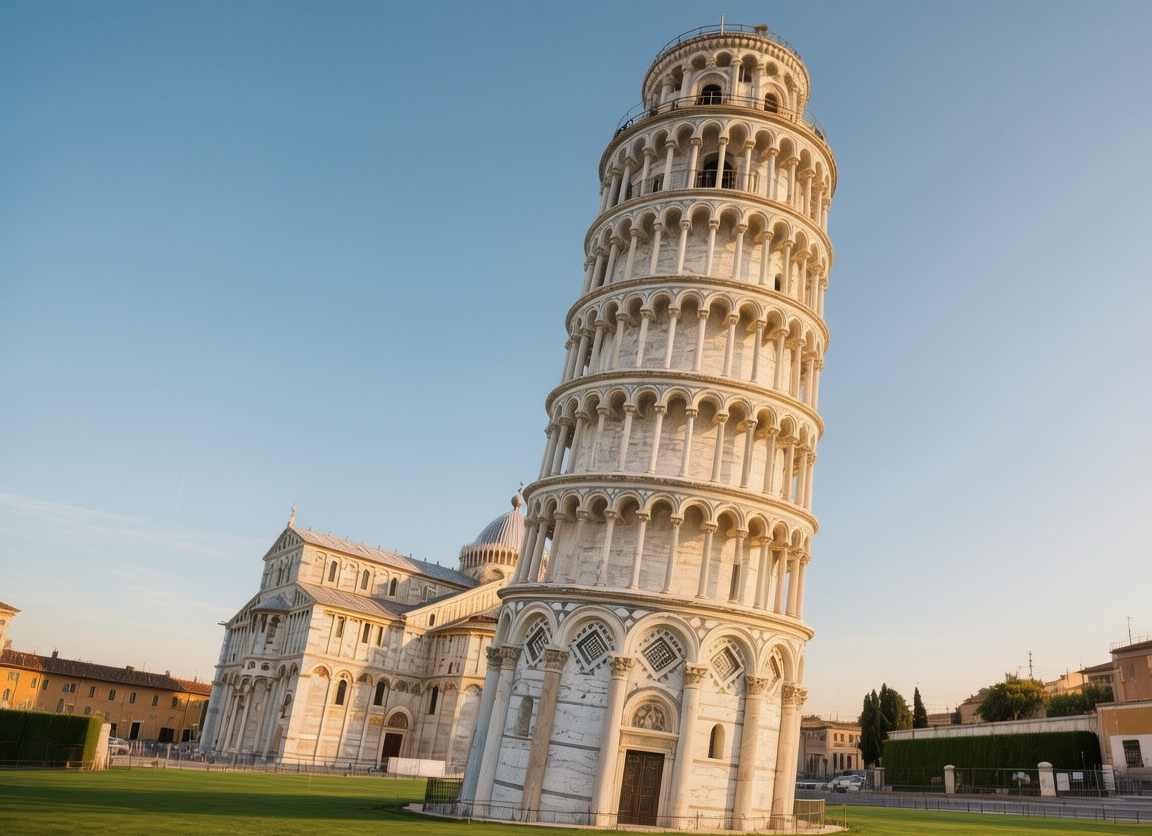
Pisa Leaning Tower Marble Defiance Meets Tuscan Sky
The late afternoon sun gilds the Piazza dei Miracoli—turning the white Carrara marble of the Leaning Tower into a luminous beacon against the soft blue of the Tuscan sky. You hear the murmur of a dozen languages, the crunch of gravel underfoot, and the distant chime of the tower’s seven bells, each tuned to a different note of the major scale. Rising 55.86 meters (183 feet) on the south side and 56.67 meters (186 feet) on the north, this cylindrical bell tower began its famous tilt in 1178—just five years after construction started—when unstable subsoil of clay, sand, and shells gave way beneath its foundation. What was once an engineering embarrassment is now one of the world’s most beloved architectural anomalies, stabilized in 2001 after a 14-year restoration that reduced its lean from 5.5 to 3.97 degrees. In 2026, as mass tourism threatens the very sites we cherish, the Leaning Tower stands not just as a marvel of medieval masonry, but as a symbol of resilience—proof that even imperfection can become iconic when met with care and ingenuity.
Why Pisa Leaning Tower Embodies Architectural Redemption
The Pisa Leaning Tower is far more than a tilted curiosity—it is a masterpiece of Romanesque architecture that turned structural failure into global legend. Construction began in 1173 as the bell tower for Pisa Cathedral, part of a grand religious complex known as the Piazza dei Miracoli (Square of Miracles). Built from luminous white Carrara marble, the tower features eight stories: a base of 15 blind arches, six open loggias with 30 columns each, and a belfry at the top. The lean emerged almost immediately due to the shallow 3-meter-deep foundation set in weak alluvial soil—a flaw compounded by wars and construction halts that allowed the ground to settle unevenly over decades. By the 20th century, the tilt had reached a precarious 5.5 degrees, threatening collapse. A massive international effort from 1990 to 2001—led by engineers like Michele Jamiolkowski—successfully stabilized the structure by extracting soil from beneath the raised north side, reducing the lean to a safe 3.97 degrees and ensuring its survival for at least 200 more years. Today, the tower houses seven bells, weighs approximately 14,500 metric tons, and contains 294 steps spiraling upward in a counter-clockwise direction—a testament to human error, perseverance, and ultimate redemption.
The Best Time to Experience Pisa Leaning Tower
To photograph the Pisa Leaning Tower without crowds and in perfect light, target the precise window of September 20–October 4, 2026. During these weeks, daytime temperatures range from a comfortable 18–25°C (64–77°F)—ideal for walking and climbing the tower’s 294 steps [[24], [27]]. The golden hour between 6:00–7:30 PM bathes the marble in warm, directional light that accentuates its texture and tilt, while the piazza empties of tour groups. Mornings before 8:30 AM also offer near solitude, especially on Tuesdays and Wednesdays—the least crowded days. Avoid visiting during peak periods: all of May, July, and August, when heat and dense crowds make photography and climbing unpleasant, and major holidays like Easter week or Italian Liberation Day (April 25) [[29]]. For the best photo angle, position yourself on the northwest corner of the piazza—this perspective exaggerates the lean while keeping the cathedral in frame. Always verify current opening hours via the official Opera della Primaziale Pisana website (opapisa.it/en), as seasonal adjustments occur annually.
Approximate Budget for a 7-Day Trip
This budget reflects mid-range 2025 pricing adjusted for Italy’s projected 2026 inflation rate of 1.5% [[37]], offering a realistic estimate for a solo traveler using Pisa as a base for day trips to Lucca, Florence, and the Tuscan coast.
- Accommodation: €700–€945 total (€100–€135 per night) for a 3-star hotel or private apartment in Pisa’s historic center, within a 15-minute walk of the Piazza dei Miracoli.
- Food: €420 total (€60 per day). Breakfast at a local bar (€3 for cappuccino and cornetto); lunch at a trattoria near Piazza delle Vettovaglie (€15 for pasta al pesto); dinner at a mid-range restaurant (€38 for bistecca alla fiorentina with contorno and house wine).
- Transportation: €85 total. Includes round-trip train from Florence (€18); regional trains to Lucca (€5) and Viareggio (€6); and local bus tickets in Pisa (€1.50 per ride).
- Attractions: €95 total. Leaning Tower climb (€22); Pisa Cathedral (free, but €5 reservation fee); Baptistery (€7); Camposanto Monumentale (€7); and a guided walking tour of Pisa’s hidden alleys (€50).
- Miscellaneous: €90 total. A high-quality print from a local artisan shop (€25); gelato from Gelateria De’ Coltelli (€4); a bottle of local olive oil (€20); and a wine tasting in nearby San Torpé (€40).
Total Estimated Budget: €1,390–€1,635
6 Essential Pisa Leaning Tower Experiences
- Climb the 294 Steps at Sunset: Book the last ascent slot of the day (typically 6:30–7:00 PM in summer). As you spiral upward inside the hollow cylinder, the tilt becomes palpable—walls slope inward, and the view through arched windows shifts dramatically with every turn. At the top, the panoramic vista of red rooftops, the Arno River, and distant hills is unforgettable.
- Photograph the “Push” from the Northwest Corner: Stand on the grassy area northwest of the tower—this angle creates the classic illusion of holding or pushing the structure. Visit during golden hour for long shadows that enhance depth and drama.
- Attend an Evening Bell Concert: On select summer evenings, the tower’s seven bells are played in harmonious sequence—a rare acoustic experience that echoes across the piazza. Check the Opera di Pisa calendar for dates.
- Explore the Entire Piazza dei Miracoli: Don’t rush past the Cathedral (a Romanesque masterpiece with a pulpit by Giovanni Pisano), the Baptistery (the largest in Italy), and the Camposanto Monumentale (a walled cemetery with frescoes). Together, they form a UNESCO World Heritage ensemble of staggering beauty.
- Walk the Medieval Walls: Climb the 13th-century city walls near Porta a Lucca for a unique elevated view of the Leaning Tower framed by terracotta rooftops—a perspective few tourists seek.
- Visit the Sinopie Museum: Located just outside the piazza, this museum displays the original preparatory sketches (sinopie) for the Camposanto frescoes, offering insight into medieval artistic process.
3 Hidden Gems Most Travelers Miss
- Giardino Scotto: A 10-minute walk east of the piazza, this 19th-century public garden surrounds a moated castle ruin. Locals picnic here under plane trees, and the café serves excellent espresso with views of the Arno—perfect for post-tour relaxation.
- Borgo Stretto at Dawn: This elegant arcade-lined street near the river awakens slowly. Arrive by 7:30 AM to see shopkeepers unrolling shutters, bakers arranging pastries, and the morning light reflecting on centuries-old stone—a glimpse of authentic Pisan life.
- San Martino Church Bell Tower: Climb the lesser-known campanile of Chiesa di San Martino for a free, crowd-free view of the Leaning Tower in the distance. Access is via a small donation to the sacristan (ask politely at the entrance).
Cultural & Practical Tips
- Book tower tickets online—at least 2 weeks ahead: Only 45 people are allowed to climb every 30 minutes. Reserve your timed slot via the official site (opapisa.it/en) to avoid disappointment.
- Dress modestly for cathedral entry: Shoulders and knees must be covered. This applies to all religious buildings in the piazza.
- Arrive 30 minutes early for your climb: Security checks and stairwell queues require buffer time. Latecomers forfeit their slot with no refund.
- Learn key phrases: “Dov’è la biglietteria per la Torre?” (doh-VEH lah bee-lyet-TEH-ree-ah PER lah TOR-reh?) for “Where is the ticket office for the Tower?”; “Grazie mille” (GRAHT-see-eh MEE-leh) for sincere thanks.
- Photography is encouraged—but be respectful: No drones without a permit. Avoid blocking pathways for “pushing” photos; wait your turn politely.
Conclusion: Travel with Curiosity, Not Just Cameras
In 2026, the Pisa Leaning Tower invites more than a quick snapshot—it calls for wonder. Your €22 ticket funds the ongoing conservation of this fragile marble giant, ensuring its lean endures as a lesson in humility and hope. To travel mindfully means resisting the urge to treat it as a prop. Instead, learn why it leans; feel the centuries in its cool stone; listen to the bells that have rung through plagues, wars, and rebirths. Support local artisans selling handcrafted ceramics rather than plastic replicas; dine in family-run trattorias where recipes haven’t changed in generations. By engaging with Pisa as a living city—not just a photo stop—you honor the ingenuity that saved this tower from collapse. Let your visit be an act of respect, and the Leaning Tower will reveal not just its tilt, but its timeless truth: that beauty often emerges from imperfection, carefully tended.