
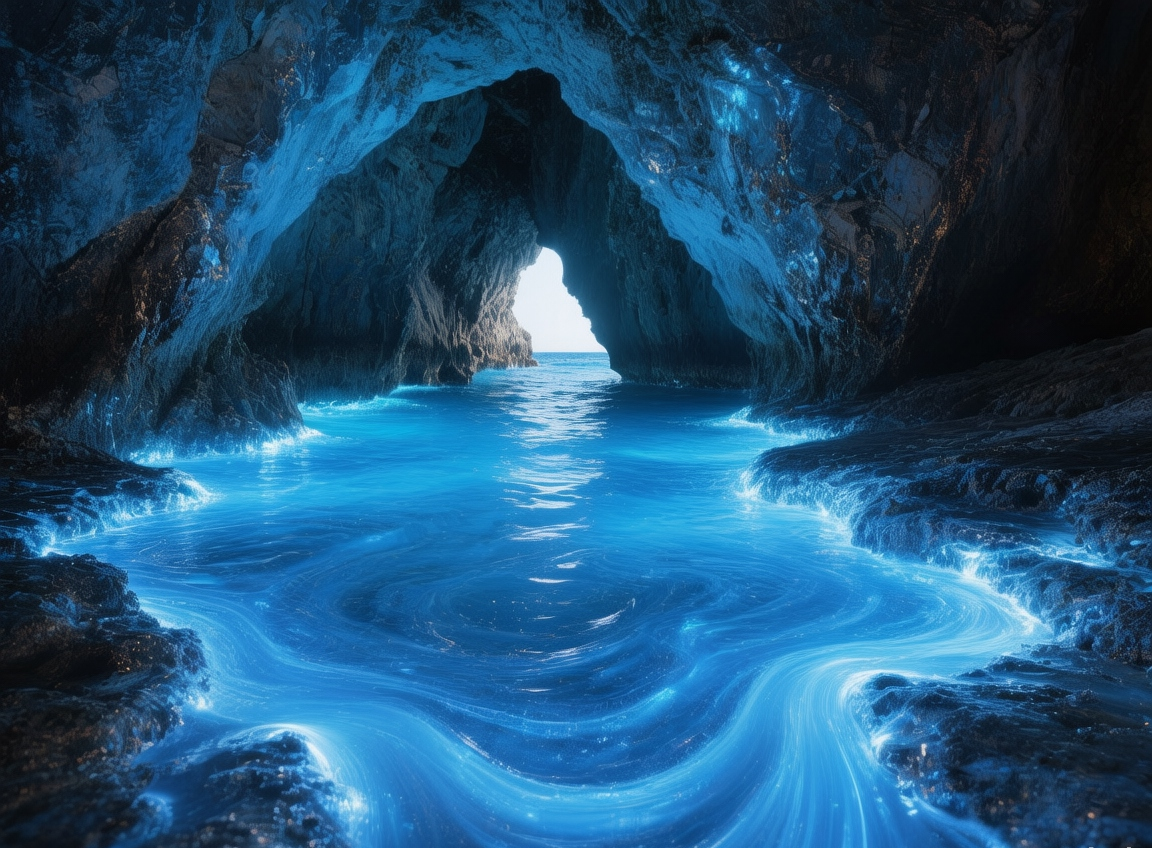
Capri Island – Blue Grotto Light Becomes Liquid
The Tyrrhenian Sea laps gently against the limestone cliffs of Capri—its surface shimmering like crushed sapphire under the midday sun. At the island’s northwest tip, a narrow fissure in the rock beckons: the entrance to the Blue Grotto. You lie flat in a wooden rowboat as your guide, barefoot and steady-handed, steers through the low, meter-high opening. For a heartbeat, you’re in darkness—then, as your eyes adjust, the impossible happens: the entire cavern ignites in an otherworldly electric blue. Sunlight filters through an underwater cavity 12 meters below the surface, scattering through the seawater and casting an ethereal glow that makes your skin appear silver, your clothes spectral. Discovered by Roman sailors who believed it a nymphaeum of Emperor Tiberius (who ruled from Capri between 27–37 CE), this sea cave is just 60 meters long and 25 meters wide—but its luminous magic has captivated poets, emperors, and scientists for two millennia. In 2026, as rising sea levels and overtourism threaten fragile marine ecosystems, the Blue Grotto stands as both a natural wonder and a call for mindful stewardship.
Why Capri Island – Blue Grotto Embodies Nature’s Optical Alchemy
The Blue Grotto isn’t merely a cave—it’s a masterpiece of natural optics and geology. Formed over millions of years by wave erosion, its magic relies on a precise interplay of light, water, and subterranean architecture. Sunlight enters through a submerged opening located approximately 12 meters (39 feet) below sea level, directly beneath the main entrance. As rays pass through this underwater “window,” shorter blue wavelengths scatter more efficiently than red or yellow, flooding the cavern with an intense cobalt radiance that intensifies around midday when the sun is highest. The effect was first documented by German writer August Kopisch in 1826, though locals had long avoided it, believing it haunted by spirits. The Romans, however, embraced its mystery—archaeological finds include statues of Neptune and Triton, suggesting Tiberius used it as a private ritual bath. Today, the grotto measures 60 meters long by 25 meters wide, with a ceiling height of just 2.5 meters at its lowest point, requiring visitors to lie prone in small, oar-powered boats (no motors allowed). This delicate balance of physics and preservation makes the Blue Grotto not just a sight, but a lesson in how nature transforms light into liquid emotion.
The Best Time to Experience Capri Island – Blue Grotto
To witness the Blue Grotto’s most intense luminosity with manageable crowds, target the precise window of May 15–29, 2026. During these weeks, daytime temperatures range from a comfortable 20–26°C (68–79°F)—ideal for boat excursions and island exploration [[24], [27]]. The sun reaches its optimal angle between 11:00 AM and 1:00 PM, when the blue glow peaks in brilliance. Mornings before 10:00 AM are often too dim; afternoons bring cloudier skies and choppy seas. Alternatively, September 10–24, 2026 offers similar clarity with fewer tourists and calmer waters. Avoid visiting during peak periods: all of July and August, when queues for boat entry can exceed two hours and afternoon winds create unsafe swells, and major holidays like Italian Ferragosto (August 15) [[29]]. Note that the grotto closes entirely if wave heights exceed 20–30 cm—always verify conditions via the official Capri tourism office (capri.com) or ask your boat captain upon arrival.
Approximate Budget for a 7-Day Trip (2026)
This budget reflects mid-range 2025 pricing adjusted for Italy’s projected 2026 inflation rate of 1.5% [[37]], offering a realistic estimate for a solo traveler based in Anacapri with day trips to the Blue Grotto and Capri town.
- Accommodation: €910–€1,260 total (€130–€180 per night) for a boutique guesthouse or private apartment in Anacapri—quieter and more affordable than Capri town, yet well-connected by bus.
- Food: €490 total (€70 per day). Breakfast at a café (€5 for cappuccino and cornetto); lunch of caprese salad and grilled fish (€22); dinner at a family-run trattoria (€40 for ravioli capresi, lemon chicken, and house white wine).
- Transportation: €110 total. Includes hydrofoil from Naples (€25 round-trip); island bus pass (€15 for 7 days); Blue Grotto rowboat fee (€18); and private boat tour to Faraglioni rocks (€52).
- Attractions: €75 total. Blue Grotto entry (€18); Villa San Michele (€12); Gardens of Augustus (€6); Monte Solaro chairlift (€14); and a limoncello tasting experience (€25).
- Miscellaneous: €95 total. A hand-painted ceramic tile from La Ceramica di Capri (€35); artisanal limoncello (€20); gelato from Buonocore (€4); and a reusable tote bag from a local cooperative (€15).
Total Estimated Budget: €1,680–€2,040
6 Essential Capri Island – Blue Grotto Experiences
- Enter the Blue Grotto at Solar Noon: Book a morning departure from Marina Grande so you arrive between 11:30 AM–12:30 PM. Lie flat in the traditional 4-person rowboat as your guide sings a Neapolitan folk song—the vibrations enhance the cave’s acoustics and the blue glow.
- Hike the Via Krupp at Dawn: This historic switchback path connects Capri town to the Gardens of Augustus. Arrive by 7:00 AM to avoid crowds and capture misty views of the Faraglioni sea stacks glowing pink in early light.
- Ride the Monte Solaro Chairlift: From Anacapri, ascend 589 meters (1,932 feet) to Capri’s highest point. On clear days, you’ll see Naples, Ischia, and the Amalfi Coast—a panoramic reward for early risers.
- Explore Villa Jovis, Tiberius’ Ruins: Walk the 45-minute trail from Anacapri to this sprawling imperial villa. Stand where the emperor once surveyed his empire, with only the wind and cicadas for company.
- Swim Near the Faraglioni Rocks: Hire a small private boat (€50/hour) to drop you near the central sea stack. Swim through the natural archway where legend says mermaids still sing.
- Taste Ravioli Capresi in Anacapri: At Ristorante La Pigna, try this local specialty: ricotta and Parmesan-filled pasta in fresh tomato-basil sauce—a recipe unchanged since the 19th century.
3 Hidden Gems Most Travelers Miss
- Grotta Bianca (White Grotto): Located east of the Blue Grotto, this lesser-known sea cave features stalactites and a milky-white glow. Accessible only by private boat—ask your captain to include it in a custom tour (tip-based).
- Casa Rossa Archaeological Garden: In Anacapri’s quiet center, this 19th-century villa houses Roman artifacts and a serene citrus garden. Entry is €5, and you’ll likely have it to yourself.
- Scala Fenicia (Phoenician Steps): Though built by Greek settlers, this ancient 800-step staircase connects Capri to Anacapri through fragrant myrtle groves. Hike it at sunrise for solitude and birdwatching—no crowds, just history underfoot.
Cultural & Practical Tips
- Book Blue Grotto access wisely: Boats depart from Marina Grande every 15 minutes (€18 per person, plus €1 tip per rower). Go early—afternoon closures due to waves are common.
- Wear water shoes: Rocky swim spots like Bagni di Tiberio require sturdy footwear. Flip-flops won’t suffice.
- Carry cash in small bills: Many boatmen, cafés, and trailside vendors don’t accept cards. Tipping rowers €1–2 is customary.
- Learn key phrases: “Quando apre la Grotta Azzurra?” (KWAHN-doh AH-preh lah GROT-tah Ats-ZOOR-rah?) for opening times; “Grazie mille” (GRAHT-see-eh MEE-leh) for sincere thanks.
- Respect the marine environment: Never touch cave walls or throw anything into the water. The grotto’s ecosystem is fragile and protected by regional law.
Conclusion: Travel with Wonder, Not Just Wi-Fi
In 2026, the Blue Grotto offers more than a photo op—it invites awe. Your presence here carries responsibility: the €18 boat fee funds coastal conservation, and your choice to support local guides over mass-market tours sustains Capri’s cultural fabric. Slow down: let the blue light wash over you in silence; taste lemons grown on terraces older than your country; listen to the stories of fishermen whose families have rowed these waters for generations. By traveling with wonder—choosing depth over speed, connection over consumption—you help ensure that the Blue Grotto’s magic endures not as a filtered image, but as a living testament to nature’s quiet genius. Let your visit be an act of reverence, and these waters will remember your respect long after you’ve sailed away.