
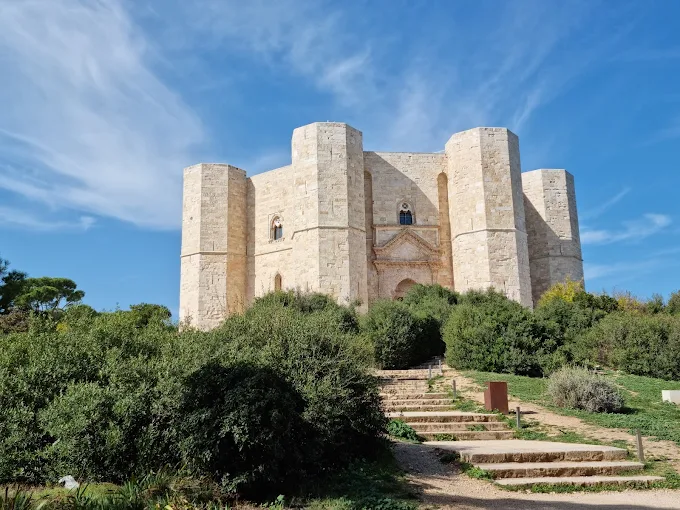
Castel del Monte Geometric Perfection Meets Apulian Light
The afternoon sun in Puglia strikes the honey-colored limestone of Castel del Monte, setting its eight perfect sides ablaze with a warm, golden glow. You hear the whisper of the wind through the surrounding olive groves, the distant hum of a tractor on a faraway farm, and the profound silence that hangs over this isolated hilltop. This is no ordinary castle—it is a geometric enigma, an octagonal fortress built in 1240 by the Holy Roman Emperor Frederick II, a man so ahead of his time he was called Stupor Mundi (“Wonder of the World”) [[19]]. Rising 25 meters (82 feet) high on a 530-meter (1,739-foot) plateau, the castle’s design is a masterpiece of mathematical precision: eight towers, each an octagon; eight rooms on each of two floors; and a central courtyard whose dimensions echo the sacred geometry of the cosmos. Its purpose remains a mystery—never used for defense, never a residence—but its presence is undeniable. In an age of chaotic information and fleeting trends, Castel del Monte matters now more than ever—it is a monument to human intellect, a silent testament to the enduring power of order, beauty, and mystery.
Why Castel del Monte Embodies Mathematical Majesty
Castel del Monte is not a fortress in the traditional sense; it is a three-dimensional manifesto of Frederick II’s humanist vision and intellectual prowess. Built between 1240 and 1250, the castle stands as a unique fusion of Northern European Cistercian architecture, classical Roman proportions, and Islamic geometric design—a reflection of Frederick’s multicultural court and his deep fascination with science, mathematics, and philosophy [[19]]. The structure’s obsessive symmetry is its defining feature: the entire building is a series of nested octagons, from its 52-meter (171-foot) wide outer walls to its eight corner towers, each 26 meters (85 feet) in diameter. This precise geometry was not merely aesthetic; it was symbolic, likely representing the emperor’s desire to impose cosmic order on the earthly realm. The castle’s location was also carefully chosen—it sits at the convergence of several ancient Roman roads and aligns with the sunrise on the summer solstice, suggesting an astronomical function. Though it lacks a moat, drawbridge, or barracks, its design “solved” a profound philosophical problem: how to create a physical space that embodied the harmony of the universe. Today, it fulfills a modern need—for a place that inspires awe not through scale, but through the quiet perfection of its form, a reminder that beauty can be found in logic and proportion.
The Best Time to Experience Castel del Monte
To experience Castel del Monte in its most photogenic and peaceful state, plan your visit for the specific windows of April 20–May 25 or September 10–October 15, 2026. During these periods, the Puglian countryside is lush and green, and daytime temperatures are a comfortable 22–26°C (72–79°F), perfect for exploring the exposed hilltop [[11]]. The best time of day to visit is in the late afternoon, between 3:00 PM and 5:00 PM, when the low-angle sunlight bathes the limestone in a rich, golden hue and casts long, dramatic shadows that accentuate the castle’s geometric lines. It is essential to avoid the peak summer months of July and August, when temperatures can exceed 34°C (93°F) and the lack of shade on the open plateau makes the visit uncomfortable [[37]]. For the most current information on opening hours, ticket prices, and guided tours, always consult the official website managed by the Italian Ministry of Culture: casteldelmonte.beniculturali.it.
Approximate Budget for a 7-Day Trip (2026)
This budget is calculated for a solo traveler seeking a comfortable, culturally rich experience in Puglia in 2026, based on current inflation trends and average regional costs.
- Accommodation: €85–€150 per night. Staying in a nearby town like Andria or Corato offers easy access to the castle and other Itria Valley attractions. Options in Bari are more varied but require a longer drive.
- Food: €42 per day. Breakfast (€5): a cappuccino and cornetto at a local bar. Lunch (€16): a plate of orecchiette pasta with tomato and ricotta forte. Dinner (€21): a main course like grilled lamb chops with a glass of local Nero di Troia wine.
- Transportation: €160 total. A regional train ticket from Bari to Andria (€3), then a local bus or taxi to the castle (€10). A rental car for the week is the most practical option (€45/day).
- Attractions: Entry to Castel del Monte (€7). Guided tour (€15). Visit to the Frederick II Museum in Andria (€5).
- Miscellaneous: €90. This covers a bottle of local olive oil (€15), several gelato stops (€3 each), a cooking class featuring regional recipes (€40), and souvenirs like a replica of the castle’s geometric floor plan.
Total Estimated Cost: €917–€1,037
6 Essential Castel del Monte Experiences
- Explore the Castle at Golden Hour: Arrive by 3:30 PM to witness the late afternoon sun transform the limestone into a glowing amber. Walk the ramparts and feel the perfect symmetry of the octagonal design beneath your feet.
- Decipher the Geometric Symbolism: Take a guided tour to understand the castle’s hidden meanings—the alignment with solstices, the numerological significance of the number eight, and the blend of Christian and Islamic architectural elements.
- Walk the Surrounding Countryside: After your visit, take a short hike on the trails around the castle. The panoramic views of the Tavoliere delle Puglie, Europe’s largest plain, provide context for the castle’s strategic and symbolic placement.
- Visit the On-Site Museum: The small museum inside the castle grounds displays original artifacts, including fragments of the marble columns and mosaics that once adorned the interior, offering a glimpse into its former grandeur.
- Photograph the Perfect Octagon: Find the official viewpoint just outside the entrance for the classic shot of the entire castle. For a more creative angle, walk the perimeter path to capture the interplay of light and shadow on the towers.
- Learn About Frederick II in Andria: Spend an hour in the nearby town of Andria, the emperor’s birthplace, to visit the cathedral where he is buried and the local museum dedicated to his life and legacy.
3 Hidden Gems Most Travelers Miss
- The Secret Spiral Staircases: Inside each tower, narrow spiral staircases connect the two floors. These are often overlooked by visitors focused on the main rooms, but they offer a thrilling, intimate climb through the castle’s core.
- The View from the Central Courtyard at Noon: Stand in the exact center of the courtyard at midday. The way the light falls creates a perfect, symmetrical pattern on the stone floor—a moment of pure geometric harmony.
- The Ancient Olive Grove on the Approach Road: Just before you reach the castle, a small, gnarled olive grove lines the road. These trees are centuries old and provide a beautiful, rustic foreground for photos of the castle in the distance.
Cultural & Practical Tips
- Wear a hat and sunscreen: There is absolutely no shade on the castle grounds. The Puglian sun is intense, especially in the afternoon.
- Bring water: There are no vendors at the site, so carry a bottle of water, particularly in the warmer months.
- Learn a few key phrases: “Dov’è il castello?” (DOH-veh eel kah-STEHL-loh?) for “Where is the castle?”, and “Un caffè, per favore” (oon kah-FEH).
- Photography is allowed, but no tripods: You can take photos inside and out, but professional equipment requires a special permit.
- Combine your visit with other sites: Castel del Monte is remote. Pair your trip with a visit to Andria, Trani, or the Castellana Grotte to make the most of your journey.
- Respect the silence: The site’s power lies in its quiet majesty. Keep your voice low to preserve the atmosphere for everyone.
Conclusion: Travel with Curiosity, Not Just a Camera
Castel del Monte is not a place to be simply seen; it is a puzzle to be contemplated. In 2026, as we navigate a world of noise and distraction, this solitary fortress offers a rare gift: the chance to engage with a mystery that has defied explanation for 800 years. Your journey here should be one of active curiosity—not just capturing its image, but pondering its purpose, feeling its symmetry, and imagining the mind of the emperor who dreamed it into being. By traveling with this thoughtful attention, you honor the legacy of Frederick II and help preserve this UNESCO World Heritage site for future seekers of truth and beauty. Slow down. Sit on the ramparts and watch the light shift on the stone. In that quiet moment of wonder, you don’t just visit Castel del Monte—you enter into a timeless dialogue with the human spirit’s quest for order in a chaotic universe.