
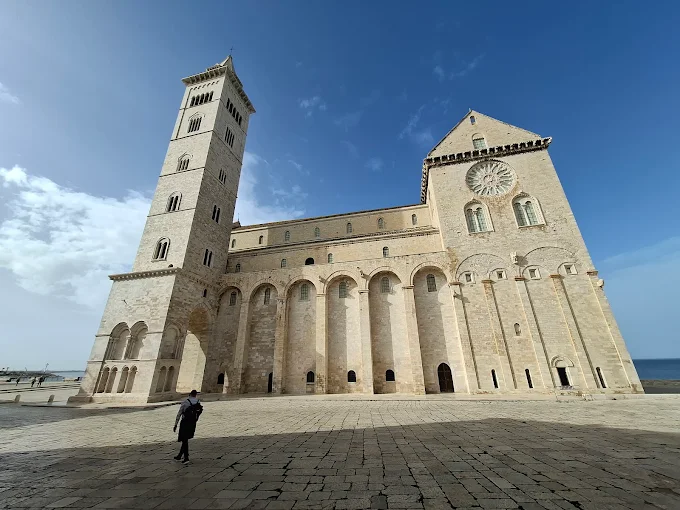
Trani Cathedral by Sea Romanesque Stone Meets Adriatic Light
The late afternoon sun gilds the honey-colored limestone of Trani Cathedral, casting a long shadow over the gentle waves of the Adriatic Sea that lap just meters from its base. You hear the soft clatter of rigging from fishing boats in the small harbor, the distant murmur of conversation from a café on the promenade, and the rhythmic toll of the cathedral’s bell echoing over the water. This is no ordinary church—it is a masterpiece of Apulian Romanesque architecture, built between 1099 and 1143 to honor Saint Nicholas the Pilgrim, a Greek monk whose relics are enshrined within [[20]]. Perched directly on the seafront, its 59-meter (194-foot) tall bell tower stands as a sentinel, its elegant arches framing panoramic views of the coastline. The cathedral’s unique position—its eastern apse seemingly emerging from the sea—was a deliberate act of faith, placing the sacred heart of the building in direct communion with the water that has sustained this port city for millennia. In an age of landlocked monuments, Trani Cathedral matters now more than ever—it is a powerful symbol of the deep, enduring connection between spirituality and the sea.
Why Trani Cathedral by Sea Embodies Sacred Harmony
Trani Cathedral’s genius lies in its profound dialogue with the Adriatic Sea—a relationship that is both spiritual and architectural. Commissioned by Bishop Bertrando in 1099 and consecrated in 1143, the cathedral was built to house the relics of Saint Nicholas the Pilgrim, a Byzantine saint whose journey ended in Trani [[20]]. Its location was not chosen for convenience but for symbolism: by placing the altar and apse directly on the waterfront, the builders created a sacred space where the divine and the maritime converged. The structure itself is a marvel of Apulian Romanesque design, constructed from local white limestone that seems to absorb and reflect the sea light. Its most striking feature is the asymmetrical facade, which blends a simple lower level with an ornate upper gallery of blind arches and sculpted columns. The detached bell tower, completed in the 14th century, soars to 59 meters (194 feet), serving historically as both a belfry and a watchtower for approaching ships. This architectural solution fulfilled a dual need: it provided a grand sanctuary for worship while anchoring the community’s identity to its lifeblood—the sea. Today, it fulfills a modern longing—for a place where beauty, history, and nature exist in perfect, unforced harmony.
The Best Time to Experience Trani Cathedral by Sea
To experience the cathedral in its full, luminous glory, plan your visit for the specific windows of April 25–June 10 or September 10–October 10, 2026. During these periods, Puglia enjoys ideal weather, with daytime temperatures ranging from a comfortable 22–26°C (72–79°F) and clear skies that make the limestone facade glow against the blue sea [[11]]. The absolute best time of day to visit is in the late afternoon, between 4:30 PM and 6:30 PM, when the setting sun bathes the cathedral in a warm, golden light and the sea is calm, creating perfect reflections. It is strongly advised to avoid the peak summer months of July and August, when the intense midday sun flattens the architectural details and the popular seaside promenade becomes crowded with tourists and locals alike [[38]]. For the most current information on opening hours for Mass, guided tours, and special events, always consult the official tourism portal: <viaggiareinpuglia.it.
Approximate Budget for a 7-Day Trip (2026)
This budget is calculated for a solo traveler seeking a comfortable, culturally rich experience in Trani in 2026, based on current inflation trends and average regional costs for southern Italy.
- Accommodation: €80–€140 per night. Staying in a historic center hotel with a sea view offers an unforgettable experience. Options in the newer part of town are more affordable.
- Food: €45 per day. Breakfast (€5): a cappuccino and cornetto at a local bar. Lunch (€16): a plate of spaghetti with fresh seafood at a harbor trattoria. Dinner (€24): a main course like grilled octopus with a glass of local Moscatello di Trani wine.
- Transportation: €140 total. A regional train ticket from Bari to Trani (€4). A rental car for exploring the coast (€40/day). Local transport within Trani is primarily on foot.
- Attractions: Entry to the Cathedral Treasury (€3). Guided walking tour of the historic center and Jewish Quarter (€20). Visit to the Swabian Castle (€5).
- Miscellaneous: €95. This covers a bottle of local Moscatello wine (€20), several gelato stops (€3 each), a cooking class featuring seafood recipes (€40), and souvenirs like handmade ceramics.
Total Estimated Cost: €910–€1,030
6 Essential Trani Cathedral by Sea Experiences
- Witness the Sunset from the Cathedral Steps: Sit on the stone steps facing the sea in the late afternoon. Watch as the sun dips below the horizon, turning the cathedral’s limestone a deep amber and the sea into a sheet of molten gold.
- Explore the Crypt of Saint Nicholas: Descend into the cool, quiet crypt beneath the main altar to see the saint’s tomb. The air is thick with centuries of prayer, and the simple stone chamber is a powerful counterpoint to the grandeur above.
- Walk the Lungomare Promenade: Stroll along the seafront path that curves around the cathedral. This is the perfect way to appreciate the building’s unique relationship with the water from every angle.
- Dine at a Harbor-Side Trattoria: Reserve a table at a restaurant like Osteria al Faro, just steps from the cathedral. Savor fresh seafood as you listen to the gentle lap of waves against the old stone walls.
- Climb the Bell Tower for Panoramic Views: For a small fee, climb the 194-foot tower. The view from the top encompasses the entire historic center, the sparkling Adriatic, and the distant outline of the Gargano Peninsula.
- Visit the Swabian Castle at Dusk: Just a short walk from the cathedral, this 13th-century fortress offers another perspective on Trani’s maritime history. The evening light on its massive walls is dramatic and photogenic.
3 Hidden Gems Most Travelers Miss
- The Secret Courtyard of Palazzo Caccetta: Tucked away on Via Madonna della Scala, this hidden courtyard offers a peaceful oasis with a view of the cathedral’s side facade. It’s unmarked, so ask a local for directions.
- The Jewish Quarter (La Giudecca): Trani was once home to a thriving Jewish community. Explore the narrow lanes of this historic district and visit the restored Scolanova Synagogue, now a museum and active place of worship.
- The View from Molo San Nicola: Walk out onto this small pier at the end of the harbor. From here, you get the iconic postcard view of the cathedral with its reflection in the water—a perfect spot for a quiet moment of reflection.
Cultural & Practical Tips
- Dress respectfully for the cathedral: Shoulders and knees must be covered to enter. Carry a light scarf or jacket even in summer.
- Time your visit around Mass: The cathedral is a living place of worship. Check the schedule to avoid visiting during services if you wish to explore quietly.
- Learn a few key phrases: “Dov’è il Duomo?” (DOH-veh eel DOH-moh?) for “Where is the cathedral?”, and “Un bicchiere di Moscatello, per favore” (oon bee-KYEH-reh dee mos-kah-TEL-loh).
- Photography is allowed, but no flash inside: Flash photography is prohibited in the crypt and main nave to protect the artwork and respect worshippers.
- Beware of the midday sun in summer: The white stone reflects intense heat. Plan indoor visits (museums, churches) during the hottest part of the day (12:00–4:00 PM).
- Tipping is appreciated but not expected: A small tip of €1–€2 for exceptional service at a restaurant is a kind gesture.
Conclusion: Travel with Reverence, Not Just a Lens
Trani Cathedral by the sea is more than a monument; it is a living conversation between stone and water, faith and community. In 2026, as we seek travel experiences that are both beautiful and meaningful, this sacred site offers a profound lesson in harmony. Your journey here should be one of reverence—not just capturing its image, but feeling the coolness of its stone, listening to the echo of its bells over the waves, and understanding the centuries of devotion that have shaped this place. By traveling with this mindful presence, you honor the legacy of Trani and help preserve its unique spirit. Slow down. Sit on the harbor wall and watch the light change on the cathedral’s facade. In that quiet moment of communion with sea and stone, you don’t just visit Trani—you become part of its enduring, luminous story.