
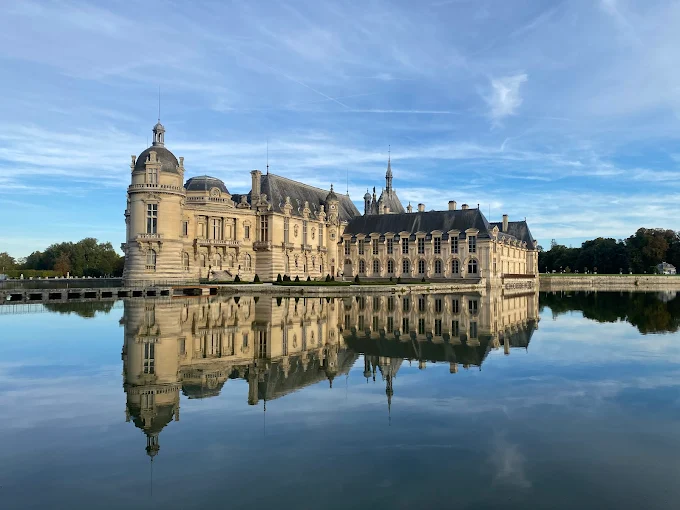
Chantilly Castle Equestrian Grandeur Meets French Refinement
The late afternoon sun gilds the pink-brick façade of the Château de Chantilly, casting a warm, ethereal glow across its vast moat. You stand on the edge of the Grand Canal, designed by André Le Nôtre himself—the genius behind Versailles’ gardens—and watch as the castle’s reflection shimmers in the still water. The air is scented with the perfume of roses from the formal gardens and the faint, clean smell of horses from the nearby stables. This is not just a castle; it is a masterpiece of French aristocratic life, rebuilt in its current majestic form between 1875 and 1882 by the exiled Prince Henri d’Orléans, Duke of Aumale [[1]]. He bequeathed the entire estate to the Institut de France on one condition: that nothing ever be changed. In 2026, as we seek places of authentic heritage and cultural depth, Chantilly offers a perfectly preserved window into a world of art, horsemanship, and refined elegance.
Why Chantilly Castle Embodies Aristocratic Legacy
Chantilly Castle is the ultimate testament to a single man’s vision and his profound love for French culture. After the original medieval fortress was destroyed during the French Revolution, the Duke of Aumale, heir to the Orléans fortune, dedicated his life to its reconstruction. His goal was not mere opulence, but the creation of a living museum to house his unparalleled collection of art and books. The result is a stunning neo-classical château that seamlessly blends architecture, landscape, and curation. The estate’s pièce de résistance is the Musée Condé, which houses one of France’s finest private art collections outside the Louvre, featuring masterpieces by Raphael, Poussin, and Watteau [[1]]. Beyond its artistic treasures, Chantilly is the historic heart of French equestrianism. The surrounding 11,500-acre estate includes the world-renowned Living Museum of the Horse and the birthplace of the famous Chantilly cream. For the modern visitor, the castle fulfills a deep need for authenticity; it is not a restored ruin, but a complete, intact world of 19th-century aristocratic life, frozen in time by the Duke’s extraordinary bequest.
TheBest Time to Experience Chantilly Castle
To experience the castle and its gardens in their most luminous and serene state, plan your visit for the specific window of May 15–June 10, 2026. During these late spring weeks, the formal gardens are in full bloom, the weather is reliably pleasant, and the summer crowds have yet to arrive [[11]]. Daytime temperatures are a comfortable 17°C to 21°C (63°F–70°F)—perfect for exploring the extensive grounds without the heat or chill of other seasons [[11]]. The ideal time of day is 3:00–5:00 PM, when the afternoon light bathes the pink brick in a warm, golden hue and the long shadows add drama to Le Nôotre’s geometric garden design. Avoid the peak summer months of July and August, when large tour groups can make the interior galleries feel congested [[11]]. For the most current information on opening hours, special exhibitions at the Musée Condé, and events at the horse museum, always consult the official website: domainedechantilly.com/en [[1]].
Approximate Budget for a 7-Day Trip (2026)
This budget is calculated for a comfortable, mid-range cultural trip centered on Chantilly and Paris in 2026, accounting for a 4% annual inflation rate as per INSEE standards.
- Accommodation: €100–€140 per night for a room in a charming 3-star hotel in the town of Chantilly, within walking distance of the château gates. Staying locally allows for a more relaxed visit.
- Food: €50 per day. Breakfast (€8): a coffee and croissant at a local boulangerie. Lunch (€18): a simple lunch of a jambon-beurre baguette or a salad at a café near the train station. Dinner (€24): a three-course meal at a traditional French restaurant featuring dishes like duck breast with Chantilly sauce.
- Transportation: The easiest way to reach Chantilly is by train from Paris (Gare du Nord to Chantilly-Gouvieux, a 25-minute journey). A round-trip ticket costs around €15. From the station, it’s a pleasant 20-minute walk or a short taxi ride (€8) to the château.
- Attractions: A combined ticket for the Château (Musée Condé), the gardens, and the Living Museum of the Horse costs €23 for adults, €15 for children (6-17) [[1]]. A guided tour of the stables is an extra €5. Tasting Chantilly cream at a local patisserie is a must-do splurge at €6.
- Miscellaneous: Allow €50 for souvenirs (e.g., a jar of authentic Chantilly cream, a book on the Duke of Aumale’s collection) and small experiences like a rowboat ride on the Grand Canal (€12).
Total Estimated Cost: €800–€1,000 for one person for 7 days.
6 Essential Chantilly Castle Experiences
- Explore the Musée Condé’s Masterpieces: Don’t rush through the castle’s interior. Spend time in the Grand Salon and the Library, which house the Duke’s incredible collection. Look for Raphael’s “Three Graces” and the stunning ceiling paintings by Jean-Baptiste-Camille Corot.
- Stroll Le Nôtre’s Grand Canal: Walk the length of the 2.5-kilometer canal, the longest in France. The perspective from the far end, looking back at the castle, is one of the most iconic views in French landscape architecture.
- Visit the Living Museum of the Horse: This is a world-class equestrian museum with live demonstrations, historical carriages, and interactive exhibits. The daily equestrian show in the Grande Écurie (Great Stables) is a highlight.
- Taste Authentic Chantilly Cream: Stop at a local patisserie like “La Fleur de Lys” to sample the real thing—whipped cream flavored only with vanilla and sugar, a recipe perfected here in the 17th century.
- Walk Through the English Garden: Beyond the formal French gardens lies a more romantic, landscaped English garden with winding paths, a waterfall, and a temple of love. It’s a peaceful, less-crowded spot for reflection.
- Attend a Classical Music Concert: During the summer months, the château often hosts concerts in its grand rooms. Check the cultural calendar on the official website for 2026 dates; these events are a magical way to experience the space.
3 Hidden Gems Most Travelers Miss
- The Hamlet of Chantilly (Hameau de Chantilly): Inspired by Marie Antoinette’s hamlet at Versailles, this picturesque cluster of thatched-roof cottages was built for the Duke’s staff. It’s a quiet, idyllic spot on the far side of the estate, rarely visited by tour groups. Access is included in the main ticket.
- The View from Montmorency Hill: A short drive or bike ride from the château, this hill offers a panoramic vista of the entire estate, with the castle as its centerpiece. Go at sunrise for a breathtaking, crowd-free photo opportunity.
- The Chapel of the Princes: Located within the château complex, this small, ornate chapel is the final resting place of the Orléans family. Its intimate scale and beautiful stained glass offer a poignant counterpoint to the grandeur of the main building. It’s often overlooked in the rush to see the art collection.
Cultural & Practical Tips
- Dress smartly for the château: While there’s no strict dress code, the refined atmosphere of the castle calls for neat, respectful attire, especially if you plan to dine at a local restaurant afterward.
- Photography is restricted in the Musée Condé: You may take photos without flash in the gardens and the horse museum, but photography is strictly prohibited inside the art galleries to protect the priceless works.
- Learn a few key phrases: A polite “Bonjour, Madame/Monsieur” (bon-zhoor, mah-dam/muh-syuh) will be warmly received by staff and local shopkeepers.
- Wear comfortable walking shoes: The estate is vast. You’ll be walking on gravel paths and grass, so sturdy footwear is essential for a full day of exploration.
- Plan for two full days: To truly appreciate both the château and the equestrian museum, you need at least a full day for each. Trying to do it all in one visit is overwhelming.
Conclusion: Travel with Curiosity, Not Just Itineraries
In 2026, Chantilly Castle stands as a powerful reminder of the enduring value of curation and legacy. It is not merely a monument to the past, but a carefully preserved world that invites you to step inside and explore its layers of art, history, and equestrian passion. To visit with a checklist is to miss its soul. By traveling with curiosity—with a desire to understand the Duke of Aumale’s vision, to appreciate the skill of the artists he collected, and to feel the spirit of the horses that have shaped this land—you become part of its ongoing story. Your mindful presence supports the Institut de France’s vital work in maintaining this national treasure exactly as it was bequeathed. So, slow down. Let the grandeur of Chantilly unfold at its own pace. Discover what it means to travel not just through space, but through time.
Image Description: Chantilly Castle at golden hour in France, its grand pink-brick façade reflected in the still waters of the moat with manicured gardens stretching into the distance