
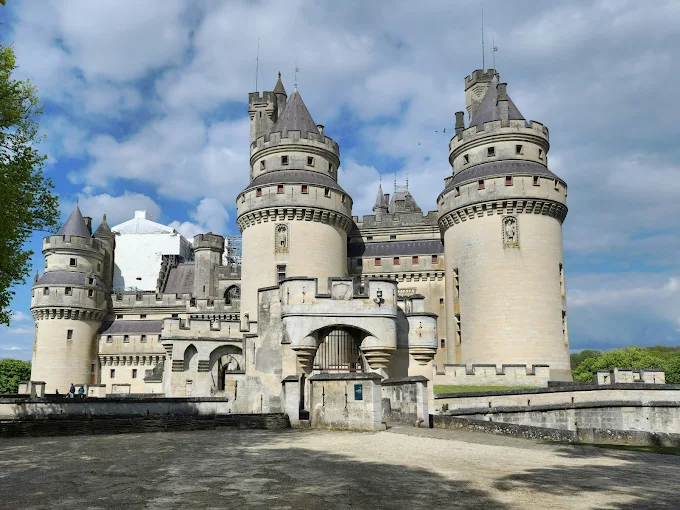
Pierrefonds Castle Medieval Might Meets Romantic Imagination
Dawn breaks over the Compiègne Forest, a soft mist rising from the moat that encircles Pierrefonds Castle. The first rays of sun strike the castle’s eight colossal cylindrical towers, each capped with a conical roof of slate, making the limestone walls glow a warm honey-gold. You can hear the distant cry of a raven and the gentle lap of water against the ancient stone—a soundscape unchanged for centuries. This is not a ruin, but a resurrection. Originally built in the 12th century by Louis d’Orléans, it was left in ruins after a 17th-century siege—until Emperor Napoleon III commissioned architect Eugène Viollet-le-Duc to rebuild it between 1857 and 1885 as a “palace of fairytale” [[1]]. Standing 35 meters (115 feet) tall, with walls up to 4 meters (13 feet) thick, it is a masterpiece of 19th-century historical reconstruction. In 2026, as we seek places that blend authentic history with awe-inspiring spectacle, Pierrefonds offers a uniquely immersive journey into a romanticized vision of the Middle Ages.
Why Pierrefonds Castle Embodies Architectural Revival
Pierrefonds Castle is a singular monument to the 19th-century passion for the medieval past. Its significance lies not in its original medieval form, but in its dramatic rebirth under the visionary architect Eugène Viollet-le-Duc—the same man who restored Notre-Dame de Paris. Commissioned by Napoleon III, who wanted a symbolic seat of imperial power near his Compiègne residence, Viollet-le-Duc was given unprecedented creative freedom. He didn’t merely restore the castle; he reimagined it as the ultimate feudal fortress, blending historical accuracy with his own romantic ideals. The result is a staggering feat of engineering and artistry: a structure with eight massive towers, a grand ceremonial courtyard, and interiors lavishly decorated with polychrome paintings, gilded woodwork, and stained glass. The Great Hall alone is 30 meters long and features a magnificent hammerbeam roof. For the modern visitor, Pierrefonds fulfills a deep need for tangible, walkable history. It solves the problem of the inaccessible past by offering a complete, immersive environment where every stone and carving tells a story of both medieval ambition and 19th-century imagination.
The Best Time to Experience Pierrefonds Castle
To experience the castle in its most atmospheric and crowd-free state, plan your visit for the specific window of May 20–June 15, 2026. During these late spring weeks, the surrounding forest is lush and green, the weather is mild, and the summer tourist influx has yet to begin [[15]]. Daytime temperatures are a comfortable 16°C to 20°C (61°F–68°F)—perfect for exploring the extensive grounds and climbing the towers without the heat of midsummer [[15]]. The absolute best time of day is 9:00–11:00 AM, right after the castle opens. This allows you to have the grand courtyards and ramparts almost to yourself, capturing the perfect light for photography and enjoying the cool morning air. Avoid the peak summer months of July and August, when large tour groups can make the interior spaces feel congested and the heat can be uncomfortable in the stone halls [[15]]. For the most current information on opening hours, special events like medieval festivals, and any restoration work, always consult the official website of the Centre des Monuments Nationaux: pierrefonds.monuments-nationaux.fr [[1]].
Approximate Budget for a 7-Day Trip (2026)
This budget is calculated for a comfortable, mid-range cultural trip centered on Pierrefonds and the Picardy region in 2026, factoring in a 4% annual inflation rate as per INSEE standards.
- Accommodation: €85–€120 per night for a room in a charming 3-star hotel or guesthouse in the village of Pierrefonds or nearby Compiègne. Staying locally provides easy access to the castle and the forest.
- Food: €45 per day. Breakfast (€7): coffee and a croissant at a local boulangerie. Lunch (€15): a simple lunch of a charcuterie board or a quiche at a café near the castle gates. Dinner (€23): a three-course meal at a traditional French restaurant featuring regional dishes like duck confit or forest mushroom risotto.
- Transportation: The easiest way to reach Pierrefonds is by train from Paris (Gare du Nord to Compiègne, then a 20-minute taxi ride). A round-trip train ticket costs around €25. Renting a car for a few days to explore the Compiègne Forest and other regional sites would cost about €40 per day.
- Attractions: Entry to Pierrefonds Castle costs €11 for adults, €8.50 for children (18-25), and is free for younger children [[1]]. A combined ticket with the nearby Château de Compiègne is €18. A guided tour of the castle’s secret passages is a worthwhile splurge at €5 extra.
- Miscellaneous: Allow €50 for souvenirs (e.g., a replica of a castle key, a book on Viollet-le-Duc’s architecture) and small experiences like a horse-drawn carriage ride around the moat (€15).
Total Estimated Cost: €750–€950 for one person for 7 days.
6 Essential Pierrefonds Castle Experiences
- Climb the Tour du Connétable: Ascend the 120 steps to the top of the Constable’s Tower for a breathtaking 360-degree view of the Compiègne Forest and the castle’s sprawling layout. The perspective is unmatched and gives you a true sense of its defensive might.
- Explore the Grand Salle (Great Hall): Step into the castle’s ceremonial heart. Admire the intricate painted ceiling, the massive fireplace adorned with the imperial eagle, and the throne platform where Napoleon III would have held court. The scale and detail are overwhelming.
- Walk the Ramparts at Sunset: As the day ends, take a slow walk along the fortified walls. The golden light bathes the stone in a warm glow, and the forest below becomes a sea of green. It’s the perfect moment to imagine life as a medieval sentry.
- Visit the Chapel of Saint-Sulpice: This small, intimate chapel is a jewel box of color, with vibrant stained-glass windows and delicate frescoes. Its peaceful atmosphere offers a quiet counterpoint to the castle’s martial grandeur.
- Attend a Medieval Festival: If your visit coincides with one of the castle’s famous summer festivals (usually in July), you’ll witness jousting tournaments, artisan markets, and costumed reenactments that bring the Middle Ages vividly to life.
- Stroll Through the Moat Gardens: The area surrounding the moat has been transformed into beautiful gardens with themed plantings. It’s a peaceful place to relax and enjoy the castle’s reflection in the still water.
3 Hidden Gems Most Travelers Miss
- The Secret Passages Tour: For an extra fee, you can join a small-group tour that takes you through the castle’s hidden corridors and escape routes. It’s a thrilling, behind-the-scenes look at medieval security that most visitors never see. Book ahead at the ticket office.
- The View from Mont Ganelon: A short 15-minute drive from the castle, this hilltop offers a panoramic vista of the entire estate, with the castle as its dramatic centerpiece. Go at sunrise for a magical, crowd-free photo opportunity.
- The Church of Saint-Sulpice in the Village: Just outside the castle gates, this humble 12th-century church is where the local villagers worshipped. Its simple Romanesque architecture is a stark and beautiful contrast to the castle’s flamboyant revivalism. It’s open daily for quiet reflection.
Cultural & Practical Tips
- Wear sturdy walking shoes: The castle grounds are vast, with uneven cobblestones and steep staircases in the towers. Comfortable footwear is essential for a full day of exploration.
- Learn a few key phrases: A polite “Bonjour, Madame/Monsieur” (bon-zhoor, mah-dam/muh-syuh) will be warmly received by staff and local shopkeepers.
- Photography is encouraged, but with limits: You may take photos for personal use throughout the castle and grounds, but tripods and drones require a special permit from the monument authorities.
- Bring a light jacket: The stone interiors of the castle can be significantly cooler than the outside temperature, even in summer. A light layer is always a good idea.
- Engage with the audio guide: The castle’s audio guide (included in the ticket price) is excellent and provides crucial context for Viollet-le-Duc’s architectural choices and the castle’s complex history.
Conclusion: Travel with Imagination, Not Just Itineraries
In 2026, Pierrefonds Castle stands as a powerful invitation to dream. It is a place where history and fantasy intertwine, where the line between what was and what could have been blurs into something profoundly moving. To visit here is not just to see a building, but to step into a story—a story of imperial ambition, architectural genius, and our enduring fascination with the chivalric ideal. By traveling with imagination—with a willingness to suspend disbelief and truly engage with the romance of the place—you honor the vision of both its medieval founders and its 19th-century rebuilder. Your mindful presence supports the ongoing preservation of this national treasure. So, let go of the checklist. Climb the towers, wander the halls, and allow Pierrefonds to transport you to a world where castles are not just stone, but symbols of human aspiration.