
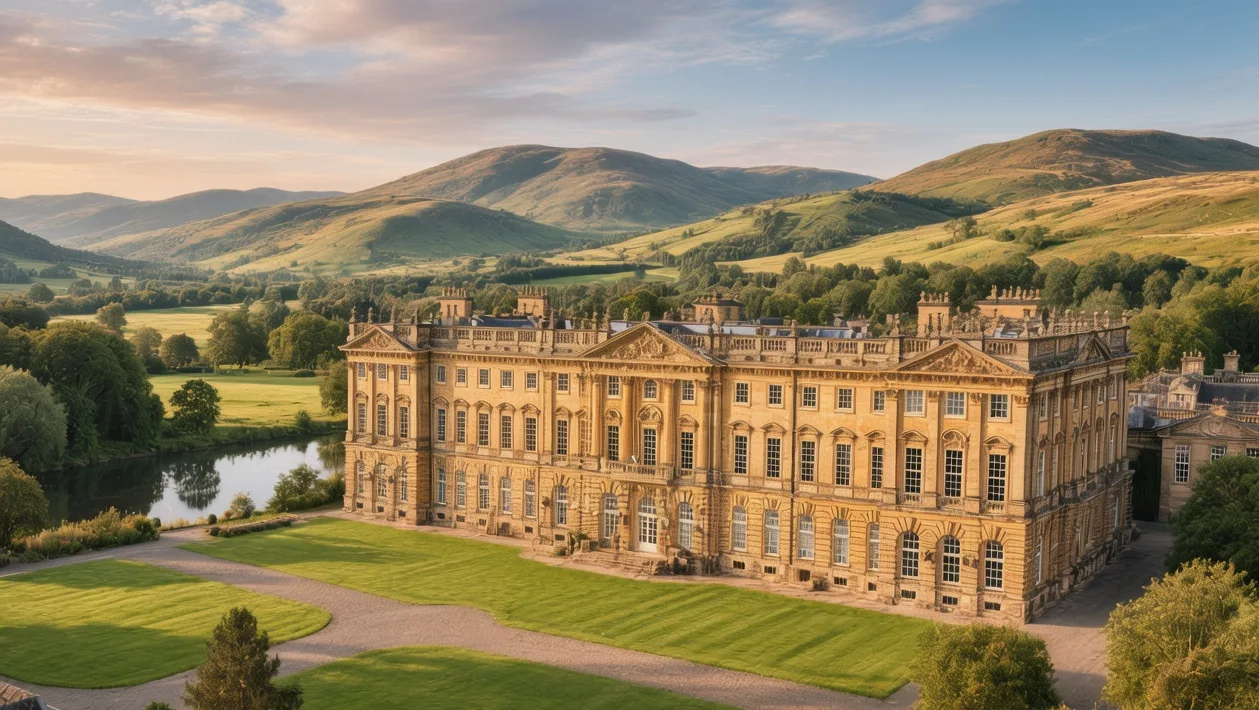
Chatsworth House Baroque Grandeur Meets Peak District Wilderness
The morning mist clings to the River Derwent like a whispered secret—slowly lifting to reveal the honey-colored Portland stone of Chatsworth House warming under the first light of day. You hear it before you see it: the rhythmic thunder of the 90-meter Cascade, water tumbling down 24 stone steps engineered in 1696 to mimic natural rapids while demonstrating absolute control over the landscape. Inside the State Rooms, dust motes dance in beams piercing 4-meter-high sash windows, illuminating gilt mirrors that have reflected centuries of aristocratic ambition and modern curiosity alike. This is not a static monument frozen in time; it is a living estate spanning 3,000 acres where the 12th Duke of Devonshire still resides, balancing private residence with public stewardship. In 2026, as heritage sites face increasing pressure to monetize history, Chatsworth matters now more than ever: it stands as a testament to adaptive preservation, proving that grandeur can coexist with accessibility, and that the past remains vital when it invites you to walk its halls rather than merely observe them from behind velvet ropes.
Why Chatsworth House Embodies Aristocratic Legacy and Landscape Engineering
Chatsworth House represents a unique convergence of architectural evolution and landscape manipulation spanning five centuries. Construction began in 1560 under Bess of Hardwick, but the current baroque structure largely dates to the 1st Duke's expansion between 1687 and 1707, utilizing local gritstone and Portland stone imported from Dorset—transported 240 kilometers by horse-drawn cart at immense cost. The estate solves a critical historical problem: how to maintain a 126-room palace without state funding. Unlike National Trust properties, Chatsworth remains privately owned by the Chatsworth House Trust, established in 1981 to ensure independence from government subsidies while maintaining public access to 30 rooms.
The landscape itself is an engineering marvel. The 1st Duke's Great Parterre covers 4,000 square meters, clipped daily during summer months to maintain geometric precision. The Emperor Fountain, created in 1844 for Tsar Nicholas I's planned visit, shoots water 90 meters into the air using gravity-fed pressure from a reservoir 100 meters above the house—a hydraulic feat unmatched in Victorian England. Beyond the house, the 3,000-acre parkland includes 14 kilometers of public footpaths, integrating working farmland with ornamental gardens. This duality—private home and public asset—defines the estate's identity. It fulfills the modern need for tangible connection to history without sanitizing the complexities of aristocratic wealth. When you walk the Long Ride, a straight avenue stretching 1.6 kilometers through ancient oak trees planted in 1720, you traverse a living timeline where every tree serves as a structural column in nature's own cathedral.
The Best Time to Experience Chatsworth House
For optimal weather and garden vitality, target April 10–May 20 or September 15–October 25. During these windows, daytime temperatures average 14°C (57°F) in spring and 16°C (61°F) in autumn, providing comfortable conditions for exploring the 105-acre garden without the oppressive heat of midsummer. The ideal arrival time is 9:30–10:00 AM, when the house opens and tour groups from Manchester and Sheffield have not yet arrived. Morning light strikes the East Front perfectly, illuminating the carvings above the main entrance for photography without glare.
Specifically, visit the Cascade between 11:00 AM and 3:00 PM when water flow is maximized for visual impact. The Farmyard and Playground are best experienced at 2:00 PM when indoor exhibits become too warm. Avoid August Bank Holiday weekend (last weekend of August 2026), when attendance spikes to 15,000 visitors daily, creating 45-minute queues for the house tour. Also avoid December 20–January 5, as the house closes for private family use, though the garden remains open with reduced hours. Rain is common in the Peak District; however, the house tour remains fully accessible, making wet days ideal for interior exploration while crowds thin.
Verify seasonal opening dates and special exhibition schedules at chatsworth.org before travel, as private events occasionally close sections of the estate without extensive prior notice.
Approximate Budget for a 7-Day Trip (2026)
Visiting Chatsworth House requires significant budget allocation for entry fees, though surrounding Peak District activities offer free alternatives. Prices reflect 2026 rates with approximately 4% inflation adjustment from 2025 data. Accommodation costs vary significantly between Bakewell (closest town) and Buxton (larger town with rail links).
Accommodation: £120–£220 per night
• Budget B&B (Bakewell center): £80–£110 per night double room
• Mid-range Hotel (Chatsworth estate cottages): £150–£200 per night
• Luxury (Devonshire Arms Bolton Abbey): £250–£350 per night
Food: £45–£70 per day
• Breakfast: £8–£15 (Full English at café: £12.50; pastry + coffee: £8)
• Lunch: £12–£20 (Second Courtyard Café sandwich: £9.50; pub meal: £18)
• Dinner: £25–£35 (Three Kings Head Bakewell: £28; fine dining: £50+)
Transportation:
• London to Chesterfield (Train): £85–£120 return (advance booking)
• Chesterfield to Chatsworth (Bus 218): £4.50 single, £8.50 day rider
• Car rental (compact): £45 per day + fuel (£1.55 per liter)
Attractions:
• Chatsworth House, Garden & Farmyard Pass: £35 adult, £18 child
• Garden Only Pass: £25 adult, £12 child
• Audio Guide: £7 (included in House Pass)
• Peak District National Park activities: Free (hiking trails)
Miscellaneous:
• Guidebook and map: £15
• Souvenirs (estate produce): £10–£25
• Parking (if driving): £10 per day (free for pass holders)
• Rain gear (essential): £25
Total for 7 days (mid-range): £1,450–£1,850 per couple
Total for 7 days (budget): £950–£1,200 per couple
7 Essential Chatsworth House Experiences
- Walk the State Rooms with Audio Guide: Enter through the Painted Hall at 10:00 AM when lighting is optimal for viewing the ceiling frescoes depicting the Cavendish family lineage. Use the provided audio guide to unlock stories behind the 6th Duke's acquisitions, including works by Rembrandt and Van Dyck. Stand directly beneath the 7-meter chandelier in the State Dining Room to appreciate the scale of Victorian entertaining. Allow 90 minutes minimum; rush hours begin at 11:30 AM.
- Witness the Cascade in Full Flow: Descend the 24 stone steps of the Cascade between 12:00 PM and 2:00 PM when water pressure peaks. The sound is deafening—a controlled roar designed to impress 17th-century visitors with human dominance over nature. Position yourself at the bottom pond for the classic reflection photograph of the house framed by water jets. The stone steps are slippery; wear shoes with grip rather than smooth soles.
- Explore the Emperor Fountain Basin: Walk 800 meters down the main avenue to the large lake where the Emperor Fountain operates. When active (check daily schedule), the 90-meter water jet is visible from the house terrace. The walk takes 20 minutes through deer parkland where wild fallow deer graze freely. Maintain a distance of 50 meters from deer, especially during May fawning season when does are protective.
- Navigate the Hedge Maze: Located in the Garden, this 1,200-meter path maze was planted in 2000 using 6,000 beech trees. Enter at 3:00 PM when shadows lengthen, creating visual disorientation that enhances the challenge. The central viewing platform offers panoramic views of the house across the valley. Average completion time is 15 minutes; children often complete it faster than adults due to lower center of gravity.
- Visit the Farmyard and Playground: Ideal for families, this area opens at 10:30 AM. Watch the twice-daily animal feeding demonstrations at 11:30 AM and 3:30 PM where keepers explain rare breed conservation efforts. The playground uses natural materials—wood, rope, stone—blending into the landscape rather than dominating it. Allow 60 minutes here; it provides a necessary break from the formal house tour.
- Dine in the Second Courtyard Café: Housed in the original 17th-century stables, this café retains stone flag floors and exposed timber beams. Order the Chatsworth Estate venison burger (£16.50) sourced from the parkland herd. Sit on the outdoor terrace when weather permits; you dine within the architectural footprint of history while watching staff comings and goings. Service slows between 12:30–1:30 PM; visit at 11:45 AM or 2:15 PM.
- Shop the Estate Produce Store: Before departing, visit the shop selling goods produced on the 3,000-acre estate. Purchase Chatsworth Farmyard cheese (£6.50 per wedge) or venison salami (£8.00 per pack). These items offer tangible connections to the land you walked. The shop closes at 5:00 PM, thirty minutes after the house; plan your exit accordingly to avoid missing final purchases.
3 Hidden Gems Most Travelers Miss
- The Rock Garden (North of the House): While 90% of visitors remain in the formal gardens near the house, the Rock Garden tucked into the northern hillside offers secluded tranquility. Built in 1840 using 1,000 tons of stone transported by rail, it features alpine plants rare in Derbyshire. Access: Follow the signpost from the Cascade toward the Pinetum; walk 400 meters uphill. Best visited: Late afternoon (4:00–5:00 PM) when tour buses have departed. Insider tip: The stone seating areas offer private views of the house roofline rarely seen from ground level.
- Stump Cross Standing Stone: Located 1.5 kilometers northeast of the house on the public footpath network, this ancient monolith predates the estate itself. Marked on Ordnance Survey maps but unsigned on estate maps, it stands 2.4 meters tall amidst bracken. Access: Exit the garden via the Northern Gate; follow the public right of way marked by yellow arrows. Why overlooked: Requires leaving the paid garden perimeter. What makes it special: Touching this stone connects you to Bronze Age inhabitants who walked this valley 4,000 years before the Cavendishes arrived.
- The Exhibition Gallery Temporary Shows: Located in the old Stables block, this space hosts rotating contemporary art exhibitions that dialogue with the historic house. Often missed by visitors rushing to the State Rooms. Access: Enter through the Second Courtyard; look for the modern glass entrance. 2026 Exhibition: Landscapes of Power (June–September) featuring modern interpretations of estate management. Insider tip: Entry is included in the House Pass; ask staff for the curator's talk schedule, usually held Thursdays at 2:00 PM.
Cultural & Practical Tips
- Photography guidelines: Photography is permitted in the garden and exterior grounds without restriction. Inside the State Rooms, photography is strictly prohibited to protect light-sensitive textiles and paintings. Staff will enforce this politely but firmly. Mobile phones must be silenced; ringing phones result in immediate removal from the tour route.
- Footwear requirements: The estate covers 3,000 acres with mixed terrain—gravel paths, grass fields, and woodland trails. Wear sturdy walking shoes with ankle support; heels sink into gravel and grass. The Peak District weather changes rapidly; waterproof jackets are essential even in summer. Temperatures can drop 5°C when moving from sunlit gardens to shaded woodlands.
- Dog policy: Dogs on leads are welcome in the garden and parkland but prohibited inside the house, Farmyard, and playgrounds. Water bowls are available at the Second Courtyard. Clean-up bags are provided at entry points; failure to clean up results in banned status. Working assistance dogs are exempt from house restrictions with prior notification.
- Local phrases: Derbyshire dialect persists among estate staff. "Owt" = anything (e.g., "Did you see owt interesting?"); "Nowt" = nothing; "Ey up" = hello. Pronunciation is soft; avoid mimicking unless invited. Staff appreciate polite greetings; "Good morning" is preferred over casual "Hi" when entering formal rooms.
- Accessibility considerations: The house has limited wheelchair access due to historic staircases; a virtual tour is available on the ground floor for those unable to ascend. The garden is 80% accessible via gravel paths, though some slopes are steep (1:8 gradient). Wheelchairs can be borrowed free of charge from the Visitor Reception; book 48 hours in advance via access@chatsworth.org.
- Transportation reality: Public transport is limited. The 218 bus runs hourly from Chesterfield; missing it means a 45-minute wait. Taxis from Chesterfield cost £25–£30. Driving is recommended for flexibility, but parking fills by 11:00 AM on weekends. Arrive early or use the overflow car park with shuttle service (included in pass).
- Seasonal considerations: The Emperor Fountain operates only between April and October, weather permitting. The Cascade runs daily but reduces flow during drought conditions. Winter visits (November–March) offer house-only tickets at reduced prices (£22), but gardens are bare. Check the website for frost closures; icy paths close steep garden sections for safety.
Conclusion: Travel with Reverence, Not Just Checklists
Chatsworth House resists the impulse to be conquered. You cannot "complete" this estate in a single day any more than you can understand the Cavendish dynasty by photographing the facade. This place demands something deeper than checklist tourism: it asks for your patience as you walk the Long Ride, your curiosity as you examine the intricate plasterwork, your respect as you tread ground worked by generations of estate staff and tenant farmers. In 2026, when travel often feels like consumption, Chatsworth offers an alternative: stewardship. When you purchase a ticket, you contribute directly to the preservation of 126 rooms, 3,000 acres, and centuries of craftsmanship that would otherwise vanish.
Travel here with reverence. Speak softly in the State Rooms; listen to the silence between the clock ticks. Notice the hands that maintain the gardens—the gardeners who clip 4,000 square meters of boxwood by hand. Let the estate work on you slowly, like the weathering of Portland stone. In an age of digital saturation, Chatsworth provides something countercultural: the profound weight of continuity, the understanding that you are merely a temporary guest in a story that began in 1560 and will continue long after you depart. That is a souvenir no gift shop can sell.